
Single-raised pots where the in-position player holds a condensed, connected range often reward patience over forced aggression.
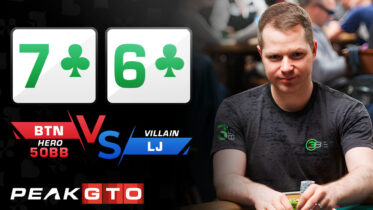
In this 50bb MTT hand, Hero defends the button with 7♣6♣ versus a lowjack open and navigates a K-high board where the solver consistently favors controlled realization over proactive betting.
Assumptions
- Stacks: 50bb effective
- Positions: BTN (Hero) vs LJ (Villain)
- Action: LJ raises to 2.2bb, BTN calls
- Flop: K♠8♥4♦ (Pot 6.9bb)
- Turn: 7♥ (Pot 10.3bb)
- River: 2♥ (Pot 30.9bb)
Flop: K♠8♥4♦
This board strongly favors the preflop raiser’s range. Solver output shows LJ checking 30.3% of the time and betting the rest with a split between 1.7bb (21.1%) and 4.6bb (48.4%). Despite this heavy betting strategy, the lowjack chooses to check this time.
Against a check, BTN responds with a 1.7bb bet 39.7% of the time, 4.6bb 11.6%, and checks 48.5%, reflecting a mixed but cautious approach. With 76s, we have a very high frequency bet using a small size.
Facing the small bet, solver has LJ continuing 57.3%, folding 24.7%, and raising infrequently. At this point, LJ decides to call, and we see a turn.
Turn: 7♥
The 7♥ is a key interaction card for Hero, pairing 7♣ and shifting relative equity without dramatically changing nut distribution. Because of this, the solver has LJ checking 99.0% of hands because betting would collapse Hero’s range and remove bluffs.
BTN now applies pressure with a 10.3bb bet 39.0% of the time, checking 53.8% overall. With 7♣6♣, The solver has Hero firing a pot sized bet of 10.3bb a massive 74% of the time as it has immediate value, benefits from position, and protection.
River: 2♥
The river is largely a blank with respect to range hierarchy. Solver keeps LJ checking 99.8% of the time, even with pairs, recognizing that leading offers little upside against LJ’s polarized responses.
LJ checks back 46.6% of the time, while betting 35.8bb 46.5% and 15.4bb 6.9% when aggressive. In this runout, LJ checks, which aligns with solver behavior for medium-strength holdings and failed bluffs. With this combo, Hero essentially never turns the hand into a bluff and never value-bets thinly. Checking down is the highest-EV outcome.
Key Takeaways
- Flop: BTN checks hands like 7♣6♣ on K-high textures, preserving equity and avoiding low-EV bets into a range-advantaged opponent.
- Turn: After improving to a pair, solver prefers continued checking. Calling preserves position and prevents Villain from cleanly realizing equity.
- River: With no meaningful change in range interaction, solver checks almost always and accepts showdown value.
- Overall: GTO rewards restraint here. In position, Hero maximizes EV not by forcing aggression, but by allowing Villain to make the final mistake.