In tournaments, many seemingly standard single-raised pot poker hands create difficult decisions even on dry boards. These situations matter because they test our ability to balance defense with discipline, recognize when equity shifts between players, and identify which hands belong in our calling region when facing polar pressure. Mastering these spots allows us to continue correctly with our range while avoiding costly over-defends when the solver wants heavy folding.
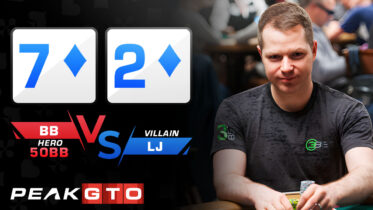
Today we will analyze a 50bb tournament spot where the low-jack opens and the big blind defends with 7♦2♦. This hand illustrates how solver logic evolves street by street across multiple bet sizes, and how the big blind should respond when the in-position player applies a polarized river bet.
Assumptions
- Stacks: 50bb effective
- Positions: LJ vs BB
- Action: LJ raises, BB calls
- Flop: Q♠7♥5♣ (Pot 5.9bb)
- Turn: T♠ (Pot 13.7bb)
- River: 2♥ (Pot 30.1bb)
Flop: Q♠7♥5♣
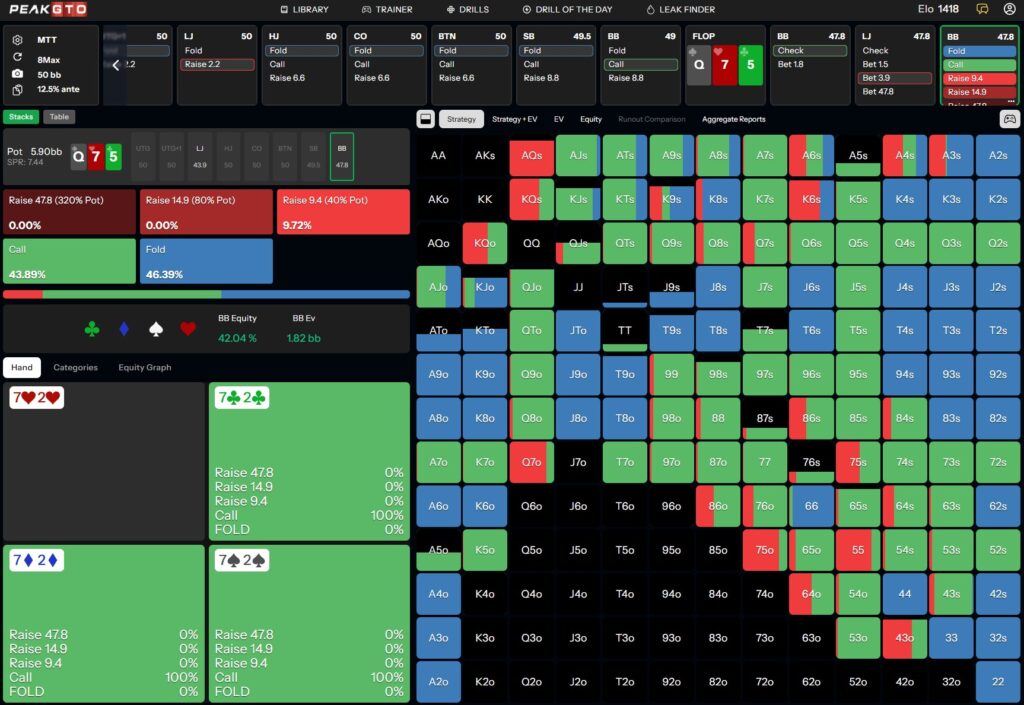
The solver has the big blind checking always. The LJ then plays a mixed continuation strategy: a small bet (1.5bb) at 55.22%, a larger bet (3.9bb) at 43.85%, and a rare check frequency (0.942%). In this runout, LJ chooses the 3.9bb sizing.
Facing 3.9bb, BB’s defense is split across folding (46.39%), calling (43.89%), and raising to 9.4bb (9.72%), with other raise sizes essentially negligible. The important point is that BB is not supposed to “always continue” after defending preflop. PeakGTO folds a large portion immediately, and the hands that continue do so with a structured mix of calls and some check-raises.
Turn: T♠
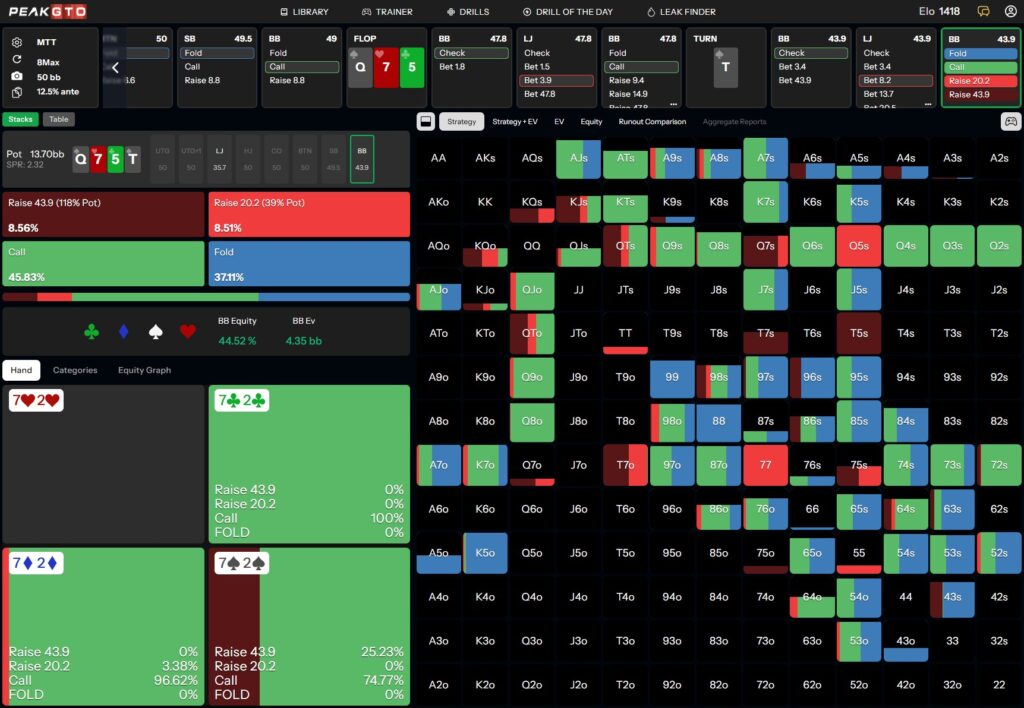
After BB calls, the solver keeps BB in a pure check strategy again. LJ continues with a mixed approach that now includes more checking: LJ bets 8.2bb at 54.12%, bets 13.7bb at 20.3%, checks at 25.58%, and uses other sizes only at negligible frequency. This time, LJ selects 8.2bb.
Versus the 8.2bb bet, BB continues with a raise to 20.2bb at 8.506%, raise 43.9bb at 8.560%, call at 45.825%, and fold at 37.110%. Even after defending flop, the solver still wants BB to fold a meaningful part of range on the turn and continue with a tight, well-defined set of hands.
On this turn, the key is that our side card drives the continue, not the “quality” of our pair. Versus a more polar barreling range, K7 and J7 aren’t meaningfully stronger than 7♦2♦ because Villain isn’t betting hands like 78 or J7 for value anyway. The deuce is excellent because it creates almost no reverse implied odds: when we river a 2 to make two pair, Villain doesn’t arrive with many strong hands improved by that card, and we also avoid blocking their natural bluffs from the middling region. That’s why 7♦2♦ becomes a higher-frequency turn continue than hands like J7 that can improve into two pair while simultaneously completing more of Villain’s strong holdings.
River: 2♥
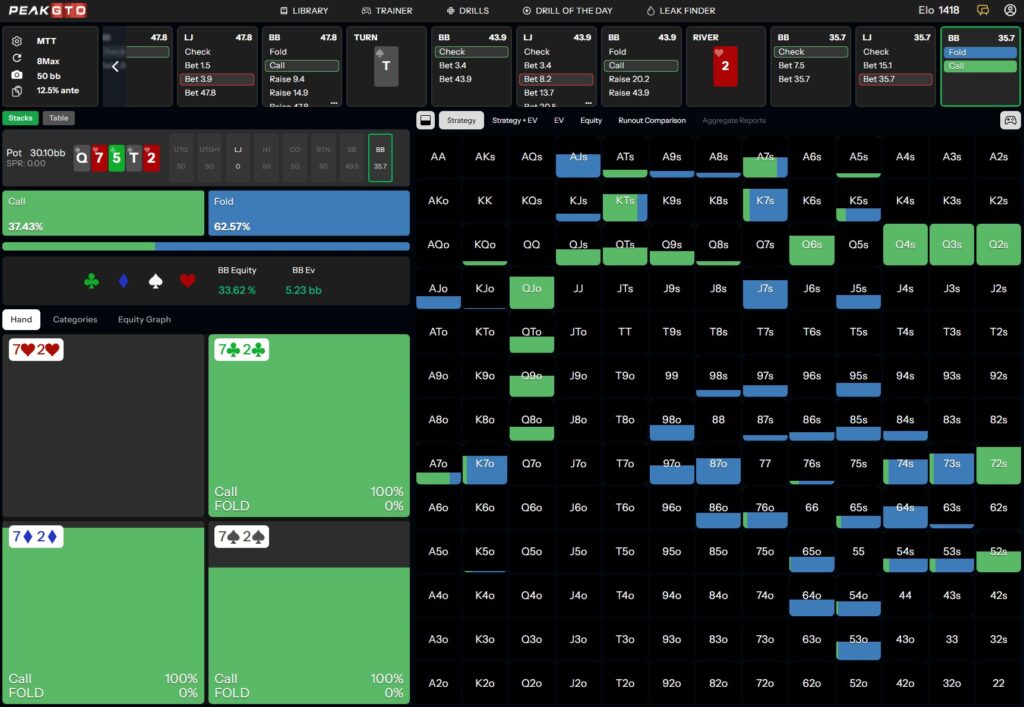
The 2♥ doesn’t look like it changes the board much, but with our exact hand it improves to two pair. BB still checks most of the time (86.92%), with some small betting of 7.5bb at 13.08%. Importantly, 72s checks at 100% frequency.
After BB checks, LJ splits between checking (46.95%) and betting, with the dominant bet size being all-in for 35.7bb at 52.57%. LJ chooses the 35.7bb bet.
Facing 35.7bb into 30.1bb, BB’s solver response is to call 37.433% and fold 62.567%. This is a polarized river node where BB must fold the majority of range and continue only with hands strong enough to sit in the top portion of the distribution.
Obviously, a rivered two pair is well within the range of hands strong enough to call off for our tournament life.
Key Takeaways
- Flop: BB checks range. LJ uses two main bet sizes at high frequency, and BB defends with a meaningful mix of folds, calls, and some check-raises versus the 3.9bb sizing.
- Turn: BB remains pure check. LJ continues aggression most often with 8.2bb and sometimes 13.7bb, while BB still folds a significant portion and continues with a tight range.
- River: LJ polarizes with the large 35.7bb sizing at high frequency. BB must fold most hands and call only 37.433% overall, meaning discipline is mandatory.
- Overall: The solver’s logic is frequency-driven across streets—range checking from BB, multi-size pressure from LJ, and a river decision that collapses into a strict call/fold requirement versus a polarized bet.