Single-raised pots where the button calls a late-position open create spots where range advantage and positional control work together. On connected, draw-heavy boards, the button’s calling range interacts well enough with the texture to support aggressive multi-street play, while the out-of-position opener’s range is capped by the flop check.
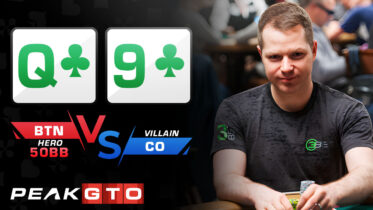
Today we will analyze a 50bb tournament hand where the button calls a cutoff open with Q♣9♣ and flops top pair on a dynamic 9♠8♠4♦ board. This hand illustrates how solver strategy uses a small flop bet to establish range pressure, a pot-sized turn barrel to isolate against a capped range, and a river overbet to polarize for maximum value.
Assumptions
- Stacks: 50bb effective
- Positions: BTN (Hero) vs CO (Villain)
- Action: CO raises, BTN calls
- Flop: 9♠8♠4♦ (Pot 6.9bb)
- Turn: 2♦ (Pot 10.3bb)
- River: 2♥ (Pot 30.9bb)
Flop: 9♠8♠4♦
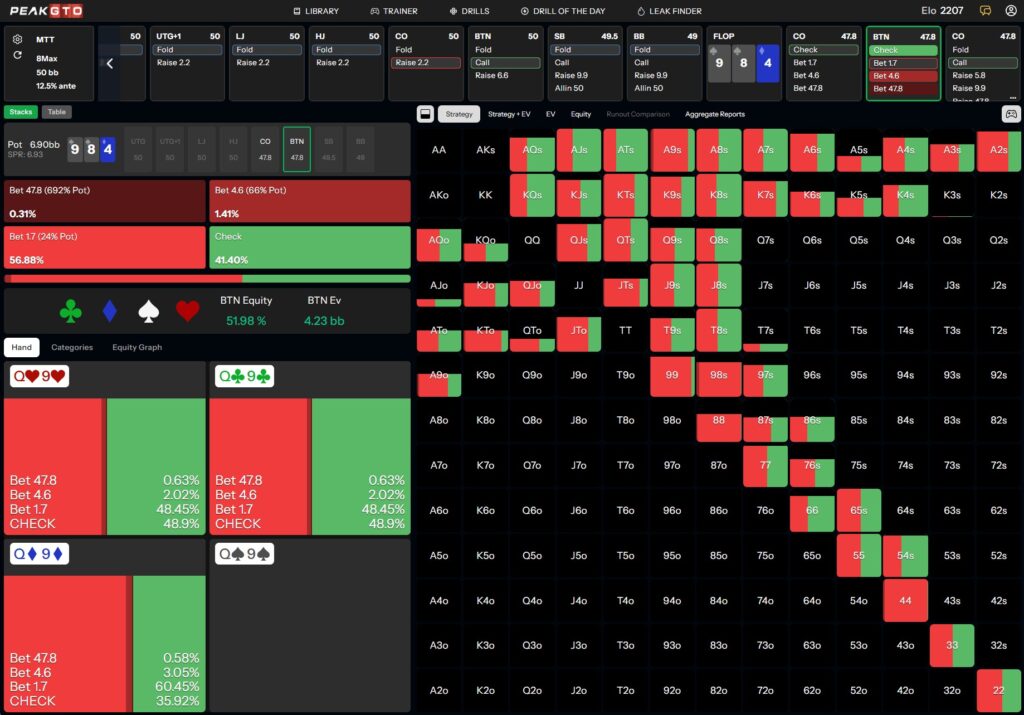
CO checks 68.1% of the time on this board. The solver reflects that BTN has significant range and nut advantage on a texture that interacts heavily with calling ranges — flush draws, open-ended straight draws, two pairs, and sets all land disproportionately in the button’s range. After CO checks, PeakGTO has BTN betting 1.7bb at 56.9%, the dominant sizing, with checking at 41.4% and other sizes used at negligible frequency.
With Q♣9♣, Hero has top pair with a backdoor straight draw on a board where CO’s checking range contains many hands with limited ability to continue facing further pressure. The small bet generates fold equity against whiffed broadway holdings while keeping draws and second pair in CO’s calling range. CO’s response to the 1.7bb bet is to call 56.5%, fold 25.5%, and raise at a combined 18.1% across three raise sizes (5.8bb at 5.3%, 9.9bb at 12.4%, and 47.8bb at 0.4%).
Turn: 2♦
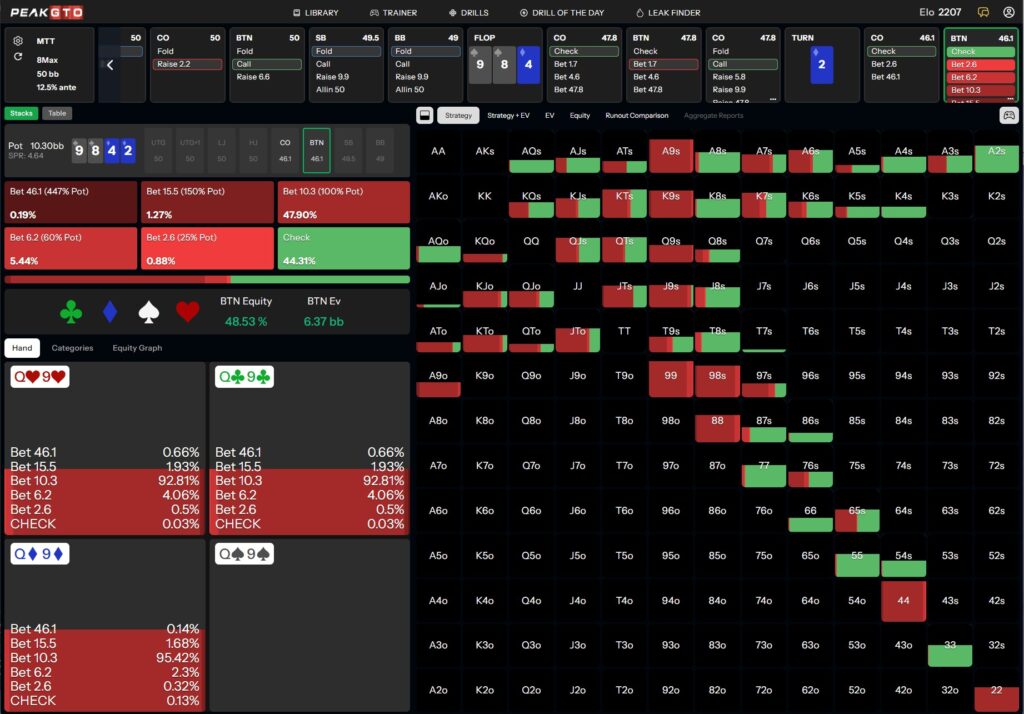
The 2♦ brings a second diamond but completes no draws and changes nothing about the board’s fundamental structure. CO checks 99.1% of the time, confirming a range that cannot or will not lead into a player with continued positional and range advantage. BTN now bets 10.3bb — a pot-sized bet — at 47.9%, with checking at 44.3% and all other sizes used at negligible frequency.
After the flop check, CO’s range is capped. It no longer contains the strongest value hands at high frequency, and it carries a significant portion of draws that missed the turn. The pot-sized sizing applies maximum pressure to that range, forcing CO to make an expensive decision with hands that don’t have the pot odds to continue. CO responds by folding 50.2%, calling 42.2%, and raising at a combined 7.6% across two sizes.
River: 2♥
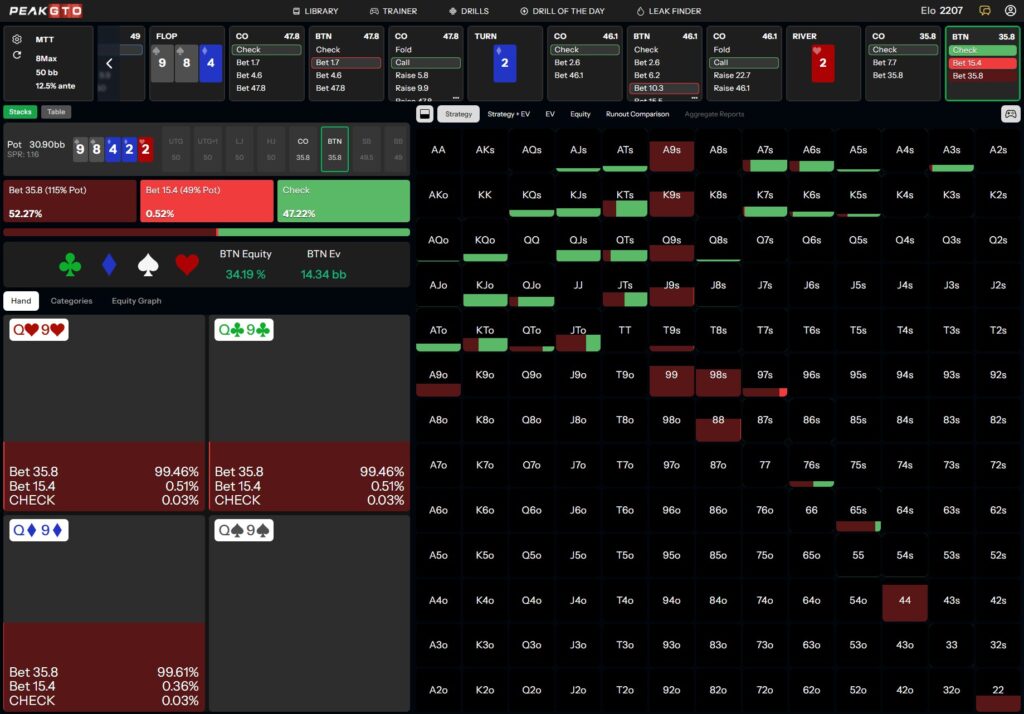
The 2♥ pairs the board and bricks both the spade flush draw and the diamond draw that picked up on the turn. CO checks 50.2%, reinforcing continued range weakness after calling two streets. BTN now oversizes with a 35.8bb bet into a 30.9bb pot at 52.3%. This is an overbet designed to polarize — it targets a CO range that has called twice with hands that can no longer improve and now faces a bet requiring genuine strength to continue.
With Q♣9♣, Hero holds a strong made poker hand in a spot where the river card eliminated a large portion of the draws CO continued with on the turn. The overbet charges those bricked draws for maximum while extracting full value from weak made hands that CO cannot fold after investing across two streets. Facing the 35.8bb bet, CO calls 44.5% and folds 55.5%.
Key Takeaways
- Flop: CO checks 68.1% on this connected texture. BTN exploits range and nut advantage with a small 1.7bb bet at 56.9%, keeping draws and weak made hands in CO’s range while generating immediate folds from whiffed holdings.
- Turn: CO checks 99.1%, confirming a capped range. BTN applies pot-sized pressure at 47.9%, forcing CO to fold 50.2% and continue with only the strongest portion of a range that is already constrained.
- River: With flush draws bricked, BTN oversizes to 35.8bb above the 30.9bb pot at 52.3%. CO calls 44.5% and folds 55.5%, producing maximum value for top pair on a runout that eliminates most of CO’s continuing equity.
- Overall: This hand shows a clean escalation pattern driven by position and range advantage — a small flop probe to build the pot, a pot-sized turn barrel to isolate, and a river overbet to extract full value when draws miss.