Try This Hand Yourself
Play this exact spot against the solver in PeakGTO before reading the analysis.
Playing top pair out of position is one of the trickiest assignments in poker. You are out of position, you cannot control the size of the pot as easily, and the temptation is to play passively and “keep the pot small.” The solver does the opposite. When the big blind defends and connects hard with the flop, check-raising top pair is often the highest-value play, and the follow-through on later streets separates the players who win big pots from the ones who let their best hands go to waste. The key is recognizing when your top pair is good enough to drive the action and when a scary card should slow you down.
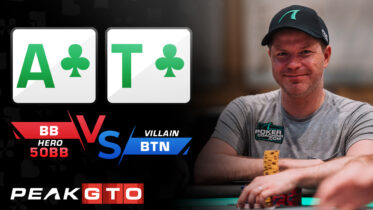
Today we will analyze a 50bb 8-handed MTT hand where the big blind defends A♣T♣ against a button open, check-raises the A♠6♥4♦ flop, and then has to decide whether to keep firing when the J♥ turn brings a flush draw. This hand shows why the big blind checks its entire range on this flop, why top pair with the best kicker is the anchor of the check-raise range, and why the strongest hands keep betting on a turn where most players freeze. It is a complete blueprint for playing aggressive top pair in a tournament.
Assumptions
- Stacks: 50bb effective
- Format: 8-handed MTT
- Positions: BB (Hero) vs BTN (Villain)
- Action: BTN raises to 2.2bb, BB calls
- Flop: A♠6♥4♦ (Pot: 5.8bb)
- Turn: J♥ (Pot: 15.9bb)
- River: 2♠ (Pot: 35.3bb)
Preflop
Facing a button open at 50bb, A♣T♣ is a pure call from the big blind. There is a subtle but important split here: ATo actually prefers to 3-bet, while ATs just calls. The offsuit version makes a slightly better 3-bet bluff because when the button folds you are happy, and when they call you still have a playable hand. The suited version, by contrast, flops too well to want to blow up the pot preflop, so it calls every time alongside the other suited broadways and the smaller pocket pairs. Hero calls and sees a flop heads-up, out of position against the button.
Flop: A♠6♥4♦
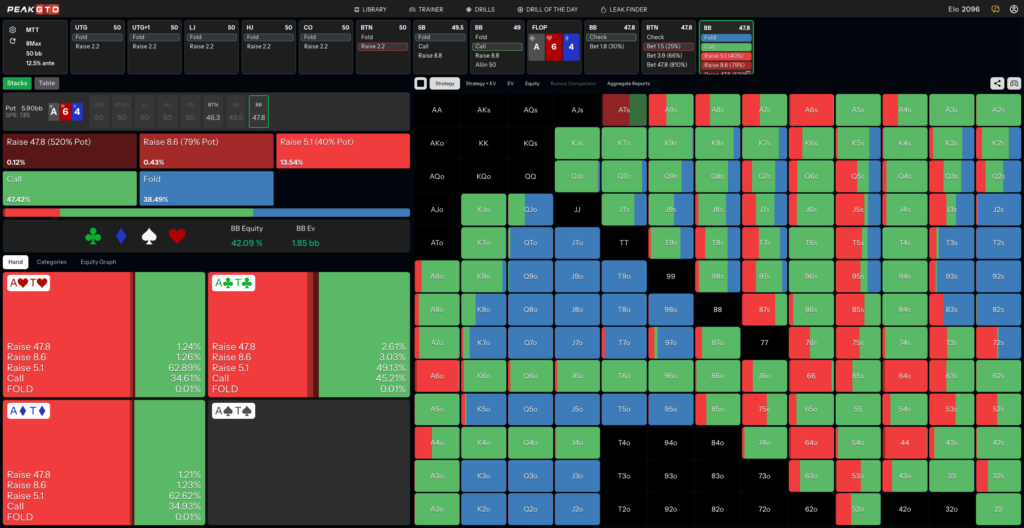
On an ace-high, disconnected board, the big blind is at a meaningful range disadvantage. The button raised preflop and holds more strong aces and big pairs, while the big blind’s range is full of unpaired offsuit and suited hands that missed. Because of that, the correct play is to check the entire range. There is no leading here. After Hero checks, the button makes a small continuation bet of 1.5bb, and the decision returns to Hero with top pair and the best possible kicker.
This is where check-raising top pair earns its keep. At equilibrium the solver raises A♣T♣ close to half the time and essentially never folds it, calling with the rest, but the practical recommendation is to simply raise it every time. Whatever your single best top-pair-top-kicker combination is, it wants to be in the check-raise range, and using an always-raise rule keeps your strategy clean and hard to exploit. PeakGTO shows the raise is well supported: other top-pair combos raise frequently here, so ATs as top-pair-top-kicker is an easy include. Crucially, the check-raise is not a thin value bet on its own. It is backed by all the sets, the two-pair combos like 64, the straight draws, and a healthy mix of flush draws and backdoor flush draws, so the range is loaded with the kind of hands that need a raise. Hero raises to 5.1bb and the button calls.
Turn: J♥
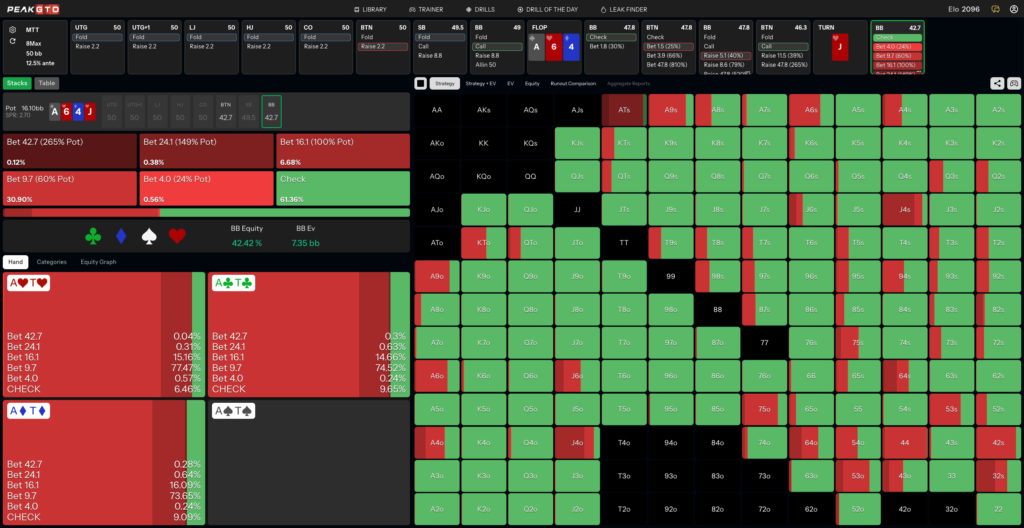
The J♥ brings a heart flush draw and adds a second broadway card to the board, and this is the moment that trips up most players. After getting the flop check-raise called, a lot of people chicken out and check their top pairs every single time, worried that the jack or the flush draw has cracked them. The GTO output says the opposite for the top of the range. The overall range checks the majority of the time here, betting only about 38% of its combos, but the strongest hands keep firing. AT and A9 are at the very top of that betting group, while A8 and lower start to slow down. The logic is straightforward. The whole range does a lot of checking on this turn, but A♣T♣ is one of the best hands in it, so it is exactly the holding that should keep value betting.
Because the overall range checks so often, the value bets need company. Hero keeps betting the sets and two pair and fires the big-gapped flush draws as bluffs. On the checking side, the range keeps some hands with showdown value, such as the queen-high heart flush draws (Q7, Q5), which reduce the button’s flush-draw combos and retain a little showdown equity, plus a portion of the middling pairs. AT uses a medium sizing of about 9.7bb, roughly 60% of the pot. That size is deliberate: it builds the pot while leaving a stack that sets up a clean, near pot-sized shove on the river. You could go larger, and that is not a mistake with a hand this strong, but the medium size keeps worse aces and draws in the pot. Hero bets 9.7bb and the button calls again.
It is worth being precise about why the jack is not as scary as it looks. A♣T♣ is still a pair of aces with the best kicker, and the hands that just beat it, like two pair and sets, are a small slice of the button’s flatting range after it only called the flop check-raise. The flush draw is live, but a draw is not a made hand, and betting denies it the free card it wants. When you can charge the draws, get value from worse aces, and only fear a narrow set of combinations, checking would be far too passive. The hand wants to keep building toward a big river.
River: 2♠
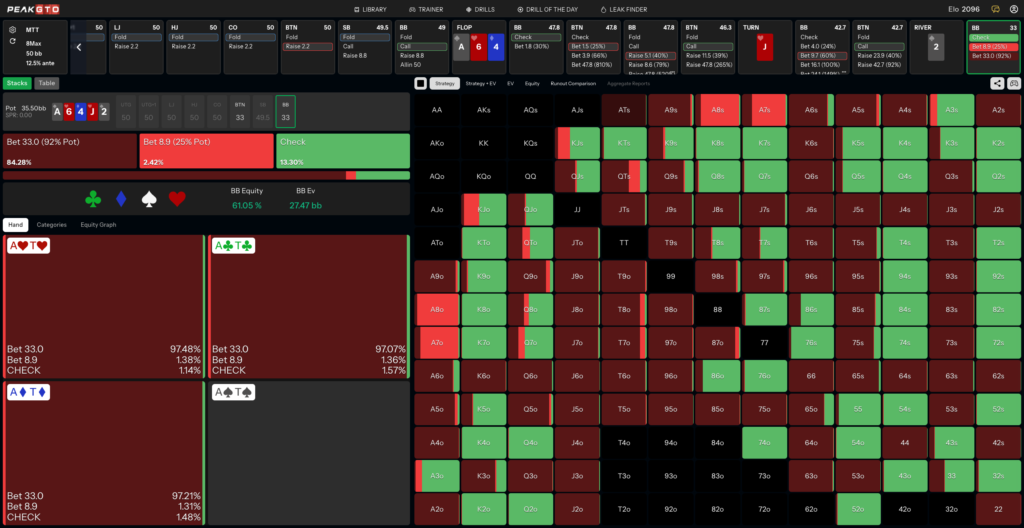
The 2♠ is close to a blank. It misses the flush draw, and the only thing it fills is a 53 for a low straight, which is a negligible part of the button’s flop-check-raise-call, turn-call range, so it changes nothing about the relative hand strength. The board reads A♠6♥4♦J♥2♠, and Hero still has top pair with the top kicker. This is the spot the turn sizing was built for. The solver bets a large size, around 92% of the pot, with the strong value hands. The range as a whole fires that large size about 85% of the time, and top pair top kicker like ours bets it closer to 97%, checking back almost never.
The reason a big bet is correct comes down to who called the turn. The button’s continuing range is full of weaker aces, exactly the hands AT beats, and they will struggle to fold for a third barrel after committing on the flop and turn. By betting close to the pot, Hero charges those worse aces the maximum and gives the button miserable pot odds to call with anything thinner. The whole point of driving the action from the flop was to reach a river where the strongest hand can get maximum value, and the disciplined line from check-raise to barrel to value bet delivers exactly that. Hero bets, and the button calls with a worse ace.
Key Takeaways
- Flop: On A♠6♥4♦, the big blind checks its entire range due to the range disadvantage. Facing the small c-bet, top pair with the best kicker is the anchor of the check-raise range. The solver mixes with ATs, but raising it every time to 5.1bb is the clean, profitable simplification.
- Turn: The J♥ scares most players into checking, but the overall range checks the majority of the time, betting only about 38%, while the strongest hands keep firing. AT sits at the top of that betting group, usually using a medium 9.7bb size and occasionally a larger one, which sets up a near pot-sized river shove.
- River: The 2♠ blanks out. Top pair top kicker value bets the large size nearly always (the overall range fires it about 85% of the time), charging the button’s weaker aces the maximum after they committed on earlier streets.
- Overall: Check-raising top pair out of position is about commitment. Pick the right hand to drive the action, keep betting when a scary card hits but your equity holds, and size the turn to set up a maximum-value river. Passive top pair leaves money on the table.