
A c-bet in poker is a flop bet made by the preflop aggressor, regardless of whether the flop improved their hand. The name comes from the idea that you are continuing the aggression you showed before the flop.
I have studied and coached c-betting poker strategy at every level of the game, and it is one of the highest-leverage skills in no-limit hold ’em. Getting it right, meaning knowing when to fire, when to check back, and what size to use on different board textures, has a direct and measurable impact on your win rate.
This guide covers the full picture: the definition, in-position and out-of-position adjustments, range advantage, multiway considerations, bet sizing by board texture, the delayed c-bet, and practice tools to build your intuition.
What Is a C-bet in Poker?
A c-bet, short for continuation bet, is the first bet on the flop made by the player who took the lead with a raise before the flop. Anytime you raise preflop, get called, and bet the flop, you are c-betting. What separates strong c-bettors from weak ones is not whether they bet, but why.
I tell students that every c-bet decision should answer two questions: does my range connect well with this board, and will a bet accomplish something against this opponent on this texture? When you can answer both of those clearly, your c-betting becomes consistent and profitable rather than reflexive.
Any flop c-bet made by the preflop aggressor is considered a c-bet, whether the player has hit the flop or not, which is why a c-bet is not a bluff or a value bet in itself.
Generally speaking, you will be c-betting a mix of bluffs and value across all board textures, making it difficult for your opponents to know when you have a big hand and when you don’t, and setting up future bets on turns and rivers.
By making a c-bet, you are telling your opponents that you have made a hand on the flop or that you already had a pair to begin with, and this is a story you can keep telling with further bets.
A c-bet is a crucial part of an aggressive poker strategy, which is the only way to play poker properly, so it is key that you master the art of c-betting if you want to become a successful poker player.
Tournament Hand C-Betting Example
We have explained what a c-bet is in poker in the most basic of terms, but let’s take a look at a couple of examples of c-bets that will make the concept even clearer.
In the first example, you are dealt 9s8s in the cutoff in a poker tournament, with blinds set at 500/1000 and an effective stack of 60,000 chips.
You open to 2,300, the button and small blind folds, and the big blind defends, making the pot 6,100 with the ante in the middle.
The flop comes 9h5d3s, giving you a top pair and some backdoor draws. Your opponent checks to you, and you fire a GTO poker-approved bet of 1,500.
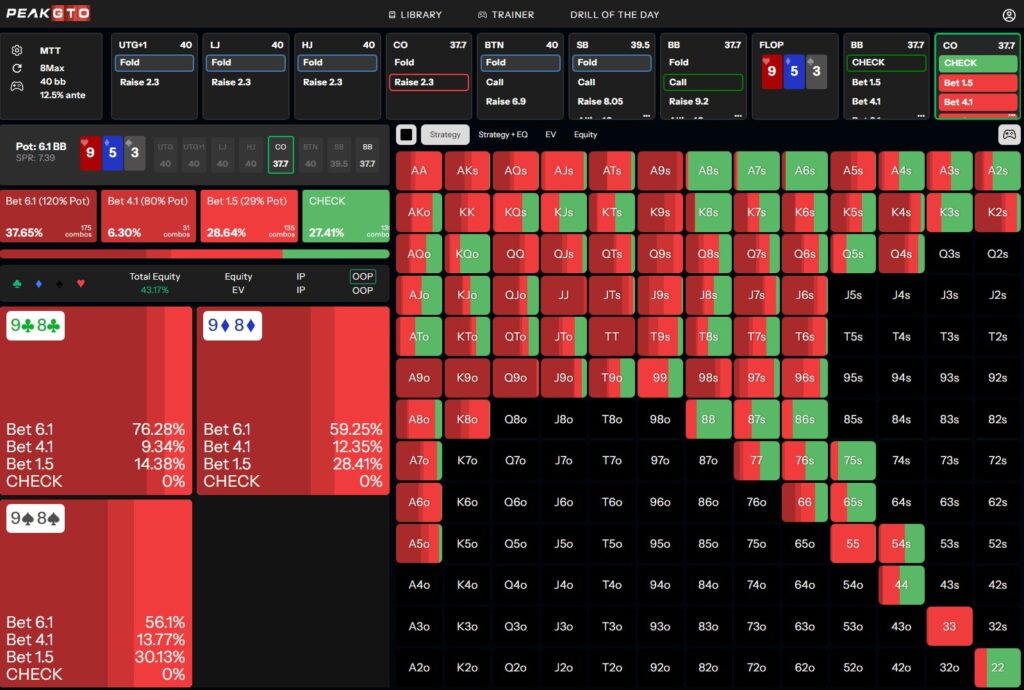
We will not go into this hand further, as your opponents’ reactions to your c-bet don’t matter for the time being. We are only trying to understand the concept of a c-bet, and this 1,500 bet on the flop is a classic example of one.
Cash Games Hand C-Betting Example
Another example of a c-bet is one where you are dealt AcKh on the button in a $2/5 live cash game with effective stacks of $500.
You open to $15 and get a call from the big blind. With $32 in the pot, you see a flop of 5c3c3d, giving you just a backdoor flush draw and two overcards.
When the big blind checks to you, you fire a bet of $10 into the pot. The only real difference between the first and the second example is the fact you made the top pair in the first one and have only Ace-high in the second one.
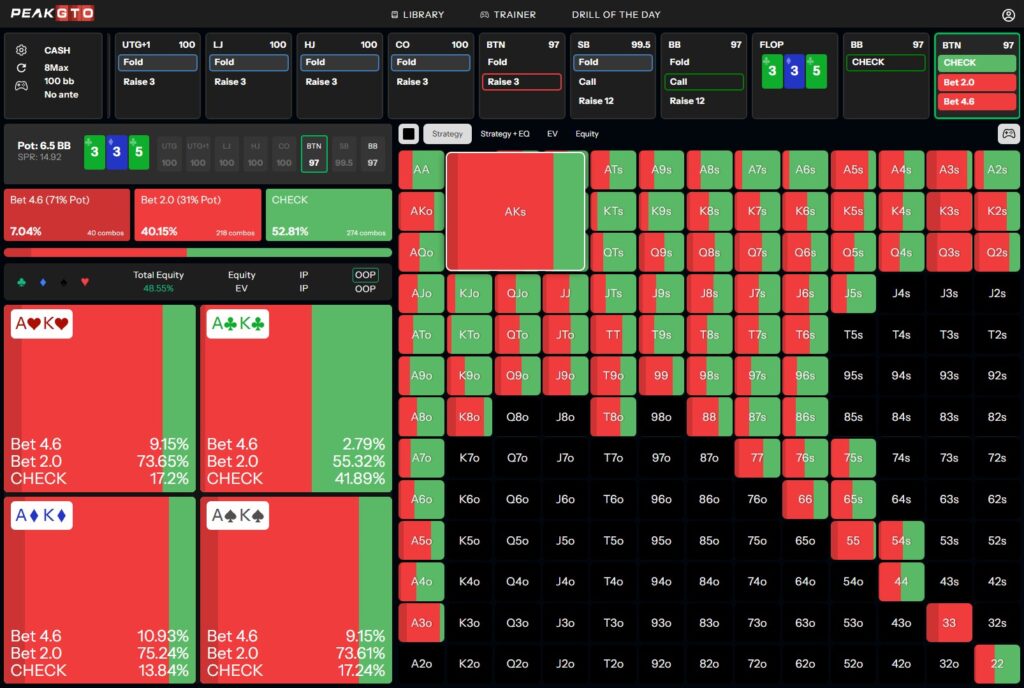
However, in both examples, firing a c-bet is correct, as the range of hands you are representing includes many value hands, and your opponents are likely to fold hands that have quite a bit of equity against you and occasionally call with weaker hands as well.
We fired a small c-bet in both cases, which means that even if our opponents only fold their cards occasionally, we are printing money with the c-bet alone, without taking into account the follow-up bets we plan on firing on a number of turns and rivers.
C-Betting In Position vs Out Of Position
Position is the single biggest factor in how aggressively I c-bet. When I am in position, I can c-bet a large portion of my range on many boards because I have the informational advantage of acting last on every future street.
In my experience reviewing student hands, one of the most expensive and consistent leaks I see is treating in-position and out-of-position c-betting identically. They are completely different spots that require different range construction.
In position against a big blind caller on most boards, you can c-bet close to your entire range at a small size and profit. Out of position, the calculus changes significantly, and c-betting too often becomes a reliable way to lose chips to players who know how to use position against you.
The most common scenario where you can c-bet in position is one in which you open in a late seat, and the big blind comes along, getting a good price to call with a wide range of hands.
However, this wide range will include very few strong hands and miss approximately 70% of all boards.
This means you can c-bet pretty much your entire range on almost all boards in this scenario, and you are likely to get a lot of folds from your opponent’s fairly weak range.
On the other hand, whenever you find yourself c-betting out of position, that means you either raised in an early position and got called by one of the late positions or you 3-bet from the blinds and got called by the original opener.
In both cases, the in-position player will have a much stronger range than a big blind defender. This range will include many small- and medium-sized pairs, as well as hands with suited Broadway cards like QJs or JTs, and suited connectors like 98s and 87s.
This range is going to be much stronger on a lot of boards, which means you should be c-betting less as you stand to get fewer folds from your opponent on the flop.
Range Advantage Consideration
Before I decide whether to c-bet, I ask myself one question: who does this board help more, me or my opponent? That is range advantage in a sentence, and it is the most important single concept in continuation bet strategy. If my range connects heavily with the board and my opponent’s does not, I can c-bet aggressively.
If the reverse is true, I should check more often, even with hands I might instinctively want to bet. Range advantage is not about what you hold; it is about the full distribution of hands you could hold relative to the full distribution of hands your opponent could hold.

For instance, let’s imagine you open from an early position in a tournament and get called by the big blind with a 50 bb effective stack.
The flop comes KsQc9h. On this board, against the big blind, you have a massive range advantage, as you have all the strongest hands in your range, while your opponent does not.
In most cases, the opponent would have 3-bet KK and QQ, as well as AA, before the flop, which means you can take those hands out of consideration. On the other hand, you still have all the combos of these hands in your range.
This is when you should start considering poker combinations. Both you and your opponent have combos of JTs in your range, and while your opponent is more likely to have JT off-suit, you are way more likely to have hands like AKs, AK, KQs, and 99, all of which are monsters on this board.
On the other hand, imagine a scenario where you open in an early position and get called by the dealer in the same tournament at the same effective stacks.
This time, the flop comes Ts8s7h, and now your opponent has quite a big range advantage on you, as they have a lot of hands that connect heavily with this board.
The player on the dealer has combos of TT, 88, and 77, as well as J9s in their range, along with hands like JTs and 87s. In some cases, depending on how loose the dealer is, they could even have hands as weak as J9 off-suit and 87 off-suit, although this is not part of the optimal strategy in their spot.
In either case, our range is now made up of a lot of hands that either missed the flop altogether or have to be quite worried about it, which means we should be c-betting a lot less frequently.
The next time you are considering a c-bet, think about how your range and your opponent’s ranges connect with the flop that was dealt out, and you should have a pretty good idea of how likely they are to fold their cards faced with your bet.
C-Betting In Multiway Pots
The biggest c-betting mistake I see when reviewing hands in multiway pots is treating the frequency the same way as in heads-up pots. I have seen students fire a large c-bet into three opponents on a draw-heavy board with second pair, get called in two spots, and then not understand why the bet was unprofitable.
In a three-way pot, the math is working against you on every street. At least one of your two opponents is likely to have a piece of the flop, and your fold equity drops substantially. This is not just theoretical. Against two callers on a wet board, a c-bet with a marginal hand often functions as a donation rather than a strategic play.
While you can get away with c-betting a ton in heads-up pots, especially in position, you should c-bet a lot less in multiway pots.
Your c-betting range in heads-up pots will generally be quite linear, as it will include your strong hands, your good bluffs, as well as plenty of complete bluffs and hands value hands that have not exactly smashed the board.
For instance, on a board of AcQd8d, you could c-bet hands like AA, QQ, 88, bluffs like Kcjs, Jd9d, as well as hands like KK, KQ, and 98. Against a big blind caller who is likely to fold a lot on this board, you would even be c-betting a hand as weak as 5c4c and get away with it.
However, if this same flop was dealt four-way, you should be c-betting a lot less frequently, as it is very likely one of the other players has made some hand.
In a multiway scenario on this same board, you would still bet hands like AA, QQ, 88, and AQ, as well as bluffs like KdJd, JdTd, and KdTd. However, hands like KsJs would no longer make for good bluffing candidates, while hands like KK or KQ would not be strong enough to bet multiway.
As a general rule of thumb, you should bet a much tighter range made up of pure value and your strongest bluffs in multiway pots, and this is especially true when more than three players see the flop.
Sizing Your C-Bets
When I review student hands, incorrect c-bet sizing is a leak I flag almost as often as incorrect frequency. The two rules I teach first are simple: smaller bets on dry boards, larger bets on wet boards.
What makes this work in practice is understanding why bet sizing follows texture rather than hand strength. If you size your c-bets based on whether you hit the board, you are giving away information with every single bet. Sizing based on board texture keeps your range balanced, which is what makes your bets credible to opponents over time.
Board texture is the most important factor in this decision, as it dictates how likely your opponents are to call you and the types of hands they will call with.
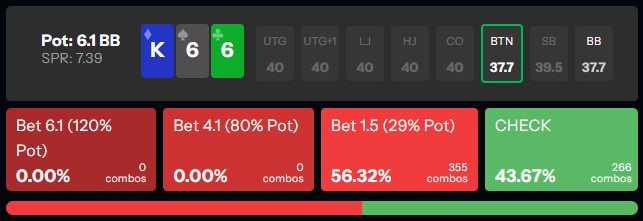
On static boards like Kd6s6c, small continuation bets are typically preferred, as it is unlikely your opponent has connected with the board, increasing the likelihood of a fold regardless of your bet size.
On this board, firing a small c-bet with the entire range you opened before the flop makes sense, as most opponents will easily fold hands like Qh7h or JdTh, which they may have called your preflop raise in the big blind without much thought.
On the other hand, dynamic boards like Jh9h8s require you to bet a more polarized range, as discussed earlier, and warrant a bigger c-bet.
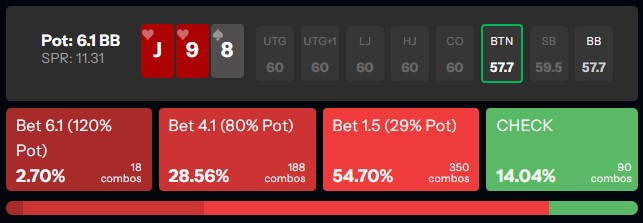
On a board like this, you would never be betting your weak value hands like 8c7c, but would rather only bet your strongest value hands and your best bluffs.
For that reason, your range will be very strong, and you can make a much bigger bet on the flop. What’s more, a big bet will help you deny your opponent’s equity when they have hands like gutshot straight draws or weak one-pair hands that would be forced to continue against a small bet.
When considering your c-bet size, think about what percentage of your range you are betting on a given board texture. The more hands you are betting, the smaller your c-bet should be.
If you are betting your entire range, aim to bet 25% to 35% of the pot. If you are only betting a small percentage of your range made up of strong value and big bluffs, a bet of 65% or more makes sense.
Practice C-Betting Ranges and Sizes
The most effective way I have found to build solid c-betting instincts is deliberate practice with a solver on the specific board textures that confuse you. I recommend starting with PokerCoaching’s own solver, PeakGTO, which lets you explore exactly how c-bet frequency and sizing should adjust across different flop textures, stack depths, and positions.
The number of board combinations in Texas Hold’em is large, but the underlying principles repeat. Once you have worked through how to c-bet a few dozen representative board textures in PeakGTO, you will start to recognize patterns that transfer to new situations at the table quickly.
The more repetitions you get in, the more confident you will feel, and the more successful you will be in making the right c-bets at the right time.
When to Use a Delayed C-Bet
A delayed c-bet is a turn bet by the preflop aggressor after both players checked the flop. You raised before the flop, your opponent called, and on the flop you both checked. When your opponent checks the turn, you bet. That turn bet is a delayed c-bet, and it is a tool that belongs in every serious player’s game.
I use delayed c-bets most often in two situations. First, when the flop is bad for my range and good for my opponent’s range. If I opened from early position and the flop comes 9-8-7 rainbow, betting immediately against a player who called from the big blind gives up little fold equity against a range that connects heavily with those cards.
Checking the flop lets me see what my opponent does next and gives me the option to fire a credible turn bet if a card arrives that improves my relative position, such as a Broadway card that hits my early position opening range hard.
Second, I use delayed c-bets with marginal hands that have showdown value but are not strong enough to bet all three streets profitably. A hand like K-Q on a J-7-2 board often plays better as a delayed c-bet than an immediate c-bet.
By checking the flop, I protect my checking range, keep my opponent from knowing exactly what my check represents, and set up a turn bet that can fold out the hands I am ahead of.
The most important discipline with delayed c-bets is balancing what you check on the flop. If you always check with weak holdings and c-bet with strong ones, your delayed c-bets become exploitable because opponents know you are weak when you check. Checking back some strong hands on certain flop textures keeps your turn bets credible across your full range.