
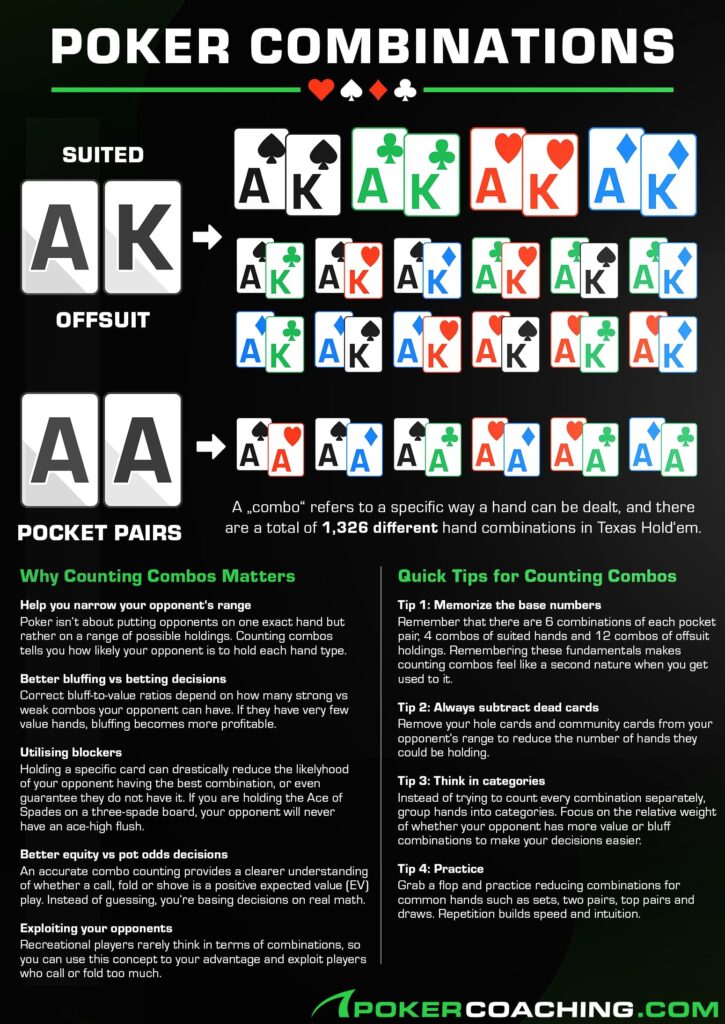
Poker combinations, also called combos, are the exact number of different ways a specific starting hand can be made from a 52-card deck. Every pocket pair has 6 possible combinations. Every suited hand has 4. Every offsuit hand has 12.
Knowing these numbers precisely — and knowing how board cards change them — is the foundation of accurate range reading. I use combo counting every time I analyze a hand, whether I am studying solver output at home or narrowing down what an opponent can realistically hold on the river.
The players who build this skill tend to find more thin value bets, make more accurate bluff-catches, calculate pot odds more correctly, and lose less money to opponents who are stronger than their bet sizing suggests.
Download Poker Combinations PDF Guide
What Are Poker Combinations
Let’s start with some poker basics. First, poker is played with a standardized deck of 52 cards. There are four suits and 13 card ranks in each deck, making up the 52 cards.
In Texas Hold’em Poker, a total of 1,326 poker combinations can be made up of these 52 cards by combining each of them with all the other ones in the deck.
This includes pocket pairs, suited, and off-suit combinations of all the possible hands.
For a visual representation of poker combinations, you can take a look at the poker hand grid, which includes every possible hand combination.

You will notice that the hand grid is not split up into 1,326 fields, and this is for a good reason. Each field on the hand grid contains multiple hand combos!
In particular, hand combinations are counted as follows:
- There are 6 combinations of every pocket pair
- There are 4 combinations of every suited hand
- There are 12 combinations of every off-suit hand
Off-suit hands have the most poker combinations because every card can be combined with three cards of suits that don’t match to create an off-suit combo. So, for instance, you can combine four Aces with three Kings each to create the 12 off-suit combinations of AK.
Similarly, each Ace can only be combined with one King to create a suited AK combination, leading to the four total combos of a suited hand.
Finally, there are six combos of every pocket pair. For example, AsAh, AsAd, AsAc, AhAd, AhAc, AdAc, and that’s the maximum number of pair combos you can have in any given spot.
This information may seem somewhat random, but it becomes essential when you start thinking about your opponent’s ranges and determining how likely they are to have different starting hands in the hole.
The most common mistake I see students make when they first start counting combos is forgetting to adjust for the board. Preflop numbers are just the starting point. Once the board runs out, those counts change fast.
Here is the shortcut I teach for postflop combo counting:
- For unpaired hands: multiply the number of unseen cards of each rank. If you want to count how many combos of AK your opponent can hold on a board showing an Ace and a King, you multiply the remaining unseen Aces (3) by the remaining unseen Kings (3) to get 9 combos. The formula is simple: unseen cards of rank A times unseen cards of rank B.
- For pocket pairs on the board: use the 6-3-1-0 rule. If no board cards of that rank are out, there are 6 combos. If one board card blocks, there are 3 combos. If two board cards block, there is 1 combo. If you see three cards of that rank, there are zero combos — it is impossible for your opponent to hold that pocket pair. This shortcut lets you count sets, full houses, and trips in seconds without any mental math.
Using Poker Combinations to Construct Ranges
The real power of combo counting comes from how it changes the way you think about your opponent. Instead of trying to guess a specific hand, you are tracking a range of possible combinations and narrowing it down with each new piece of information.
In my experience coaching players at all levels, this is the single biggest mental shift between a player who loses money and a player who wins consistently. The players who guess hands lose to variance. The players who track ranges and count combos profit from it.
Long gone are the days when guessing one specific hand was good enough. Every skilled opponent is now playing on the level of ranges, and the only way to play back at that level is to know, in real time, how many combinations of each hand exist in their range, given what you see on the board.
Instead, the game is now played on the level of poker ranges, where all skilled players are trying to pinpoint the range of hands their opponents could have in a given situation.
For example, a player raising from UTG can easily have AA, KK, QQ, AK, and a number of other hands, and there is really no way to tell one hand from another by that raise alone.
Yet, we can most definitely say (assuming he is a reasonably skilled player) that he does not have a hand like T2, 73, or K5, as he would definitely fold this hand from his position.

With each new action that is made at the table, we can narrow down the hand range of each active player in the hand until we are left with only a few possible hand combinations by the river.
As we enter the later streets, the importance of poker combinations becomes significant, as we can now start counting particular poker hand combinations a player might have.
For instance, we know there are six combinations of AA, twelve combinations of AK, and four combinations of AK.
However, on a board of As9d7s, that number changes. There are now only three remaining combos of AA, nine combos of AK, and three combos of AKs, as the As on the board block out the other combos.
This, of course, is a very basic example of how counting hand combinations can help you throughout a poker hand as you reach the later streets and are able to discount more and more of the hand combos your opponent might have.
By the river, you will often be able to determine which specific card combinations your opponent may be betting for value and which could serve as reasonable bluff candidates to fire with, which can be the great deciding factor between bluff catching a big river bet or throwing your cards in the muck correctly.
Putting Poker Combinations to Use
Counting combinations sounds abstract until you see it working in a real hand. The example below is a situation I use when coaching students who are new to combo-based thinking. Walk through the logic carefully the first time. Once it clicks, you will find yourself doing this automatically at the table.
In a $1/3 live game in Las Vegas, you are seated in the big blind, and a player in the Cutoff opens to $10, which you call.
The dealer puts out a flop of Ad5s6s, you check your entire range, and your opponent puts out a bet of $8 into the $21 pot.
At this point, our opponent’s range is still very wide and can include all sorts of hands, as it would make sense for them to continue betting with a big chunk of their opening range, if not the entire opening range.
This includes all pocket pairs, all suited Aces, all suited Broadways, plenty of off-suit Broadways, suited connectors, suited Kings, Queens, and more.
In fact, the opponent should be opening with about 30% of all starting hands, which would amount to over 400 poker combinations, too many to pinpoint at this time.
However, let us imagine you have a hand that’s worth raising on this flop, and you bump it up to $35, to which your opponent responds with a call.
Things have now changed dramatically!
Your opponent can no longer have random suited hands in clubs or hearts and will even give up some suited combos in diamonds, while some players will fold all diamond combos except the ones that also have a straight draw.
You can now start counting actual hand combinations that our opponent can have. Let’s start by counting the hands that have at least top pair or better in this spot:
- AA – 3 combos
- 66 – 3 combos
- 55 – 3 combos
- A6s – 2 combos
- A5s – 2 combos
- 65s – 3 combos
- AKs – A7s – 21 combos
- AKo – A7o – 63 combos
- A4s – A2s – 6 combos
- A4o – A2o – 9 combos
This is a total of 115 poker combinations of top pair or better that our opponent would probably call the flop raise with, considering we can have a number of drawing hands to be raising with.
In addition, our opponent can have a number of flush draws and straight draws himself, with hands like 43s, 87s, and 97s all coming to mind, along with all suited hands in spades like KsQs, KsJs, KsTs, QsJs, QsTs, JsTs, Ts9s, Ts8s, 9s8s, and numerous straight draws in other suits.

As the hand progresses and you get more information on your opponent’s hand, it is possible to decrease the number of poker hand combos in their range, often to just a few dozen total combos.
Thinking about poker hands in terms of hand combinations every time you play will help you get a better understanding of poker and determine what playing style you’re up against and how likely they are to be bluffing in certain spots.
For example, if you notice a player continuing to barrel turns with hands like weak draws or even no-draw type hands, you can use that information to your advantage later and assume they have a lot more combos of bluffs in their range when betting than an average player.
How Blockers Change Your Combo Count
Blockers are cards in your hand or on the board that make certain opponent combinations impossible. Every combo count you do should account for blockers — ignoring them leads to inaccurate range reads and incorrect decisions.
There are two sources of blockers in any hand: the board cards, and your own hole cards.
- Board cards as blockers. Every card on the board eliminates combinations that require it. If the board shows the Ace of spades, your opponent cannot hold any combination of AK, AQ, or AA that requires the Ace of spades. You already saw that at work in the combo counting section above, where the presence of an Ace and King on the board reduced AK from 16 combinations to 9.
- Your hole cards as blockers. This is where I think most players leave the most money on the table. If you hold the Ace of diamonds, your opponent cannot have any combination of AA that uses that card. Instead of 6 combos of AA, they can only have 3. More importantly, you can use your own hole cards to select better bluffs. If you are choosing between two bluff candidates on the river, the better choice is typically the one that blocks more of your opponent’s value hands and fewer of their folding hands. This is the core logic behind why players use specific cards as bluffs — not because the hand is weak, but because those cards reduce the combos of strong hands your opponent can hold.
I have seen players make calls on the river that look loose until you account for blockers. On a flush-heavy board, a player holding one of the flush suit cards reduces their opponent’s flush combos meaningfully. That small reduction can shift the math from a marginal fold to a profitable call.
A quick blocker reference:
- You hold the Ace of Spades. Your opponent’s combos of AA drop from 6 to 3.
- You hold the King of Hearts. Your opponent’s combos of AKs drop from 4 to 3. Their combos of AKo drop from 12 to 9.
- The board shows two Spades. Your opponent’s spade flush draw combos are meaningfully reduced — any hand requiring two specific spades is now impossible.
When I review hands with students, blocker awareness consistently separates players who make correct marginal decisions from those who are just guessing. It is one of the most cost-effective skills to develop because it applies on every street of every hand you play.
Practice Combo Counting Before Your Next Game
The gap between knowing the formulas and applying them in real time is pure repetition. I recommend drilling this away from the table before you expect it to work under pressure at the table. When I was developing my own range-reading process, the turning point was not a strategic insight — it was the practice of counting combinations on random boards until it became automatic.
Take ten random two-card hands, put out a random three-card flop, and count the combos of each hand type that can exist on that board. Do this for fifteen minutes before each session and your in-game range reads will improve within weeks.
Doing these types of exercises at home can help you improve your poker strategy, become a much better poker player over time, and think about poker on a whole other level than most other players in your games.