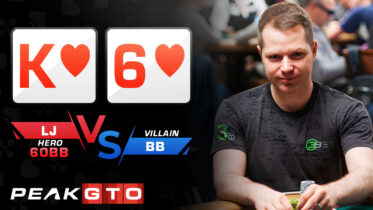
Most players understand that a continuation bet on the flop and a follow-up on the turn are standard parts of an aggressive strategy. The three barrel bluff is where the discipline breaks down. Firing the river with king-high and no draw feels reckless, and most players shut down. But the solver does not see it that way. When the preflop raiser builds a pot-sized flop bet, continues on a favorable turn, and arrives at a bricked river with a range that still contains enough value hands to justify it, shoving the river with select king-high combinations is not reckless. It is required.
Today we will analyze a 60bb 8-handed tournament hand where the lojack opens K♥6♥, the big blind defends, and the flop comes 8♠7♠3♥. This hand illustrates how a backdoor flush draw with an overcard becomes a pot-sized flop bet, why king-high continues bluffing on a queen turn even without improving, and how the absence of spades in the hero’s hand turns a marginal bluff into one the solver fires at full frequency on the river.
Assumptions
- Stacks: 60bb effective
- Format: 8-handed MTT
- Positions: LJ (Hero) vs BB (Villain)
- Action: LJ raises, BB calls
- Flop: 8♠7♠3♥ (Pot: 6.1bb)
- Turn: Q♣ (Pot: 18.3bb)
- River: 2♣ (Pot: 42.9bb)
Preflop
K♥6♥ sits near the bottom of the lojack opening range at 60bb. King-five suited is roughly the weakest king-x suited hand that still raises at meaningful frequency from this seat, so K6s is a standard open. The hand has enough playability through its suited component and overcard potential to justify entering the pot, but it is far from a premium holding. When the big blind calls, Hero enters the flop with a hand that will need to navigate postflop carefully, relying on board texture and positional advantage rather than hand strength.
Flop: 8♠7♠3♥
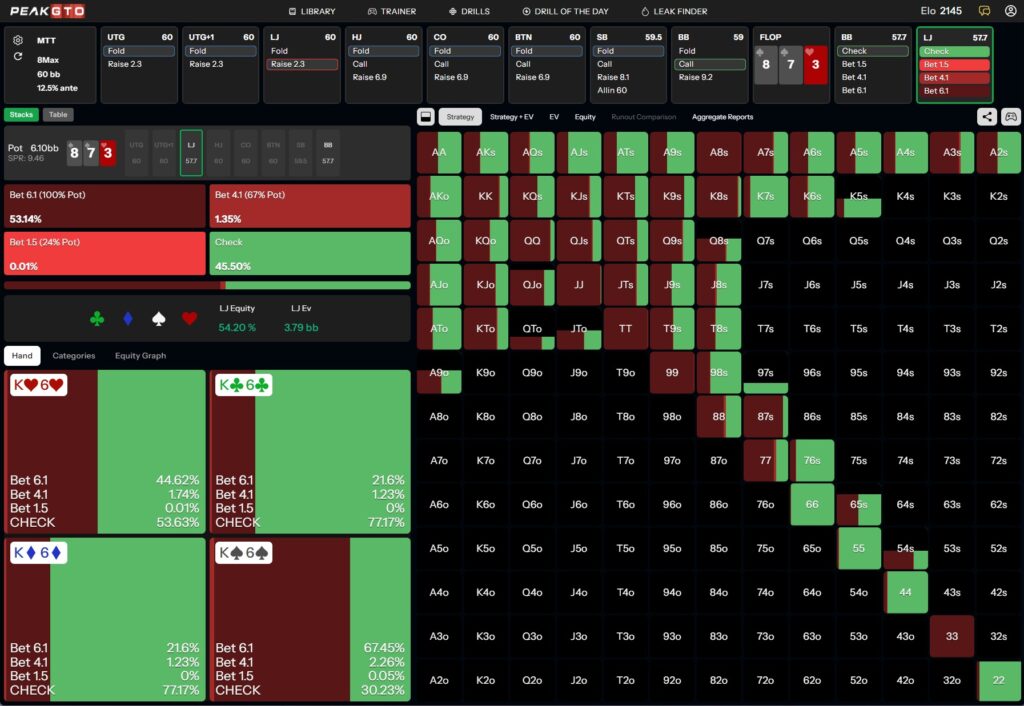
BB checks 99.97% of the time on this board. This is a connected, two-tone flop that favors the big blind’s defending range more than most boards. The big blind holds the majority of the two-pair and set combinations (87, 83, 73, 88, 77, 33), plus a dense collection of flush draws, straight draws, and pair-plus-draw combos. That would normally suggest the lojack should tread carefully.
But PeakGTO shows the lojack still continuation bets 53.1% of the time, primarily using the full pot sizing of 6.1bb. The check frequency is 45.5%. This is a polarized betting strategy: when the lojack does bet on a board that does not favor their range, the sizing is large and the hand selection is deliberate.
The best candidates for the pot-sized bet are draws that combine a backdoor flush draw, a backdoor straight draw, and an overcard. K♥6♥ fits this profile. The heart backdoor flush draw, the possibility of picking up a straight draw on certain turns, and the king as an overcard all contribute. Hands like K♥9♥, K♥T♥, and Q♥T♥ follow the same pattern. When you bet polarized on a dynamic flop, these overcard-plus-backdoor combinations are the right bluffs to include.
After the 6.1bb bet, BB folds 51.6%, calls 47.2%, and raises just 1.1%. The fold equity alone makes the flop bet profitable with most of the lojack’s bluffing range. Hero bets 6.1bb. BB calls.
Turn: Q♣
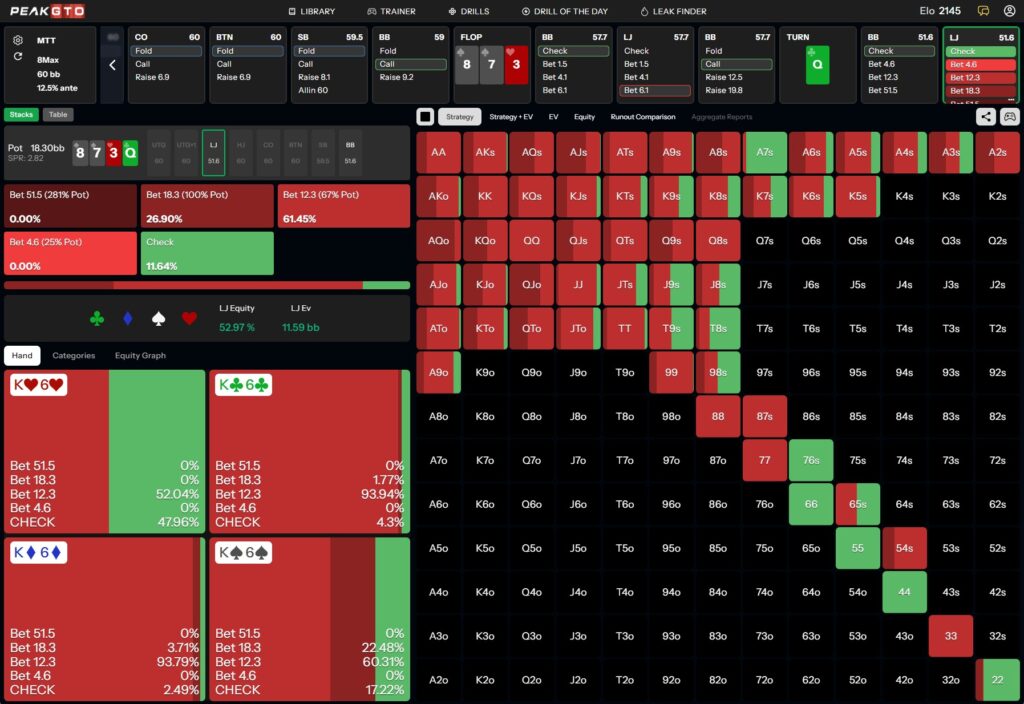
The Q♣ is a favorable card for the lojack’s flop betting range. BB checks 100%. The solver has the lojack betting 88.4% of the time across two sizings: 12.3bb at 61.5% and 18.3bb at 26.9%. The check frequency is only 11.6%.
The standard rule with backdoor draws is to only continue bluffing on the turn when the card improves your equity. The Q♣ does not give K♥6♥ a draw. But there is a key exception: king-high and ace-high hands that have no showdown value are still good bluff candidates. The queen connects well with the lojack’s overall range, since LJ holds unpaired queen-x hands that now have top pair. The big blind, by contrast, should not have many queens after calling a pot-sized flop bet on a dynamic board. That range asymmetry means the lojack can bet aggressively and not expect to get raised often, which makes it safe to include thin value bets and additional bluffs.
From out of position, you would need a real draw to continue bluffing. But in position, you can afford to include low-equity bluffs like K♥6♥ that fire as a pure bluff roughly half the time. Hands with straight draws like JT and T9 also continue at high frequency, but those have equity to fall back on. King-high does not. It is betting purely because the range construction demands it.
After the 12.3bb bet, BB calls 47.7%, folds 39.3%, and raises a combined 13.0%. Hero bets 12.3bb. BB calls.
River: 2♣
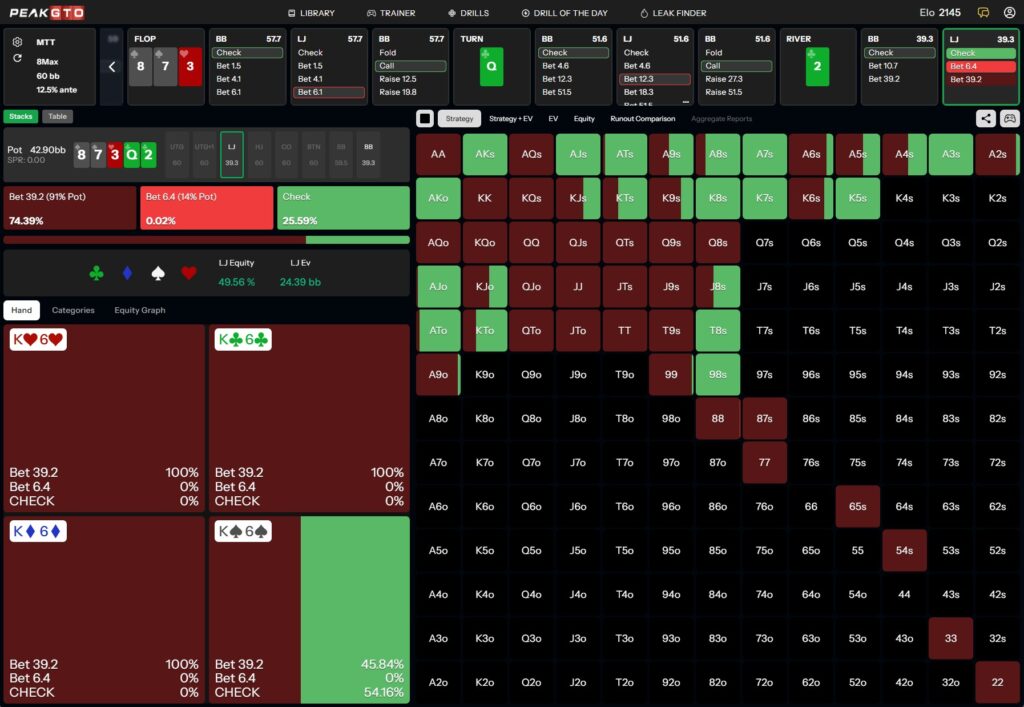
The 2♣ is a complete brick. No draws completed. The board reads 8♠7♠3♥Q♣2♣. BB checks 100%. The solver has the lojack betting 74.4% of the time, primarily using the 39.2bb sizing, which is essentially an all-in shove. The check frequency is 25.6%.
The value range on this river extends surprisingly wide. Even a hand like pocket nines can shove for value because the big blind should hold very few queen-x combinations at this point. With that many value hands pushing all-in, the lojack needs a proportionally large bluffing range to stay balanced.
The critical factor in selecting which bluffs to fire is the spade blocker. Hands that contain spades block the big blind’s busted flush draw combos, which are the hands most likely to fold. If you hold K♠T♠, for example, you remove the opponent’s missed spade draws from the folding range, which makes your bluff less effective. The solver gives up with K♠T♠ at high frequency. But K♥6♥, with no spades, does not block any of the opponent’s folding range. The solver fires this hand all-in at full frequency.
The same principle applies across similar holdings. Any suited king-x or ace-x without spades that bet the flop and turn should shove this river. Hands with two hearts, two diamonds, or two clubs all qualify. If you fire the flop and turn with one of these hands and then check the river, you are playing too passively. The GTO strategy demands the third barrel.
Facing the 39.2bb shove, BB folds 54.1% and calls 45.9%. That fold frequency makes the bluff directly profitable. Hero shoves 39.2bb into 42.9bb. At breakeven, the bluff only needs to work 47.8% of the time. The solver expects it to work 54.1%.
Key Takeaways
- Flop: BB checks 99.97% on this connected, two-tone board. The lojack still bets 53.1% of the time using a full pot sizing of 6.1bb, despite the board favoring the defender’s range. The betting strategy is polarized: large size, deliberate hand selection. K♥6♥ qualifies as a bet because of its backdoor flush draw, backdoor straight potential, and king overcard. BB folds 51.6%.
- Turn: The Q♣ does not improve K♥6♥ directly, but the solver still bets 88.4% of the time because the queen favors the lojack’s range. In position, king-high and ace-high hands are exceptions to the “only continue when your equity improves” rule. They fire as pure, low-equity bluffs because the range demands it.
- River: The 2♣ bricks all draws. The solver shoves 74.4% of the time because value hands extend as thin as pocket nines and the bluffing range must be proportionally wide. The key filter is the spade blocker: hands with spades block the opponent’s folds and check, while non-spade holdings like K♥6♥ shove at full frequency. BB folds 54.1%.
- Overall: This hand demonstrates the full anatomy of a three-barrel bluff: a polarized flop bet with a backdoor draw, a positional turn barrel that fires without improving, and a blocker-informed river shove. The lesson is that once you commit to the flop and turn with a non-spade suited hand on this texture, giving up on the river is a leak. The range construction requires the third barrel, and the math supports it.