
Texas Hold’em is played with two hole cards dealt to each player and five community cards dealt face-up in the center of the table. Players use any combination of those seven cards to make the best possible five-card hand.
There are four betting rounds, including preflop, flop, turn, and river. The player with the best hand at showdown wins the pot, unless everyone else folds first.
I have been teaching Texas Hold’em rules and strategy for over a decade, and in that time I have coached thousands of students. This guide covers everything a beginner needs: the full rules, every action explained, hand rankings, positions, and the five strategy concepts that separate players who consistently win from those who consistently lose.
If you want a printable reference to take with you to your first game, download the PDF version of my guide on how to play Texas Hold’em and always have it on hand.
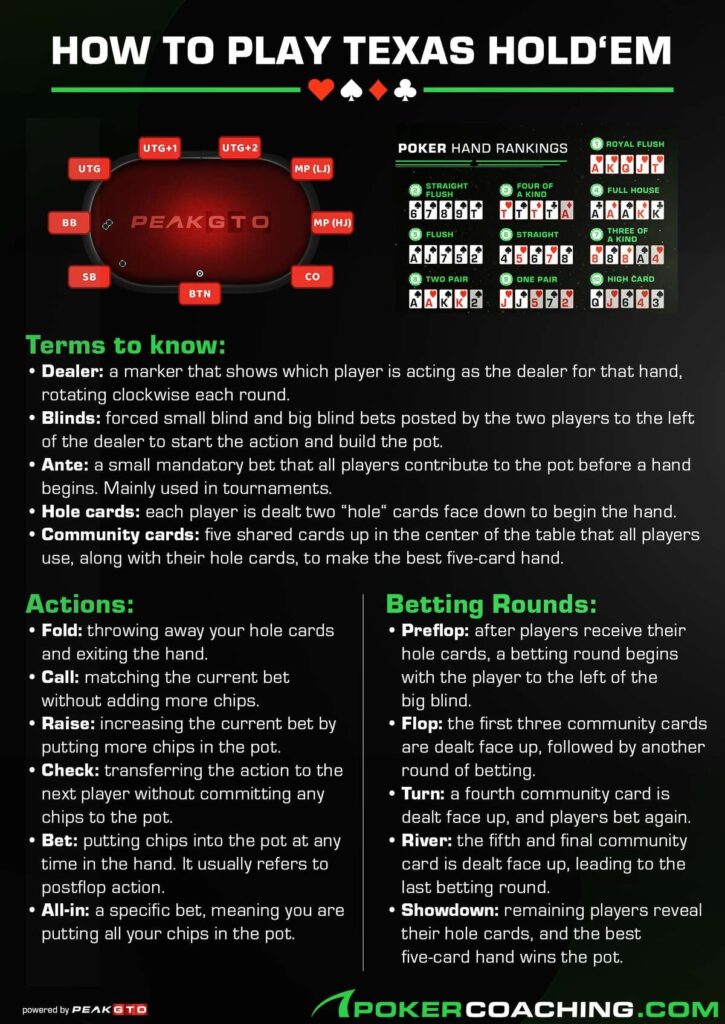
Download Printable How To Play Texas Hold’em PDF
Quick Overview: How a Hand of Texas Hold’em Works
- Two players post forced bets (the blinds) to start the pot.
- Every player receives two private hole cards face down.
- A betting round takes place (preflop). Players can fold, call, or raise.
- Three community cards are dealt face-up (the flop). Another betting round.
- A fourth community card is dealt (the turn). Another betting round.
- A fifth and final community card is dealt (the river). A final betting round.
- Remaining players reveal their cards (showdown). Best five-card hand wins.
- Quick Overview: How a Hand of Texas Hold'em Works
- How to Play Texas Holdem
- Texas Hold'em Rules – Betting Rounds
- Poker Hand Rankings
- Texas Hold'em Actions
- Positions in Texas Hold'em
- Cash Game vs. Tournament Poker
- 5 Texas Hold'em Strategy Tips for Beginners
- Mastering Texas Hold'em Basics
- Texas Hold'em Rules FAQ
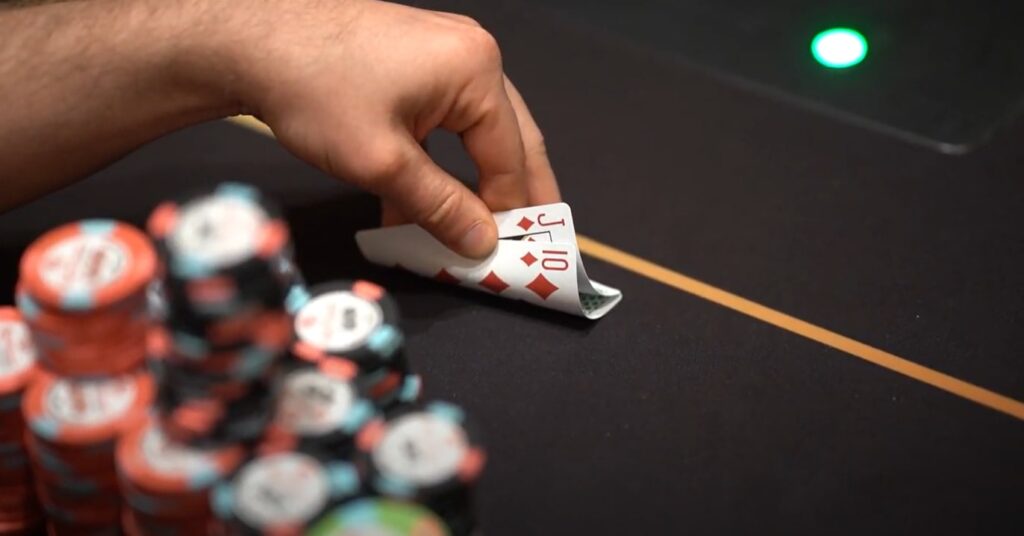
How to Play Texas Holdem
Before we proceed to any specific rules of Texas Hold’em, it is important to understand what your goal in poker is and how you win in this game.
There are two basic ways to win in Texas Hold’em: either having the best five-card poker hand at showdown or getting all opponents to fold their cards.
Both ways of winning the hand are equally legitimate, and both will result in you scooping all the chips that were put into the pot by that point.
The size of the pot you win will depend on the actions you and other players take through the various betting rounds, as well as the stakes you are playing, which are determined by the forced bets (blinds and antes) at the start of the hand.
Blinds and Antes – Forced Bets in Poker
To get things started in poker, two players at the table must post the blinds; forced bets designed to initiate action and give everyone else a reason to put chips into the pot.
Before a hand can start, one player must be assigned as “the dealer.” This player is marked by the dealer button, which sits on the table in front of them throughout the hand.
The two players sitting to the left of the dealer must post the small blind and big blind, the two main forced bets in Texas Hold’em.
In tournaments and sometimes in cash games, players are also asked to post an ante bet, which can be posted by every player at the table or by one player per hand for the entire table.
The blinds and antes are all predetermined. In cash games, the blinds do not change as the game progresses, whereas in tournament poker they increase with each level.
For example, in a $1/2 cash game, the small blind must post $1, while the big blind must post $2 to get things started.
It is also worth noting that the dealer button and the blinds move one position to the left every hand, so every player pays the same amount of blinds and antes per orbit.
Texas Hold’em Rules – Betting Rounds

Once the blinds and antes are set, the game can start. The dealer deals two face-down cards to each player at the table. These are called hole cards, and they are not to be revealed before showdown.
After the hole cards are dealt, every player at the table, starting with the one to the left of the big blind, is given a chance to act on their hand. We will expand on the actions you can take in each round in further text.
According to poker rules, there are four betting rounds, followed by the showdown. These are:
- Preflop: The preflop betting round is the first betting round, which follows the dealing of hole cards. At this point, players can only see two cards and must make their actions based on very limited information.
- Flop: The dealer deals the first three community cards in the middle of the table, called the flop. Players act on their hands, with five cards at their disposal, starting with the player closest to the left of the button.
- Turn: The dealer deals the next community card, called the turn. Once again, all active players get to act on their hands in the same order as they did on the flop.
- River: The dealer deals the final community card, called the river. With all seven cards at their disposal, players get to act on their hand one last time before the showdown.
Following the four betting rounds in the Texas Hold’em poker game, the dealer will announce a showdown, prompting the remaining players to reveal their hole cards.
Once the cards are revealed, the dealer compares all the hands and declares the winner based on the standardized poker hand rankings.
If two or more players have the same hand, according to the rankings, the pot will be split evenly among the winners.
In case everyone but one player folds before reaching the showdown, the last remaining player is awarded the pot despite his holdings.
Limit, Pot Limit, and No Limit Poker
Texas Hold’em rules define many different things, including the betting limits, which determine the way in which players can make bets and raises in each betting round.
These days, No Limit poker is most commonly played, especially No Limit Texas Hold’em. In No Limit poker, there are no limitations to how much you can bet or raise at any point, except for your stack size, which is the maximum you can bet.
Pot Limit poker has been popularized by the rise of Pot Limit Omaha, another poker game that’s been widely spread in recent years. In Pot-Limit Poker, players can bet or raise the maximum of the current pot at any point, and the dealer is obligated to monitor the pot size and assist players in making correct bets. That said, the Texas Hold’em game is rarely played as a pot-limit.
In Limit Poker, which is usually played in Mixed Games these days, players can only make bets and raises in preset increments, which significantly changes the strategic approach one must take to the game.
Poker Hand Rankings
Poker hand rankings are an integral part of the rules of poker, and the same rankings are used in most poker variations, not just Texas Hold’em.
The following are the best possible hands in poker, ranked from strongest to weakest:
- Royal Flush: The best hand in poker, a royal flush is made up of the five highest-ranked cards of the same suit. For example, A♦ K♦ Q♦ J♦ T♦.
- Straight Flush: Made up of any five consecutive suited cards, Straight Flush is the second-best hand in poker, and holding one means you almost always have the winner. For example 9♠ 8♠ 7♠ 6♠ 5♠.
- Four of a Kind: Four cards of the same rank make for a true powerhouse in poker. Almost always the best hand, Four of a Kind is also known as Quads. For example, Q♠ Q♦ Q♥ Q♣ T♦.
- Full House: Three cards of one rank and two of another make up a Full House. For example, A♠ A♦ A♣ J♥ J♣
- Flush: A flush consists of five cards of different ranks but the same suit that are not all in a row. For example, K♥ J♥ 9♥ 7♥ 2♥.
- Straight: Holding five cards of different suites but consecutive ranks gives you a Straight, powerful poker hand in its own right. For example, 8♥ 7♠ 6♦ 5♣ 4♠
- Three of a Kind: Also known as Trips, Three of a Kind is a poker hand made of three cards of the same rank, along with two other unpaired cards. For example 8♠ 8♦ 8♣ 5♠ 2♦.
- Two Pair: A hand made up of two different pairs of equally ranked cards, along with one unmatched card called the kicker. For example, T♠ T♦ 7♥ 7♣ A♦.
- One Pair: The weakest “made hand” in poker, One Pair is made up of two equally ranked cards, along with three unpaired cards on the side. For example, K♦ K♣ T♠ 5♥ 3♣.
- High Card: If your cards are all unpaired, and you hold no Straight or Flush, you will be left with just a High Card combination. If multiple High Card hands are left at the end, the player with the highest High Card wins. For example, A♠ Q♦ 9♥ 6♠ 3♠.
Knowing poker hand rankings by heart is the first thing you should master when learning poker strategy, since you should be able to identify all possible combinations in the hand by simply glancing at community cards.
Texas Hold’em Actions
We have already discussed the different betting rounds in poker and the fact that players must take action on their hands in each of them.
Now is the time to explore the different actions available and their functions in the game of poker.
The following is a list of possible actions each player can take when the option comes to them in each of the betting rounds:
- Fold: The simplest of all poker actions. Folding means throwing away your hole cards and exiting the hand. Once you have folded your cards, you can no longer win the hand, but you can’t lose any more chips either.
- Call: When you announce a call or throw in the chips to make the call, you are matching the current bet without putting in further chips. In the preflop betting round, you will have to at least call the value of the big blind to remain in the hand.
- Raise: If you think you have a strong hand or are looking to make other players fold their cards, you can raise the bet up instead of calling. In No Limit Texas Hold’em, you are allowed to raise the bet to any amount, up to table stakes.
- Check: In all betting rounds except preflop, players are allowed to check when they are not facing a bet. Checking transfers the action to the next player and does not require any chips to be invested. Simply tap the table, and the action will move on for the time being.
- Bet: If you are not facing a bet, you can choose to make the first bet instead of checking. You can bet a minimum of one big blind and a maximum of your entire stack in No Limit Texas Hold’em.
- All In: While this action is identical to betting or raising, it is considered a unique action because it requires you to commit all your chips. Announcing all in will tell the dealer that you are betting all your chips, regardless of how many you have.
Knowing which action to take will require some studying, but if you are just starting in the game, make sure to check our article with the best poker tips.
Positions in Texas Hold’em
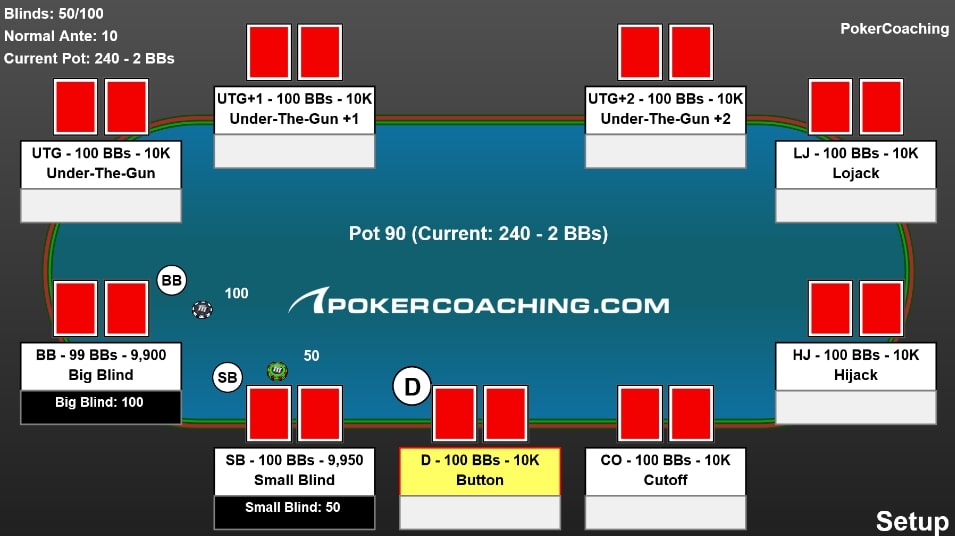
Another important element of poker is the poker positions. Poker positions change from hand to hand as the dealer button circles the table, giving every player a chance to play each seat once per orbit.
Your position relative to the dealer button is one of the most important concepts in all of Texas Hold’em. I teach this to every student before I teach them anything about specific hands.
Here is why it matters: when you act last in a betting round, you have seen what every other player has done before making your decision. That information is enormously valuable. When you act first, as the blinds must do on every postflop street, you are making decisions blind to what your opponents want to do.
In my coaching sessions, I constantly see position mistakes. Players in early position call too widely because they like their hand, not realizing they have to play the rest of the hand without position. Players in late position fold too conservatively, giving up a major strategic advantage. Getting position right is free, it costs nothing to tighten your range from early seats and open up from the button.
- Early Positions: The first three positions at a 9-handed poker table are considered early positions. These are marked as Under the Gun (UTG), UTG +1, and UTG+2. These positions generally require tighter play, as there are many players left to act after you.
- Middle Positions. Marked as MP1 and MP2, the next two positions at the table are considered middle positions. These positions are sometimes also called the Lojack (LJ) and Hijack (HJ) by poker analysts.
- Late Positions: The best positions at the table, from a strategic point of view, the Cutoff (CO) and the Dealer (D), allow you to act last in every postflop betting round, giving you a significant advantage. Late positions are the most favorable and let you play more hands profitably.
- The Blinds: The Small Blind (SB) and Big Blind (BB) start the hand with a significant disadvantage. Not only do they have to invest money before seeing their hole cards, but they must also act first in every postflop betting round. Be careful when playing hands from the blinds!
This is a very simplified explanation of table positions. For a full breakdown of how to adjust your strategy in each position, see our dedicated guide to poker positions.
Cash Game vs. Tournament Poker
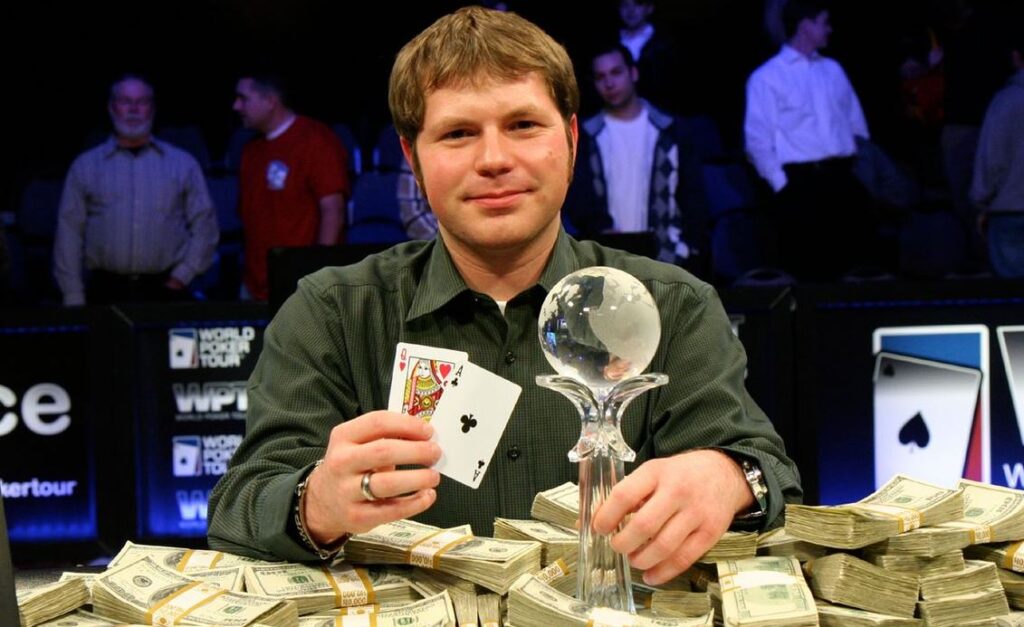
Before you start playing, you should understand the difference between cash game and tournament poker, two of the most popular game formats.
The main difference is quite simple and doesn’t really have too much to do with the basic Texas Hold’em rules, which remain the same for the most part in both formats.
In cash games, players purchase chips with cash, meaning the blinds are set at a certain level, and each new hand is dealt with those blinds, regardless of how long the game goes on.
One practical difference I always explain to new students: in a cash game, every chip has a direct dollar value. If you have $200 in chips at a $1/$2 table, you have $200. In a tournament, your chips have no cash value, and they only represent your survival in the field. This changes decisions dramatically. In a cash game, I might take a thin value bet on the river because the expected value is slightly positive. In a tournament, I have to account for the risk of elimination and the structure of the prize pool. These are fundamentally different games that happen to share the same rules.
Cash games often have minimum and maximum buy-ins, and they allow players to purchase new chips when they lose or to top up their stacks when they lose a portion of their chips, with each chip bought for real money.
In tournaments, on the other hand, a fixed buy-in will get you a starting chip stack, which doesn’t directly reflect the monetary value you paid for it. If you lose all your chips, you are out of the tournament and can’t compete for the prizes.
What’s even more, tournament chips have no cash value and cannot be cashed out at any time. At the end of the tournament, players who finish in the top 10%, 15%, or another predetermined percentage of the field receive cash prizes.
The first-place finish in a poker tournament generally takes the biggest part of the prize pool, while other players who finish “in the money” are paid based on their finishing position.
Blinds in a poker tournament keep increasing over time, which inevitably leads to players busting out until only one player remains as the champion.
5 Texas Hold’em Strategy Tips for Beginners
Knowing the rules of Texas Hold’em gets you to the table. Understanding these five concepts is what helps you win once you get there.
After reviewing thousands of student hands at PokerCoaching, I can tell you that almost every mistake a beginner makes traces back to one of these five areas. If you fix these, you will be ahead of the majority of players you meet at low-stakes tables.
Tip 1. Play Fewer Hands and Play Them Aggressively
The single biggest mistake I see in beginner students is playing too many hands. When you are new, it is tempting to call with any two cards that look interesting. But the best starting hands in Texas Hold’em are high pairs (AA, KK, QQ, JJ) and high card combinations (AK, AQ, AJ). These hands win the most at showdown.
My advice: in your first sessions, fold everything that does not feel clearly strong. You will fold more than you play, and that is correct. When you do play a hand, play it with confidence. Limping in with a weak hand and then folding to any bet is the worst of both worlds.
Tip 2. Position Is More Valuable Than Your Cards
In Texas Hold’em, the player who acts last in a betting round has a significant advantage. They get to see what every other player does before making their decision. This is called being “in position.”
The dealer button (the BTN) is the most powerful position at the table. From the button, I can see how every player before me has acted, and I can tailor my response with maximum information. From the blinds, I act last preflop but first postflop — the worst of both worlds.
In my experience, position is worth at least one full rank of hand strength. I would rather play a medium hand in position than a strong hand out of position against an aggressive opponent. As a beginner, simply tighten up your calling range from early position and widen it when you are on the button.
Tip 3. Understand Why You Are Betting Before You Bet
Before making any bet, ask yourself: what am I trying to accomplish? There are three legitimate reasons to bet in Texas Hold’em: to get value from a worse hand calling you, to fold out hands that would beat you at showdown, or to set up a future bet on a later street.
What is not a legitimate reason: “I have been in this hand for two rounds and I want to see what happens.” That is not a strategy, it is a habit. Every time I put chips in the pot, I know why I am doing it.
For beginners, I recommend focusing on value betting: when you have a hand you believe is best, bet it. Do not check a strong hand hoping your opponent will bet for you. Bet it yourself, charge them to see the next card, and build the pot.
Tip 4. Basic Pot Odds: Knowing When a Call Is Correct
Pot odds are the ratio of the pot size to the cost of your call. If the pot has $100 and your opponent bets $25, you are calling $25 to win $125 — pot odds of 5 to 1. If the odds of winning the hand are better than 5 to 1, the call is mathematically correct over the long run.
Here is the shortcut I use when teaching beginners: count your outs (the cards that will make your hand), then multiply by 2 for each remaining card. If you have a flush draw after the flop (nine outs), you have roughly an 18% chance of hitting on the turn. If the pot odds justify the call at 18%, call. If not, fold.
This is not complicated once you practice it a few times. The goal is not to be a mathematician at the table; the goal is to avoid calling large bets when the pot is offering terrible odds.
Tip 5. Bluffing: What It Is, When to Use It, and When Not To
Bluffing is betting or raising with a hand you believe is not the best hand, with the goal of making your opponents fold. It is one of the most powerful tools in poker, and also the most misused by beginners.
In my experience, most beginning players either never bluff (too passive) or bluff too much (too obvious). The correct approach for a beginner is to bluff selectively — only when the board and betting story make it plausible that you could have a strong hand.
The best bluffs are made when you have some outs even if called (a semi-bluff): for example, betting with four cards to a flush, so that even if your opponent calls, you still have a chance to improve to the best hand. Pure bluffs with no equity are higher risk and should be used sparingly until you have a solid read on your opponents.
Mastering Texas Hold’em Basics
You now have everything you need to sit down at a Texas Hold’em table and understand what is happening at every stage of the hand. Rules are the foundation. What you build on top of that foundation is strategy.
The five strategy tips above are where I would start if I were teaching a friend how to play today. They are not complicated, but they cover the decisions that come up in every single session: which hands to play, where to play them, why to bet, when to call, and how to bluff with purpose.
When you are ready to go deeper, the next step is to study real hands and real decisions. At PokerCoaching, I review student hands every week and identify the exact spots where players leave money on the table. That is where the real learning happens.