
Poker is gambling in the strictest sense: you are risking real money on uncertain outcomes, and short-term luck plays a significant role in any given session.
But what makes poker fundamentally different from other gambling games is that skilled players can generate a consistent positive edge over time, which is something no slot machine or roulette wheel allows.
I have been playing poker professionally for over two decades and coaching thousands of students, and the data consistently confirms what I see at the table: your skill level is the dominant factor in your long-term results.
The debate over whether poker is gambling is worth having, but the more important question is whether skill can produce consistent edges. The answer to that one is clear.
What Is Gambling?
According to some definitions, gambling is the action of wagering money or other possessions on the outcome of a game or event that is somewhat random.
However, there are many different degrees to gambling. For instance, playing a tennis match against Rafael Nadal would hardly be gambling for most of us, as we would stand to lose any wager we made on such a foolish endeavor.
On the other hand, wagering if a coin will land on heads or tails is perhaps the purest form of gambling, as neither side has an advantage, and the odds are dead even.

Contrary to this, most casino games actually give the house a significant edge. Anytime you play slots or blackjack against the casino, you are not really gambling but rather losing money in terms of expected value, as the games inherently favor the casino.
Yet all these games are considered pure gambling games, mostly because there is very little one can do to tip the scales in their favor. While poker can be considered a sport by some, that’s not the case with casino games.
Even playing optimally in games like blackjack, the best you can do is get close to breaking even, still losing a slight amount of EV every time you bet.
So, we can conclude that gambling is the act of wagering money on games in which only pure chance can help us win on any given day. In the long run, all gambling games you will find in a casino lead to a loss, regardless of your strategy.
Something worth noting before moving on: by the strictest definition of gambling, buying stock in a company also qualifies. You are risking money on an uncertain outcome. Paying for health insurance is technically gambling too.
You pay premiums hoping you will not need them, but you do not know the outcome. I bring this up not to be clever, but because it changes the frame of the question entirely.
The real question is not whether poker fits a dictionary definition. The real question is whether the activity rewards skill or purely rewards luck, and that is a very different test with a very different answer.
Does Poker Fit the Criteria?
Does poker fit the criteria to be a gambling game? Technically, yes. You are risking money on an uncertain outcome, and that is what gambling means by most definitions.
I want to be direct about this because I think sidestepping the definition actually weakens the argument for poker as a skill game. The honest answer is that poker fits the narrow definition, and then it goes far beyond it.
Here is the key difference. Unlike casino games, where you play against the house, poker is played between individuals, and poker strategy matters.
There is no inherent edge built into the game that guarantees one side wins. If every player at the table made identical decisions, the rake would eventually consume all the money.
What makes poker different is that decision quality determines long-term outcomes. I have seen this play out at every level of the game, from small-stakes cash games to high-stakes tournaments: the players who make better decisions consistently end up winning the money over time, and the ones who make worse decisions consistently lose it. That is not a feature of any pure gambling game.
The Role of Luck in Poker
The reason many people think the impact of luck on poker is greater than it really is comes from focusing on some specific scenarios in the game.
Indeed, there are many situations in poker where luck will determine the outcome of a given hand or your destiny in a tournament.
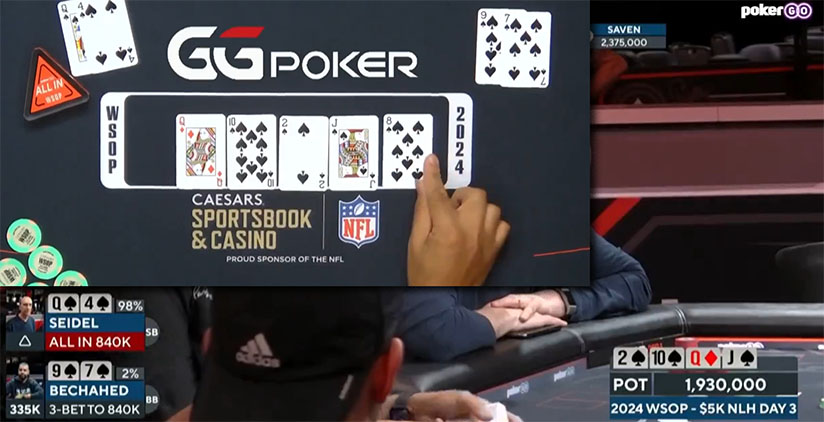
Some examples of this include:
- Going all in with a pair against two overcards
- Going all in with a made hand against a draw
- Going all in with a strong preflop hand like KK or QQ
In all of the scenarios above, you may end up committing all your chips with a statistically better hand and still end up losing.
What’s even more, a hand like KK or QQ will end up running into AA from time to time, causing you to lose your entire stack without making what professionals would call a mistake.
Of course, if you were to only ever play that single hand of poker in your life, then poker would be all about luck and there would be very little skill involved.
Yet, it is important to remember that these things even out over the long run, and you will get AA against KK just as many times as you will get KK against AA. Throughout your career, you will hit exactly the right number of flush draws and straight draws and fade just the right number of draws with your sets, completely negating the role of luck in your results.
Here is a simple test I use to explain to new students why poker cannot be a pure luck game: ask yourself whether you could deliberately choose a losing strategy in the game. In a pure chance game like flipping a coin or spinning a slot machine, no losing strategy exists because no strategy of any kind exists.
But in poker, you absolutely can choose to play badly. You can call every bet, play every hand, and never fold. Any player who has ever sat at a table with someone on tilt knows this works exactly as described: deliberate bad play produces predictable losses. That only happens in games where skill is a factor.
In my experience coaching players at the beginning stages of their development, the biggest obstacle is not variance. It is convincing them to stop treating short-term results as a measure of decision quality.
Good decisions made with a losing outcome are still good decisions. That is a concept that does not exist in games of pure chance, and it is the clearest sign that skill governs long-term poker results.
What Does the Science Say?
Science has weighed in on this debate, and the results align with what I observe in my own career and in coaching.
The most widely cited study comes from researchers at the Institute of Law and Economics at the University of Hamburg, and while it was published in 2009, its methodology and conclusions have held up over time.
Subsequent research on poker outcomes has continued to support the same core finding: skill is the dominant variable in long-term results. The Hamburg study looked at records from over 50,000 online poker players.

The research included records of over 50,000 online poker players and looked to determine the Critical Repetition Frequency (CRF) for different players.
This measure represents the number of poker hands (or repetitions of any kind) needed to get within 95% certainty that the findings are dependable.
The research found that the players with higher bb/100 (win rate) would need fewer hands to get within that 95% certainty, indicating that in-game skill directly correlated with the results.
Players with a 5bb/100 needed 118,000 hands on average to get within that range, which is exactly what most professional poker players have come to expect.
Overall, this study showed a very strong argument for poker as a skill game and proved almost beyond any doubt that any impact luck has on poker is only short-term, while the long-term results are determined solely by the player’s skill and strategy employed at the tables.
Impact of Skill in Poker
While millions of people around the world play poker on a semi-regular basis, only some of them win regularly, with some of those making the game into a career.
Professional poker players rely on skill and strategy instead of luck and understand that playing against inferior players for enough hands will produce positive results.
Skill in poker includes everything from your starting hand poker ranges to bet sizing and bluffing frequencies, and the more versatile your poker skillset is, the more likely you are to be a big winner.

Note that there are many different degrees to which you can win at poker, and just because you are a big winner in one game does not mean you will be a big winner in another.
In fact, choosing the right table to sit at and players to play against might just be one of the most important poker skills, called table selection.
When all different poker skill elements are added up, the difference between the best players and the worst players in a game can be quite drastic, and the final win/loss rates of the two players can end up being the exact opposite.
Look at the long-term records of professional players online, and the pattern is impossible to miss: the same names appear at the top of the win-rate charts across millions of hands.
That does not happen in roulette. I have played at every level of this game, and the consistent finding is that the players who study, who understand ranges and frequencies, and who manage their mental game are the ones who end up with positive long-term results.
The ones who do not study eventually give their money to the ones who do. Skill separates the long-term winners from the long-term losers in a way that no other gambling game allows.
Importance of Consistency
I tell every student the same thing when variance starts to beat them down: the session you just played does not tell you very much about your skill level. What tells you about your skill level is a long-term record built over tens of thousands of hands.
This is one of the hardest lessons in poker to accept, because the human brain naturally wants to draw conclusions from small samples. But poker does not care about your recent run. It cares about your decision quality compounded over time.
Looking at all the elements that make up the game of poker, it is quite clear that this is a skill game in which luck only plays a role in the short term.
This is the one area where most players get it wrong, as they focus on short-term results and forget the importance of consistency of volume.
If you want to see success in poker, you will need to play better than your opponents and put in enough volume for your skill edge to overcome short-term variance.
The higher your edge over your opponents, the fewer hands you will need to play to overcome variance. However, playing a single session of poker will never be enough to demonstrate your skill level in its entirety.
So, if you are still wondering if poker is all about luck or skill, keep on playing, improve your poker skills, and you will see that the results will follow without mistakes.
As long as you are able to find weaker opponents and play enough hands against them, the skill advantage will overcome the impact of luck, and you will end up on the right side of things.
Is Problem Gambling a Risk in Poker?
Yes, and it is worth addressing directly. The fact that poker rewards skill does not make it immune to compulsive behavior. Gambling addiction is a real condition, and poker is not exempt from it.
In my experience, the difference between a serious poker player and a problem gambler is trackable in a few specific behaviors. Serious players track their results and study to improve.
They set and follow bankroll management rules. They play within their means and are honest with themselves about whether they are playing at the right stakes for their skill level. Problem gamblers, by contrast, typically chase losses, play above their bankroll, and avoid tracking results because the numbers are painful to see.
If you are playing poker and find yourself consistently losing more than you planned, playing in sessions that go far longer than intended, or making financial decisions around poker that are affecting other areas of your life, those are signs worth taking seriously. Resources like the National Council on Problem Gambling (ncpgambling.org) can help.
Poker as a studied discipline, is genuinely different from the way problem gambling manifests. But that distinction only exists if you are actually treating it as a discipline.