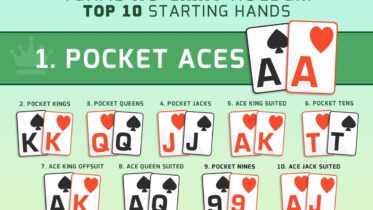

The best Texas Hold’em starting hands are, in order: pocket aces (AA), pocket kings (KK), pocket queens (QQ), ace-king (AK), pocket jacks (JJ), ace-queen (AQ), pocket tens (TT), pocket nines (99), ace-jack (AJ), and king-queen (KQ).
In my experience coaching players at all levels, the most expensive mistake I see is not bad starting hand selection from the top of this list, but playing too wide below it. Players who master these ten hands and learn when to fold the ones just off this list move up in stakes faster than almost any other adjustment they make.
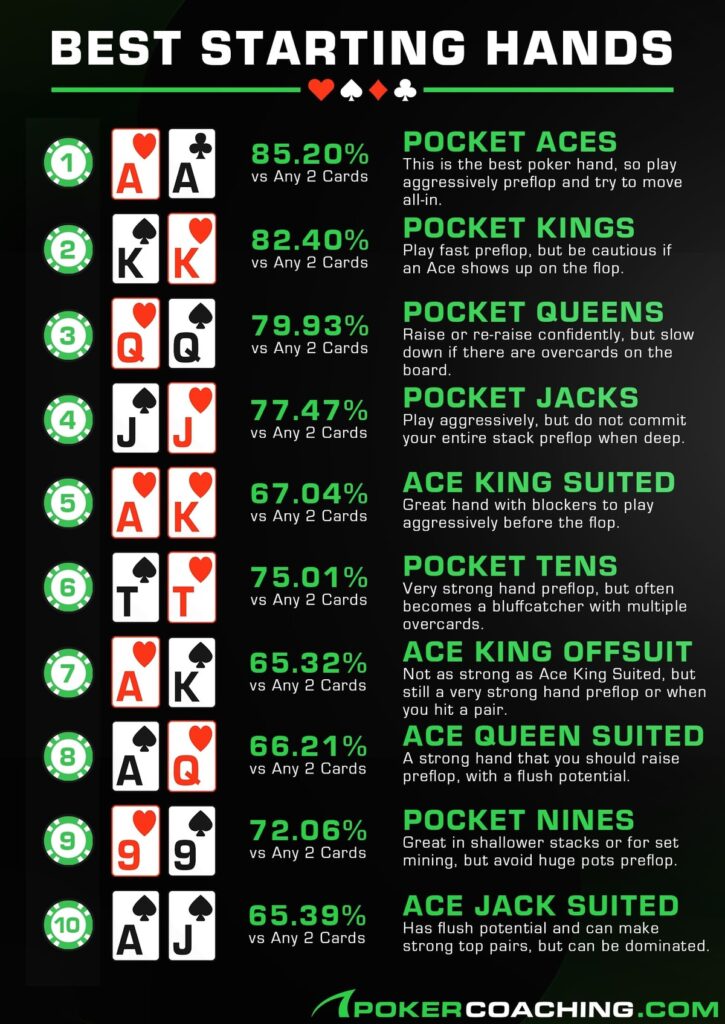
Download Best Starting Hands PDF Guide
#1. Pocket Aces

Also known as Pocket Rockets or American Airlines, Pocket Aces is the best starting hand in the game, and one you will never want to fold before the flop.
Pocket Aces are good enough to play from any position and at any stack depth and should always be played as a raise unless you have a specific reason to set a trap.
Regardless of your skill level, Pocket Aces should be the most profitable hand you play. You will only get dealt Pocket Aces once in 221 hands, so make sure to make the best of them when you do.
Strategy with Pocket Aces
- Preflop: Always raise, and usually re-raise. This is the strongest starting hand in Texas Hold’em.
- Postflop: Continue betting for value unless the board is extremely coordinated (e.g., straight or flush heavy).
- Common Mistake: Slow-playing and letting multiple opponents in cheaply, which reduces your equity.
#2. Pocket Kings
Ranked just below Pocket Aces, Pocket Kings is another hand that players get super excited to see, as it beats nearly all other cards in the game.
Like Aces, Pocket Kings are dealt once in 221 hands, making it a rare but welcome sight in any game, tournament, or cash.
As long as you are not playing an extremely deep stack, you should always be happy to commit your chips with KK, as you will usually be up against a weaker pair or worse.
Strategy with Pocket Kings
- Preflop: Raise or re-raise aggressively in almost any situation.
- Postflop: Bet confidently unless an Ace appears and opponents show strength.
- Common Mistake: Going all-in without caution on connected boards or when an Ace is visible on the flop.
#3. Pocket Queens
A pair of Ladies is almost as good as a pair of Kings, but Pocket Queens fade a bit in strength as they only have a slightly above 50% chance of winning against Ace King specifically.
That said, a pair of Queens is still always a great starting hand that you should open with a raise and usually put in multiple raises when the opportunity arises.
Like other pairs, Pocket Queens come once in 221 hands, and as long as you are not super unlucky, they will be the best hand before the flop.
Strategy with Pocket Queens
- Preflop: You should still usually raise and re-raise preflop with this premium holding.
- Postflop: Play strongly on low boards, but be cautious if an Ace or King comes and the action is heavy.
- Common Mistake: Overcommitting with overcards on the board.
#4. Ace King Suited
Next on the poker hand rankings is Ace King Suited, another powerhouse of the game, and a hand many players prefer to see over Pocket Queens, which is dealt once in 111 times.
Ace-King suited is a hand that plays extremely well in deep-stacked games, but also performs well in tournaments, as it is almost never a huge underdog. Having the highest card with the highest face card makes it a very powerful holding.
Ace-King suited plays great against all hands except AA and KK. It will even do okay against KK, which is why it’s ranked as the number four of all Texas Hold’em Poker hands.
Strategy with Ace-King Suited
- Preflop: Raise or re-raise with this top drawing hand.
- Postflop: If you hit top pair (A or K), you’re often best, and even if you miss, you should almost never fold on the flop.
- Common Mistake: Overplaying Ace-high when you completely miss the board.
#5 – Pocket Jacks
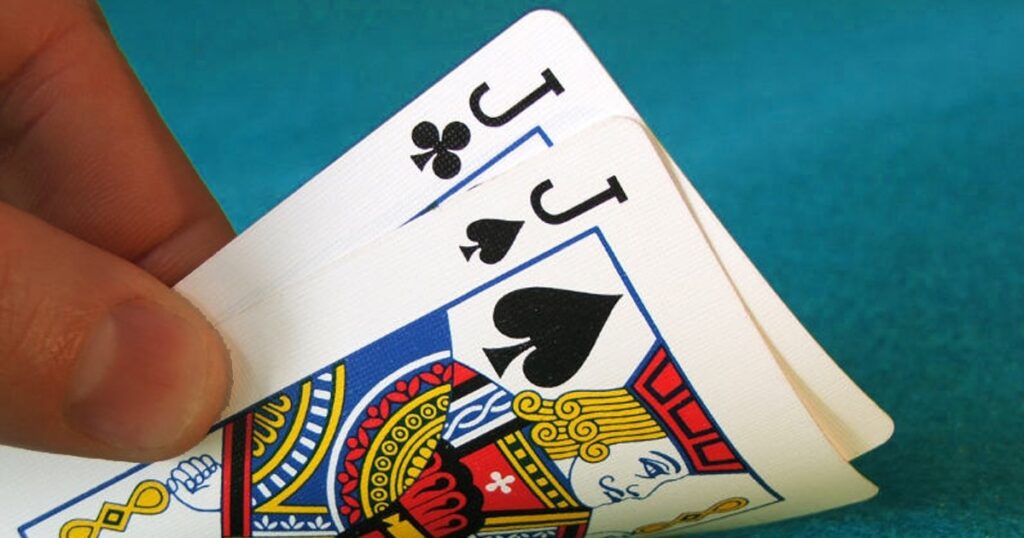
The next pocket pair in order is Pocket Jacks, a hand that some players struggle to play, but it’s generally still an extremely profitable one.
Pocket Jacks can be a bit tricky to play, especially as stacks get deeper, and you want to make sure not to overplay this particular pocket pair.
All that said, JJ will make you a lot of money over a lifetime of playing poker, and even more if you don’t get married to them and are willing to fold when the going gets rough.
Strategy with Pocket Jacks
- Common Mistake: Falling in love with Jacks and ignoring the texture of the flop.
- Preflop: Strong but tricky. Raise if you are first to act, but evaluate the situation before re-raising.
- Postflop: Great on low flops. Dangerous on boards with overcards (Q, K, A).
#6. Ace King Offsuit
The offsuit version of the game’s fourth-best hand comes in place number six, as Pocket Jacks has a bit more playability and value.
Nevertheless, Ace King Off has almost as much equity in all situations as its suited version and is a hand you will usually want to play for a lot of chips.
Strategy with Ace-King Offsuit
- Common Mistake: Bluffing too hard when you miss the flop. AK offsuit doesn’t have the same backup draws as suited AK.
- Preflop: Raise confidently. Still very strong, though less powerful than suited AK.
- Postflop: Play strong if you hit, but be careful if you miss and face resistance.
#7. Ace Queen Suited
Next on our list of the best poker hands is Ace Queen Suited, an unpaired hand that has a lot of similarities with Ace King Suited.
Ace Queen Suited is nearly the same hand, but you will run it into AK specifically from time to time, which makes it slightly worse to play.
Yet, AQs is a hand you should rarely miss playing and one that will win you many big pots once you learn how to play it right.
Strategy with Ace-Queen Suited
- Common Mistake: Overcommitting with just one pair against strong players.
- Preflop: Strong drawing hand. Always raise first and sometimes re-raise.
- Postflop: Good when you pair the top card (A or Q), or when chasing nut flush/straight draws.
#8. Pocket Tens
Another good pocket pair, Pocket Tens, is one that some don’t consider a premium, while others do, which makes it a bit of a fringe hand.
That said, TT is a very powerful pocket pair, but one that will often face overcards on the board, which can make it slightly tricky to play after the flop.
Strategy with Pocket Tens
- Common Mistake: Overvaluing the hand both preflop and postflop against heavy action.
- Preflop: Good but vulnerable. Raise when first to act, but usually call when facing a 3-bet unless you have a short stack.
- Postflop: Excellent on low boards. Play cautiously against heavy action if overcards appear.
#9. Pocket Nines
A pair of Nines is not much different in value than a pair of Tens, and the value of the two hands is quite similar in every poker format.
Pocket Nines are always a good raising hand and one that you will be happy to commit many tournament stacks with, but one that you must be more cautious with in deep-stacked games.
Strategy with Pocket Nines
- Common Mistake: Overvaluing Nines against strong preflop aggression.
- Preflop: Open-raise when first in, but think carefully about calling or re-raising if facing heavy action from tight players.
- Postflop: Great on low, uncoordinated boards. However, it becomes tricky when overcards appear, and it usually becomes just a bluff catcher.
#10. Ace Jack Suited
Completing our list of the top ten hands in poker is Ace-Jack suited, another version of a suited Ace that does not quite compare to its stronger counterparts.
Ace Jack Suited is a pretty good hand, but certainly no longer falls into the line of premiums and can be folded before the flop quite often under the right circumstances.
Strategy with Ace Jack Suited
- Common Mistake: Overvaluing Ace-Jack after hitting an ace since AK and AQ can dominate you.
- Preflop: Playable in most positions, so raise when first in and usually call when facing an open.
- Postflop: Good straight and flush potential. Be cautious with the top pair, as kicker problems can occur against AQ and AK.
How Position Affects Your Starting Hand Selection
One thing the top-10 list above does not capture is how dramatically your position at the table changes which hands you should play. I always tell students that a starting hand does not have a fixed value: its value depends heavily on where you are sitting relative to the dealer button.
- Early position (first two or three seats after the blinds) is where the top-10 list matters most as a floor, not a ceiling. From early position, you are acting before most of the table, which means you should stick primarily to premium hands: the top six on this list (AA, KK, QQ, AK, JJ, AQ) are comfortably playable from early position in most games. Pocket tens, nines, and hands like AJ or KQ require more caution from early position because you will frequently face raises behind you that put you in a dominated position.
- Middle position opens up your range meaningfully. From middle position, all ten hands on this list are playable as raises, and you can begin adding hands like small pocket pairs (for set-mining potential) and suited connectors when the situation allows.
- Late position (cutoff and button) is where your range expands the most. Acting last gives you information before every decision, which transforms marginal hands into profitable plays. From the button, virtually all pocket pairs are playable raises (even 22-55 have set-mining value with position), and suited connectors like 87s, 76s, and 65s become regular open-raises.
The key takeaway: the hands on this list are strong enough to play from anywhere at the table in most situations. Where position changes your decisions most is in the hands just off this list, and in how much you are willing to commit before the flop against players who raise from early position.
Best Starting Hand Odds & Tips
| Hand | Equity vs Any 2 Cards | Tips |
| AA | 85,20% | This is the best poker hand, so play aggressively preflop and try to move all-in. |
| KK | 82.40% | Play fast preflop, but be cautious if an Ace shows up on the flop. |
| 79.93% | Raise or re-raise confidently, but slow down if there are overcards on the board. | |
| JJ | 77.47% | Play aggressively, but do not commit your entire stack preflop when deep. |
| AKs | 67.04% | Great hand with blockers to play aggressively before the flop. |
| TT | 75.01% | Very strong hand preflop, but often becomes a bluffcatcher with multiple overcards. |
| AKo | 65.32% | Not as strong as AKs, but still a very strong hand preflop or when you hit a pair. |
| AQs | 66.21% | A strong hand that you should raise preflop, with a flush potential. |
| 99 | 72.06% | Great in shallower stacks or for set mining, but avoid huge pots preflop. |
| AJs | 65.39% | Has flush potential and can make strong top pairs, but can be dominated. |
| KQs | 63.41% | Strong suited connector that plays well on most flop textures; raise from middle and late position as a default. |