Try This Hand Yourself
Play this exact spot against the solver in PeakGTO before reading the analysis.
When an opponent flat-calls a raise from the button instead of re-raising, their range is wide but capped. They rarely hold the strongest hands, because those would have three-bet, and they are loaded with speculative holdings that float one street and hope to improve. That structure is an invitation to apply pressure. The out-of-position raiser who keeps firing can attack the soft middle of that range across multiple streets. The catch is that the best bluffs are not random air. They are chosen by which better hands they fold out and which folds they unblock.
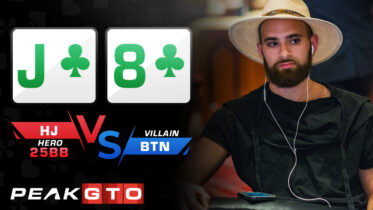
Today we will analyze a 25bb 8-handed tournament hand where the hijack opens J♣8♣, the button calls, and the hijack runs a triple barrel bluff on 5♠5♥3♦, the 7♥ turn, and the T♣ river. J8 never makes a pair on this paired board, yet it jams the river as a pure bluff. This hand shows why a low paired flop favors the out-of-position raiser, why a small turn card is more aggressive than a scary overcard, and why the exact suit of the bluff decides whether it fires or gives up.
Assumptions
- Stacks: 25bb effective
- Format: 8-handed MTT
- Positions: HJ (Hero) vs BTN (Villain)
- Action: HJ raises, BTN calls
- Flop: 5♠5♥3♦ (Pot: 6.5bb)
- Turn: 7♥ (Pot: 14.3bb)
- River: T♣ (Pot: 31.5bb)
Preflop
The hijack opens to a standard raise and the button calls. That call is the most important fact in the hand. At 25bb, a strong button would often three-bet or jam, so the flat-calling range is concentrated in suited connectors, suited aces, broadway combinations, and middling offsuit hands that want to see a flop in position. The result is a range that is wide and capped at the top. J8s is a comfortable open from the hijack, and once the button flats rather than re-raising, Hero is already looking at an opponent who will struggle to defend against sustained aggression.
Flop: 5♠5♥3♦
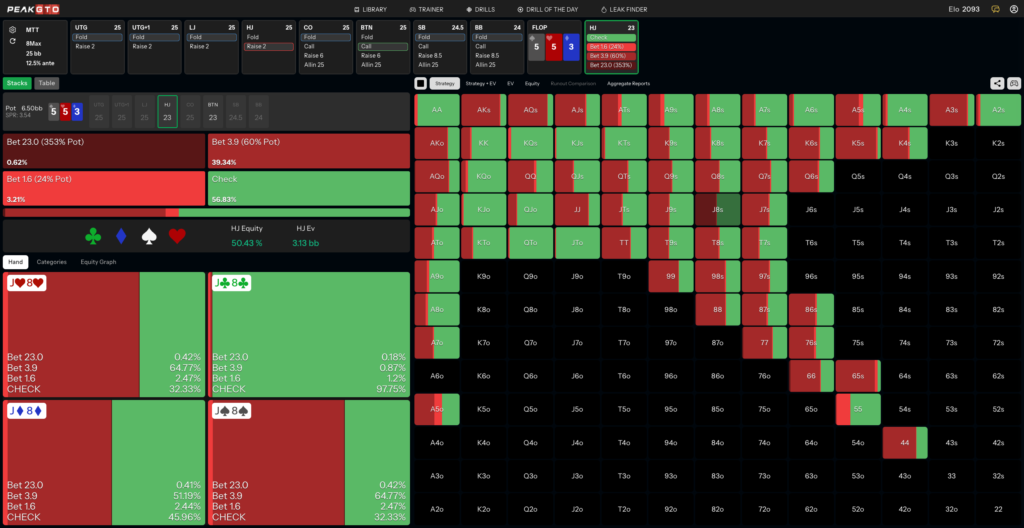
A paired low board like 5♠5♥3♦ favors the out-of-position raiser. Hero retains the overpair and overcard advantage on this texture. The preflop raiser holds all the big pairs and most of the high cards, while the button’s flatting range is full of hands that completely miss. Position calling ranges shove their best made hands here, hands like eights through tens, while jacks, queens, kings, and aces trap at a high frequency. That leaves the button defending mostly air and weak pairs.
Hero fires a continuation bet of 3.9bb, about 60% of the pot. J8s has no pair and no real draw, but it is an excellent candidate to start bluffing because of what it attacks. The hand does a nice job of targeting ace-highs and jack-highs in the button’s range, hands like AJo, KJo, J9s, and JTs. By betting, Hero pressures all of those holdings while representing the big pairs and the fives that make trips, the holdings that genuinely favor the raiser on a paired board. The 5♠5♥3♦ texture is exactly where this kind of light barrel begins. Our specific J♣8♣ is not actually a high-frequency bet on the flop, though. The solver checks this exact combo about 98% of the time, so firing here is the aggressive side of the mix rather than the default. Hero takes the bet, and the real edge for this combo shows up on the later streets.
The button calls. Nothing about that call narrows the range in a way that should slow Hero down. The float range is still mostly weak, and Hero now gets to see a turn with the initiative intact and a plan to keep applying pressure.
Turn: 7♥
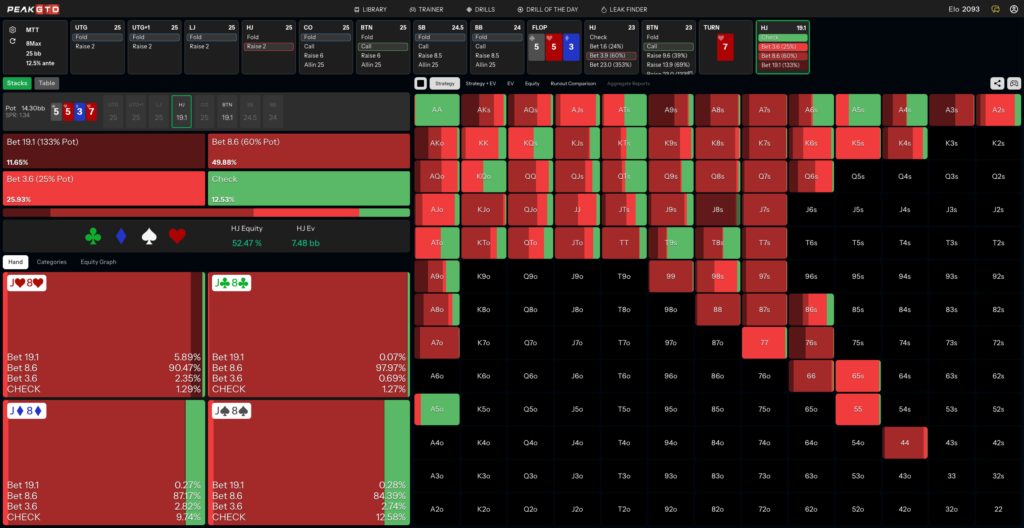
The 7♥ looks like a blank, but it is a sneakily good card for the out-of-position player. It does two things. First, Hero keeps the overpair advantage carried over from the flop. Second, the seven now pairs part of Hero’s range, adding hands like Q7s, T7s, 97s, and K7s to the value side. Those new sevens are exactly the kind of combos a balanced barreling range wants, because they let Hero keep firing for thin value while the bluffs ride alongside them. With more value available and the range advantage intact, Hero can keep barreling at a very high rate. The solver bets 87.5% of its range on this turn and checks only 12.5%.
The reason a low card is so aggressive here is counterintuitive. A scary overcard like an ace would actually be worse for Hero, because the button floated so many ace-high hands on the flop. An ace on the turn improves the caller and slows Hero down. A low card does the opposite. It misses the button’s float range entirely and lets Hero attack it. PeakGTO shows that the button now has to defend AQ, AJ, and AT, pure-call hands like A6s and A4s, and continue with flush draws such as K♥9♥ and Q♥J♥. That is a difficult, stretched defense.
Hero bets 8.6bb, again about 60% of the pot. J♣8♣ barrels almost every time, about 98%. The hand is still pure air, but it is air that fits the plan: it folds out the very ace-high and jack-high combinations Hero is targeting, and it keeps the pressure on a range that cannot comfortably continue. The button folds 38.5% of the time, calls 36.5%, and raises all-in 24.9%. Hero bets, and the button calls.
River: T♣
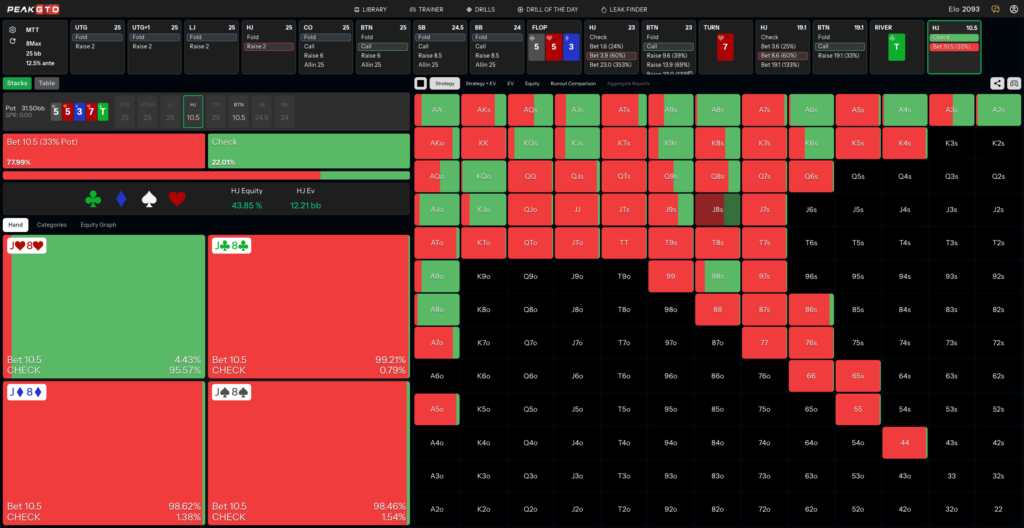
The T♣ is a blank that completes no obvious draw, and the situation sums up in two words: go time. The board reads 5♠5♥3♦7♥T♣, Hero still has jack-high, and the only stack left is a 10.5bb jam into a 31.5bb pot, around a third of the pot. That small third-pot sizing is correct precisely because the jam is polarized into strong value and pure air. A cheap price lets Hero get value bets called by the button’s bluff catchers while keeping the bluffs inexpensive when they are caught, and it puts the entire remaining stack in so there is no awkward bet left for later. The solver jams 78% of its entire range and checks 22%. The question is which exact hands should fire that jam, and this is where the suit of the bluff becomes the whole story.
There are two criteria for a river bluff. The first is simple: can betting fold out a better hand? The answer is clearly yes. J8 folds out ace-highs, king-highs, and the busted flush draws that picked up hearts on the turn. The second criterion is the one most players miss: does the bluff unblock the hands that fold? Holding no heart is extremely useful here. Hero wants the button to actually fold its busted heart flush draws, the K♥9♥ and Q♥J♥ combinations and the various jack-x and ace-x heart hands. A bluff that holds a heart removes those folding combos from the opponent’s range and makes the bet less effective.
This is why J♣8♣ is such a premium hand for bluffing. It blocks nothing the button wants to fold, so it jams the river 99.2% of the time. Contrast that with the same hand holding a heart. J♥8♥ checks 95.6% of the time, because it blocks the busted heart draws Hero is trying to fold out and it gives up rather than firing. The two hands are identical in rank and equity, yet one is a near-mandatory jam and the other is a near-mandatory check. The deciding factor is purely the unblocking effect.
On the other side of the bet, the button faces a genuinely uncomfortable decision. To stay balanced against a triple barrel, it has to call with every pocket four and pocket six, and it has to make hero calls with hands like AQ, AJ, A4, and even K♥9♥. The pot odds on a third-pot jam are tempting, so the solver only folds 28.5% of the time, but the bet is cheap relative to the dead money already in the middle, and against a real opponent who has not built a perfectly balanced defense, the fold-out rate is usually higher. That gap between solver discipline and human discipline is exactly the edge a relentless triple barrel is built to exploit, and it is a core idea in GTO bluff construction.
Key Takeaways
- Flop: A paired low board like 5♠5♥3♦ favors the out-of-position raiser, who keeps the overpair and overcard advantage. Hero c-bets 3.9bb, and J♣8♣ begins its bluff by targeting the ace-highs and jack-highs in the button’s wide float range.
- Turn: The 7♥ is a sneakily good card. It pairs part of Hero’s range and, crucially, misses the button’s many ace-high floats, making a low card more aggressive than an overcard would be. Hero barrels 8.6bb and bets 87.5% of the range.
- River: On the blank T♣, Hero jams 10.5bb. J♣8♣ jams 99.2% because it holds no heart and unblocks the busted flush draws that fold, while J♥8♥ checks 95.6% for the opposite reason.
- Overall: Attacking a wide, capped flat-calling range is about more than firing every street. The barrels work because the board favors the raiser and the bluffs are chosen by their blocker and unblocker effects. The same hand can be a clear jam or a clear give-up depending only on its suit.