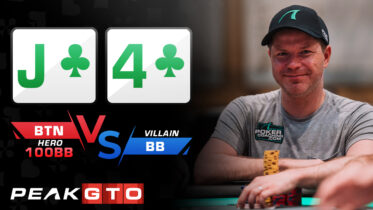
You raise JT on the button, the big blind calls, and the flop comes 9-8-2 with three different suits.
Congratulations, you just flopped an open-ended straight draw, since any queen or any seven makes your straight.
That’s a strong hand, but it’s still just a draw, and how you play it decides more than you think.
This guide covers what an open-ended straight draw is worth in Texas Hold’em, why some open-enders are much better than others, when to bet or raise them, when to just call, and the mistakes that cost players the most.

What Is an Open-Ended Straight Draw?
An open-ended straight draw (OESD) is four cards in a row that can become a straight at either end. Once you make it, a straight sits in the middle of the poker hand rankings.
With J-10 on 9-8-2, you need a queen (8-9-10-J-Q) or a seven (7-8-9-10-J). That’s two ranks, four cards each, so eight outs.
Compare that with a gutshot straight draw, which needs one rank in the middle and has only four outs. The open-ender hits about twice as often.
| Situation | Chance to make the straight |
|---|---|
| Flop, with the turn and river to come | about 31.5% |
| Flop, with just the turn to come | about 17% |
| Turn, with just the river to come | about 17.4% |
For a quick estimate at the table, use the rule of 4 and 2. Eight outs times 4 is 32% on the flop, and eight times 2 is 16% on the turn. Close enough.
A double gutshot, like J-9 on K-10-7, also has eight outs (any 8 or any queen). It looks weaker, but it plays like an open-ender, so treat it as one.
Not All Open-Ended Straight Draws Are Equal
Eight outs is the starting point. What you actually win depends on which straight you make, whether your outs are clean, and what else your hand has going for it.
Top End vs Bottom End
On 9-8-2, J-10 is drawing to the high end. A queen gives you the nut straight, and a seven gives you a straight that’s almost always good.
Seven-six on the same board is drawing to the low end. A five is fine, but a ten is dangerous, because queen-jack also makes a bigger straight with that card. Straights are ranked by their top card, as our guide to the straight in poker explains. Low-end draws hit the same eight outs but lose more big pots when they get there.
Overcards Add Real Equity
Your draw isn’t only eight outs if your cards are higher than the board. Here’s how a few hands do on 9-8-2 rainbow if the money goes in on the flop.
| Your hand | Against | Your equity |
|---|---|---|
| J-10 (open-ender plus two overcards) | A-9 (top pair) | about 50% |
| 7-6 (open-ender, no overcards) | A-9 | about 34% |
| J-10 | Q-Q (overpair) | about 24% |
| J-10 | 9-9 (a set) | about 26% |
Against top pair, J-10 is a coin flip, because a jack or a ten also beats a pair of nines. Against an overpair or a set, the overcards don’t help and you’re a big underdog.
Dirty Outs
Some of your outs can make your straight and still lose. On a two-tone board, two of your eight outs also complete a flush draw. On a paired board, your straight can lose to a full house.
When either is true, count fewer outs. On a two-tone board, think of your eight outs as six good ones and two risky ones.
When to Bet or Raise an Open-Ended Straight Draw
When you bet or raise a draw, you win two ways. Your opponent folds now, or you hit later. That’s fold equity plus your equity, and it’s why open-enders are often better played aggressively than passively.
As the Preflop Raiser, Usually Bet
With J-10 on 9-8-2 after the big blind checks, betting is right most of the time. Your continuation bets include strong hands too, your opponent has plenty of weak pairs and overcards that fold, and when the straight comes you get paid.
Bet a bit bigger on connected boards like this one, because your opponent has more draws and pairs that will continue anyway.
Raise More Against Small Bets and From Out of Position
The rules for raising draws are the same ones that work for flush draws. Raise more when you face a small bet, because small bets come from wide ranges full of medium hands that don’t like a raise. Raise more out of position, because calling and checking out of position makes it hard to win the pot when you miss.
From the big blind, check-raising your open-enders some of the time also protects the rest of your hands. If you only ever check-raise sets, observant opponents fold to every raise.
Don’t Raise a Draw You’d Have to Fold to a Shove
This is the rule that saves the most money with straight draws.
Say you’re 100 big blinds deep, you call a 3-bet with 5-4 of hearts, and the flop comes 10-3-2 with two spades. You have an open-ender, and the 3-bettor makes a continuation bet. If you raise, your opponent can simply shove with every overpair and set. Now you need about 32% equity to call, and against that range you have about 30%. You’ve turned a good drawing hand into a fold.
Just calling keeps you in the hand, gives you great pot odds, and lets you win a big pot when the straight comes on the turn or river. I’ve seen players make this raise, get lucky once, and then keep doing it forever. That habit costs a lot of money.
The draws that want to raise in spots like this are the ones that can happily call a shove, like king-queen of spades with a flush draw and overcards (about 38% even against aces), or weak ones you can fold without regret, like 6-5 without a backdoor flush draw.
When to Just Call With Your Straight Draw
When the Price Is Right on the Turn
On the turn you have one card to come and about a 17% chance to hit. Facing a half-pot bet, you need about 25% equity to call on pot odds alone. A bare open-ender doesn’t have it.
You can still call when you expect to win more when you hit. Against an opponent who pays off big on the river, a well-hidden straight is worth a lot. Against a tight player who checks and folds the moment four cards to a straight hit the board, it isn’t.
When You’re Multiway With a Non-Nut Draw
In a three-way pot, a mediocre open-ender is usually a check and call, not a bet or a raise. With two opponents, it’s much more likely one of them has a strong hand, and a raise mostly gets called or shoved on by hands that beat you.
This matters even more when your draw isn’t to the nuts. If you check-call and make a non-nut straight, then face big bets on every street, slow down.
A player who bets the flop, turn, and river after your straight comes in often has a bigger one, and with a short stack left, keeping those chips can be worth more than a thin raise.
Common Open-Ended Straight Draw Mistakes
These leaks show up most often.
- Raising draws that have to fold to a shove. Shallow stacks and 3-bet pots make this especially costly.
- Chasing on the turn without the price. Seventeen percent needs good pot odds or real implied odds.
- Ignoring which end you’re on. A low-end draw on a connected board can make a straight and lose to a bigger one.
- Counting dirty outs as clean. On a two-tone board, two of your outs may give someone a flush.
- Paying off a big river bet with a non-nut straight. Check the board for bigger straights, flushes, and full houses before you call it off.
Conclusion
The biggest win with open-ended straight draws comes from one habit. Before you raise, ask what you’ll do if your opponent shoves. If you’d have to fold, just call.
Beyond that, bet your draws as the preflop raiser, raise more against small bets and from out of position, and call more multiway and on the turn only with the right price.
An open-ender is a strong hand, not a hope. Once you see it as a specific amount of equity, the bet, raise, or call decision gets much easier.