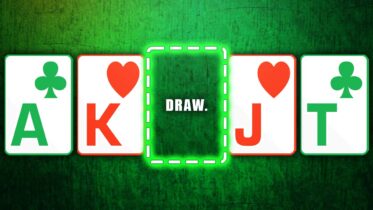

A gutshot straight draw in poker is an inside straight draw that needs one specific card rank to complete, giving you exactly four outs and roughly 8.5% equity on the flop.
Despite being weaker than open-ended straight draws, gutshots are poker hands that come up constantly in both tournaments and cash games, and knowing how to play them correctly is essential for any serious player.
In my experience reviewing thousands of student hands, gutshots are misplayed more often than almost any other draw type, with players either chasing too aggressively or folding in spots where a semi-bluff would win the pot at high frequency.
- What Is a Gutshot Straight Draw in Poker?
- The Math Behind Gutshot Straight Draws
- Good vs. Bad Gutshot Straight Draws
- Dirty Outs: When Your Gutshot Outs Aren't Clean
- Double Gutshot Straight Draws
- Playing Gutshots in Multiway Pots
- Playing Gutshot Straight Draws with Initiative
- Playing Gutshot Straight Draws as the Defender
- Play Your Gutshots to Perfection
- Frequently Asked Questions About Gutshot Straight Draws
What Is a Gutshot Straight Draw in Poker?
A gutshot straight draw is one of the most common draws you will encounter in Texas Hold’em, and understanding it is a foundational step for any player building a solid strategy. Here is a quick breakdown of what it looks like in practice.
In essence, anytime you have a hand that needs one particular card rank to come to complete your straight, you have a gutshot straight draw.
For example, on a board of Ks3d4c, holding 6s7s gives you a guthost straight draw, as any 5 on the turn or river makes you a straight.
Similarly, on a board of QcJdTs, holding Ah7h gives you a gutshot straight draw, as hitting any King would make you a straight.
This kind of draw is much weaker than an open-ended straight draw that can be completed on both ends, such as holding 6s5s on the Ks3d4c board, where any 2 or 7 would complete the straight.
Yet, you will find yourself holding nothing but a gutshot straight draw on quite a few boards, so it is essential to understand the math and make the best of these hands.
The Math Behind Gutshot Straight Draws
Before making any decision with a gutshot straight draw, you need to understand the math. The numbers are not in your favor in isolation, but that is not the whole picture.
Then add the following immediately after the paragraph that ends “…some of our straight outs may not be clean, as they could make our opponents a flush.”:
I always ask students this when reviewing hands with gutshots: before you call or raise, identify how many of your four outs are actually clean. On a two-tone board, you might only have two or three clean outs if one of the completing cards also makes a flush for your opponent.
Treating a gutshot as if it has 8.5% equity when it really has 4% because of dirty outs is one of the most expensive calculation errors in poker.

According to the Texas Hold’em Odds calculator, holding 7h6h against AdAs on a board of Kc4d3s, we have 18.69% equity.
The majority of this equity comes from the chance to hit a 5 on the turn or river, but some of it also comes from the off-chance of making two pairs or trips by the river.
To make things simpler, we can use the rule of 4 and 2, which tells us to multiply our number of outs by 4 on the flop or by 2 on the turn to calculate our equity.
When holding a gutshot straight draw against a made hand like a pair or two pairs, we will have exactly four outs, which means we will have about 16% equity on the flop and 8% equity on the turn.
Of course, any additional options we may have, such as runner-runner trips, two pairs, or flush, may give us additional equity.
On the flip side, if we have a gutshot straight draw on a board with two or three cards of the same suit, some of our straight outs may not be clean, as they could make our opponents a flush.
For that reason, it is important to be careful when trying to calculate your equity with a gutshot straight draw and mainly only consider the outs that give you a clean straight.
Good vs. Bad Gutshot Straight Draws
A gutshot straight draw is technically any straight draw that can be completed by a single card rank in the deck, but not all gutshots are created equal.
Here are five specific scenarios that illustrate the full range of gutshot quality. The difference between the best and worst of these is enormous, and treating them the same is a costly mistake.
Then add the following immediately after the paragraph that ends “…and you should not value the fact you have a gutshot much when a scenario like this arises.”:
Here is the key principle I teach: a gutshot draw is only as valuable as its nut potential and its added equity. Scenario 1 has two overcards and a backdoor flush draw. Scenario 5 has nothing. These are not two versions of the same hand. Make sure you evaluate the whole picture before you decide whether to bet, call, or fold.
- Scenario 1: Ts9s on a 7s6h2d flop
- Scenario 2: Ah5h on a KhJsTs flop
- Scenario 3: 4s3s on a Qs7c6h flop
- Scenario 4: 6c5d on a Kc9s8s flop
- Scenario 5: 9h8h on a KdQdJs flop

We start with scenario 1, which is one of the best possible gutshot straight draw scenarios. We have two overcards to the board, a backdoor flush draw, and a chance to make the nuts with any 8.
A gutshot straight draw like this gives you many options depending on the exact scenario, from calling bets to using the hand as a great bluffing candidate.
In scenario 2, we also have a gutshot to the nuts, but one that will often end up in a split pot if a Q does hit and a lot of money gets into the pot.
Still, we also have a backdoor flush draw and blockers to the nuts, which makes this hand a great one to bluff with and get our opponents to fold a wide poker range like JX, TX, and even KX on some runouts.
Scenario 3 gives us a much weaker gutshot straight draw. The 5 gives us a straight, but not the nuts, and we have a backdoor draw to a very weak flush.
This kind of a gutshot straight draw is often a good candidate for a fold to even a single bet, as it is not a hand you want to get too involved with.
The fourth scenario gives us a similar example of a hand that can only make the bottom end of a straight with one card but can’t even make a backdoor flush.
With two undercards and little hope of making anything good but a straight, this hand makes for an even easier fold in many situations and is not a great bluffing candidate.
Finally, the last gutshot scenario gives us two undercards with a gutshot to a straight that will often not be good, as any Ace will beat us if we do hit the Ten.
This kind of a gutshot straight draw is the least worth pursuing, and you should not value the fact you have a gutshot much when a scenario like this arises.
Dirty Outs: When Your Gutshot Outs Aren’t Clean
One of the most important concepts when playing gutshot straight draws is understanding dirty outs, which are completing cards that make your straight but simultaneously give your opponent a better hand.
The most common dirty out scenario involves two-tone or three-tone boards. If the board shows two hearts and your gutshot completes on the four of hearts, you have made your straight, but your opponent now has a potential flush if they are on a heart draw. In this case, the four of hearts is a dirty out because it does not guarantee you have the best hand even when you improve.
There are three main categories of dirty outs with gutshot draws:
- Flush-completing outs. Any card of the board’s dominant suit that completes your straight also completes a flush draw for an opponent holding two cards of that suit. On a two-tone board, at least one of your four gutshot outs may be dirty.
- Pair-the-board outs. If the completing card pairs a card already on the board, your opponent may have made a full house. This is most dangerous when your opponent has shown significant strength and the board is dry before the potential pairing card hits.
- Straight-over-straight outs. If you are drawing to a non-nut straight, the completing card may give your opponent a higher straight. This is covered in the Good vs. Bad section above, but it also falls into the dirty out category.
In my experience, the practical adjustment is simple: when playing a gutshot on a two-tone board, mentally subtract one out from your total and calculate equity as if you have three outs rather than four. This gives you a more conservative and more accurate estimate of your true equity in the hand.
Double Gutshot Straight Draws
A double gutshot straight draw, also called a double-belly buster, is a hand that can complete a straight with one of two different ranks, but only one specific card from each rank works. The result is a draw that looks like a gutshot but actually has eight outs, the same as an open-ended straight draw.
Here is an example: you hold Tc8c on a board of Kd9s7h. A jack makes you a straight (T-J-K… wait, let me think again. T-9-8-7-K. You hold T8, board has K97. A J gives T-9-8-7-J… no. T-9-8-7-6 = need 6, and J-T-9-8-7 = need J. Yes, you need either a J (J-T-9-8-7) or a 6 (T-9-8-7-6) to complete a straight. Both are gutshots individually, but together they give you eight outs.
The key strategic point with double gutshots is recognizing them correctly before acting. Because the draw looks like two separate gutshots, many players underestimate how strong it is. With eight outs on the flop, you have approximately 31% equity to make your straight by the river, which is near flush draw territory. This changes the math significantly.
When you hold a double gutshot, the correct strategic adjustment is to treat it much like an open-ended straight draw: it is a strong semi-bluffing hand from the initiative position, and it is often worth raising as a semi-bluff from the defending position as well, because your equity and fold equity combine to make the play highly profitable.
Playing Gutshots in Multiway Pots
Multiway pots require a fundamentally different approach to gutshot draws than heads-up pots. The raw pot odds may look better in multiway pots because there is more money to win, but the implied probability of getting through multiple players is significantly lower.
In a heads-up pot, a well-timed semi-bluff with a gutshot wins the pot outright a meaningful percentage of the time. In a three-way or four-way pot, that same bet now needs to fold two or three players, which is far less likely. The fold equity component of your gutshot’s value drops dramatically.
My general rule is this: in multiway pots, play gutshot straight draws primarily as calling hands rather than raising hands, and only when you have significant added equity from overcards, backdoor draws, or when you are drawing to the nuts. A naked gutshot to a non-nut straight in a multiway pot is almost always a fold against any serious bet.
The one exception is when you are the preflop aggressor and the flop checks around in a multiway pot. In that case, a bet with a gutshot as a continuation bet can still work, particularly on boards where your button range has a significant advantage. But even then, keep your bet small and be prepared to abandon the hand against a check-raise.
Playing Gutshot Straight Draws with Initiative
Generally speaking, you will make a gutshot straight draw either as the last preflop aggressor or as one of the defenders against the aggression.
When you make a raise or a 3-bet and go to a flop that gives you a gutshot, you have the initiative and can play your gutshot as a part of your overall betting strategy.
For example, imagine holding Th9h on the button in a $2/5 cash game. You raise it up to $15, and the player in the big blind makes the call.
With $32 in the pot, the flop comes Kd 7h 6s.
Your opponent checks to you. You have a gutshot to any 8, a backdoor flush draw, and most importantly, you have the initiative.
On a board like this, you can represent all the strongest hands, such as AA, KK, AK, 77, and 77, as well as K7s, K6s, and 76s, all of which you would have opened from the button.
Your opponent, on the other hand, can also have quite a few of these hands, but not AA, KK, or AK, as he did not re-raise your late position raise.
The board does hit your opponent’s defending range reasonably often, but many of the hands they make here are second pair, third pair, or a straight draw.
For that reason, you can start applying the pressure and fire out a $20 bet on this flop, with the intention of firing further barrels on later streets.
Your opponent calls, and you go to the turn card of 2d.
Your hand does not improve to a flush draw, but you still have the straight draw and can still have all the best hands on this board.
Your opponent checks once again, and this time, you fire $55 into the $72 pot. What can your opponent realistically do with a hand like 87, 86, 55, and many other hands in their range that only have a straight draw?
In most cases, this second barrel will work and get your opponent to fold everything but a King. If not, you may be able to continue telling your story on many rivers and even get players to fold a hand like KT.
What I find in hand history reviews is that players either fire the flop and give up on the turn, or never fire at all. Both are mistakes. The real value of a gutshot with initiative is that you can build a multi-street story that forces your opponent to fold hands with better raw equity than yours.
The flop bet sets it up. The turn bet closes the deal in most cases. If you are not thinking about all three streets before you fire the flop, you are not playing the draw correctly.
Playing Gutshot Straight Draws as the Defender
On the flip side of the scenario, you will often find yourself as the defender holding a gutshot straight draw, and you will often be out of position when you do.
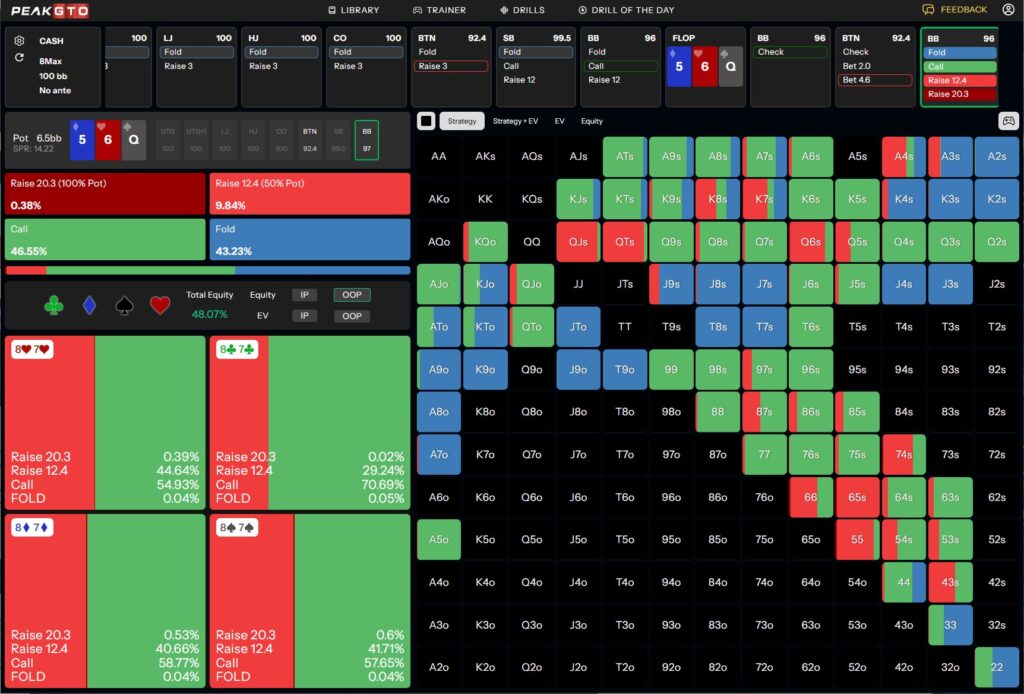
For example, imagine the same scenario from the last hand. This time, you are in the big blind, and the player on the button raises to $15, and you defend with 8s7s.
The board comes 5d6hQs, and you check to your opponent.
The player now fires a small bet of $10 into the $32 pot, which they would likely do with both their strong hands and many draws in their range.
You have enough equity and implied odds to make the call with your gutshot straight draw here, but this is also a great spot that a GTO poker strategy loves to start raising.
Try PeakGTO for FREE and up your game!
Your gutshot is not very likely to come in on the turn, and you will likely face further bets if you check the turn when you miss.
On the other hand, your opponent may very well have nothing more than an A or K-high and will be in a tough spot facing a raise on this board.
Hands like Q6, Q5, and 56 make a bigger portion of your range than they do of theirs, which means you can start repping those hands right here on the flop.
Putting in a raise to $45 on this flop will win you the pot more often than not, and even when it does not it will give you the initiative and a chance to steal the pot on later streets.
Every once in a while, you will face a 3-bet on this flop, and you will have a very easy fold, as your hand has very little actual equity against such a play.
From the defender position, I look for one key condition before raising with a gutshot: do I have a credible range on this board? In the hand example above, 8s7s on a 5d6hQs board gives me a range that legitimately includes sets, two pairs, and straights. My raise looks real.
On a board like KdQc5h holding 8s7s, I have no credible range and my raise will get called by top pair more often than it will fold it out. Choose your gutshot semi-bluff raises based on whether the board texture supports your range, not just based on the draw itself.
Play Your Gutshots to Perfection
Gutshots are one of those hand types that look simple but have enormous strategic depth in Texas Hold’em once you move past the basic definition.
The difference between a profitable and unprofitable gutshot player comes down to three things: knowing which draws are genuinely worth playing, knowing when to bluff versus when to call, and knowing how to adjust for board texture and position.
My recommendation for improving your gutshot play is to study them specifically, not just as part of a general draw strategy. Pull up hands where you had a gutshot from both positions and review each decision against the range your opponent most likely held.
Ask yourself whether you had a credible range on that board, whether your outs were clean, and whether you had added equity that justified the action you took.
If you want to study gutshot spots in depth with solver precision, PokerCoaching’s own solver tool, PeakGTO, will show you exactly how GTO strategy handles gutshot draws across different board textures, positions, and stack depths.
This kind of study will sharpen your intuition faster than playing through the same situations without reviewing the theory behind them.