
Heads-up poker is a two-player format where every hand carries more strategic weight than in any other form of the game, requiring wider ranges, constant aggression, and rapid adjustment to a single opponent.
Unlike full-ring tournament play, there is no escaping action: you pay a blind every hand and face that same opponent across every decision point. In my experience coaching players at all levels, heads-up is where strategic understanding and psychological edge are tested most directly.
The players who thrive here are not the ones who simply play more hands. They are the ones who adjust faster, read tendencies earlier, and maintain their game plan when things go wrong, in both cash game and tournament scenarios.
- Tip #1. Play Aggressively from the Button
- Tip #2. Defend Your Big Blind a Lot
- Tip #3. Think In Terms of Hand Ranges
- Tip #4. Balance Out Your Ranges
- Tip #5. Don’t Be Afraid to Bluff
- Tip #6. Adapt to Your Opponent
- Tip #7. Stay Consistent
- How to Read Your Opponent and Catch Their Bluffs
- The Mental Game of Heads-Up Poker
- How to Improve Your Heads-Up Poker Fast
- Frequently Asked Questions About Heads-Up Poker
Tip #1. Play Aggressively from the Button
One of the key things you need to understand is that position is very important in a heads-up, and having the button means more than it does in any other form of poker.
With only one other player in the game, there is no chance of hands going multi-way. Having the button means you will be in position against a single opponent every time.
When playing from the button, you will want to start by raising a huge number of hands. When I say huge, I don’t mean 50%, but rather 85% or event almost 100% of all hands you are dealt in some cases.
The exact poker range you should be opening with depends on your opponent. Against an average opponent who does not defend enough, you can easily get away with making a small raise with any two cards.
If your opponent folds too often, you will be picking up so much dead money that nothing else will even matter. You will simply dominate your opponent. If your opponent starts responding to your raises appropriately, you will still have an advantage on the button, but your opponent’s responses will somewhat reduce it.
Regardless of who you are playing and what their style may be, raising at least 80% of all hands from the button in a heads-up match is a must.
I typically open somewhere between 80% and 100% of button hands in heads-up, and the exact number depends entirely on how my opponent responds. If they fold more than roughly half of their big blinds, I will raise close to every hand. If they start 3-betting frequently, I tighten slightly and shift toward a more polarized raising range.
A good default open size is 2.5x the big blind. Against opponents who fold a lot, I drop to 2x. Against opponents who call frequently and play well post-flop, I widen my sizing to reduce their calling frequency. The size of your open and your raising frequency are two levers you should always be adjusting independently.
Tip #2. Defend Your Big Blind a Lot
In 50% of all your heads-up hands, you will be in the big blind and have cards that don’t seem that appealing.

If you are transitioning from the full-ring on six-max games, you will probably look at hands like J7 or Q5 and want to automatically fold to a raise, but you can’t actually do that in heads-up games.
If you play fewer than 70% of your big blind hands facing a min-raise, your opponent will be able to raise every button and print money from your folds.
Your exact defending range against a button open in a heads-up game should depend on the raise size, as you will want to defend more hands facing min raises and fewer hands facing a big raise, such as 3x the big blind.
Against all reasonable raise sizes, you will want to continue with all suited hands, while your off-suit hand selection will depend on the sizing.
However, remember that you can’t play all your hands as calls either, as you will want to include some hands in your 3-betting range to balance for the times you want to 3-bet with strong hands like big pocket pairs or AK.
Typically speaking, most professional poker players defend upwards of 75% of their big blinds in heads-up games, and that’s a great place to start.
What I tell students who are new to heads-up is this: if you are folding more than 25% of your big blinds, you are giving your opponent free money every orbit. The bigger mistake, though, is not calling too wide. It is failing to include enough 3-bets in your defending range.
You cannot just call every hand from the big blind or your opponent can simply raise every button and see easy flops in position. Against a wide button opener, I mix in 3-bets with my strongest hands and with some bluff candidates like suited connectors and low pocket pairs.
Against a tighter opener, I shift toward a merged range of strong and semi-strong hands. Matching your 3-bet strategy to your opponent’s opening range is what separates good big blind defense from passive defending.
Tip #3. Think In Terms of Hand Ranges
Even in a full-ring game, it is nearly impossible to identify your opponent’s exact hand despite starting hand ranges being narrower.
In a heads-up game, where most players enter pots with nearly their entire range, trying to figure out the exact two cards a player has would be a nightmare.
What you can do, instead, is narrow down their hand range with every play they make, potentially bringing it to a few likely combinations by the river.
If you think about hand ranges correctly, you will always be able to assume which value hands and which bluffs your opponent can have in a given spot.
Based on board texture, the actions your opponent takes, and the cards you are holding, you will be able to construct strategies that work well against your opponent’s particular hand range.
In my hand history reviews, the most common mistake I see in heads-up games is players reacting to the specific cards in front of them rather than the range their opponent most likely holds.
When I coach this concept, I ask students to assign a range before the flop based on position and sizing, then update it every street based on the action. By the river, you should be able to narrow your opponent to a small group of likely combinations and make a decision that beats the majority of their range, not just the specific hand you are most afraid of.
Players who think in ranges make far fewer exploitable mistakes than players who react hand by hand.
Tip #4. Balance Out Your Ranges
In an ideal world, you could make big bets when you have the goods and get paid off while giving up when you don’t and getting away from it cheap.

In reality, however, you will have to make big bets with both your made hands and bluffs from time to time if you want to have any chance of getting called when you have a monster or get a fold when you don’t.
Heads-up poker, in particular, requires the art of range balancing as long as you are playing against opponents who are at all capable of playing the game.
In most heads-up poker hands, neither you nor your opponent will make much of a hand, so it will come down to who plays their hands more aggressively and in line with the board texture and their perceived range.
Whether you are playing as the aggressor or the defender, you will always want to include some value hands and some bluffs in your range at each decision point in a hand.
Here is what I find most effective when teaching balance to intermediate players: think of it as a ratio, not a rule. On the flop, a reasonable bluff-to-value ratio is roughly 2:1 in many spots.
On the river, it tightens considerably, often closer to 1:1 or even tighter, because the pot is large and your bluffs need to be genuinely credible. If you bluff too often on the river in heads-up games, even recreational opponents will start calling you down. Real balance is not random. It is mathematical.
If you want to study your specific spots in detail, PokerCoaching’s own solver tool, PeakGTO, will show you exactly what a balanced strategy looks like on any board texture you face regularly.
Tip #5. Don’t Be Afraid to Bluff
The scariest thing about heads-up poker is the fact you have to bluff a lot. Playing a lot of hands means you will end up seeing many boards on which you have absolutely no connection.
Don’t let the lack of direct connection with the board deter you from bluffing, as it is equally as likely that your opponent has nothing as well.
While in ring games, you may look for hands like flush draws and straight draws to start bluffing, in heads-up games, backdoor draws, and overcards will become prime bluffing candidates.
One thing you must consider before you start bluffing is that you will have to fire multiple bullets to win a pot in many cases.
So, before you raise the flop with your backdoor draw, decide which cards you will continue barreling on the turn and how likely your opponent is to fold to further aggression on later streets.
The specific bluffing hands I gravitate toward in heads-up are backdoor flush draws with an overcard, gutshot straight draws, and hands that pick up a draw on the turn after a flop call.
These hands give you two ways to win: they can make a real hand, and they carry enough equity that you are not in terrible shape when called. In my experience, most players bluff too wide on the flop and not enough on the turn and river where the real money is won.
Pick your spots carefully, but once you commit to a bluff plan on the flop, follow through on the turn with a clear read of which river cards you will continue on.
Tip #6. Adapt to Your Opponent
At the highest levels, all heads-up poker players try to mimic the solvers and play some version of GTO poker. At the lower levels, however, you will come across many players who play a poker strategy that deviates from GTO quite a bit.
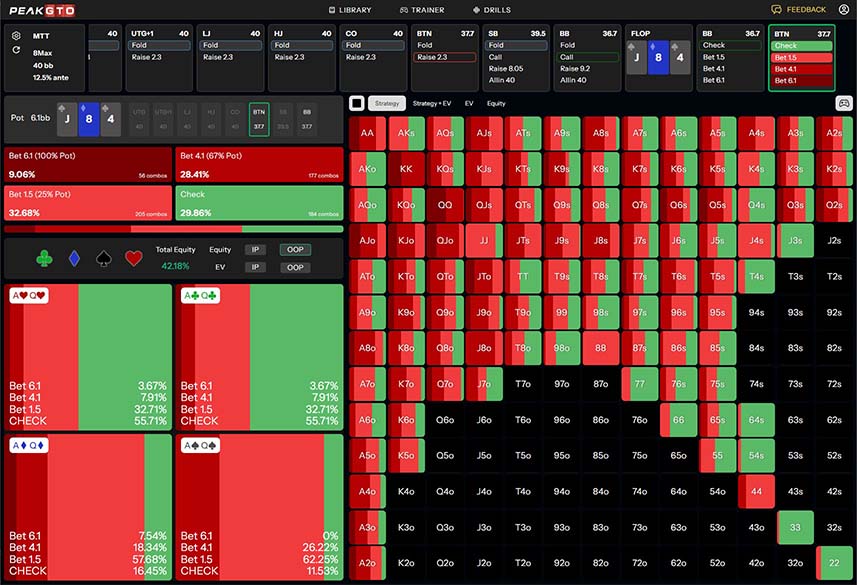
Try PeakGTO for FREE and up your game!
In such situations, you should be able to make many exploitative plays that will use the information you collect on your opponent to your advantage.
Playing exploitative poker is the way to go as long as you are not playing the very best heads-up players in the world, as most other players tend to make terrible mistakes.
If your opponent tends to bluff too much on turns and rivers, expand your call-down ranges. If your opponent tends to give up too much, steal more pots on later streets.
Most players tend to go one way or the other when playing heads-up, and very few remain consistently balanced across different betting streets and board textures.
Adapting to each particular opponent as quickly as possible could help you win a lot of money as long as you are not abandoning the fundamentals for the sake of playing exploitatively.
I try to identify my opponent’s biggest leak within the first 20 to 30 hands. The two most common patterns I see in students I coach are: opponents who fold too often to three streets of aggression, and opponents who call too liberally and never fold a pair.
Against the first type, I dramatically increase my bluffing frequency across all three streets. Against the second type, I tighten my bluff range almost entirely and let my value hands do the work. Adjusting your exploit quickly is worth far more than grinding out a technically perfect GTO strategy against a player who has an obvious hole in their game.
Tip #7. Stay Consistent
One thing you will often see players do in heads up games is they will change their game too often based on how the match is going, abandoning the very basic principles of their poker strategy.
This is a terrible idea, as a sound baseline strategy is key to any adaptations you want to make, and your entire game plan can fall apart without it.
What I mean by staying consistent goes especially for your preflop ranges, which should be more or less set in stone, as well as your checking and betting frequencies on each betting street.
Instead of playing your exact hand, play your hand range and the board texture instead, and you will become unpredictable enough that most players won’t be able to beat you.
In fact, once you learn how to play good heads up poker, most players won’t have the slightest idea where you are at in hands and won’t be able to successfully counter you in the slightest.
How to Read Your Opponent and Catch Their Bluffs
Most heads-up strategy content focuses on aggression and attack. What is equally important, and often more profitable against aggressive opponents, is knowing when to defend and catch bluffs.
In heads-up poker, your opponent bluffs at a far higher frequency than in full-ring games because ranges are wider and the pressure to win pots is constant. Learning to recognize over-bluffing patterns gives you a significant edge.
The most reliable timing tell I look for is bet speed on the river. Players who fire large bets quickly on all three streets are often running a mechanical bluff rather than making a genuine sizing decision. Players who pause before a river bet often have a hand they are thinking about how to extract value from. This is not a universal rule, but it is a pattern that shows up at every stake.
Here are the key defensive adjustments I make when catching bluffs in heads-up games:
- Widen your call range on paired boards. Opponents who barrel all three streets on boards that pair on the turn or river often do so with air, because the paired board improves their perceived value range without helping their actual holdings.
- Check your top pairs more often on drawy boards. If you always bet top pair on three streets, aggressive opponents can float and bluff you off your hand on scare cards. Mixing in checks with strong hands on drawy textures forces opponents to check back mediocre hands rather than bluffing through you.
- Use pot-sized river bets strategically. When an opponent fires a large bet on the river after checking the turn, their range is often polarized to the nuts or a bluff. Wide calls with mid-strength hands that block the nut bluffs are frequently correct in heads-up spots.
The Mental Game of Heads-Up Poker
Heads-up poker is the most psychologically demanding format in the game. You are not waiting for good cards and picking spots. You are in a constant, direct battle against a single opponent who is adapting to you the same way you are adapting to them.
The most important mental adjustment I coach is learning to separate short-term results from decision quality. In a heads-up match, you will run bad. Your opponent will hit cards. You will play a hand correctly and still lose a large pot. If you adjust your strategy based on those outcomes rather than their underlying logic, you will start making errors that compound over time.

The specific pattern I see most often in losing heads-up players is what I call frustration loosening. After three or four successive losses, players start calling down wider, bluffing more frequently, and defending every big blind out of ego rather than strategy.
This is exactly when a disciplined opponent takes control. Stick to your preflop ranges and your approved bluffing spots, especially when you are running cold.
One final note on session length: take breaks during long heads-up sessions. Mental fatigue in heads-up poker is real and measurable. I play far worse in the third and fourth hour of a tough match than in the first.
If you notice your decision times getting shorter and your adjustments becoming less precise, step away for ten minutes. Your win rate in the second half of a session depends on staying sharp.
How to Improve Your Heads-Up Poker Fast
Heads-up poker rewards players who study systematically, not those who simply log more hands. The fastest way to improve is to find the specific leaks in your game and target them directly.
I recommend starting with your preflop frequencies. Most players do not know their actual button open percentage or how often they fold the big blind. These are easy to track and easy to improve, and fixing them alone will change your win rate significantly. Once your preflop play is solid, focus on identifying your current opponent’s tendencies and building a specific exploit around their most obvious weakness.
If you are studying with a solver, PokerCoaching’s own tool, PeakGTO, is the recommended starting point for heads-up range work. It will show you exactly how your betting frequencies should shift across different board textures and opponent types.
The players who improve fastest are those who review sessions rather than just playing them. Even five to ten hands reviewed per week, with one focused question per session, will accelerate your improvement more than hundreds of hours of untargeted play.