


Poker cash game strategy differs from tournament strategy because every chip has a direct cash value, you can buy in and leave whenever you like, and the blinds never go up. There’s also a rake taken out of most pots, which quietly changes which hands you can play.
That means hand selection, position, and discipline drive your results far more than any single hero call or big bluff. You’re dealt in every hand, so a small preflop mistake repeated all night costs more than one misplayed river.
The ten tips below cover the adjustments that move players from break-even to consistently winning in deep-stack cash games. I’ve added the specifics most guides skip, including which hands to open from each seat, how big to raise, why the rake forces you to tighten up, and how to pick a game and a bankroll that give you a real edge.
What Is a Cash Game in Poker?
A cash game is a poker format where each chip has a direct monetary value, players can buy in for a set amount and leave whenever they choose, and there are no eliminations. Unlike tournaments, the blinds never increase, so stacks stay deep relative to the blinds throughout the session.
If you’re brand new to the format, start with the Texas Hold’em rules and come back. Everything below assumes you know how a hand is dealt and bet.
Three structural differences shape cash game strategy.
No Elimination Pressure
You can rebuy if you lose your stack, so you never need to fold your way to a payout. There’s no ICM and no bubble. Each hand stands alone, and cash games are really one long session, so whether you’re up or down on a given day doesn’t matter.
Deep Stacks
Most cash games play 100 big blinds deep or deeper. Deep stacks reward position and hands that can make the nuts, and they punish hands that make one weak pair. Knowing your hand rankings is only the starting point, because a hand’s value changes with the stack depth behind it.
No Ante, and Usually a Rake
This is the difference most players ignore. A tournament pot starts with an ante in it and nothing is taken out. A cash game pot usually has no ante, and in most rooms the house takes a share of it, often around 10% up to a cap.
Both make the pot you’re fighting for smaller, and a smaller pot means tighter ranges.
You can see the gap in our charts. In the 100 big blind cash chart, the button opens 40.3% of hands. In the 80 big blind tournament chart, the button opens 53.9%.
The rake pushes you tighter again, and it changes how you play more than which hands you open.
- Call raises less often, because seeing a flop is usually when you pay the rake
- Defend your blinds tighter than you would in a tournament
- Raise or fold when it’s folded to you, and never open limp
- From the small blind against a raise, re-raise or fold instead of calling
Before you sit down, work out your room’s rake cap in big blinds. A $6 cap is three big blinds at $1/$2 and barely more than one at $2/$5. A 10% rake capped at three big blinds is already difficult to beat, so the heavier it is, the tighter you play.
If your room charges time instead of raking each pot, or your game has an ante, you can play a little looser.
Cash Game Strategy Tip #1 – Think About Hand Ranges
When you first learned to play, someone probably told you to “put your opponent on a hand” before you act. In most cases that’s nearly impossible, which is why the term “hand range” exists.
A range is the group of hands a player is likely to hold based on their position, their actions, and how they play. A tight player raising under the gun has a strong range, mostly big pairs, A-K, A-Q, and some suited Broadway hands. A loose player raising first in from the button can have a very wide range.
Thinking in ranges isn’t more complicated than guessing a hand. It’s more accurate, because every check, bet, call, and raise narrows the range instead of contradicting a single read.
Play the Range They Actually Have
At small stakes, the real skill is noticing when someone’s range isn’t what it should be.
If a loose player raises from the hijack with half of all hands, stop treating them like they have a proper hijack range. Play against the range they really have.
Start by assuming an unknown player is roughly competent, then adjust when you’ve seen real evidence. The exploit follows the observation, not the other way around.

Cash Game Strategy Tip #2 – Always 3-Bet Your Monsters
A mistake many cash game players make is trapping too much with their strongest hands. Unless a player behind you has been re-raising constantly, you should 3-bet A-A, K-K, and A-K suited against a raise.
You want to build a big pot with these hands. And if you only ever call, you invite multi-way pots, where even aces are much harder to play.
The opposite leak is just as common. Players who only re-raise their very best hands never get paid, because everyone knows what a re-raise means.
So add some other hands, and choose them by opponent.
Against a player who can fold, add a few bluffs that have something going for them, such as low suited aces.
Against the typical live small stakes player, who opens too wide, calls 3-bets too often, and rarely 4-bets, drop the bluffs. Re-raise strong hands that dominate what they call with, like A-J, K-J suited, and pocket nines. When that passive player suddenly 4-bets, hands like K-Q and A-Q can fold.
For sizing, our 100 big blind cash charts 3-bet to 10 big blinds in position and 12 from the blinds against a 3 big blind open. That’s a little over 3 times the raise in position and 4 times out of position. Against a $10 open, make it about $33 to $35 on the button and about $40 from the blinds. You go bigger out of position because you gain more from fold equity when you’d otherwise have to act first on every street.
My full guide to 3-bet strategy covers range building, bluff selection, and what to do when you’re the one facing a 3-bet.
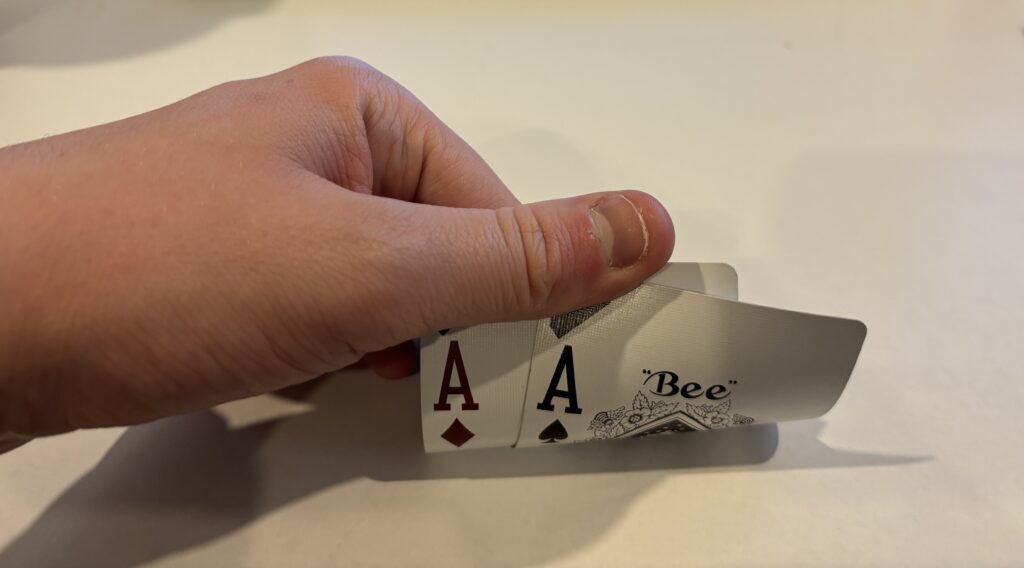
In cash games, it is almost always best to 3-bet with your best hands.
Cash Game Strategy Tip #3 – Be Mindful of Stack Sizes
Online poker makes tracking stacks easy. In a live cash game it takes focus, but you should always know the effective stack before you put the first chip in the pot.
If you don’t, you’ll make silly plays like setting up a river bluff against a player who is nearly all-in, or 3-bet bluffing a short stack that’s clearly committed.
Use Stack Sizes to Decide Which Hands Can Call
Small pairs and suited connectors make money by occasionally winning a big pot. They need room behind to do it, which is the whole idea behind implied odds.
The rule of thumb we teach is that you want to be able to win about 10 times what you’re calling with a pocket pair, and about 20 times with a suited connector. It’s a rough guide, not an exact threshold.
So if you’re calling $8 more with a small pair, you’d want a realistic chance to win around $80 after the flop. Facing a big raise with shallow stacks behind, just fold.
How Much to Buy In For
When you’re better than your opponents, buy in for enough to cover the weaker players, which is usually the table maximum.
You lose money to the players on your left. So if the weak players on your right are short and a strong player with a big stack sits on your left, buy in for just enough to cover the weak players.
Cash Game Strategy Tip #4 – Use Position to Your Advantage
Position matters in every form of poker, and it matters more as stacks get deeper. When you act last, you see what your opponent does first, you control the size of the pot, and you get to put in one more bet when you want to.
That’s why you play the most hands on the button and progressively fewer the worse your seat gets.
Raise or Fold When It’s Folded to You
When everyone folds to you, enter the pot with a raise and never a limp. Limping lets the big blind see a free flop and lets everyone else in for the minimum.
Raise to 2.5 or 3 big blinds. Our 100 big blind cash charts use 3. At $1/$2 that means opening to $5 or $6.
Many live games have a “standard” raise that’s much bigger. Don’t copy it just because the table does. If your table calls a slightly bigger raise with the same weak hands, go a little bigger. If they start folding, come back down.
Opening Ranges by Position
In plain terms, early position plays big and medium pairs, suited aces, the best suited Broadways, A-Q, and K-Q. The button plays about four hands in ten.
Here are the opening ranges from our 8-max, 100 big blind cash charts, for when everyone folds to you. The percentages are exact. The hand lists are simplified, because the hands at the edge of each range are only raised part of the time. Treat them as a baseline, and lean tighter in a heavily raked game.
| Position | Hands opened | Range |
|---|---|---|
| UTG | 11.4% | 77+, A3s+, K9s+, QTs+, JTs, T9s, AQo+, KQo |
| UTG+1 | 13.2% | 77+, A3s+, K8s+, QTs+, JTs, T9s, AJo+, KQo |
| Lojack | 15.7% | 66+, A2s+, K7s+, QTs+, JTs, T9s, ATo+, KJo+ |
| Hijack | 19.6% | 55+, A2s+, K5s+, Q9s+, J9s+, T8s+, 65s, ATo+, KTo+, QJo |
| Cutoff | 26.1% | 44+, A2s+, K4s+, Q8s+, J8s+, T8s+, 97s+, 87s, 76s, 65s, 54s, A8o+, KTo+, QTo+, JTo |
| Button | 40.3% | 22+, A2s+, K2s+, Q3s+, J5s+, T6s+, 96s+, 86s+, 75s+, 65s, 54s, A3o+, K9o+, Q9o+, J9o+, T9o |
In this notation “s” means suited, “o” means offsuit, and “+” means that hand and every better one of the same type.
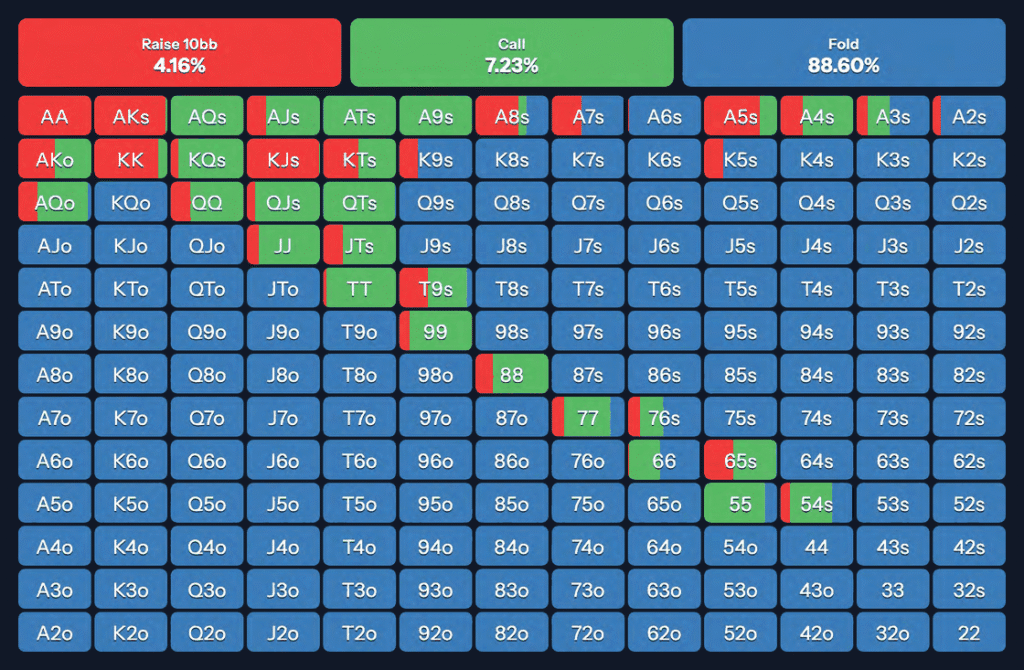
Red is a raise and blue is a fold. Same game, same stacks, and the button plays more than three times as many hands as under the gun. That’s how much position is worth.
Look at what isn’t there. Under the gun, most pairs below sevens, A-J offsuit, A-10 offsuit, and K-J offsuit all fold. Even on the button, hands like 9-8 offsuit and K-7 offsuit aren’t opens.
You can download the full set, including the 6-max ranges, from our free preflop charts page.
How to Adjust in a Soft Live Game
In most live games the players behind you call too much and 3-bet too little, so you get to see more flops.
That lets you open a little wider from early position. When I widen, I add hands that flop well, like smaller pairs, more suited aces, and suited connectors. I don’t add weak offsuit hands.
For the full reasoning, read my guide to preflop strategy for cash games.
Cash Game Strategy Tip #5 – Isolate Limpers a Lot
Good players don’t limp into pots in deep-stacked cash games, so when you see someone limping a lot, treat them as one of your main targets.
Weak players often limp with hands like 9-8 suited, small pairs, or even 7-6 offsuit, and then play them in a very straightforward way. They call your raise, miss the flop, and fold. You’ll even see them fold middle pair to a turn bet without much thought.
Isolating these players in position is one of the most reliable ways to win small pots over and over.
For sizing, a good live formula is three to four big blinds plus one more for every limper when you’re in late position, and bigger again when you’re out of position in the blinds. Raise strong hands that play well after the flop, not any two cards.
One warning. Most limpers raise their good hands and limp the rest, but a few limp big pairs hoping to re-raise. If a limper comes back over the top of your raise, believe them.
My colleague Lee Jones covers the full plan in his article on how to punish limpers.

Cash Game Strategy Tip #6 – Defend Your Big Blind Tighter Than in Tournaments
The big blind is an interesting seat. You’re at a positional disadvantage against everyone, but you get to see flops at a discount and you close the action.
If you’re coming from tournaments, this is where your habits will cost you the most. In a tournament you defend extremely wide because the raises are small, an ante sweetens the pot, and no rake comes out of it. In a cash game every one of those conditions flips against you.
So you still defend more hands from the big blind than you call with anywhere else. You just defend far fewer than you’re used to.
The hands that hold up best are pairs, suited aces, and suited connected cards. Weak offsuit hands are the ones that get you in trouble, because they make dominated pairs out of position.
Fold More as the Raise Gets Bigger
Live small stakes players often raise three to five times the big blind. Most opponents don’t punish it. They call with the same junk anyway and then play a weak range out of position in a bloated pot.
The fix is boring and very profitable. Hands on the edge against a three big blind raise, like weak suited connectors, offsuit Broadways, and bad suited kings, become clear folds against five.
For what to do after you call, see our guide to big blind strategy.
This adjustment is one of five in my article on beating small stakes cash games.
Cash Game Strategy Tip #7 – Know When to Control the Pot Size
Pot control is an essential part of a good poker strategy, because it lets you get to showdown with medium-strength hands without paying off better ones.
Say you hold 9♠8♠ on a K♣8♥7♦ flop in a single-raised pot. You opened the cutoff and the big blind called.
You could c-bet here, but checking second pair often makes sense. You have plenty of stronger hands to bet for value, like A-K, K-Q, and your sets, and plenty of natural bluffs, like J-10 suited and 6-5 suited.
So 9-8 suited is a great hand to check back, keep the pot small, and pick off bluffs on the turn and river in position.
A rule of thumb I use for one-pair hands at small stakes is to plan on two bets after the flop, not three. If you bet all three streets, most players have folded their worse pairs by the river, so the hands that call the last bet tend to beat a marginal top pair.

Although it may be hard, work to monitor the size of the pot when playing live poker.
Cash Game Strategy Tip #8 – Be Careful in Multi-way Pots
Multi-way pots are far more common in cash games than in tournaments, especially live. At lower stakes it’s normal to see four, five, or more players take a flop.
When that many players see a flop, someone usually has something. If it isn’t you, it’s probably someone else.
Overpairs and top pairs lose a lot of value here. Players flop top pair 100 big blinds deep, pile their stack in against several opponents who all want to play, and find out they were crushed.
A few rules keep you out of trouble.
- Out of position, check a lot, especially on low, connected boards that hit the callers’ ranges
- Don’t bluff with low-equity hands like two bare overcards
- When it’s checked to you in position and you have a hand that’s probably best but vulnerable, like top pair, bet, and lean toward a smaller size
- When there’s a bet and a call or a raise in front of you, tighten up sharply
Be more willing to believe people in a four-way pot than you would be heads-up. Our guide on how to play multi-way pots goes deeper.
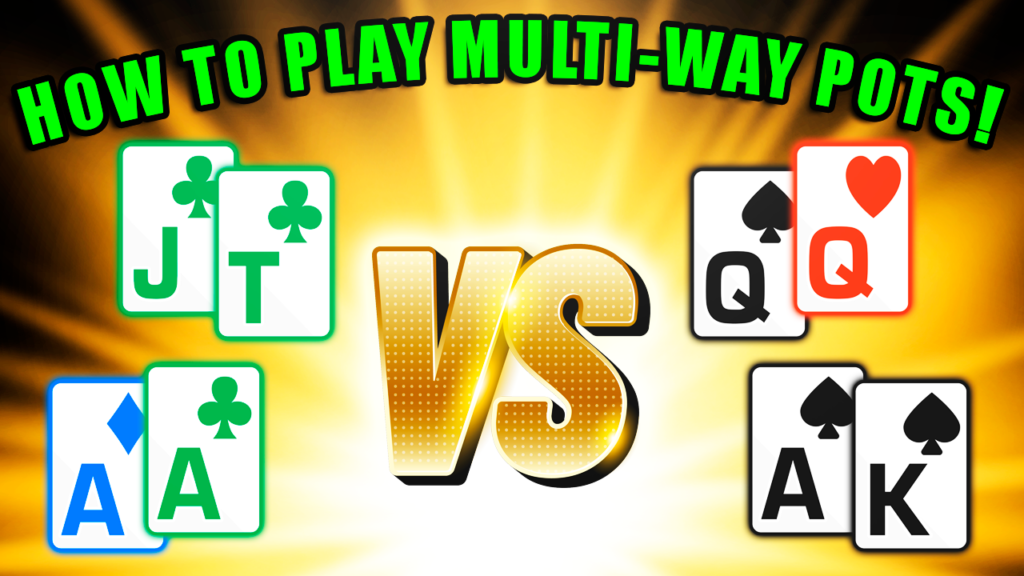
Learn how to play multi-way pots like the pros with the help of Louis-Philipe Mondoux.
Cash Game Strategy Tip #9 – Consider Future Streets
The price of poker goes up on every street, so think about the turn and river before you act on the flop.
If you’re calling the flop with a bluff catcher, are you willing to call again on the turn and river? If not, now may be the time to fold.
Likewise, when you check a very strong hand “for deception,” ask how you plan to get all the chips in. You want big pots with your best hands and small or medium pots with everything else. Slow playing is best saved for very dry boards where you hold most of the strong hands yourself, like top set.
Plan for the river too. Most small stakes players don’t bluff nearly enough for big money, so when a tight, straightforward player bets big on the river, a marginal top pair is usually a fold.
The same tendency works in your favour. Players who call too wide on the flop and turn arrive at the river with a range too weak to stand serious pressure.

Consider what may happen on turns and rivers when playing the flop.
Cash Game Strategy Tip #10 – Always Keep Studying
At some point you’ll become good enough to beat the games you play. This is exactly when many players stop studying.
If you don’t work on your game away from the table, other players catch up and your own thinking gets sloppy.
The players who improve fastest aren’t the ones who study the most hours. They’re the ones who study the right spots.
Pick one leak each week. It might be your calling range against 3-bets, your sizing on wet boards, or how often you bet the turn in position. Then run that spot through PeakGTO, PokerCoaching’s own trainer, until you understand why the answer is what it is.
A poker solver shows you the baseline. Your job is to learn the reasoning well enough to adjust when your opponents don’t play that way.
Game Selection, Seat Selection and Straddles
You make money when your opponents make mistakes. So one of the most valuable decisions in any session happens before you’re dealt a hand.
The best table usually isn’t the wildest one. It’s the one full of loose, passive players who see too many flops, call too much, and rarely re-raise. Look before you sit, ask for a table change if a better game is running, and reassess every time you take a break. Lee Jones has a full guide to game selection that covers live rooms and online lobbies.
Ego is the enemy here. When I played $5/$10 every day, if the table was tough I’d give it an hour to see whether weaker players sat down, and if it stayed tough I quit. My goal was to make money, not to sit at a table and play poker.
Seat matters too. You lose money to the players on your left, so you want the loose and aggressive players on your right, where you act after them.
Finally, watch what straddles do to your stack. Sit down at $1/$2 with $200 and you have 100 big blinds. When the table straddles to $8, you’re effectively playing 25. Buy in deeper or find another table, and don’t post an under-the-gun straddle yourself. My guide to the poker straddle explains the different types and the few times posting one makes sense.
Live vs Online Poker Cash Game Strategy
Poker is poker, and the fundamentals above apply to both formats. What changes is how far you should deviate from them.
Live games are softer. Online cash games are a lot more difficult than live ones at the same stake, and winning players have a higher win rate live. The catch is volume. You see far fewer hands per hour live, so break-even stretches can last months.
Three live tendencies show up again and again, and each has a simple counter.
- They don’t 3-bet or 4-bet enough, so when they do, fold hands that are easily dominated, like A-J offsuit and K-Q offsuit
- They c-bet the flop too often, so continue more often against their flop bets
- They don’t bluff for big money, so fold most of your bluff catchers to large river bets and raises
Online, a rake comes out of nearly every pot, the games are faster, and your opponents make fewer mistakes. Stay closer to the baseline, use the 6-max charts if you play six-handed, and be careful about calling raises from the middle seats, where a 3-bet behind you is always a threat.
Online games also tend to be softer on evenings and weekends, when more recreational players are active.
Bankroll Management for Cash Games
To win at poker you have to find a game you can beat, play it a lot, and keep enough money behind you to survive the swings. Most players manage one or two of those.
How much you need depends on your win rate. By my Bankroll Bible guidelines, a player winning 20 big blinds per 100 hands needs about 2,500 big blinds, and a player winning three per 100 needs about 10,000. That keeps your chance of going broke to roughly 3%.
You can’t guess your win rate, so track every session. My full guide to bankroll management has the complete table, plus shot taking and hidden costs like tips and travel.
Why the Rake Should Push You to Move Up
Here’s the example I use. Assume you win eight big blinds an hour before rake, in a game raked at 10% with a $4 cap.
At $1/$2 that’s $16 an hour, minus about $10 an hour in rake, which leaves $6. At $2/$5 it’s $40 an hour, minus about $14 in rake, which leaves $26.
Your room’s numbers will differ, and your win rate will dip against tougher players. The point is that the rake is proportionally smaller at the bigger game, so move up once your bankroll allows.
When to Quit a Session
I suggest most small stakes players cap their loss in any one session at three buy-ins. Many players tilt after losing a few big pots, and a stop-loss protects you from yourself.
Don’t quit just because you’re winning, as long as the game is good and you’re playing well. Cash games are one long session. The last hand of today is the first hand of tomorrow.
Playing above your bankroll and staying too long are two of the costliest errors on my list of cash game mistakes.
Conclusion
If you take one thing from this guide, make it this. Play tight and aggressive before the flop, then spend your attention on what the players at your table are doing wrong.
Sound poker cash game strategy starts with ranges that respect position and the rake. The profit comes from adjusting, by 3-betting the players who call too much, folding to the ones who never bluff, and sitting where the mistakes are being made.
Pick one tip, apply it in your next session, and track the result. Once it’s automatic, add the next.



Jonathan Little seems to have a skilled and astute poker face…
This is a very nice blog that I will definitely come back to more times this year! Thanks for the informative post.
This is actually the kind of information I have been trying to find. Thank you for writing this information.
This is a great article. Thank you for putting complex ideas into simple words. Your writing style is interesting and the website is very readable. I admire creators like you who prioritize value and clarity.
The progression of ideas in this article is excellent. Each section connects well with the next, making it easy to stay engaged and retain the information