
The squeeze play in poker is a re-raise (3-bet) made after one player raises and at least one other player calls. The squeeze strategy exploits the “sandwich effect”: the original raiser now faces pressure from multiple opponents, and the caller’s flat call reveals a hand that is unlikely to withstand a large 3-bet.
When executed in the right spots, the squeeze is one of the most profitable preflop moves available to an aggressive player. I have used squeeze plays at every level of poker throughout my career, and the mechanics are the same whether you are playing in a $1/$2 cash game or a major live tournament.
In this guide, I will cover when to squeeze, how to size it correctly, how to construct a balanced squeezing range from both in-position and out-of-position spots, and how to handle 4-bets after you squeeze.
- What Is Squeeze Play in Poker?
- What Does a Squeeze Play Achieve?
- When Should I Squeeze In Poker?
- Constructing Your Squeezing Range In Position
- Constructing Your Squeezing Range Out of Position
- Sizing Your Squeeze Plays
- Playing Against a 4-Bet
- Perfect Your Squeezing Ranges for Optimal Results
- Frequently Asked Questions About the Squeeze Play
What Is Squeeze Play in Poker?

In the simplest of terms, squeeze play is defined as a re-raise you make over the top of a raise and one or multiple calls.
Anytime one player opens the pot with a raise, and at least one player makes the call, you have a chance to apply a squeeze play.
Some very aggressive players tend to squeeze extremely wide and try to play as many 3-bet pots in position as possible, especially when they play in very tight and passive games.
The squeeze play needs to be a part of your arsenal if you want to have any hope of being a big winner in your games, as it is an extremely effective play that can print money, especially in the less aggressive games at lower stakes.
So, if you are only just learning how to play poker on a higher level, introducing squeeze play into your overall strategy should give your overall winnings a fairly instant boost.
What Does a Squeeze Play Achieve?
The biggest mistake that many players make with squeezing in poker is that they don’t quite understand why they are squeezing, so they end up squeezing way too many hands and in all the wrong spots.
The reality is that a squeeze play will always achieve one of the following:
- Everyone Folds: In this scenario, you pick up the dead money already in the pot, which is usually quite substantial, and you move on to the next hand.
- Multiple Players Call: When the original caller calls your squeeze, this often allows other players to join as well. In this case, the pot will be very big, and you will often need to hit a big hand to win, but you will be playing for a very big pot.
- One Player Calls: If only one player calls your squeeze, the pot will swell quite a bit, but you will often win the pot by c-betting on the flop, raking in even more chips than if everyone folded.
- Someone 4-Bets: When faced with a 4-bet, you will need to continue with quite a few of the hands you 3-bet, which is why the way you construct your squeezing range is very important.
When thinking about squeezing, you should always think about all of these scenarios and how your hand is going to play if your opponents don’t all end up folding.
This will come into play when we think about constructing our squeezing range, which will be made up of both value hands and particular bluffing hands, which make sense for this scenario, but more on that a bit later.
When Should I Squeeze In Poker?
The single most important question I ask myself before executing a squeeze play is: what do I expect my opponent to do when I 3-bet? If the original raiser is an aggressive player who opens many hands but folds to 3-bets at a high frequency, and the caller has shown a wide, passive flatting range, those are ideal conditions.
In my experience coaching student hand reviews, the most common squeeze mistake is not timing; it is failing to consider whether the players involved will actually fold often enough to make the play profitable. A squeeze play is not a bluff in a vacuum. It is a targeted exploit against specific player types in specific positions.
While you can technically squeeze anytime someone raises and someone calls, you should not be that trigger-happy if you want to show a profit with your squeeze plays.

Many factors play a role in picking the spots to squeeze in, but the perceived opening range of the original raiser, as well as the ranges of the players who called the raise, should all be considered.
Even more so, you should consider your hand and whether or not it fits into the range of hands you want to be squeezing.
Your position at the table should also play a major role in the decision, as squeezing in position and out of position is not quite the same.
Finally, you should be mindful of stack sizes and think about whether or not you will have enough chips to make a call with the appropriate range when facing a 4-bet.
Before you put in those squeezing chips, think about all these elements, and don’t be afraid to take the time you need to process every bit of information before you put in the 3-bet.
Constructing Your Squeezing Range In Position
Building a squeezing range in position starts with understanding what your solver is telling you and why. I recommend running these spots in PeakGTO because it is specifically designed for the PokerCoaching learning method and lets you see the exact frequency at which each hand class should be squeezing versus calling for any given opponent range.
The general framework the solver provides is a linear one: your strongest hands (AA, KK, QQ, AK) squeeze at close to 100% frequency, your medium-strength hands (JJ, TT, AQs) squeeze at a high frequency with occasional flat calls, and your bluffing hands (suited connectors, suited aces with low kicker) are added at lower frequencies to balance the range and deny opponents the ability to exploit you by always 4-betting when you squeeze from late position.
Quite often, you will find yourself on the button facing a raise from one of the early or middle positions and a call from one of the late position players.
In a situation like this, you will want to construct a squeezing range that is made up of all your strongest hands and quite a few bluffing hands as well.
Your value hands in this scenario should include pairs from AA to QQ, AK, and AQ0. These hands are pure 3-bets, according to solvers, and generally should be well ahead of the ranges of both your opponents.
Again, you should sometimes re-consider squeezing the bottom of your value range when facing a raise from a tight player in one of the earlier positions, as they are quite likely to have a very strong hand.
To balance out all your strong hands, you will want to introduce quite a few bluffs into your squeezing range in position as well.
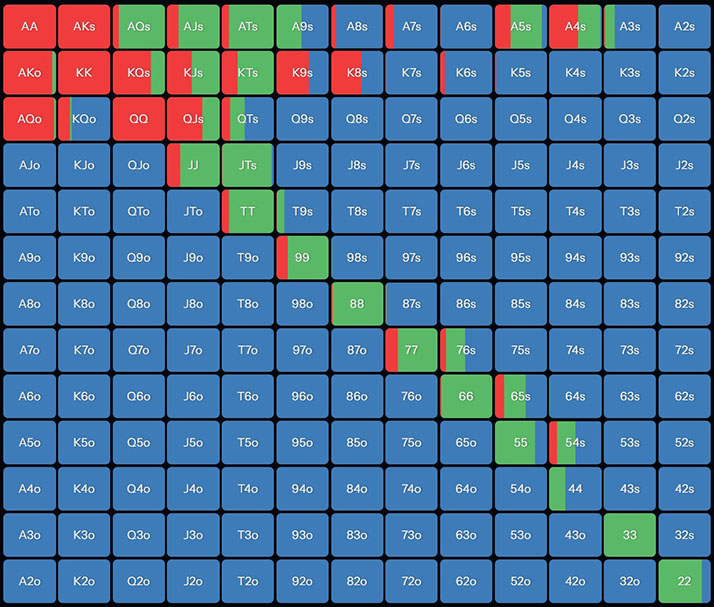
Solvers like hands like QJs and KJs, as well as hands like AJs, ATs, A5s, A4s KTs, K9s, J9s, and 76s at a lower frequency, and occasionally hands like 76s, 65s, and 54s.
Hands like A5s and A4s should also serve as great squeezing candidates, although solvers prefer hands like ATs, A9s, and A8s as bluffing hands in tournaments where stacks typically tend to be shallower, increasing the value of top pair.
Of course, the exact range you use for this play should depend heavily on the range you assign the original raiser, who is the most likely to have a strong hand and continue against your 3-bet.
Keep in mind that you should also not fold the combos of these suited bluffing candidates that you decide not to squeeze with but rather call with them, as well as all pocket pairs you aren’t 3-betting.
The exact range of hands you should squeeze within position will also change quite significantly if you are in the cutoff, as you will have to 3-bet somewhat tighter with yet another player behind you to worry about.
Constructing Your Squeezing Range Out of Position
Out-of-position squeezes are the spots I see students mishandle most often in hand reviews. The natural tendency when playing out of position is to either squeeze too rarely (giving up the fold equity the spot offers) or to squeeze too wide (building an unbalanced range that more attentive opponents can exploit).
When I study these spots in PeakGTO, the solver consistently shows that the out-of-position squeezing range should be significantly tighter than the in-position range, weighted more heavily toward value, and only including bluffing hands with strong postflop playability.
Suited aces with strong kicker (AJs, ATs) typically appear at the highest bluffing frequencies, while off-suit broadways and low suited connectors are often used as flat calls instead.
Playing out of position, you will want to apply a squeeze with a much tighter range than you can in position due to the obvious positional disadvantage.
This range will still include all your strong hands like AA-JJ, AK, and AQs, but also hands like 99 and 88 at a much higher frequency, especially in tournaments.
According to the solvers, GTO poker also suggest you bluff with hands like AJs, ATs, AQ, KQs-KTs, QJs, JTs, and some weaker-suited connectors in tournaments, while hands like A5s-A2s are typically not included in the small blind squeezing ranges.
Generally speaking, you will want to make your squeeze plays more value-heavy when playing out of position while still adding some bluffs into the range to ensure balance.
Also, keep in mind that squeezing from the big blind should be done at a much lower frequency, as the discount you are getting on a call gives you many more opportunities to call with a variety of hands instead of 3-betting.
Sizing Your Squeeze Plays
Sizing the squeeze correctly is where many players leave money on the table. The goal is to charge your opponents enough that calling requires real equity, while keeping the size small enough that you are building a favorable pot when you get called with your value hands.
Here is a concrete example of how I would think through the sizing in a typical live cash game situation: UTG opens to $15 in a $2/$5 game, the HJ calls, and I am on the button with ATs. The pot before my action contains $37 (including the blinds).
A squeeze to $55 gives my opponents pot odds of roughly 36%, which is too attractive against two players. A squeeze to $75 puts them at roughly 25%, which is more appropriate. With each additional caller in the hand, I increase the size by approximately $15-$20 to account for the extra player and the expanded pot size their call creates.
Winning the pot outright with your squeeze play is always a favorable outcome and one that you want to see happen as often as possible.

To make that possible, you need to make sure that you are not making your squeeze plays too small and not giving your opponent good odds on calling you.
Imagine a hand at a $2/5 cash game table where the hijack raises to $15, the cutoff calls, and you squeeze to $45.
In this scenario, either of your opponents needs to call just $30 to play for a pot of $105, meaning they are getting excellent pot odds and only need less than 30% equity to continue with their hand, compelling them to continue with the vast majority of their raising range.
If you were to raise to anywhere between $60 and $75, the odds you would be giving your opponents would be much less favorable, making it less likely you will get called.
Typically speaking, you will want to raise around full pot anytime you are squeezing in position and a bit more than the pot when out of position to account for your positional disadvantage.
Keep in mind that the size of the pot and the size you should be making your squeeze plays will both go up as more callers are involved, but your squeezing range should tighten up a bit for every new caller in the hand.
For instance, you will want to have slightly fewer bluffing hands in your squeezing range when 3 players call the original raise, but you will also want to make your squeeze significantly bigger.
Playing Against a 4-Bet
Facing a 4-bet after squeezing is the part of this play that most players have no clear plan for, and that uncertainty leads to costly mistakes in both directions. I have seen students call too wide with hands like AQo or TT against 4-bets from tight ranges, losing their stack in a spot where a fold was clearly correct.
I have also seen students fold too often against aggressive 4-bettors, surrendering fold equity they had already built with the squeeze. The key is to construct your squeezing range with the 4-bet response in mind before you put in the 3-bet.
If you are squeezing with ATs and your opponent 4-bets to a size that gives you poor implied odds, you need to have decided before the action reaches you whether ATs is a call or a fold in that scenario, not after.
While the most favorable outcome of a squeeze play is generally to have all players fold their cards, the least favorable is usually getting 4-bet.
Since you have many bluffs in your squeezing range, getting 4-bet means you can’t just play for all your chips every time it happens.
Obviously, you are going to want to put your chips into the pot with your strongest hands like AA, KK, AKs, and QQ, barring extreme reads or circumstances.
However, your suited Broadway hands and pocket pairs will usually want to continue for a call, provided the 4-bet is not too big, while hands like AQ or KQ without suits should generally be folded.
You can also fold hands like A5s-A2s in some cases (and use them as 5-bet bluffs in others) while calling a big chunk of your range, especially in position.
If you are out of position, you will definitely want to call much tighter and only continue with the best-suited connectors like QJs and JTs, while folding suited hands with gaps that don’t play well enough after the flop.
Perfect Your Squeezing Ranges for Optimal Results
Squeeze play is an essential play in any strong No Limit Texas Hold’em poker strategy and one you should spend a fair bit of time studying.
We have broken down the most basic elements of squeezing in poker in this guide, but there is plenty of room to work on your squeezing game and achieve perfection.
You will want to run simulations of squeeze plays from and against different positions to figure out the ideal squeezing ranges for every scenario that you can walk into, along with ranges for different effective stack sizes.
If you stick with it long enough, you will get very close to squeezing with optimal ranges in every situation and intuitively recognizing the situations in which a squeeze play works better than a call or a fold.
Start working on your squeezing game today and building on the foundations we set forth in our guide, and you will be on your way to joining the ranks of elite poker players in no time.