
The best poker books are the ones that fundamentally change how you think at the table, not just add new terms to your vocabulary. Over the past two decades as a professional player, I have read hundreds of books on Texas Hold’em poker.
The ones that made the biggest difference were the ones that forced me to rethink how I approached the game. In this guide, I am sharing the 15 I recommend most, organized by skill level and game type, along with my honest assessment of who each book is best suited for. I have also included a dedicated section on my own books for players who want to learn the PokerCoaching method from the ground up.
If you take a look at Jonathan Little’s bibliography, you will probably notice there are more titles in there than you can count, and you may be confused as to where to start.
So, here is a list of the top 10 Jonathan Little books for beginners and a short synopsis of each to help you decide which Jonathan Little book will be the best choice for you to start with.
- Best Poker Books for Beginners
- Best Poker Books for Tournament Players
- Best Poker Books for Cash Game Players
- Best Poker Books for Advanced Players
- Best Poker Books From PokerCoaching
- #1 – Secrets of Professional Tournament Poker (3 Volumes)
- #2 – Live No Limit Cash Games (2 Volumes)
- #3 – Mastering Small Stakes No Limit Hold’em
- #4 – Bluffs: How to Intelligently Apply Aggression to Increase Your Profits from Poker
- #5 – Strategies for Beating Small Stakes Cash Games
- #6 – Cashing the WSOP Main Event
- #7 – Excelling at No Limit Hold’em
- #8 – The Poker Workbook
- #9 – Excelling at Tough No Limit Hold’em Games
- #10 – Positive Poker
- Frequently Asked Questions About Poker Books
Best Poker Books for Beginners
If you are new to poker or have been playing casually and want to start studying seriously, these three books are the ones I recommend to every beginner who asks me where to start.
They are not the flashiest or the most technically advanced books on the market, but they build the foundational thinking that every improving player needs before moving on to more complex material.
The Theory of Poker by David Sklansky
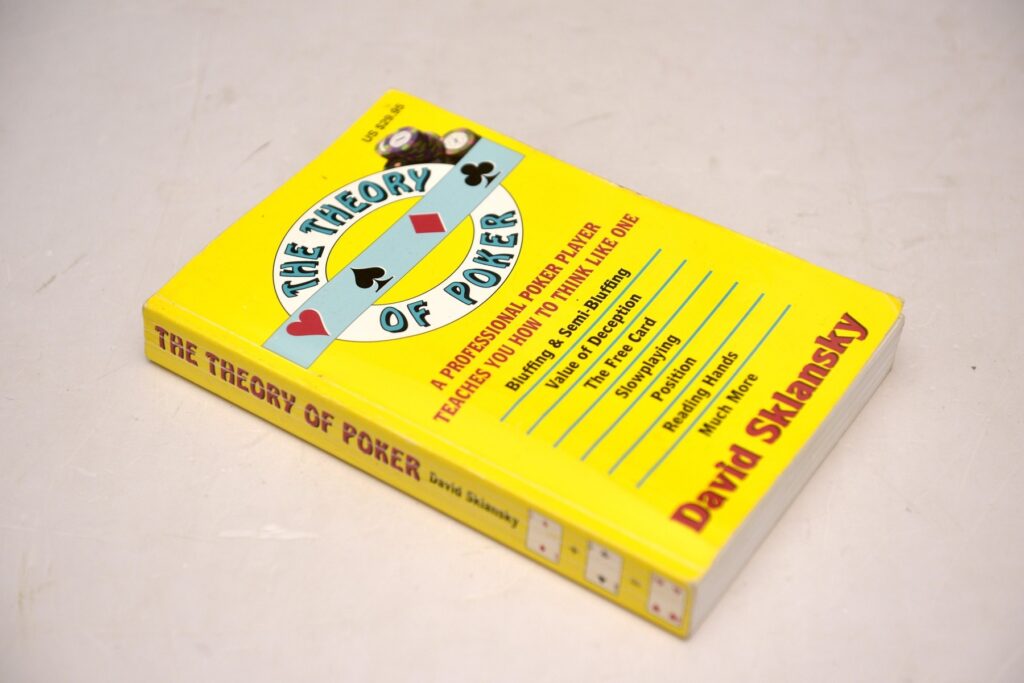
The Theory of Poker by David Sklansky is the book that changed the way I thought about poker as a young player. It is not a Texas Hold’em strategy guide. It is a framework for thinking about the game.
The central concept, the Fundamental Theorem of Poker, explains that every time your opponent makes a decision that differs from the one they would make if they could see your cards, you gain. Every time you force that mistake, you profit. Once that idea sinks in, almost every other poker concept falls into place. The book is old, and some of the specific strategies are outdated, but the thinking behind them is as relevant today as it was when it was published.
Harrington on Hold’em, Volume 1 by Dan Harrington
Dan Harrington’s tournament series taught me how to think systematically about stack sizes and tournament stages at a time when most players were still winging it. Volume 1 remains one of the best introductions to positional awareness, stack management, and opponent profiling for tournament players.
The M-ratio concept is not the way most serious players calculate stack pressure today, but the underlying logic is correct and easy for beginners to grasp. If you are preparing for your first serious tournament run, Harrington on Hold’em is the place to start.
The Mental Game of Poker by Jared Tendler
Most players lose more money from tilt than from strategic mistakes, and Jared Tendler’s Mental Game of Poker is the only book I have read that treats the psychological side of poker as seriously as the strategic side.
I have worked with Jared directly over the years, and the system he describes for identifying and correcting tilt patterns, performance under pressure, and emotional decision-making is based on real cognitive science. This is not a mindset fluff book. It is a structured program for diagnosing and fixing the mental leaks that cost players the most money.
Best Poker Books for Tournament Players
Tournament poker requires a different skill set from cash games. The constantly changing stack sizes, the pressure of increasing blinds, and the importance of ICM create situations that cash game strategy does not address. These two books are the ones I recommend most for players who want to compete seriously in multi-table tournaments.
Applications of No-Limit Hold’em by Matthew Janda
Applications of No-Limit Hold’em by Matthew Janda is the book that introduced most serious players to the concept of balanced ranges and bet sizing based on equity distribution.
When it came out, it changed how I thought about constructing ranges postflop. It is a demanding read and not suitable for beginners, but for a player who understands basic hand ranges and wants to understand why certain bet sizes work better than others, it is one of the most important books ever written on no-limit hold’em strategy. I recommend reading it alongside a solver like PeakGTO so you can see the concepts in action.
Modern Poker Theory by Michael Acevedo
Modern Poker Theory by Michael Acevedo is the most comprehensive book on GTO-based tournament strategy available in print. It explains how to build ranges from scratch, how to analyze equity distributions on different board textures, and how to apply solver output to real-game decisions.
I use PeakGTO (peakgto.com) to study these concepts because it was designed specifically for the PokerCoaching learning method, but Modern Poker Theory is the conceptual framework that makes solver output meaningful. If you study both together, you will understand not just what the solver recommends but why.
Best Poker Books for Cash Game Players
Cash games reward a slightly different approach than tournaments. There is no ICM, no blind pressure, and the ability to reload means the strategic decisions focus more on exploiting player tendencies and maximizing edge over long sessions. These are the books I recommend most for players who prefer the cash game format.
Doyle Brunson’s Super System
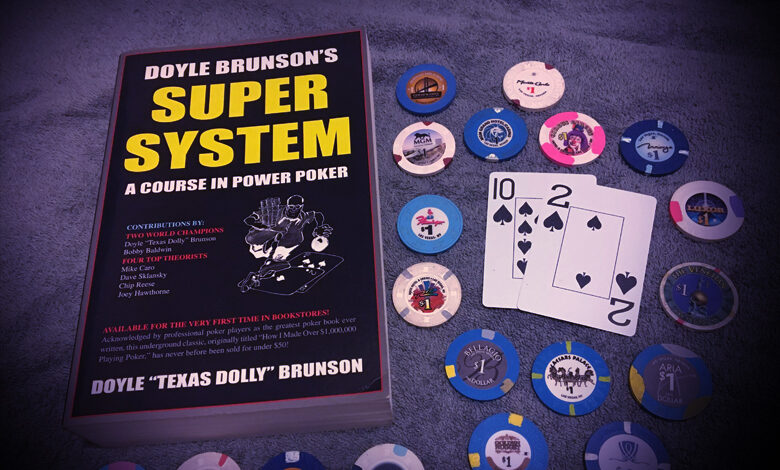
Super System by Doyle Brunson is nearly 50 years old, and much of the advice is outdated by modern standards. I include it on this list not because the strategy holds up perfectly today, but because understanding where modern poker thinking came from gives you a richer sense of why the game evolved the way it did.
The no-limit hold ’em section written by Brunson himself has a loose-aggressive style that influences how many high-stakes cash game players think today, even if the specific plays are no longer optimal. Read it as history and context.
Play Optimal Poker by Andrew Brokos
Play Optimal Poker by Andrew Brokos (also known as “Foucault” online) is one of the most accessible GTO-oriented books for cash game players. Where Janda’s work requires significant background knowledge to absorb, Brokos writes for players who understand the game but want a structured introduction to game-theory concepts without needing a math degree.
I recommend it for players who have beaten small and mid-stakes cash games exploitatively and want to understand the balanced strategies that tougher opponents will try to use against them.
Best Poker Books for Advanced Players
Once you have a solid foundation in both strategy and the mental game, these books will push your thinking further. They are not easy reads, and they are not designed to be. They are designed to make you uncomfortable with imprecision in your own game.
Elements of Poker by Tommy Angelo
Elements of Poker by Tommy Angelo is the poker book I recommend most to winning players who are stuck at a level they cannot seem to break through. Angelo writes about the game in a way that is almost philosophical, with short, precise observations about how the decisions players think are small actually compound into the results that define their careers.
The concept of “reciprocality” (that winning poker is about doing the right things when your opponent does the wrong things) is the most elegantly stated poker principle I have ever read. It is short, but reading it slowly will take you longer than you expect.
How to Study Poker, Vol. 2 by Sky Matsuhashi
Sky Matsuhashi’s approach to structured self-study is something I believe every improving player needs. Most players study the wrong things in the wrong order and wonder why their game does not improve.
This book outlines a study process that actually transfers to in-game improvement. I recommend combining it with PokerCoaching’s training resources and PeakGTO to give your study sessions the direction they need.
Best Poker Books From PokerCoaching
The following 10 books are ones I wrote myself. I include them here not only because I obviously stand behind them, but because they were each written specifically to solve the problems I see most often in student hand reviews.
Every concept, every example, and every exercise in these books comes from real hands I have played or reviewed in coaching sessions. They are designed to complement the PokerCoaching training method, so if you are working through courses on the site, these books will reinforce what you are learning in video format.
#1 – Secrets of Professional Tournament Poker (3 Volumes)
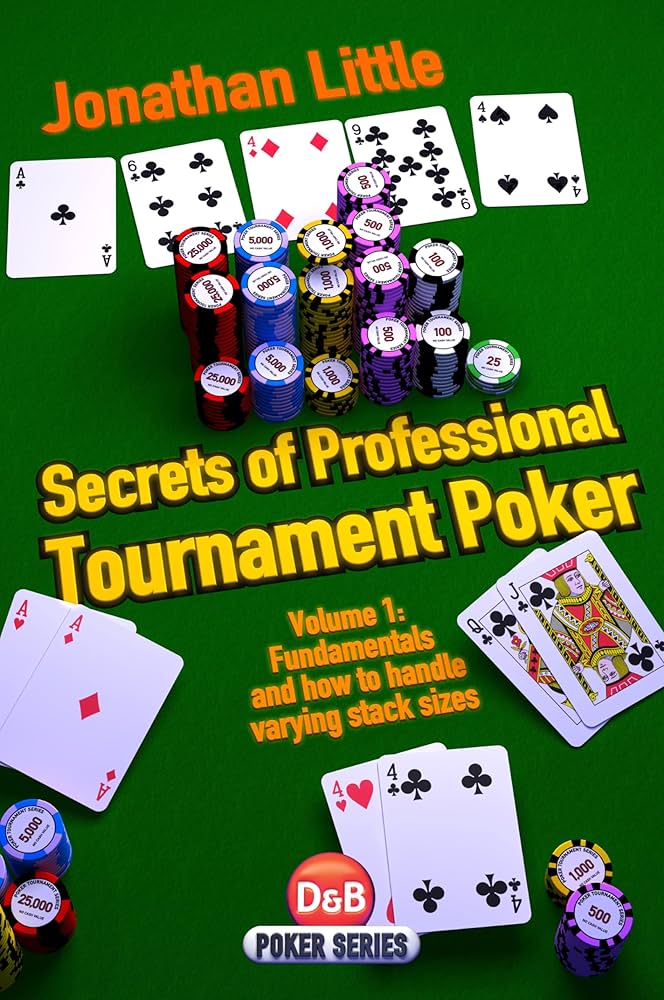
Secrets of Professional Tournament Poker is the book I am most proud of in my entire bibliography, and it is the one I recommend first to any tournament player, regardless of their current level.
When I wrote it, my goal was to create the resource I wished had existed when I was learning the game.
The three-volume set covers everything from early-level chip accumulation to bubble strategy to final-table ICM decisions, and it is the foundation for most of what I teach in PokerCoaching’s tournament training courses.
In Secrets of Professional Tournament Poker – Volume 1, Little delves into the basics of tournaments, teaches you why tournaments are the most profitable form of poker, talks about different stack sizes and stages of the tournament, and how to orient your strategy towards winnings instead of surviving.
While Volume 1 is a great start, Volume 2 of Secrets of Professional Tournament Poker delves deeper into the different tournament stages and explores gear shifting and playing aggressively in the later stages of the tournament.
In the final Volume, Jonathan dedicates lots of time to explaining ICM poker and how to exploit tournament bubbles and final tables and how to maximize your winnings in every situation.
Overall, this book series should give you a great fundamental framework to crush tournaments and do exceptionally well in the lower stakes events against your average set of opponents.
#2 – Live No Limit Cash Games (2 Volumes)
Live No Limit Cash Games is the most practical book I have written for players who grind live poker rather than online.
The distinction between “the theory” (Volume 1) and “the practice” (Volume 2) was intentional. I wanted to give readers a framework to understand why certain adjustments work before giving them the specific adjustments for different opponents and situations.
Most losing cash game players have the same set of leaks, and this book is designed to address them directly.
If you don’t have the time to grind out the long tournament hours or the patience to brick one event after another before finally making a deep run, live cash games could be the right game for you.
Jonathan Little wrote his Live No Limit Cash Games in two Volumes. The first is called The Theory, and the second is The Practice.
- In Volume 1, Jonathan goes over the most fundamental concepts of cash game play, starting with preflop strategy, and teaches you about different playing styles you can employ and the ways you should adapt to your table.
- In Volume 2, a lot more practical advice is given, covering how to play at different stack sizes, positions, and situations on different board textures.
The two Volumes of Live No Limit Cash Games alone should be enough to turn you from a break-even cash game player to a winner, and by exploring the concepts found within, you will have the potential to go even further and truly master live cash games.
#3 – Mastering Small Stakes No Limit Hold’em
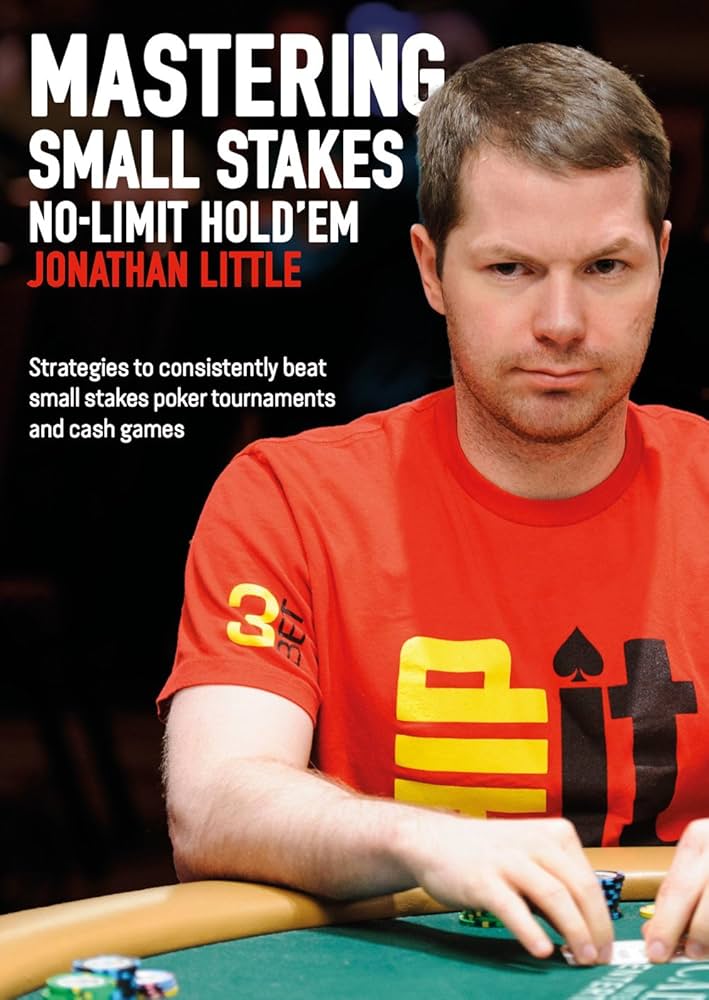
Mastering Small Stakes No-Limit Hold’em is the book I recommend to players who are studying GTO content and wondering why their results at small stakes are not improving.
The reason, in most cases, is that small-stakes games are populated by recreational players who do not play in balanced ranges and who have easily exploitable tendencies. Trying to play optimally against opponents who play randomly is a mistake.
This book teaches you how to identify the common recreational player mistakes and profit from them consistently.
While top players will always beat low stakes No Limit games or any game with a lot of recreational poker players, they will often leave a lot of money on the table as well.
If you have been studying GTO poker with solvers or watching highly advanced training videos to learn how to play, you may want to take a step back and read Jonathan Little’s Mastering Small Stakes No Limit Hold’em.
This book is designed to teach you how to play exploitatively against recreational poker players and how to absolutely dominate small-stakes games without playing perfect poker or trying to copy solvers.
Instead, it aims to teach you when to get out of line, when to make the plays no one expects, and how to make recreational players play to the beat of your drum.
If you often play low-stakes poker games or compete with weak players, such as the ones in various WSOP events, Mastering Small Stakes No Limit Hold’em is a book that could improve your win rate significantly.
#4 – Bluffs: How to Intelligently Apply Aggression to Increase Your Profits from Poker
Bluffs is the book I wrote to address what I believe is the single most common mistake I see in student hand reviews: players who either bluff too much without a plan, or players who bluff too little because they are afraid of getting looked up.
The right answer is neither. This book gives you a decision framework for evaluating every bluffing opportunity based on position, board texture, stack depth, and your read on the opponent.
Every poker player knows that bluffing is an essential part of any good poker strategy, but knowing how to time the bluffs and choose hands to bluff with is where the real poker art comes into play.
Great poker players like Jonathan Little know how to pick their spots and put maximum pressure on their opponents, and Bluffs is a book designed to teach you the same.
This book revolves around low and mid-stakes games and offers applications in both tournament and cash game poker, with a variety of examples showing you how and when to bluff for maximum success.
If you feel like you don’t bluff often enough or like your bluffs are getting picked off too much, Bluffs is a great book that will help you make better decisions when bluffing in the future.
Little focuses on explaining the exact reasons to bluff in different situations, covering position, hole cards, board texture, stack size, and your perception of the player you are trying to bluff, creating a comprehensive guide to bluffing that will significantly solidify your game.
#5 – Strategies for Beating Small Stakes Cash Games
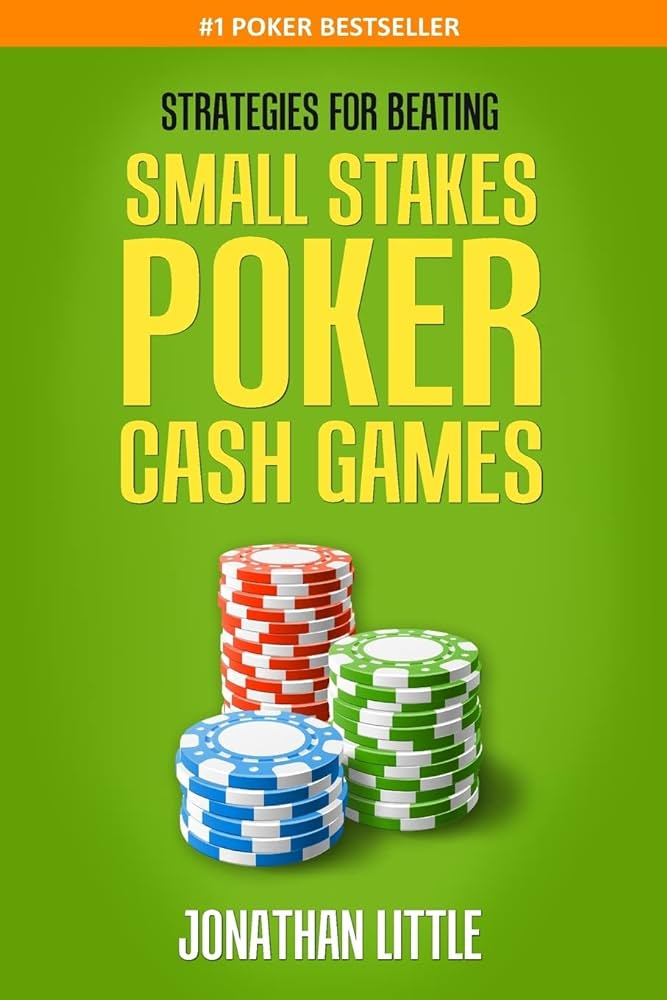
Strategies for Beating Small Stakes Cash Games is the most direct book I have written for players who are stuck in micro and small-stakes games. It does not try to teach you optimal theory.
It teaches you the specific strategic adjustments that separate winning small-stakes players from break-even ones, and it explains why many players who think they are playing well are actually leaving significant money on the table.
The truth is that beating small-stakes cash games is not that difficult, but many players continue playing flawed strategies and blame luck for lack of success.
In Strategies for Beating Small Stakes Cash Games, Jonathan Little aims to teach novice cash game players how to crush those games by adopting the strategies he’s learned over the years.
The book goes straight to the point and teaches you skills you can use in-game to instantly make money, along with introducing you to a new set of methods and strategies that will make you a better player from the ground up.
The book also teaches you how to stay away from blaming others or bad luck for your poker downswings, and, focus on your own game and making the right decisions at the right time to win the maximum instead to finally work your way up from small stakes.
#6 – Cashing the WSOP Main Event
Cashing the WSOP Main Event is a hand history walkthrough of my 2014 World Series of Poker Main Event run. I wrote it because hand history books are, in my opinion, the most efficient way to teach situational decision-making.
Reading how a professional thinks through each decision in real time is fundamentally different from reading general strategy advice. The 54 hands in this book were chosen because each one illustrates a concept that applies broadly to deep-stack tournament play, not because they were the most dramatic hands of the run.
Massive field tournaments like the WSOP Main Event can seem so daunting to an average poker player, as playing poker for days to make money can be quite challenging.
In Cashing the WSOP Main Event, Jonathan Little walks us through his 2014 Main Event run of his own and dissects 54 hands he played during the tournament on his way to making the money.
While Little did not make the final table that year, his deep run came as a result of playing every hand to the best of his ability and staying consistent with his strategy.
The book looks to teach you how to adjust your big field tournament strategy to survive and accumulate chips as you go through the motions and approach the final table.
If you plan on playing some live events this year, Cashing the WSOP Main Event is a book that can give you some great ideas on how to play, along with the right perspective on playing such tournaments overall.
#7 – Excelling at No Limit Hold’em
Excelling at No Limit Hold’em is a multi-author project I edited and contributed to along with players including Phil Hellmuth, Mike Sexton, and several others. My goal was to give readers access to a range of perspectives on the game from professionals who approach strategy very differently.
My own contributions focus on value betting and hand reading, but the chapters from other contributors often surprised me with insights I had not considered. It is one of the few poker books where I learned something new even as an editor.
If you want a book that summarizes all the poker skills you should have in one, Excelling at No Limit Hold’em by Jonathan Little might be the right read for you.
Written by Jonathan with the help of over a dozen excellent poker players like Phil Hellmuth and Mike Sexton, the book includes strategic analysis, hand reviews, mental game tips, and much more.
Excelling at No Limit Hold’em is designed to help novice poker players fight their way out of the micro stakes, and those who are already doing well there move on to the next stages of their poker career.
Whatever your current stakes are, and no matter how well you are doing, Excelling at No Limit Hold’em is a book that’s well worth a read and almost guaranteed to teach you at least something new about the game of No Limit Hold’em.
#8 – The Poker Workbook
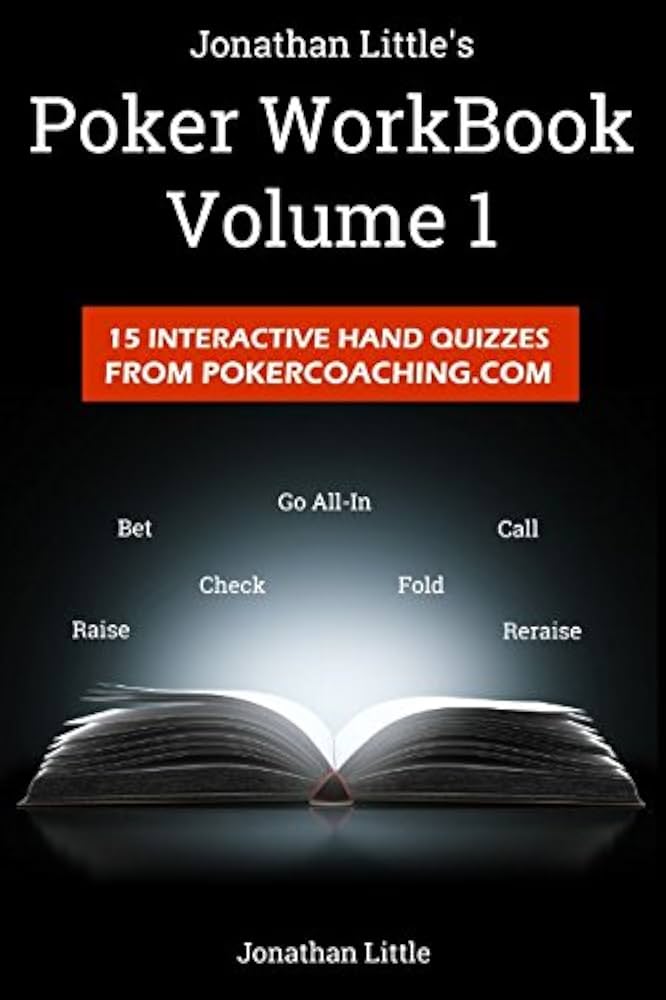
The Poker Workbook is the only book I have written that asks you to work rather than read. Most poker books give you information.
This one gives you situations and asks you to make decisions, then walks through the reasoning for the correct answer. I co-wrote it with Matt Affleck and Alexander Fitzgerald because I wanted perspectives from other coaches on what the most important quiz situations should be.
If you have read several strategy books and wonder why your in-game decisions still feel uncertain, a hands-on workbook format is often the missing piece.
Offering a slightly different format than most other poker books, The Poker Workbook is a hands-on training book that will help you understand the concepts you have learned and put them into practice.
Written by Jonathan Little in collaboration with Matt Affleck and Alexander Fitzgerald, the book introduces an interactive quiz format that will allow you to go from just reading to actually getting involved with your poker coaching.
Take your game to the next level with 15 interactive poker quizzes and change the way you think about poker once and for all.
#9 – Excelling at Tough No Limit Hold’em Games
Excelling at Tough No Limit Hold’em Games is the book in my catalog that is most explicitly aimed at moving from recreational player tables to games with skilled opponents.
Once you are consistently beating small and medium-stakes games, the adjustments required to compete at tougher tables are substantial. This book addresses the specific situations (multiway pots against good players, ICM-aware opponents at final tables, aggressive regulars in cash games) where the strategies that work against recreational players will get you in trouble.
While most Jonathan Little books are focused on lower-stakes players and novices, Excelling at Tough No Limit Hold’em Games is a book that is designed for slightly more advanced players.
Once you are done reading the more basic books on this list, Excelling at Tough No Limit Hold’em Games is the next thing to read to take your game to the next level.
While the book is designed with the idea of moving to the next level and learning the strategies needed to play at higher stakes, it can also be quite useful to beginners.
The book introduces many poker concepts and teaches about concrete situations in poker like continuation betting, multi-way pots, ICM, final table play, and much more.
If you are not comfortable with poker basics, hold out for this book a bit later, but if you feel like you are doing well in the low-stakes games, check it out and take your game to the next level.
#10 – Positive Poker
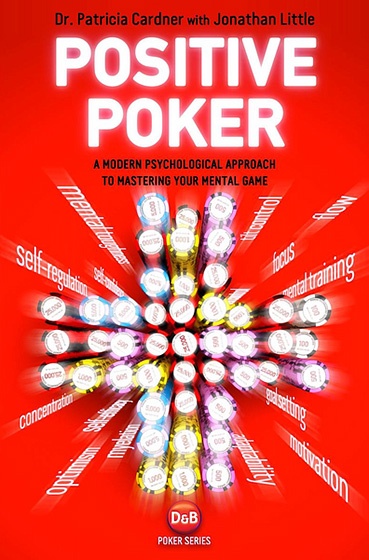
Positive Poker is the book in this section I did not write alone. Dr. Patricia Cardner conducted the research, interviewed the professional players, and wrote the core psychological framework.
My contribution was grounding the mental game concepts in real poker situations. The reason I recommend it alongside Jared Tendler’s Mental Game of Poker is that they cover different parts of the problem: Tendler’s work is better for diagnosing and fixing specific mental leaks, while Positive Poker is more about the long-term mindset habits that keep you performing consistently over a career.
A psychology professor and dedicated poker player, Cardner decided to interview a number of successful poker players and find out what exactly made them as successful as they are.
Through her study, she discovered what makes some of the best players out there tick and how they overcome the numerous problems they encounter in their careers.
If you find yourself suffering with your poker mindset from tilt, poor bankroll management, negative thinking, and other psychological issues in your game, Positive Poker is the right book for you.
In fact, every poker player should have a read, as the book teaches mechanisms that everyone can use to optimize their mental game, guaranteed to reflect in actual poker results.