

A poker downswing is a prolonged period of losing results that stems from variance rather than poor play. Most players experience multiple significant downswings each year regardless of their skill level, and some lasting hundreds of buy-ins are mathematically normal, especially in tournament formats.
I have coached players who were genuinely excellent at poker but nearly quit the game because of a downswing they did not recognize as normal variance. The difference between players who survive downswings and players who do not is almost never skill. It is preparation, bankroll management, and the ability to separate variance from a real leak in your game.
- What Is a Downswing in Poker?
- Identifying a Poker Downswing
- Planning for Downswings
- Dealing with Downswings
- Is It a Downswing or a Leak in Your Game?
- How Long Does a Poker Downswing Last?
- The Mental Edge: Turning Downswings Into Competitive Advantages
- Final Words on Poker Downswings
- Frequently Asked Questions About Poker Downswings
What Is a Downswing in Poker?
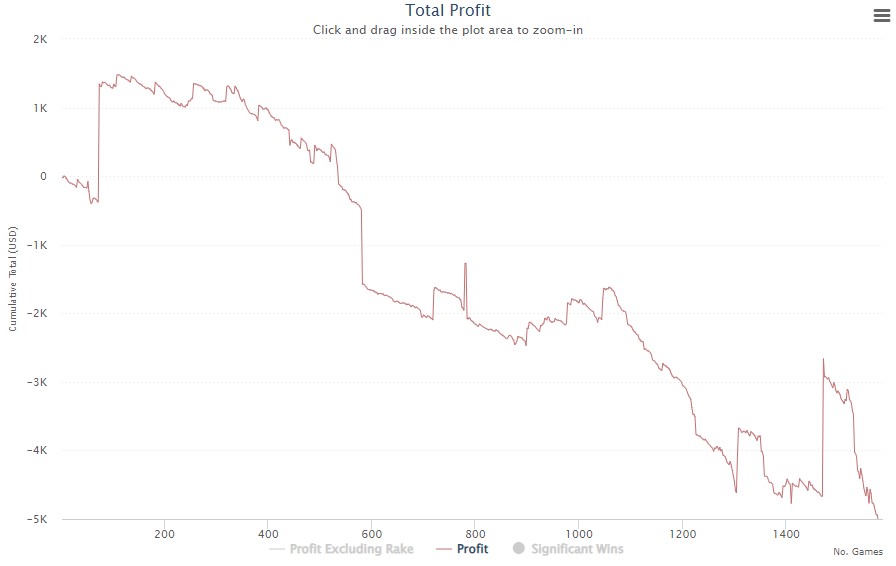
Poker players use the word downswing to describe different things, but generally speaking, the term refers to a prolonged period of losing money at the poker tables.
The exact amount of money lost and the duration of a poker downswing can differ wildly from one case to another. The thing they all have in common is that they have the potential to ruin even the best of players mentally.
Before you start playing poker with any degree of seriousness, you need to understand you will experience some downswings, so the most important thing is to be able to identify them.
In my experience reviewing thousands of hands with students, the most common mistake I see is players treating a short losing session as evidence that something is wrong with their game. Two losing sessions in a row is not a downswing. It is noise.
A genuine downswing is a statistically meaningful departure from your expected win rate sustained over a significant volume of hands, and the threshold for “significant” varies considerably depending on the game type you play.
Let’s start by identifying what a poker downswing might look like in different game formats.
Identifying a Poker Downswing
Many players I have personally encountered over the years start moaning about a downswing as soon as they have two consecutive losing sessions, but that’s not the definition of a downswing.
Regardless of the game format you play, losing sessions in poker are inevitable. The more variance-heavy your format is, the more likely you are to encounter them. Thus, you should only be worried about a downswing when you experience a prolonged set of losing sessions in a relatively short period of time.
For instance, if you play live cash games as a big favorite, you can expect to win quite often. Losing five or six times in a row can be considered a downswing in such a game, while losing 20 buyins over a couple of weeks of play is also definitely a downswing.
On the other hand, losing 20 buyins in big field online tournaments is routine, and you should not pay any attention to it.
For this exact reason, professional poker players make sure to identify the game type they are playing and the likelihood of encountering certain downswings before they start playing. This helps them plan out their bankroll management ahead of time.
But how can you plan for downswings and know what’s possible and likely? Let’s find out!
Planning for Downswings
Bankroll management is one of the most important yet most underestimated skills that a professional poker player must master.
Even many players whose overall skillset is quite solid encounter problems with bankroll management because they underestimate the likelihood of downswings.
Using a simple poker variance calculator, it is possible to calculate the likelihood of running into a downswing of a certain magnitude using the following information:
- Average buyin
- Number of games played
- Win rate/ROI
- Average field size (in tournaments)
Once you enter all this information into a variance calculator, the calculator will tell you how likely you are to lose a bankroll of a certain size.
The hardest part of entering this information is calculating the correct win rate or ROI you have in the games you plan to play.
So, if you don’t have enough information from previous games, aim for a low number and try to create a bankroll that will not get demolished, even if you are only winning at a low win rate.
When I talk to students about bankroll planning, I give them these minimum guidelines as a starting point: for live cash games, 20 buy-ins is the floor; for online cash games, aim for 30 buy-ins; for multi-table tournaments, budget for 100 buy-ins at minimum, and 200 if you are playing larger fields.
If your bankroll sits below these numbers, your risk of ruin during a normal downswing climbs dramatically, regardless of how good you are. A player with 10 buy-ins for their stake is one bad week from being broke, even if they are a long-term winner at that level. Planning for downswings means having the bankroll before the downswing arrives, not scrambling to rebuild during one.
If you want to model specific downswing scenarios for your game type and win rate, PokerCoaching’s own solver, PeakGTO, is the recommended study tool for players working on their game at this site.
If you play a certain number of games and see that you are crushing the games at a significantly higher rate, you may be able to update those numbers or move up the stakes rather quickly.
Dealing with Downswings
If you have used the variance calculator properly and done all the necessary preparation, you will have the bankroll to sustain even some nasty downswings.
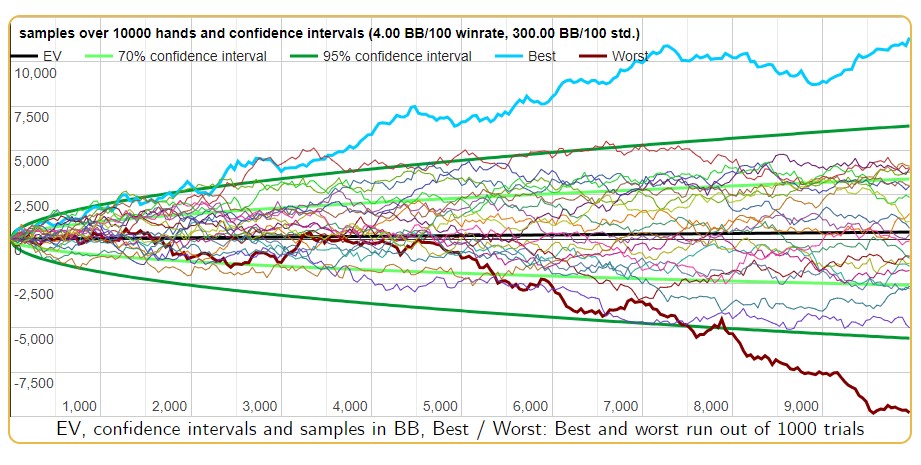
And yet, even if you have the appropriate bankroll, encountering a downswing in real life will not be a pleasant feeling.
Many times, poker players allow downswings to completely ruin their motivation and their self-confidence, making them question every decision they make.
However, this is not the right approach to take. If you know downswings are coming sooner or later, encountering them should become routine.
The way to tackle a downswing is head-on!
What I find in reviewing student sessions is that tilt during downswings rarely looks like obvious rage. The subtle forms are the dangerous ones: making bad river calls when you know you are beaten because you feel like you are owed a win; playing passively and checking back hands that should be bet because you expect bad things to happen; or over-aggressing against a specific opponent because you are annoyed at how many pots they have won against you.
If you notice any of these three patterns in your session, that is your signal to take a break, not to play through it. The cost of one more hour of tilted poker almost always exceeds the value of whatever you might recover.
Keep playing your game without hesitation, and don’t deviate from the decisions you would normally make.
Regardless of how many times in a row you shove into the nuts, keep doing it if your study sessions have shown it to be a profitable play.
Remember, every play in poker will go wrong sometimes, and you will lose many pots in any given session, holding both bluffs and second-best value hands.
Instead of quitting the game or throwing your bankroll away at the blackjack tables, focus on playing good poker, and the results will balance out over time.
Is It a Downswing or a Leak in Your Game?
One of the hardest questions to answer during a losing stretch is whether you are running bad or playing bad. In my experience, most players instinctively blame variance because it is the more comfortable explanation. But assuming variance when the real problem is a leak in your game is expensive. It keeps you losing at a rate you could be fixing.
Here is how I approach this distinction with students:
The first thing to look at is whether your losses are concentrated in specific spots. If you are losing roughly evenly across many different situations, that points toward variance. If your losses are clustering around a particular scenario (say, three-bet pots as the caller, or spots where you are out of position against aggressive players), that clustering is a signal worth investigating.
The second check is to run a session review during the downswing, not after it. Look at the hands where you lost the most chips. Ask: Was the money going in as a significant underdog, or were you ahead and got unlucky? If the majority of your big pots went in with the worst of it, that is not a downswing. That is a strategy problem.
The third check is to compare your current results to a sample from six months ago playing in the same games. If your win rate has dropped significantly, that is worth taking seriously. If your win rate looks similar but the short-term variance is negative, that is a downswing.
Knowing which situation you are in changes what you should do next. A downswing calls for patience and continued play at the appropriate stakes. A leak calls for study, not more hands.

How Long Does a Poker Downswing Last?
This is one of the most common questions players ask in regard to poker downswings, but it is one that can’t really be answered easily.
I have seen students lose 30 buy-ins over the course of two months in soft live cash games and eventually recover fully. I have also seen tournament players lose over 200 buy-ins across six months before their results normalized. Both situations were within the mathematically expected range for their format and win rate.
The honest answer to “how long will this last?” is that the math does not care about your timeline. The downswing ends when the cards run differently, and the only variable you control is the quality of your decisions while you are waiting.
For instance, in soft live cash games where you are a big winner, the downswing won’t last too many hands. However, you will only be playing some 30 hands per hour, which can still make a downswing last quite a few hours.
On the other hand, in higher-stakes online tournaments, where the edges are much closer, even the best players run into long downswings and lose money over hundreds or even a thousand games.
You should not focus too much on when a downswing will end or even worry about it starting in the first place. Instead, focus on making the right plays, and all the upswings and downswings will even out at the end of the day.
Steps to Take During a Downswing
While encountering a downswing can be just a part of the routine for the most experienced poker players out there, for many of us, downswing can be mentally exhausting.
If you find yourself in the midst of a downswing and can’t quite seem to keep playing your best game, there are steps you can take instead of playing through it.
When I work with students who are deep in a downswing, the first question I ask is: what does your session review process look like? Almost always, the answer is “I do not have one.” Players who lack a structured review process struggle most during downswings because they have no feedback loop to tell them whether their decisions are actually good or whether a leak has crept in. Before you add more volume in an attempt to run well, make sure you have a process for evaluating the volume you have already put in.
Beyond studying on your own, working with a coach or a poker community during a downswing is something players often overlook. PokerCoaching offers access to coaching and hand review resources specifically designed to help players identify leaks and rebuild confidence during losing stretches. Getting an outside perspective on your game during a downswing is often faster and more effective than trying to diagnose the problem alone.
Main steps to take during a downswing include:
- Playing lower stakes
- Studying poker
- Taking time off

One of the first steps to tackle a downswing, when it gets severe, is to move down in stakes and play in games where your bankroll is much safer.
While playing lower stakes will limit your ability to recuperate your losses, it will also allow you to regain your confidence in games that should be softer on average.
If you don’t feel like playing at all, taking time away from the poker tables is also a good idea. Engage in other fun activities, preferably outdoors, and forget about the game for a while.
When you get back to it, sit at your computer and do some studying. Review your own sessions and look for leaks in your game instead of jumping right back into the action.
Studying poker is a great way to regain perspective, and if you get the right resources, you could also find new ways to win more in future sessions.
Only get back to playing when you are mentally in a good place, well-rested, and not thinking about all the ways you lost pots the last time you played the game.
The Mental Edge: Turning Downswings Into Competitive Advantages
Here is a perspective I come back to often when coaching players through difficult stretches: a downswing affects everyone at the table. The player running badly is not the only one being tested by variance. Your opponents are also dealing with bad beats, losing pots they should win, and feeling the same psychological pressure.
The difference is how each player responds.
If you are the player at the table who maintains discipline, makes sound decisions, and does not chase losses or alter your strategy based on recent outcomes, you are extracting value from everyone else who does.
The player who calls that bad river bet because they are tilted is giving you chips. The player who moves up in stakes to try to recoup losses quickly is playing in a tougher game than their bankroll supports. The player who stops thinking clearly because they are frustrated is making the same mistake you are deliberately avoiding.
In my experience coaching players at all levels, the ones who grow most quickly are almost always those who develop genuine resilience during downswings, not the players who run hot for six months.
The ability to stay focused and disciplined when results are running against you is a skill that compounds over time. Every downswing you navigate correctly makes the next one easier to handle.
Final Words on Poker Downswings
The most important thing to remember when it comes to poker downswings is that they happen to everyone and that no poker player is immune to them.
I have gone through downswings myself at every level I have played, including at the highest stakes. Each time, the thing that helped most was not changing my strategy or moving to a different game.
It was returning to first principles: am I playing the hand correctly, am I managing my bankroll correctly, and am I studying regularly? If the answer to all three is yes, the results will follow.
Whether you play at the highest stakes at the Las Vegas casinos or micro stakes in your friend’s garage, you will run into a downswing sooner or later.
When your next downswing comes along, ensure you have the bankroll to sustain it, the tools needed to tackle it, and the willingness to take the appropriate steps to get out of it.
If you play poker long enough, downswings will become a part of the routine, and you will get to a place where you no longer pay too much attention to the results of your plays but rather to how you play your hands and counter your opponents’ tendencies.