
Poker etiquette is the set of unwritten behavioral standards that govern how players are expected to act at a live poker table, from how you handle your chips to how you behave after a bad beat.
I have played poker in rooms around the world, and I can tell you that the players who consistently get invited back to the best games, attract the loosest recreational players to their tables, and earn the respect of staff and dealers are almost always the ones who take these rules seriously.
Below are the most important poker etiquette rules every player should know, including several that even experienced players consistently get wrong.
- #1 – Act Fast When Possible
- #2 – Don’t Look for Angles
- #3 – Don’t Slow Roll
- #4 – Stack Your Chips Appropriately
- #5 – Don't String Bet
- #6 – Don't Act Out of Turn
- #7 – Be Gracious in Victory and Defeat
- #8 – Wait for the Hand to Finish
- #9 – Don’t Hit and Run
- #10 – Don’t Collude
- #11 – Tip When Tips Are Due
- #12 – Don't Tell Bad Beat Stories
- #13 – Be Kind to the Dealer
- #13 – Be Considerate to Others
- Frequently Asked Questions About Poker Etiquette
#1 – Act Fast When Possible
Even as I write this, I can see a number of poker players rolling their eyes at me for asking them to act fast, as they think taking their sweet time on every decision gives them an edge over their opponents.
In truth, there are plenty of situations in live poker when you may need to take as many as several minutes to make your decision, but these times usually occur on turns and rivers and rarely in the early betting rounds.

However, plenty of players love to take a full minute every time the action is on them, even if they look down at cards that they know they will be folding.
While there may be some slight theoretical edge you may gain from always taking the maximum amount of time possible, there is also plenty to be said for not wasting everyone’s time and being considerate towards other players.
If you are the only one at the table taking a minute to fold your cards before the flop, no one will like you, and you will not really gain too much of an edge at all.
In fact, some of the better players might end up going the extra mile to try and stack you in particular if they notice you stalling all the time, and that’s just one of the many reasons not to waste time at the poker table.
When the action is on you, only take time if you need it, or take a few seconds for the purposes of balance, but never waste unnecessary time when you know what you are going to do.
#2 – Don’t Look for Angles
Angle shooting is one of the few things in poker that can permanently damage your reputation at a specific room or game. I have seen angle shooters get frozen out of soft, profitable games because the recreational players they were targeting simply refused to sit with them again. The short-term gain from an angle shot, even a successful one, almost never justifies what you lose in terms of game access and table goodwill.
Angle shooting is an umbrella term that encompasses many different actions that don’t exactly break the rules of the game but go against the poker etiquette rules.
Throwing in a big chip and claiming you made a mistake, discussing the strength of your cards during an active multi-way pot, or trying to kill someone’s hand over a slight mistake they made are all examples of angle shooting.
While everyone’s goal at the poker table should be to win, you should also look to do it fairly and honestly and without pulling any tricks.
In fact, angle shooters can often be penalized in poker tournaments for their stunts, and being a famous angle shooter in your poker room is the worst thing for your reputation.
Never shoot angles on purpose, and if a situation arises in which it appears you are shooting an angle, explain your position and make sure everyone knows your intention.
On the other hand, if you are baselessly accused of angle shooting by a known angle shooter, don’t worry too much about it, as everyone else will likely know what’s going on to begin with.
#3 – Don’t Slow Roll
In all my years of playing poker, I have never seen a slow roll make a situation better. It creates bad blood, it embarrasses the player being slow-rolled in front of a table of strangers, and it signals to everyone watching that you either do not know the etiquette rules or do not care about them. Neither impression helps you at the table. When you know you have won, turn your cards over.
Slow rolling is the art of taking forever to make the call with a hand you know is best, only to rub it in someone’s face or make someone look like a fool.
While there are a few big-name players who slow-roll their opponents quite often, the act itself is widely considered highly unethical and should be avoided at all times.
Not only is slow rolling a needless waste of everyone’s time, but it is also highly disrespectful towards the player you are slow rolling, and it adds no advantage to you.
Regardless of who the player is and what they have done to you, make sure to act quickly when there is no further action, and you know you have won. The pain of losing a big pot will be enough without any additional insult.
#4 – Stack Your Chips Appropriately
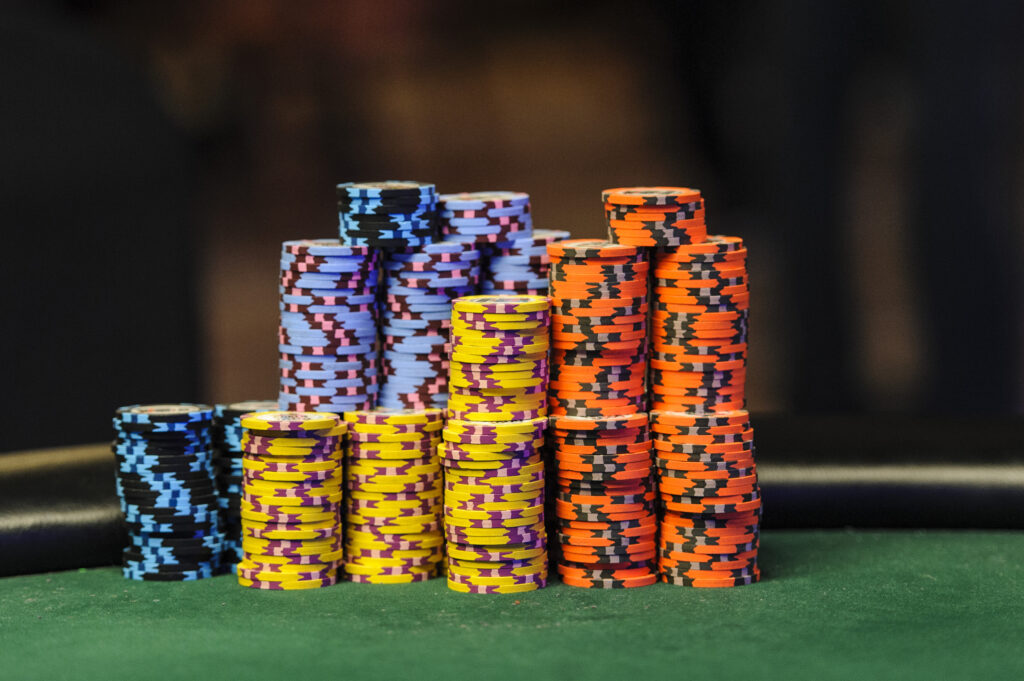
Another thing that is not a part of the official poker rules but is an important part of poker etiquette is the way you stack your chips.
While complete amateurs get away with stacking their chips any which way, experienced players are expected to stack their chips correctly.
What I mean by correctly is in a stack of 20, with big chips on top or in front of the small chips, and without mixing the colors.
Appropriate chip stacking will help others know how many chips you have, speed up the game, and ensure that you are not accidentally angle-shooting your opponents.
While cash game players often ignore this poker etiquette rule, stacking chips the right way is important in both cash games and tournaments, although bigger stacks of 40 or 50 chips are often the norm in deep-stacked live cash games.
#5 – Don’t String Bet
A string bet occurs when a player announces or places a bet in multiple separate motions rather than pushing the full amount forward in a single, continuous action. In live poker, all chips in a bet must be moved into the pot at once. If you place part of your bet, pause, and then add more chips, the dealer will typically rule that your bet is limited to the first amount you moved.
I have seen string bets cause real confusion and conflict at the table, most often when a player is trying to gauge a reaction before committing to a full bet size. Even when done accidentally, it looks like an angle shoot.
The clean solution is to either announce your bet size verbally before moving chips or push the entire amount forward in one smooth motion. If you are making a raise, say “raise to [amount]” before touching your chips, and the rest takes care of itself.
#6 – Don’t Act Out of Turn
Acting out of turn means folding, calling, or raising before the action has officially reached you. In live poker, this is one of the most disruptive mistakes a player can make, because it gives information to players who have not yet had to make their decision. If you fold prematurely, the player to your right may get a free pass on a bet they otherwise would have had to face resistance on.
I understand the impulse: you look at your cards, you know you are folding, and you want to move on to the next hand. But that impatience has a real cost for the integrity of the game.
Train yourself to keep your cards on the table and your hands still until the action has clearly reached you. The dealer will let you know when it is your turn, and acting two seconds later will not meaningfully slow the game down.
#7 – Be Gracious in Victory and Defeat
Handling the swings of poker with composure is a skill, and like most skills in poker, it can be practiced and improved. I have had sessions where I lost buy-in after buy-in to what felt like an endless stream of bad beats, and the discipline required to stay calm, stay polite, and stay focused is genuinely hard-earned.
What I have found is that the players who maintain that composure in the worst moments are also the ones who consistently make better decisions in the next hand, while players who blow up emotionally almost always leak chips afterward.
Poker rooms can get quite rowdy at times, and more often than not, the chaos ensues when a player loses or wins a big pot.
Poker etiquette cuts both ways when it comes to being gracious, as it is critical to remain composed both when you are winning big and when you are losing.
When you win a big pot or are on a massive heater, try not to talk too much, be aware of the tone of your voice, and try not to give anyone any lectures as to how they should have played their hand.
On the other hand, if you are losing big, do your best to keep your emotions in check, never throw cards or chips and the dealer or other players, and never raise your voice too much or swear out loud.
While we all make mistakes and sometimes do things in the heat of the moment, acting emotionally at the poker table too often will make you look like a clown.
If you feel like your emotions are getting the best of you, leave the table and come back when you are composed and ready to play the game without unnecessary outbursts.
#8 – Wait for the Hand to Finish
This rule matters more than most players realize, because the damage from mentioning a folded hand during an active pot is not always obvious. I have watched players give away critical information without any intention of doing so, simply by commenting on the action while a hand was still in progress.
Even a facial reaction, a sigh, or a glance at the board can influence a player’s decision. The safest rule is simple: when you are out of a hand, stay completely out of it until the cards go in the muck.
There is nothing worse than being in a hand, pulling a big bluff, and hearing another player at the table who is not involved in the hand say something like: “Well, I folded the Ace of clubs.”
While players often do this completely oblivious of what it could mean for other players, it can literally make the difference between someone winning or losing a monster pot.
For instance, the Ace of clubs I mentioned above might be the nut flush card, and another player might have a much easier time calling you with a weaker hand if they know the Ace of clubs can’t be in your hand.
For this reason, and many others, you should never discuss what you folded or anything else about an active hand until the moment the hand is over and cards are in the muck.
Even when two players go to showdown and turn over AK and QQ, saying “I folded a King” out loud, whether it’s true or not, is considered bad poker etiquette.
#9 – Don’t Hit and Run

The hit-and-run question comes up a lot in poker circles, and I think the answer depends on what kind of poker player you want to be. If you are a professional playing for long-run EV, the math technically says your obligation ends when the hand is over.
But if you care about having access to the best games with the most recreational players, leaving immediately after tripling up sends a message that sticks. I generally make it a practice to stay for at least an hour after a significant win, and I think most players who care about their table image should do the same.
Hit and Run is a name poker players use to describe a player coming into a cash game, winning one or two big pots, and immediately cashing out their chips.
While it is technically allowed in public poker games, a hit-and-run is considered an unethical way to play poker, although many professional poker players don’t care too much if you do it.
Recreational poker players hate seeing a Hit and Run as they feel you have swindled them out of their money without giving them a chance to win it back.
So, the next time you sit down at the poker table and triple up right away, stick around for a while, play some more hands, and get involved even as the big stack.
At the end of the day, the results will even out, and you sticking around won’t hurt you too bad, while your reputation will stay intact, and you won’t be the player no one enjoys playing with.
#10 – Don’t Collude
Collusion is the act of playing “in tandem” with other players in order to help yourself and that player at the expense of others.
Collusion is especially unacceptable in tournament poker but is equally as bad in any multi-way pot in a cash game.
I have seen collusion in poker tournaments more often than I care to admit, and it is one of the worst things you will see in a live poker room.
What’s worse than players constantly dumping chips to each other, checking it down to a showdown with monsters, and deliberately making sure they don’t bust their buddies from the event?!
If you enter a poker game, leave all friendships at the doorstep, but don’t forget to pick them back up the moment cards are in the muck and the action is over.
Don’t expect your friends to soft-play you, don’t soft-play them, and forget about collusion unless you want to be both penalized by the floor man and hated by every other player in the room.
#11 – Tip When Tips Are Due
Tipping is one of those topics where I see very smart poker players make a socially costly mistake. Some players treat every dollar in tips as a direct leak from their win rate, and technically they are right.
But dealers work long shifts for modest pay, and the culture of tipping in most live poker rooms is well-established. In my experience, players who tip fairly and consistently are treated better by dealers over the course of a session, get more attentive service, and are generally more welcome in the games they want to play. The cost of appropriate tipping is real but small; the benefit to your table relationship is significant.
Tipping is another highly contentious issue in some poker circles, and there are definitely players who never tip, as well as those who tip way too much.
If you want to follow proper poker etiquette, don’t fall into either one of these groups and tip reasonably, at the right time, and without flaunting it.
If you win a poker tournament, a tip of anywhere up to 5% is considered gracious, although this certainly doesn’t apply to the biggest scores out there.
In cash games, tipping when you win a big pot or throwing a few dollars the dealer’s way, even when you are losing, will be highly appreciated.
On the other hand, if you find yourself at a table with a drunk millionaire throwing hundreds at the dealer and making you feel bad, completely ignore the joker and keep doing what proper poker etiquette demands.
#12 – Don’t Tell Bad Beat Stories
Every poker player has a collection of brutal bad beat stories, and every one of those stories has exactly one interested listener: the person telling it. I have sat through countless sessions in which one player monopolized the table’s attention with a replay of a hand from three months ago, and I can tell you that nothing drains the energy of a poker room faster.
If you suffer a bad beat, you are allowed a sentence or two. “Wow, that was unlucky” is fine. A five-minute breakdown of the hand from preflop action to river outcome, including the pot odds analysis and the stats on how often your opponent should have folded, is not. Save the full debrief for your poker study group or your coach. At the table, take a breath, post your blind, and play the next hand.

#13 – Be Kind to the Dealer
The dealer has no control over the cards, no stake in the outcome of any hand, and no ability to change a result that has already been dealt. I cannot think of a less productive outlet for frustration than blaming the dealer for a bad beat, and yet it happens constantly in live poker rooms.
Beyond the obvious fact that it is unkind to someone doing their job, berating a dealer makes the table uncomfortable for everyone around you, including the recreational players you most want to keep in a good mood and having fun.
Dealers will also remember how you treat them, and consistent rudeness tends to earn a reputation that travels through a poker room quickly. Be patient with dealer errors, which are rare, correct them politely, and treat the person across the table from you like a professional doing their job under pressure.
#13 – Be Considerate to Others
Live poker rooms are often crowded, with dozens or even hundreds of people in the same space and other players sitting very close to you.
I love my personal space as much as the next guy, but it is important to understand that in a poker room, we each only get so much of it, and we need to be considerate of others.
Make sure to sit in your seat without taking up the space to the left or right of you, be careful with your hand movements and gestures, and above all, make sure to show up to play poker in clean clothes, showered, and groomed.
While there is no rule saying you have to shower after your workout and before a poker session, showing up sweaty and sitting in your seat for hours will make other players uncomfortable and make you seem like a slob.