Many players feel reasonably comfortable with opening ranges and preflop GTO rules, but once the flop hits, decisions feel complex.
The good news is that postflop GTO is not about memorizing solver trees. It is about understanding a few core principles that explain why certain actions are profitable while recognizing when real opponents deviate from those assumptions.
This article breaks down the foundational principles of GTO postflop play and the most profitable postflop adjustments you can make in small stakes games.

Core GTO Postflop Principles
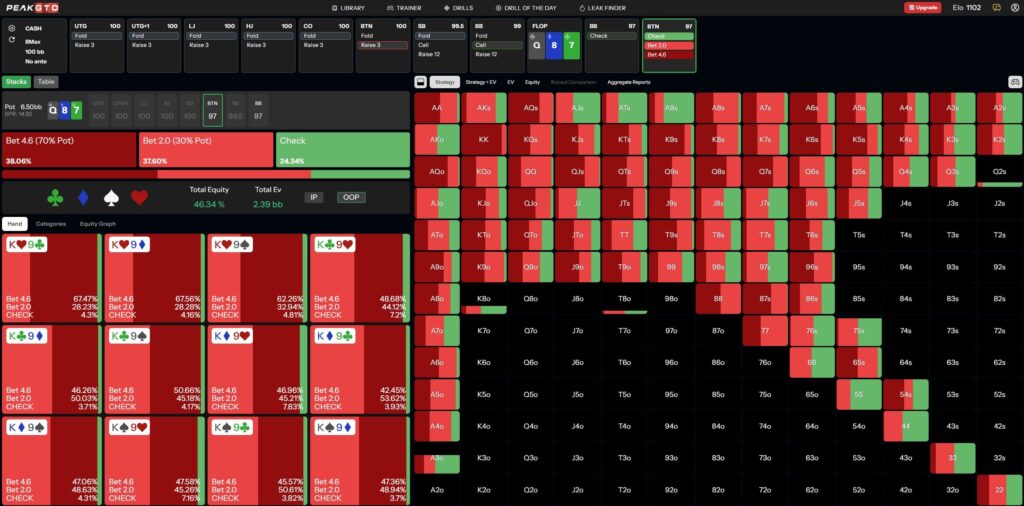
GTO postflop strategy aims to make your range difficult to exploit across all board textures and bet sizes. Instead of focusing on individual hands, it focuses on range vs range interactions.
Before talking about adjustments, it’s essential to understand what GTO is trying to accomplish after the flop.
Range Advantage and Nut Advantage
One of the most important GTO concepts is that not all players arrive on the flop with equal ranges.
- Range advantage means one player has more overall equity across all hands.
- Nut advantage means one player has more of the strongest possible hands.
These advantages dictate who should bet more often and who should check more frequently. For example, preflop aggressors usually retain a range advantage on high-card boards, while callers often have more nut combinations on low, connected boards.
GTO uses these advantages to determine betting frequency and sizing, but not individual hand strength alone.
Betting Frequencies Over Hand Strength
A common misconception is that GTO bets only strong hands. In reality, GTO bets ranges, not hands.
On boards where one player has a clear range advantage, solvers often recommend betting very frequently using small sizes, even with weak hands. The goal is to apply pressure efficiently while protecting checking ranges.
This is why GTO strategies often include:
- High-frequency small c-bets
- Checking strong hands on certain boards
- Betting weak hands that have little showdown value
Polarization on Later Streets
As the hand progresses, GTO strategies become more polarized. By the turn and river:
- Strong hands bet for value
- Weak hands bluff
- Medium-strength hands often check or call
This polarization ensures that betting ranges remain protected and opponents cannot exploit one-sided aggression.
Indifference and Bluffing Theory
At equilibrium, bluffs are chosen so that opponents are indifferent between calling and folding. This requires precise bluff-to-value ratios and careful hand selection based on blockers and equity removal.
This concept is central to GTO, but it is also where real-world opponents deviate the most.
Common Population Tendencies & Profitable Postflop Adjustments at Small Stakes
Many small stakes player repeat the same mistakes whether playing live or online, so you can exploit them by applying pressure where it matters the most.
Here are the most common patterns you should be looking for:
- They call too often on the flop
- They fold too much on the turn and river
- They under-bluff missed draws
- They rarely turn medium-strength hands into bluffs
As a result, balanced bluffing strategies often lose money, while value-heavy lines outperform theory.
Tip 1. Bet Less Frequently, But With Clearer Purpose
GTO often recommends frequent c-betting on favorable boards. In small-stakes games, however, players tend to call too wide on the flop and make poor folding decisions later.
A profitable adjustment is to:
- Reduce low-equity, automatic c-bets
- Bet when you have equity, value, or a clear plan
- Check more often with weak hands that have little fold equity
This results in fewer bloated pots with marginal holdings and more controlled decision trees.
Tip 2. Value Bet Much Thinner and More Often
One of the biggest leaks at small stakes is missing value.
Many players are overly cautious with hands like top pair weak kicker, second pair, or overpairs on safe boards. GTO may mix these hands between betting and checking, but against calling-heavy opponents, betting becomes clearly profitable.
Value betting thinner works because:
- Opponents overcall with worse hands
- They struggle to fold pairs
- They rarely raise without strong holdings
Tip 3. Bluff Far Less on the River
GTO river strategy relies on opponents folding correctly. Small-stakes players often don’t.
Missed draws rarely get turned into bluffs, and many players simply “want to see it.” As a result, river bluffs are often negative EV unless you have strong evidence otherwise.
A profitable exploit is to:
- Bluff selectively on the river
- Favor smaller, targeted bluffs
- Give up more often with missed hands
Folding a missed draw is not a mistake. Bluffing it into a calling station is.
Tip 4. Over-Fold to Aggression, Especially on the Turn and River
Just as preflop 3-bets are under-bluffed, turn and river aggression at small stakes is usually value-heavy.
When players:
- Check-raise turns
- Lead rivers
- Overbet without history
They almost always have strong hands.
GTO demands defending at certain frequencies, but, in practice, folding more often preserves money and reduces variance. Hero calls feel good—but disciplined folds win more over time.
Tip 5. Simplify Multiway Pots
GTO theory largely focuses on heads-up pots. Small-stakes games frequently go multiway, where GTO assumptions break down entirely.
In multiway pots:
- Bluff far less
- Value bet stronger hands
- Check marginal holdings more often
Ranges tighten naturally when more players are involved, and aggression should decrease accordingly.
Conclusion: Postflop Success Comes From Discipline, Not Complexity
Postflop poker does not need to be complicated to be profitable.
By understanding the core goals of GTO postflop strategy and recognizing where real opponents fail to meet those assumptions, you can make simple, disciplined adjustments that dramatically improve results.
Bet thinner for value. Bluff less without evidence. Fold more to strength. Keep pots simple.
That’s not just good exploitative poker—it’s good poker, period.