
PLO (Pot Limit Omaha) is a poker variant where each player receives four hole cards instead of two and must use exactly two of them, combined with exactly three community cards, to form their best five-card hand.
Unlike No-Limit Hold’em, the maximum bet at any point equals the current size of the pot. I have been playing and coaching PLO for years, and the single most important thing I tell new players is this: PLO looks like Hold’em on the surface, but it plays completely differently.
Internalizing the two-card rule is the first step, because players who treat PLO like Hold’em consistently overvalue weak made hands and severely underestimate their opponents’ drawing equity.
That said, PLO games tend to be juicier and more fun than Texas Hold’em, so there is a lot of incentive to learn Pot Limit Omaha rules and join the fastest-growing poker game in the world.
If you are looking to start at the very beginning, we offer a full guide to PLO rules from the moment the first card is dealt to the showdown.

- PLO vs Texas Hold'em: The Key Differences
- Dealing and Betting Rounds in PLO
- Player Actions in Pot Limit Omaha
- Specific PLO Rules to Remember
- PLO Hand Rankings
- PLO Hand Example: Why the Two-Card Rule Changes Everything
- 3 PLO Strategy Principles Every New Player Needs
- Pot Limit Omaha Rules Summary
- Pot Limit Omaha FAQ
PLO vs Texas Hold’em: The Key Differences
Most players learn PLO after Texas Hold’em, and the biggest early mistakes come from carrying Hold’em intuitions into a game where those intuitions actively hurt you. Here are the differences I emphasize most in coaching sessions:
| Feature | Texas Hold’em | PLO (Pot Limit Omaha) |
|---|---|---|
| Hole cards | 2 | 4 |
| Cards you must use | 0, 1, or 2 from hand | Exactly 2 from hand |
| Board cards used | 3, 4, or 5 | Exactly 3 |
| Maximum bet | Any amount (no-limit) | Equal to pot size |
| Average winning hand strength | Lower (pairs often win) | Higher (two pair frequently loses) |
| Draw equity | Lower (2-card draws) | Higher (4-card draws hit more often) |
The most dangerous assumption a Hold’em player makes in PLO is that top two pair or even top set is a “monster.” In Hold’em, flopping top two pair is often the best hand and a large favorite. In PLO, four-card hands give every player in the field more ways to make straights, flushes, and two pairs. What crushes the field in Hold’em often barely holds on in PLO.
The two-card rule is also the source of the most common rule error I see from new PLO players: using three hole cards and two community cards, or using one hole card and four community cards. If you ever find yourself claiming a hand using those card counts, your hand is dead. You must use exactly two and exactly three.
Dealing and Betting Rounds in PLO
In many ways, PLO is a poker game similar to Texas Hold’em. If you are already familiar with basic poker rules, the dealing and betting rounds in PLO will be quite familiar, but we will go over them just the same.
If you are completely new to poker or have only ever played variants like Stud and Draw, then you will want to pay attention and learn this part too.
To start a hand of PLO, every player is dealt four cards face down. These are called hole cards, and they remain hidden from other players for the duration of the hand.
To get the action started, the two players seated to the left of the dealer button place a predetermined small blind and big blind, respectively. These blind bets are set in place to entice further action, much like in other forms of poker.
Once all the hole cards are dealt, players take turns acting on their cards in the first betting round, which is called “preflop.”
In this betting round, the player to the left of the big blind acts first, while the big blind acts last. In all other rounds, it is the player with the dealer button who acts last, while the player who posted the small blind goes first.
Once all the players act on their hand in the preflop betting round, the dealer deals out the first three community cards in the middle of the table, face up. These cards are there for everyone to use, and they are used in combination with the hole cards to create the best poker hand.
The first three community cards are called “the flop,” and they are followed by another betting round, with active players once again taking turns to act on their hands around the table.
Once all the flop actions are completed, the next community card, called “the turn,” is dealt on the table, followed by the third betting round.
Finally, a fifth community card, called “the river,” is dealt onto the table, with the last betting round following to end the action.
The ultimate goal of the game of PLO is to create the best possible poker hand using a combination of exactly three community cards and exactly two hole cards.
While Texas Hold’em players may be used to combining their hole cards and community cards in any fashion they choose, PLO rules dictate that you can only use two cards from your hand and three cards from the table to make your five-card hand.
But before we can get to the stage where hands are shown, we need to understand all the actions that can be taken in each of the betting rounds, so let’s elaborate on those.
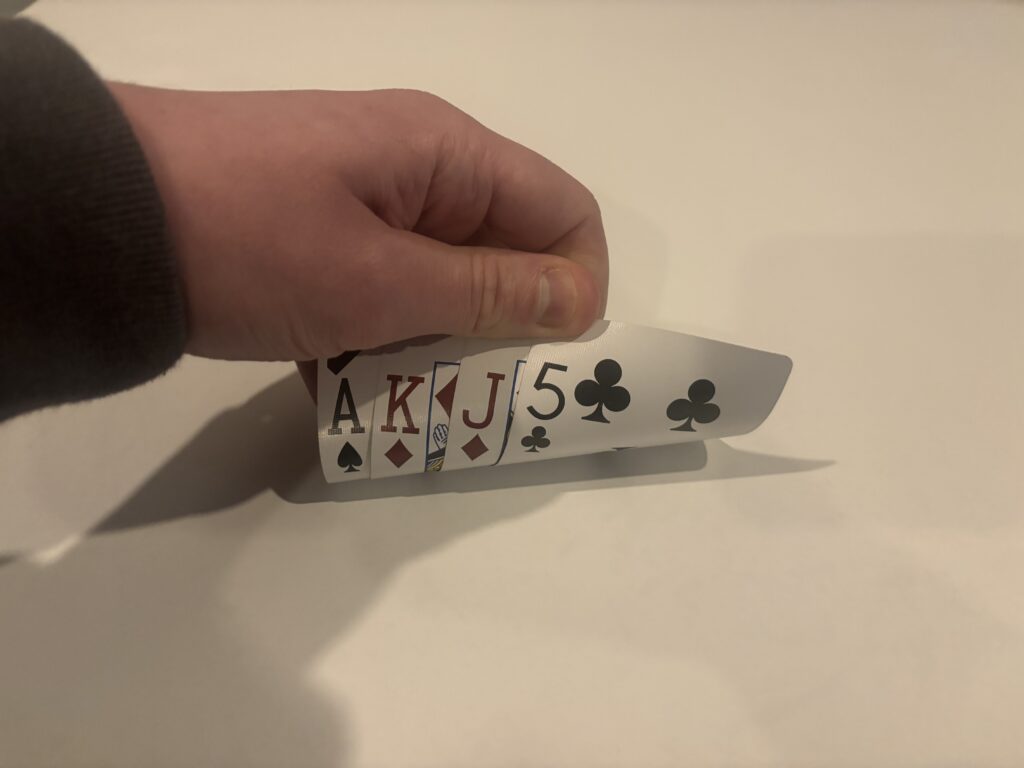
One of the biggest differences between PLO and NLH is the amount of cards you are dealt.
Player Actions in Pot Limit Omaha
In the previous section, we explained that there are four betting rounds in the game of PLO and that players are given a chance to act on their hand in each of these betting rounds, also called streets.
But what are those actions, and how do they affect the play? Here is a quick overview of all the possible actions in PLO:
- Call: You match the value of the previous bet. Preflop, this will mean calling the value of the big blind if there is no other action in front of you. After the flop, you will be able to call any bet made by another player.
- Raise: Before or after the flop, you increase the size of the bet to your chosen value. Keep in mind that you can only raise up to the size of the pot in PLO, and no more.
- Bet: After the flop, if there is no action before you, you make the first bet for that betting round. You can only bet up to the size of the pot in PLO.
- Check: After the flop, you choose not to make the bet and simply relinquish the action to the next player at the table.
- Fold: You throw away your hole cards without having to pay any additional chips. Once you have folded, you will no longer participate in the hand in any way.
- All-In: If the pot is big enough, you may be able to bet all your chips on a given betting street. Once you are declared all-in, you won’t have further action until showdown, when you must turn your cards over at the instruction of the dealer.
It is worth noting that some of the actions are not available in the preflop betting round, with both bet and check only becoming available once the flop is dealt out, simply because the big blind already puts an active bet into play, making it impossible to either check or make the first bet for that betting round.
There is only one exception to that. This comes if no one raises before the flop but merely calls, known as limping, which gives the player sitting in the Big Blind the option to check and see the flop. Other than that, betting and checking are considered postflop actions.

PokerCoaching.com coach Adam Hendrix crushes PLO when not playing NLH.
Specific PLO Rules to Remember
These are the rules I see overlooked most often by players transitioning from Hold’em. The first two are responsible for the majority of disputes and errors I observe at the table:
- Pot Limit Betting: All betting in PLO is limited to the size of the pot. Whether you are betting or raising, the size of the pot will determine the maximum you can put into the pot. If you don’t know the size of the pot, the dealer will help you.
- Four Hole Cards: It can be a bit scary to play PLO for the first time, as the hole cards just keep on coming. PLO is played with four hole cards instead of two, so try to get used to the notion.
- Only Two Hole Cards Play: At showdown, you are required to use exactly two hole cards and three community cards to make your hand. You cannot make a flush with one hole card or use three cards from your hand to form a full house.
That’s just about it! All other PLO rules resemble those of Texas Hold’em very closely and transitioning over will not be too hard once you get accustomed to these three rules.
However, while the rules of PLO and Texas Hold’em may be very similar, the strategy needed to win at PLO is quite a bit different, which is why we recommend making a slow transition and studying PLO extensively before playing for significant stakes.
PLO Hand Rankings
Pot Limit Omaha uses the standard poker hand rankings that are shared among games like Texas Hold’em, Seven Card Stud, and Five Card Draw.
Yet, if you are new to poker as a whole and don’t know the hand rankings just yet, here is a quick look at all the possible hand combinations from strongest to the weakest, along with a quick example of each:
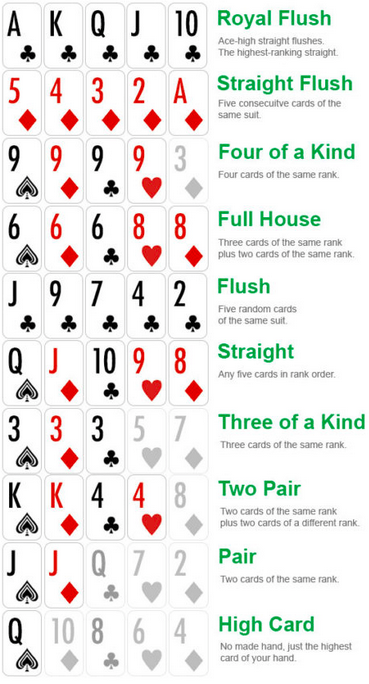
Note that many of the card combinations listed here don’t include all five cards you need to make a full poker hand.
In case two or more players have the same hand combination (for example, one pair of Aces), the remaining cards are the ones that decide the winner, from highest to lowest.
Your highest remaining card is called “the kicker” and can be quite important in certain scenarios if both you and another player share the same hand strength at showdown.
PLO Hand Example: Why the Two-Card Rule Changes Everything
Here is a hand from a $5/$10 PLO cash game that shows why experience from Hold’em does not always translate directly to PLO.
I held A♥A♦K♣Q♦. In Hold’em, aces are simply the best starting hand. In PLO, I value this hand because of how many strong combinations it can form: top set with the aces, the Broadway nut straight with A-K-Q combined with board connectors, and high pair combinations with K-Q.
The flop came A♠J♣T♦. In Hold’em, flopping top set on A-J-T would be extremely close to a lock. In PLO, I had to think more carefully: my opponents each hold four cards, which gives them far more ways to make straights and two pairs on a connected board like this one.
I took stock of my own hand: A♥A♦ from my hole cards combined with A♠J♣T♦ on the board gave me top set (three aces). At the same time, K♣Q♦ from my hole cards combined with A♠J♣T♦ gave me the Broadway nut straight (A-K-Q-J-T). I held both simultaneously, which is one of the most powerful positions you can be in PLO.
I made a pot-sized bet. One player called. The turn was 4♥, a blank. I bet pot again. The same player called. The river came 2♠, another blank. I made a final pot-sized bet and my opponent mucked.
The lesson from this hand: in PLO, you want to be drawing to the nuts or holding the nuts. Players who chase non-nut hands in PLO are regularly paying off the nuts. The connected A-K-Q-J hand type I held works in PLO precisely because it builds toward the best possible combination, not just a good one.
3 PLO Strategy Principles Every New Player Needs
After reviewing hundreds of PLO hands from students making the transition from Hold’em, I see three principles separate the players who adapt quickly from those who struggle.
1. Position matters more in PLO than in Hold’em. Because the pots in PLO are frequently large and multiway, acting last gives you an enormous amount of additional information before you must commit chips. I play a tighter range from early position in PLO than I do in Hold’em, and I widen my range significantly in late position. When you are out of position in a large PLO pot, you are making decisions without the information your opponent has already given you.
2. Blockers affect the nuts in ways Hold’em players overlook. In PLO, holding the J♦ in your hand when the board shows T-9-8 means you personally “block” opponents from holding Q-J (one of the nut straight combinations). This information is valuable: if you are considering a bluff or a semi-bluff, having the blocker to the nuts is a real edge. I pay attention to which nut hands I am blocking and which I am not before deciding how aggressively to play a draw.
3. Draw to the nuts, not just to good hands. In Hold’em, a flush draw to the nine is often profitable. In PLO, the same non-nut flush draw on a multiway board is frequently a losing proposition because someone else is drawing to the ace-high flush and will not fold the river. I look for draws that make the best possible hand, not just a good hand. Nut flush draws, nut straight draws, and wrap draws (four-card straights that can hit a large number of cards to make the nuts) are the draws worth committing chips to.
Pot Limit Omaha Rules Summary
If you are looking to play some PLO for the first time and you haven’t played any poker in the past, make sure to pay attention to all parts of this article and carefully examine poker hand rankings, betting streets, and our example hand.
If you are transitioning from Texas Hold’em, pay special attention to the three unique rules of PLO that make the biggest difference between the two games.
In either case, make sure to approach PLO very carefully and slowly, and don’t assume you know anything before you have played a bit and gotten fully acquainted with all the rules.
Even more importantly, don’t assume you are a great PLO player just because you are good at Texas Hold’em, as the strategy for the two games can be very different in many different situations.
Learn PLO one bit at a time and only up your stakes once you feel like you are actually getting the grasp of the complexities of Pot Limit Omaha, and have a poker bankroll as well.