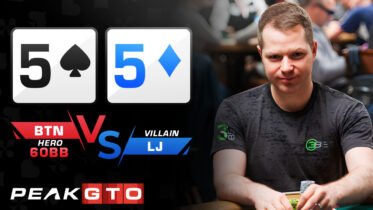

Low connected boards often create deceptive situations. At first glance, a flop like 6♠5♥ 2♦ looks relatively safe, but solver outputs reveal just how narrow the margins can be. With 5♠5♦ in hand, Hero holds middle set, which is a very strong but still vulnerable holding against LJ’s range. The following breakdown shows how GTO strategy treats this exact combo across each street and why patience on the flop, controlled aggression on the turn, and maximum value on the river create the highest EV line.
Hand setup:
- Stacks: 60bb effective
- Positions: LJ vs BTN
- Action: LJ raises to 2.2bb, BTN calls with 5♠5♦
- Flop: 6♠ 5♥ 2♦ (Pot 7.1bb)
- Turn: 2♠ (Pot 21.3bb)
- River: 8♥ (Pot 31.9bb)
Flop: 6♠ 5♥ 2♦
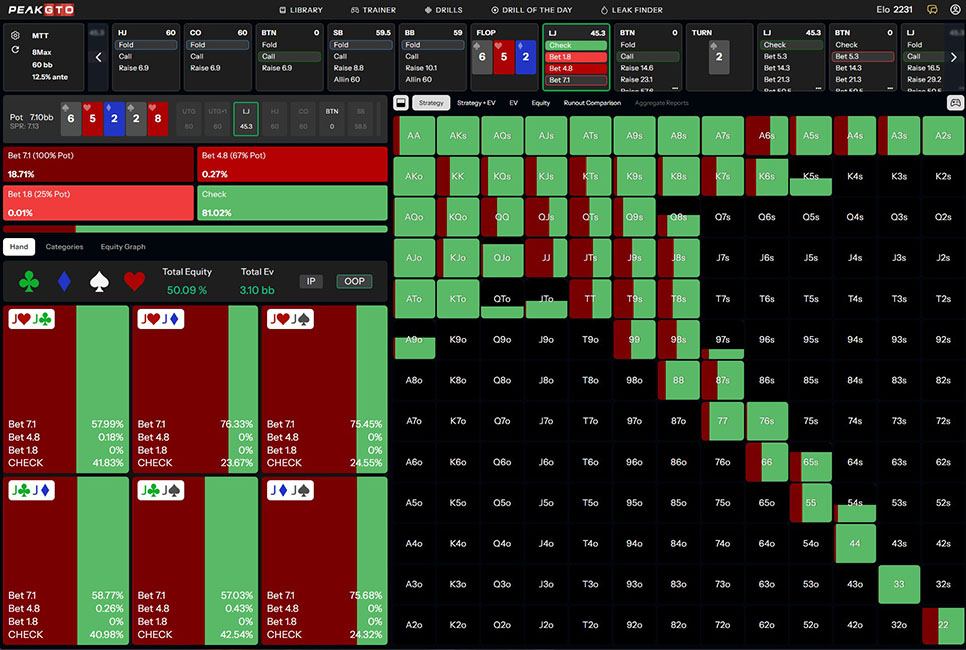
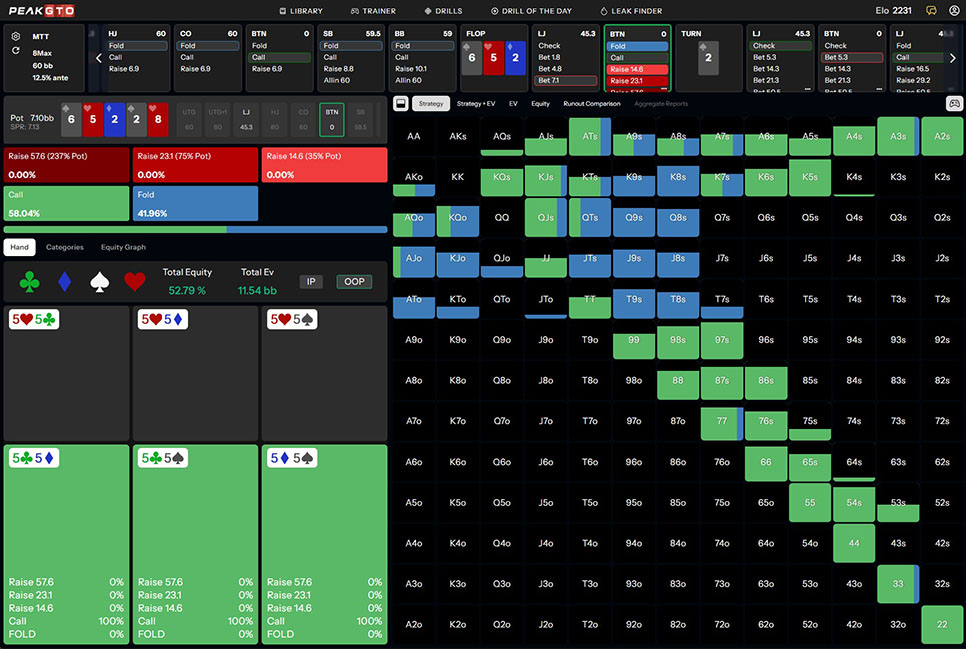
PeakGTO prefers that LJ checks on this texture about 81% of the time, betting only 19% and mostly at larger sizes. In this runout, LJ takes one of those less common lines, betting pot for 7.1bb. The solver does mix this sizing in around 18.7% of the time, generally with a polarized range.
For Hero holding 5♠5♦, the decision is clear: continue always. Solver shows BTN folding 42% of hands in this spot, but sets are never part of the folding range. Interestingly, solver does not encourage frequent raising with sets here—raising occurs at essentially 0% frequency—because calling has higher EV. The call keeps Hero’s range balanced, disguises the strength of the hand, and allows weaker LJ holdings such as overcards or semi-bluffs to keep firing on later streets. Raising would risk isolating against only the top of LJ’s range (overpairs or top set), which is unnecessary when Hero already has the effective nuts.
Turn: 2♠
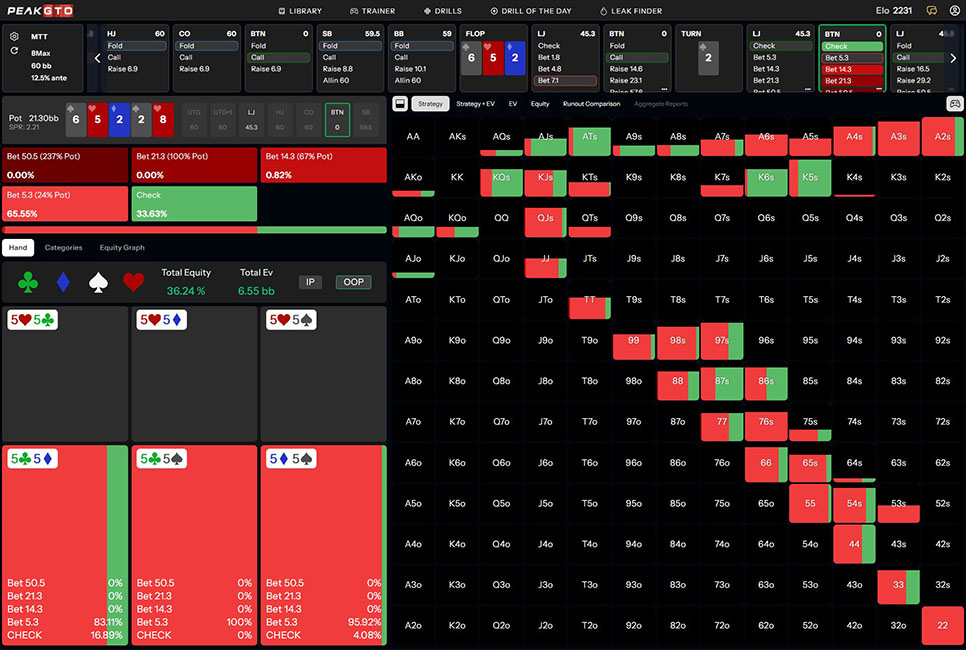
The board pairs, which is a dream card for 5♠5♦as hero now has a full house. PeakGTO shows LJ betting here 59% of the time, usually with medium to larger sizing, while checking 41%. In this case, LJ checks.
Facing the check, the solver has BTN betting at a high frequency, most commonly with the small sizing of 5.3bb (65%). 5♠5♦ falls cleanly into the value-betting region. Betting achieves multiple goals: it extracts value from overpairs like AA, KK, and QQ, gives a good price for the villain to continue with what they think is decent equity with poker hands like overcards and flush draws, and starts to build a pot for river play. Solver likes small bets here because they pressure LJ’s range while still keeping BTN’s range uncapped. By betting small, BTN forces LJ to continue with weaker holdings while obviously getting called by stronger but dominated hands.
When LJ calls, BTN maintains significant nut advantage. Full houses and quads are heavily weighted toward BTN’s range, while LJ’s check-calling range now consists mostly of overpairs, weak sixes, and draws.
River: 8♥
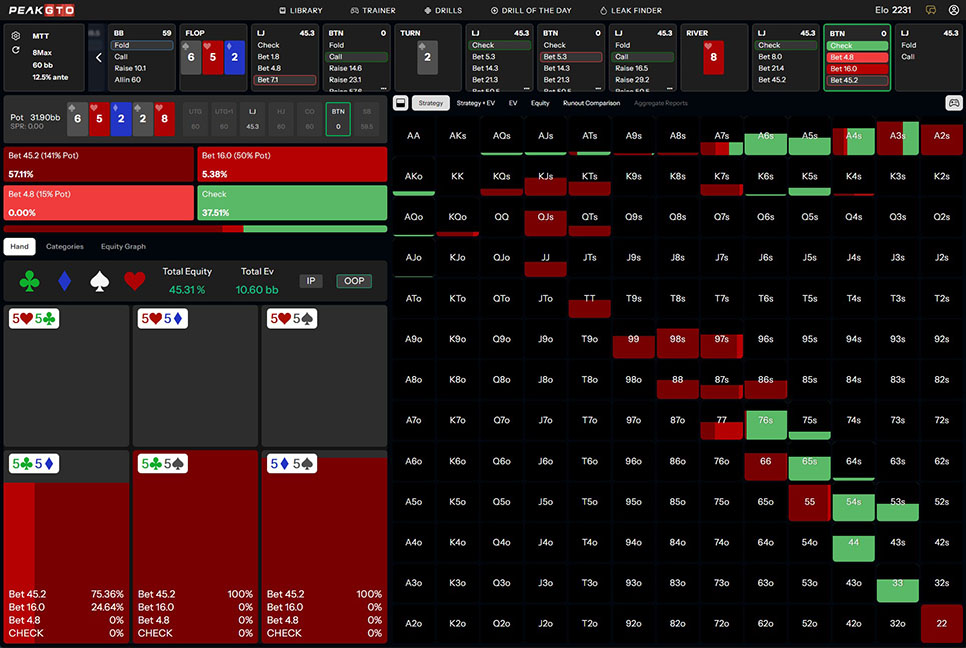
The river changes little. Some two-pair combos improve, but most draws miss. Solver shows BTN polarized here, betting big (45.2bb) about 57% of the time and checking 37%. With 5♠5♦, Hero is near the very top of the value range, making this a pure shove for maximum value.
Solver expects LJ to fold about 66% of the time, continuing only with trips, boats, and strong overpairs. This is exactly the type of range that pocket fives dominates. Jamming allows Hero to extract maximum value from hands like AA or KK, while still keeping bluffs credible in the overall strategy. By including 5♠5♦ in the value-jamming range, the solver ensures BTN’s river shoves are balanced and difficult to exploit.
Key Takeaways
- Flop: LJ bets infrequently, usually large. 5♠5♦ is a pure continue, always calling to trap and protect range.
- Turn: The 2♠ improves Hero to a full house. 5♠5♦ becomes a clear small value bet, targeting overpairs and draws while blocking quads.
- River: Solver polarizes BTN to large bets. 5♠5♦ is always a value shove, maximizing EV against LJ’s continuing range.
- Overall: With 5♠5♦, BTN holds a top-tier value hand. Solver emphasizes slow-playing on the flop, betting small for value on the turn, and shoving river blanks to achieve balance and maximum payoff.