
Most players treat short-stack play the same way they do in 100bb games. Play tight, keep it simple, hope for the best. That instinct is understandable, but it misses what is actually happening.
Short stack postflop strategy is not simpler. It is differently structured.
The ranges that reach the flop look different, the bet sizes that make sense are different, and the hands you fast-play versus slow-play flip in ways that catch a lot of players off guard. Here are the five adjustments that matter most.

Tip 1. Understand How Your Pre-Flop Range Already Changed
Before you think about postflop strategy, you need to understand what range you are actually working with.
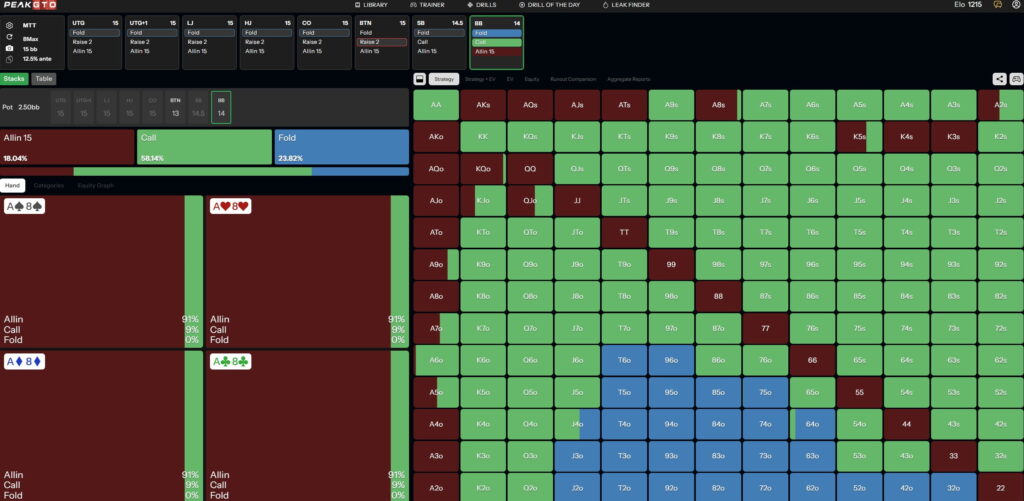
At 15 big blinds, a large portion of your stronger hands never get to the flop in the first place. Ace-x suited goes in as a shove. Ace-x offsuit goes in as a shove. By the time a flop comes down, those hands are gone from your range.
That reshapes everything.
Take a concrete example. You are in the big blind versus a button raise, 15 big blinds deep. The flop comes ace-high. At 60 big blinds, you have plenty of ace-x combinations in your calling range. At 15 big blinds, almost all of them got shoved preflop. Ace-high boards that would be neutral or manageable deeper are now genuinely bad for you from out of position.
The hands that do survive into your short-stack calling range are the suited connectors, the middle connected hands, and the hands that had no reason to shove. On the right board textures, those hands actually play quite well at short stack depths because middle pair plus a draw is often good enough to get the money in.
Before every postflop decision when short-stacked, ask yourself which hands are actually in your range given the stack depth. Some boards will hit you harder than you expect. Others will be better than they look.
Tip 2. Shift Your Bet Sizes Down
As stacks get shallower, bet sizes should come down across the board. There is a straightforward reason for this.
When you are deep, you need to build the pot aggressively on the flop and turn to set up getting all the money in by the river. You have multiple betting streets ahead of you, and a lot of money still to put in. Large bets make sense.
When you are short-stacked, you simply do not have the same problem. There is not much money left behind. Smaller bets on early streets still allow you to reach an all-in by the river without oversizing early.
Here is how this plays out in practice. Consider UTG+1 versus the big blind on a 9-8-4 board:
- At 60 big blinds: pot-size bets appear roughly 50% of the time with strong holdings.
- At 25 big blinds: the largest bet size drops to 60% pot. Top pair and overpairs are bet at 60% pot and that does the same job.
You also see far heavier use of the 25% pot bet at shallow depths. Not as a weak probe, but as a legitimate, efficient sizing that keeps the stack-to-pot ratio in the right range heading into the turn and river.
A simple rule of thumb: if a spot called for a pot-size bet at 40 big blinds or deeper, shift toward 60% pot at 25 big blinds or shallower. Stop defaulting to large bets when short-stacked. You do not need them.
Tip 3. Fast-Play Your Vulnerable Strong Hands
At deeper stack depths, a top pair with a mediocre kicker is often a check-call from out of position. You are not thrilled about playing for stacks with it, your stack-off threshold is high, and letting your opponent keep betting into you has some value.
At 25 big blinds or fewer, that reasoning falls apart.
Top pair is a hand you are genuinely happy to get all in with at short stack depths. Getting outdrawn is far less costly because the stacks are shallow. Draws chasing you do not have the implied odds to justify calling. Your stack-off threshold is low, and the priority becomes winning the pot now.
Here is how this looks in practice. Button raises, big blind calls, flop comes king-ten-five, big blind checks, button bets 25% pot.
- At 60 big blinds: the big blind check-raises for value with king-jack and better. Weaker kings just call along.
- At 25 big blinds: all king-x hands are raising some portion of the time. The sizing also comes down. Instead of a 75% pot check-raise, the right size is closer to 40% pot. If they bet 1.5 big blinds, you raise to around 4 big blinds.
The reason to fast-play vulnerable strong hands when shallow is to deny equity. You want to charge draws, prevent cheap cards, and avoid giving opponents free EV against you when you are ahead and happy to be all in.
Tip 4. Check-Raise Nearly Twice as Often
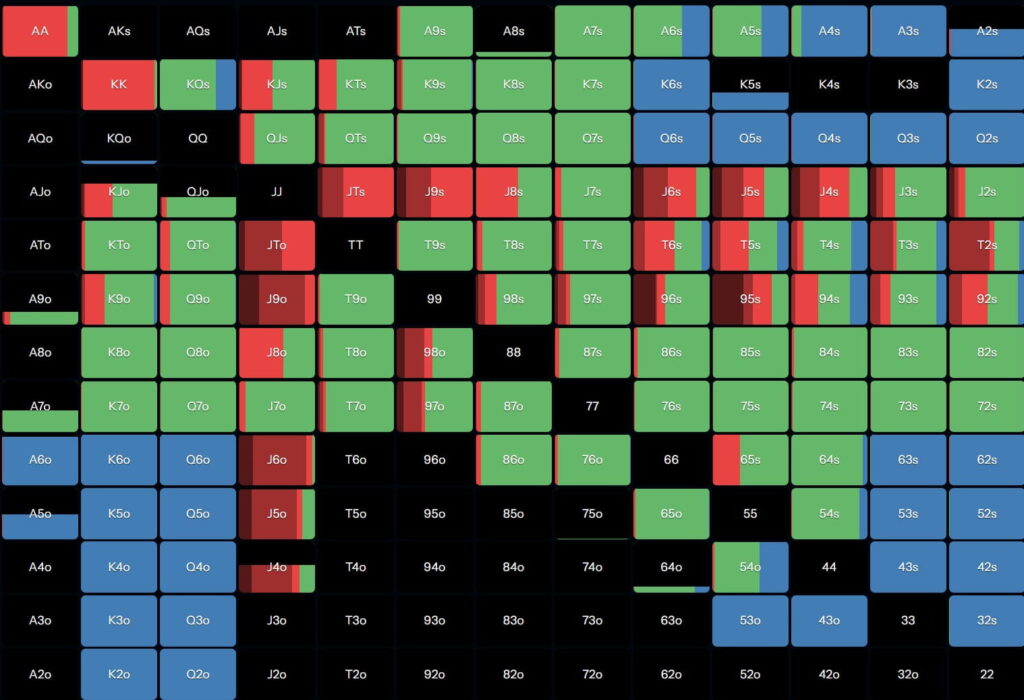
One of the biggest adjustments in short-stack postflop play is how often you check-raise.
At 60 big blinds, a typical out-of-position check-raise frequency runs around 12% of hands, depending on the board texture. At 25 big blinds, that number jumps to around 23 or 24%. Nearly double.
This follows directly from the previous point. When more of your range is happy to play for stacks, your value check-raise range expands. A wider value range means you can support more bluffs alongside it without the range becoming unbalanced.
The sizing comes down here, too. Raising from 1.5 big blinds to 4 big blinds is completely correct short-stack play. The goal is to set up a manageable all-in on the next street, not to win the pot immediately with one big sizing.
If you are only check-raising with near-nut hands at shallow stack depths, you are playing too passively. More hands qualify as value raises when you are short, and your bluffing frequency should grow right alongside them.
Tip 5. Slow Play Your Best Hands More Often
Here is the counterintuitive part of short stack postflop strategy. While medium-strength hands play more aggressively at shallow depths, your absolute premium holdings should trap more often.
When top pair and two pair are raising at high frequency, your opponent knows your raising range contains a lot of good-but-not-great holdings. Your true monsters, sets, straights, and top two pair now have far more room to just call and let the pot develop.
Look at how this plays out on a 9-8-5 board. Big blind versus lowjack, facing a 67% pot bet.
- At 60 big blinds: 7-6 suited (the nuts) raises most of the time. Sets and two pairs also raise some portion.
- At 20 big blinds: 7-6 suited always calls. 8-5 suited always calls. 9-8 always calls. The nutted hands are letting the opponent keep betting.
Meanwhile, the top pair hands, ace-nine, queen-nine, jack-nine, are the ones raising aggressively, often at 100% frequency. Those hands need equity protection. The nutted hands do not.
The core principle is simple. Let your best hands trap because the medium-strength hands in your range are already handling the raising. Your sets and straights do not need to pile on.
Putting It All Together
Short stack postflop strategy rewards players who understand why each adjustment exists, not just that it exists.
Your preflop range has already changed, so certain board textures hit you differently than they would deeper. Your bet sizes come down because smaller bets still accomplish the same job with less stack behind. Your vulnerable, strong hands get played fast because the stack-off threshold is low and equity denial matters more. Your check-raise frequency nearly doubles because more hands qualify for value. And your best hands trap more often because the rest of your range is already raising aggressively enough.
These spots come up constantly in tournaments and short-stack cash games. Understanding the logic behind each adjustment, rather than relying on instinct, is what separates players who thrive in short-stack spots from those who just survive them.