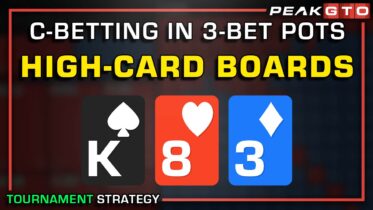

We already covered c-betting on high-card boards in single raised pots, so today we will concentrate on strategy for high-card boards in 3-bet pots.
Today, we will examine different board textures to identify strategy after 3-betting preflop and summarize key takeaways for each section.
Key Takeaways 45-second read
- High-card boards in 3-bet pots favor the aggressor. Whether in or out of position, c-betting small and often keeps pressure on capped ranges and maximizes fold equity.
- In position at 40bb, c-bet 85% of hands on dry flops like Ks8h3d. Always use a small 25% pot sizing. Check only weak Ax, pocket pairs, and middle connectors.
- In position at 20bb, strategy simplifies, mostly shove or call. Polarize your range by jamming medium-strength hands and flatting top and bottom ranges.
Show all 5 takeaways
- Out of position at 40bb, c-bet nearly your entire range (94%) with a 25% pot size. Keep aggression high to exploit your range advantage after 3-betting from the blinds.
- Out of position at 20bb, mostly call preflop and shove strong Ax and pocket pairs. If you 3-bet, still c-bet wide (83%) with a small 25% pot size to apply pressure.
C-Betting On High-Card Boards In Position – Ks8h3d
Key assumptions:
- The hand is played 40 bb deep with 12.5% ante
- Our opponent opens from the cutoff
- We 3-bet from the button
- CO calls to see the flop and checks to us
Let’s dive deeper into an example on a dry board of Ks8h3d to see our strategy in this situation.
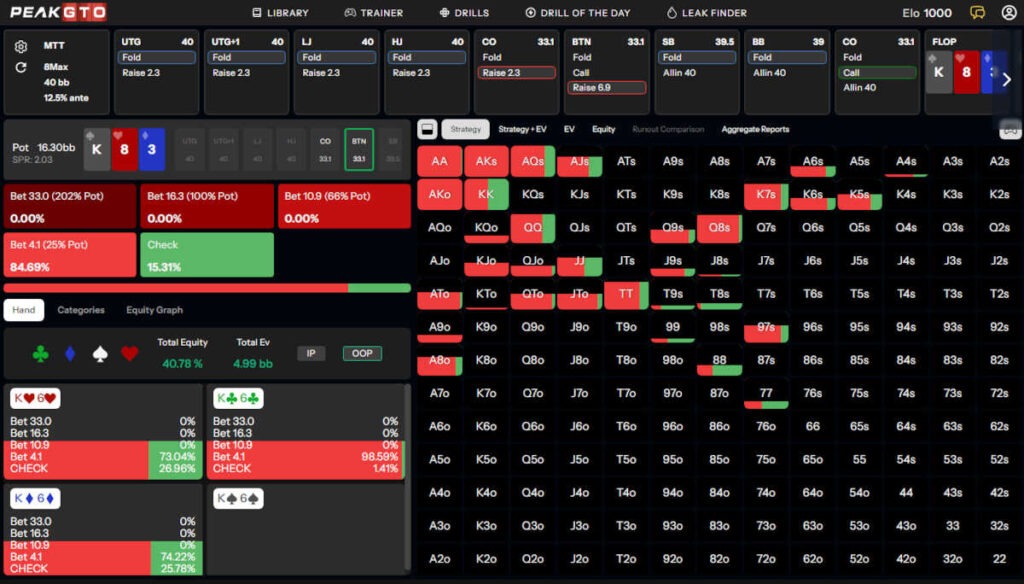
In this spot, we will be c-betting 85% of the time and picking the small bet sizing every time that we bet. The GTO strategy depends a bit on the exact board texture, but we are always c-betting the big part of our range on these dry flops.
While our checks are distributed throughout the range, we usually check some pocket pairs, weak Ax hands, and some of the connectors with second pair.
As we move down to 20bb, we mostly only call or move all-in just as on ace-high boards.
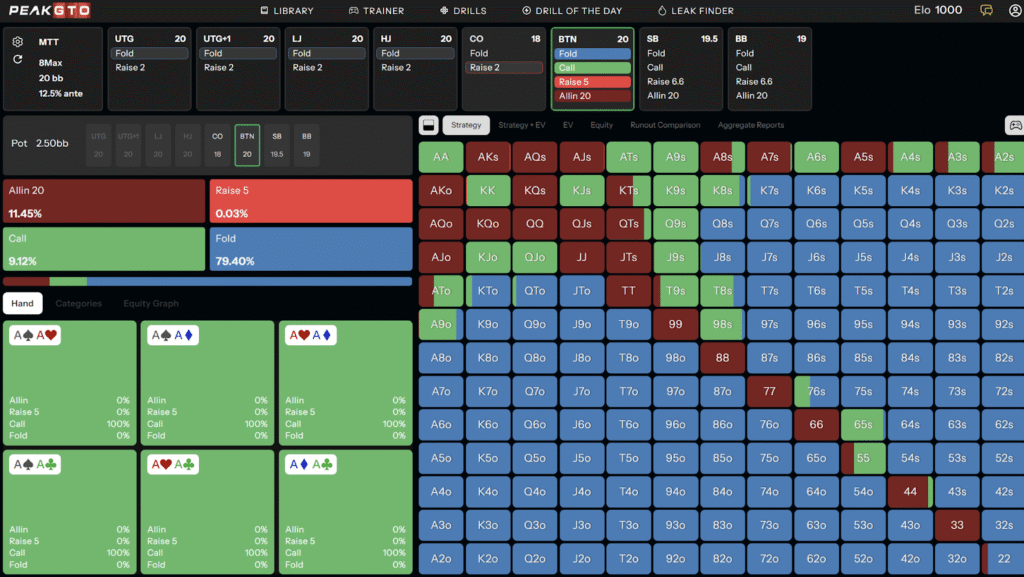
In this spot our range becomes very polarized so we call with top hands like AA or KK and the bottom part of our range, and shove everything in the middle including most pocket pairs, some strong Ax combinations, and broadways.
Key takeaways
- C-bet very aggressively on dry boards with over 85% of hands
- Always pick a small bet sizing of one-fourth the pot when continuing
- Mostly shove or call when stacks move down to 20bb
C-Betting On High-Card Boards OOP – Ks8h3d
Now, let’s look at the same hand OOP. In this case, we face an open from the BTN and we 3-bet from the BB.
Key assumptions:
- The hand is played 40bb deep with 12.5% ante
- Our opponent is opening from the button
- We 3-bet from the big blind
- The button calls
Let’s look at Ks8h3d to see how we should adjust here after 3-betting.
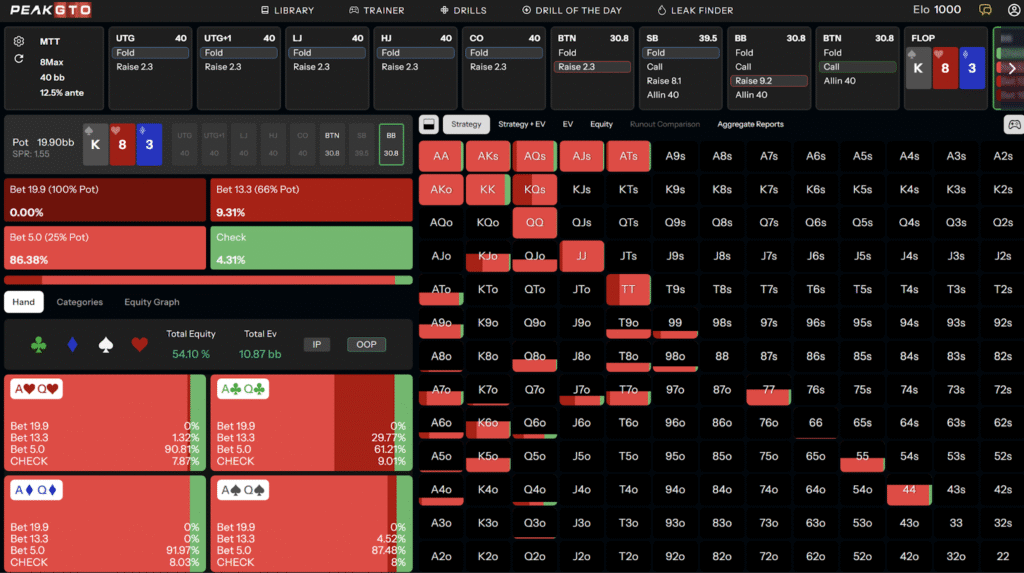
In this situation, PeakGTO suggests c-betting 94% of the time and picking small bet sizing of one-fourth of the pot in the vast majority of cases.
Since we have range advantage it simply makes sense to keep the pressure on by c-beting wide. Our checks are distributed quite evenly across the range, meaning that we check small amount of the time with most combinations.
When the stacks get down to 20bb, our strategy changes significantly.
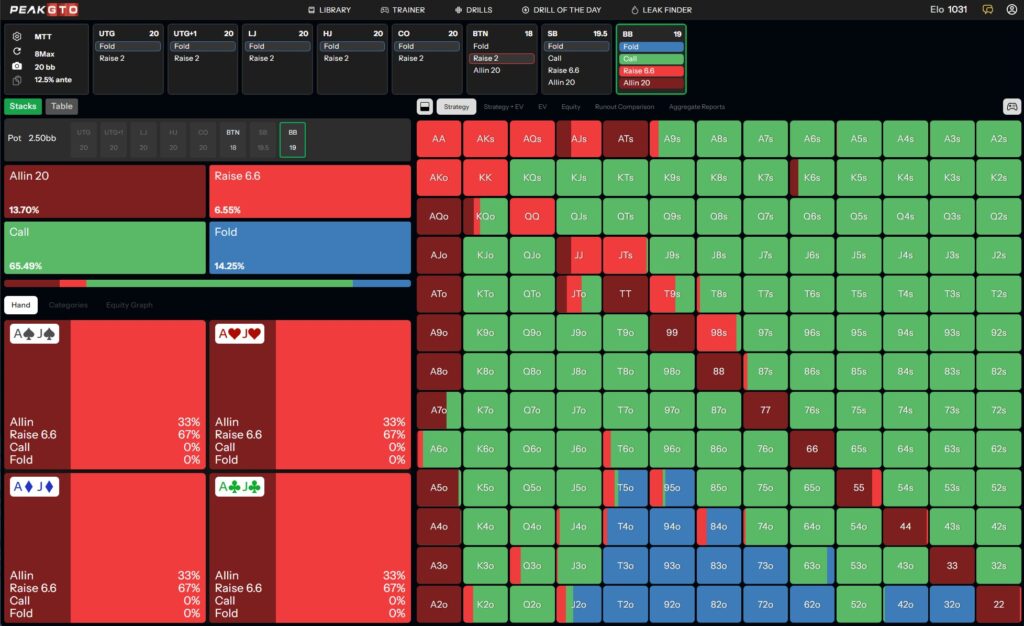
In this spot, we will be calling with 65% of the hands preflop, moving all-in with 14% holdings, and 3-betting just with 6.5% of the range.
When we do 3-bet, we will continue with a very wide c-bet again.
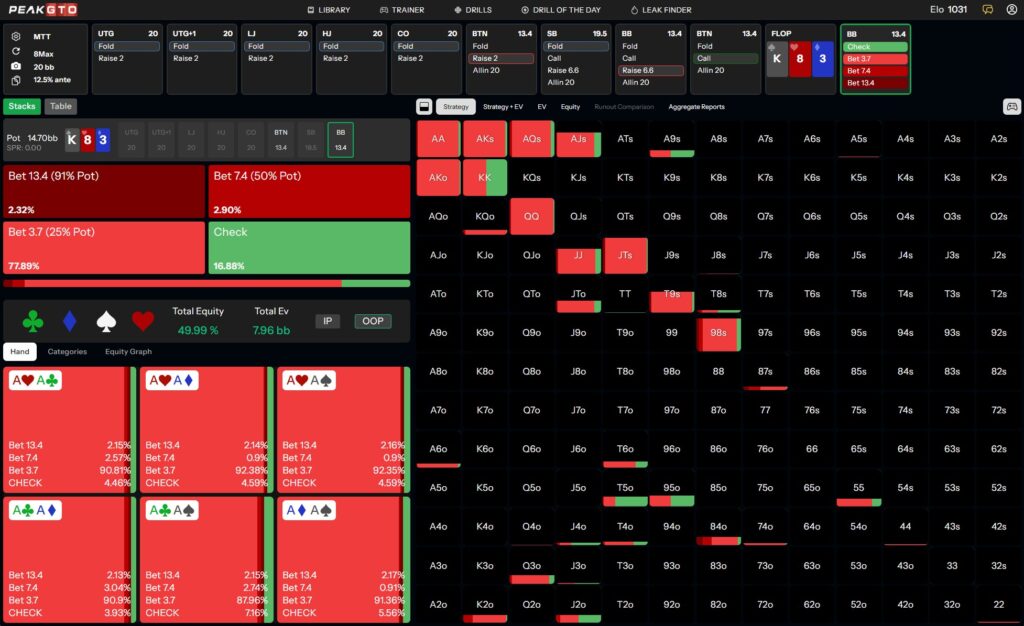
We are c-betting 83% of the time, once again sticking to 25% pot size bet in almost all situations.
Key takeaways
- C-bet almost your entire range with 95%+
- Stick to a small sizing of 25% of the pot with almost your entire range and bix in bigger bets around 10% of the time
- When stacks drop to 20bb mostly call preflop and 3-bet shove with pocket pairs and Ax hands
- If you 3-bet with 20bb stacks, c-bet small but do that with over 83% of the hands