
Three Card Poker is a casino card game where you play against the dealer using a three-card hand, with one meaningful decision each round: whether to make a play bet or fold after seeing your cards.
The dealer must have queen-high or better to qualify, and the optimal strategy is to play any hand of queen-6-4 or better and fold everything weaker. I play 3 Card Poker occasionally between longer sessions at the poker table, and what I appreciate about it is that the strategy is mathematically solved.
You cannot bluff the dealer, read tells, or outplay the table. What you can do is follow the Q-6-4 rule precisely and give yourself the best mathematical odds every time.
If you have never played 3 Card Poker and are looking to learn a new casino game, this guide covers everything you need to know in just a few minutes.
Keep reading to learn the basic Three Card Poker rules, the differences between the bets you can make, and the payouts you can expect. We also dedicated a small section to optimal 3 Card Poker strategy to ensure you get the best possible value from every hand you play.
What Is 3 Card Poker?
3 Card Poker is a casino poker game played between the player and the dealer. As the name suggests, the game is played with just three cards dealt to each party, which changes the poker hand rankings and payouts a bit from what you may be used to.
If you are transitioning from games like Texas Hold’em, where you are used to multiple betting streets, bluffing, and value betting, you will have to take a step back and realize that 3 Card Poker is a much simpler game.
In each hand, you will be dealt three cards, and your only decision point will be whether to play the cards you are dealt or not.
Before a hand is even dealt, however, you get to decide which bets you want to place, which can greatly change the dynamics and the volatility of the game.
Betting Options in 3 Card Poker
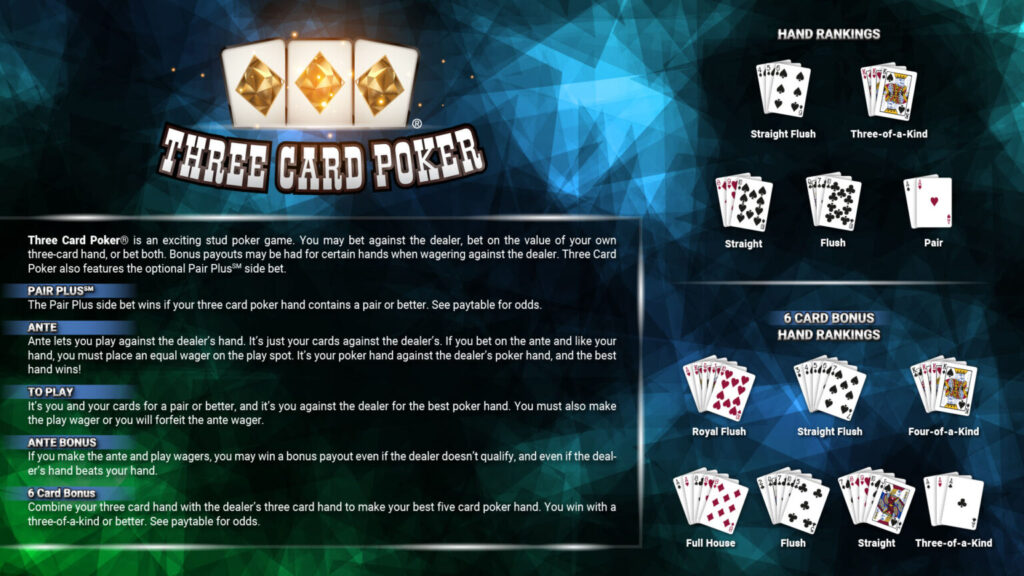
Before you can start playing 3 Card Poker, you need to understand the different betting options being offered.
Whether you play in a live or online casino, the table will have slots for the Ante and Play bets in the middle, along with Pair Plus and 6-Card Bonus bets on the sides.
The Ante bet is the only one you have to place to be dealt in, so let’s start there.
The Ante Bet
The Ante bet is the most basic bet in Three Card Poker. You will have to bet at least the table minimum on the Ante in order to get cards and play a hand.
Once the Ante bet is active, you will be dealt cards and will get to decide whether to place a Play bet or not.
If you do play your hand, you will win 1:1 on your Ante bet anytime your hand is better than the dealer’s, as well as anytime the dealer doesn’t qualify. To qualify, the dealer must have at least Queen-high.
So, if the dealer doesn’t have Queen-high or better, you double your Ante bet regardless of your hand, and if the dealer does qualify, you double your bet if your hand beats theirs.
In addition, you will receive the following Ante Bonus payouts if you make a straight, three of a kind, or a straight flush:
| Poker Hand | Ante Bonus Payout |
| Straight Flush | 5:1 |
| Three of a Kind | 4:1 |
| Straight | 1:! |
The Play Bet
The Play bet is optional. Every time you are dealt your three cards, you get to choose between placing the Play bet or folding your cards.
However, you will have to place the Play bet in order to go to a showdown. If you don’t, your cards will be folded, and you will forfeit your Ante bet.
When you do place the Play bet, your hand will be active, and the dealer will reveal their cards. If the dealer doesn’t qualify, the Play bet will result in a push, which means you will get your money back.
If the dealer does qualify, you will win 1:1 on your Play bet if your hand is better, and you will lose the Play bet if the dealer’s hand is better.
The Pair Plus Bet
The Pair Plus bet is an optional side bet that you must place before the cards are dealt. If you choose to place the Pair Plus bet, you will receive a payout anytime your initial three cards contain a pair or better.
Of course, since you only have three cards, the number of poker hands you can make with your hand is limited, as are the potential payouts you can expect.
The Pair Plus payouts are paid regardless of whether your hand wins or loses, or whether you choose to play the hand or not.
The payouts are made in accordance with the following paytable:
| Poker Hand | Pair Plus Payout |
| Straight Flush | 40:1 |
| Three of a Kind | 30:1 |
| Straight | 5:1 |
| Flush | 4:1 |
| Pair | 1:1 |
6-Card Bonus
The final side bet you can place before getting your cards in 3 Card Poker is the 6-Card Bonus side bet.
As the name suggests, this bet pays based on the sum of all six cards dealt, taking into account your three cards and the dealer’s three cards.
With six cards in play, the 6-Card Bonus bet reverts to regular poker hand rankings, where a flush beats a straight, and hands like full houses and four of a kind are possible.
The 6-Card Bonus bet pays regardless of the outcome of the hand, and all you need to do is make three of a kind or better with all six cards in play.
Here is a look at all the 6-Card Bonus payouts you can expect:
| Poker Hand | 6-Card Bonus Payout |
| Royal Flush | 1,000:1 |
| Straight Flush | 200:1 |
| Four of a Kind | 50:1 |
| Full House | 25:1 |
| Flush | 20:1 |
| Straight | 10:1 |
| Three of a Kind | 5:1 |
How often do these hands occur? Here is the approximate frequency for each 3 Card Poker hand:
| Hand | Approximate Frequency |
|---|---|
| Straight Flush | 0.2% (1 in 460 hands) |
| Three of a Kind | 0.2% (1 in 420 hands) |
| Straight | 3.3% |
| Flush | 4.9% |
| Pair | 16.9% |
| High Card | 74.4% |
The most important number: roughly 25% of 3 Card Poker hands result in a pair or better. That means three out of four hands are high-card only. This frequency distribution is why the Pair Plus bet, despite its appealing payout structure, carries a built-in disadvantage over time.
How to Play Three Card Poker
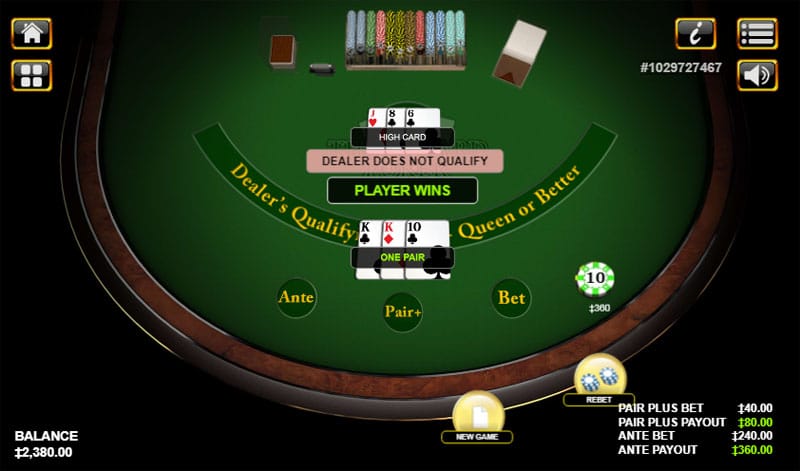
Now that we have covered all the different betting options you have in 3 Card Poker, let’s walk you through a hand and explain how the game actually works.
Step 1. Placing Your Bets
The first step in a 3 Card Poker hand is betting. You will need to start by placing an Ante bet, and you can choose a value between the table’s minimum and maximum.
Once you have placed the Ante bet, you can also place a Pair Plus and a 6-Card Bonus bet if you choose to. Remember that these bets are optional, and you don’t have to place them if you don’t want to.
Once you have placed your bets, the dealer will proceed to deal you three cards.
Step 2. Deciding Whether To Play or Not to Play
Once you receive your three cards, you are given your only option in this game. You can fold your cards and forfeit your Ante bet, or you can place a Play bet equal to the Ante bet.
If you fold, you will not be eligible for the Ante bet bonus or any Ante or Play bet payouts. You will, however, still be eligible for any side bet payouts.
If you decide to play, the hand will go to a showdown, and your hand will be compared to the dealer’s.
Step 3. The Showdown
At showdown, your hand is compared to the dealer’s, and payouts are made accordingly. All Ante and Play bet payouts are determined by the game rules and the dealer’s qualification.
If the dealer has not qualified, your Play bet will always result in a push, while your Ante bet will win at 1:1. If the dealer has qualified, you will need to beat the dealer’s hand in order to receive 1:1 payouts on both the Ante and the Play bet.
All Pair Plus payouts are made as soon as your initial three cards are dealt, so you won’t need to worry about those at showdown.
All 6-Card Bonus payouts will be made at showdown, as all six cards are required to determine qualifying hands.
Basic 3 Card Poker Strategy
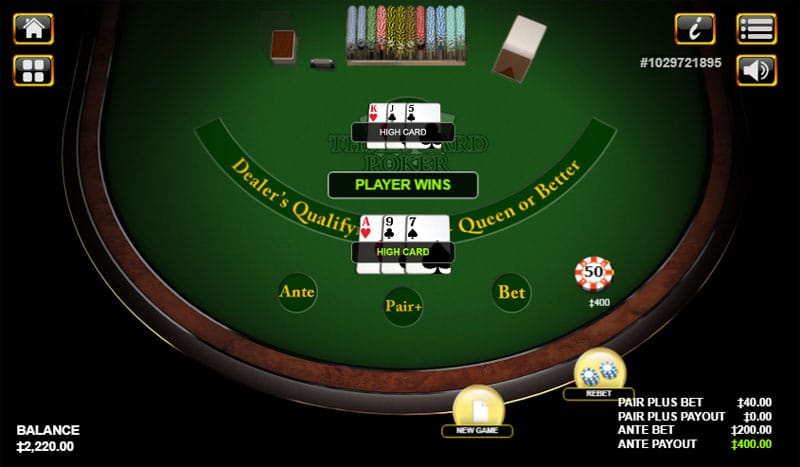
In my experience playing casino table games, 3 Card Poker is one of the few games where the optimal strategy fits on a single line: play queen-6-4 or better, fold everything weaker.
I had a hand recently where I was dealt Q♣6♦4♠, which is exactly the minimum qualifying hand under this rule. It was the boundary case. The mathematically correct play is still to make the play bet, not fold.
The dealer did not qualify, my ante paid even money, and the play bet pushed. Even when the dealer misses, following the rule consistently is the right approach because over hundreds of hands, deviating from Q-6-4 costs you money. The tips below explain each betting decision in detail.
Tip 1. Optimal Play Bet Strategy
The most important decision you can make in 3 Card Poker is which cards to play and which ones to fold after you’ve had a look at your hand.
The golden rule of 3 Card Poker is to play when you have Q-6-4 or better, and to fold when you have a weaker hand.
If you are unsure which hands are better than Q-6-4 and which are not, always look at the highest card first, then the second, and then the third.
So, any hand containing a K or an A is better than Q-6-4, as is any hand containing a Q and a 7. For example, Q-7-2 beats Q-6-4.
If you apply this optimal betting strategy, you will get the best possible results against the dealer in the long run. With this strategy, the house edge on the Ante bet stands at 3.37%, which is the best you can hope for in 3 Card Poker
Tip 2. Optimal Pair Plus Strategy
Unlike the Ante bet, the Pair Plus bet is optional in 3 Card Poker. While most players choose to place Pair Plus bets to make the game more fun, the bet itself is a major losing proposition.
The house edge on the Ante bet is 3.37%, while the house edge on the Pair Plus bet is 7 to 11%, which is a very unfavorable proposition.
If you want to know what the optimal Pair Plus strategy is, it’s very simple. Don’t place any Pair Plus bets at all, and you will save money in the long run.
Tip 3. Optimal 6-Card Bonus Strategy
Much like the Pair Plus bet, the 6-Card Bonus bet in 3 Card Poker is an optional bet with an extremely high house edge (up to 15%) and no major upside.
The only reason to place 6-Card Bonus bets is to add extra excitement to the game, but that should never be your main concern.
The optimal 6-Card Bonus strategy is to avoid the bet altogether, or only place very small amounts on it if you want to spice things up.
3 Card Poker Strategy Cheat Sheet
The table below summarizes every decision in 3 Card Poker. Print it, save it, or memorize it before your next session.
Play or Fold Decision Table:
| Your Highest Card | Secondary Cards Required | Decision |
|---|---|---|
| Ace | Any | Play |
| King | Any | Play |
| Queen | 6 and 4 or better | Play |
| Queen | 6 and 3 or weaker | Fold |
| Jack or lower | Any | Fold |
Quick note on “Queen-6-4 or better”: Your hand beats the threshold if your highest card is a queen AND your next two cards are at least 6 and 4. A hand like Q-7-2 qualifies (7 beats 6 at the second-card position). A hand like Q-6-3 does not (3 fails at the third-card position).
House Edge by Bet Type:
| Bet | House Edge | Recommendation |
|---|---|---|
| Ante (optimal play) | 3.37% | Play with Q-6-4 rule |
| Play bet | 2.01% | Always matches Ante |
| Pair Plus | 2.32% to 7.28% (varies by casino) | Optional; check table pay schedule |
| 6-Card Bonus | Up to 15% | Avoid |
The Ante bet at 3.37% house edge is the most favorable wager in the game when you follow optimal strategy. The 6-Card Bonus bet at up to 15% house edge is one of the worst bets at any casino table game. I skip it entirely.
Enjoy Simple Gameplay with Three Card Poker
Three Card Poker, alongside Ultimate Texas Hold’em and Pai Gow Poker, is one of the simplest games you can find in a casino, and if you have read through our guide, you know everything you need to get the optimal results.
You can find 3 Card Poker offered in both live and online casinos, with the online versions often offering significantly lower stakes.
Apply the optimal 3 Card Poker strategy we taught you here at the tables, and you will find the game is highly enjoyable and reasonably low-variance compared to most other casino table games.