Block bet poker strategy solves a very specific problem: what do you do when both you and your opponent have the nuts at high frequency? The instinct is to bet big with strong hands. The solver says the opposite. When the nut advantage is shared, small bets extract more value, induce more bluffs, and let you keep your weaker value hands in the betting range without getting punished.
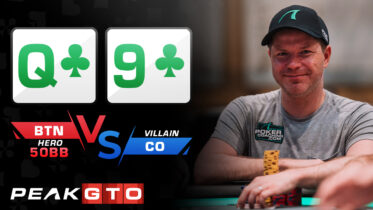
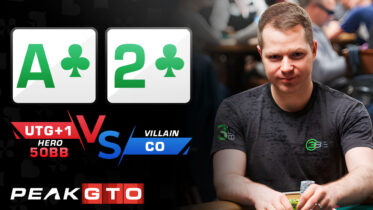
Today we will analyze a 50bb 8-handed tournament hand where UTG+1 opens A♣2♣, the cutoff calls, and the board runs out K♣T♣5♠Q♠6♣. This hand illustrates three separate reasons to use small sizings: range advantage on the flop, shared nut advantage on the turn, and a shared flush on the river that turns the nut flush into a block-bet candidate rather than a value-bet-big candidate.
Assumptions
- Stacks: 50bb effective
- Format: 8-handed MTT
- Positions: UTG+1 (Hero) vs CO (Villain)
- Action: UTG+1 RFI, CO calls
- Flop: K♣T♣5♠ (Pot: 6.9bb)
- Turn: Q♠ (Pot: 10.3bb)
- River: 6♣ (Pot: 15.5bb)
Preflop
At 50bb from UTG+1, A♣2♣ is a standard open. The cutoff flat-calls rather than 3-betting, which matters for the rest of the hand. A caller from the cutoff has a wider, looser range than the 3-betting cold. That range is loaded with suited broadways, suited connectors, middling pocket pairs, and suited aces that chose not to reraise against an early-position open.
Hero’s opening range from UTG+1 at 50bb is tight and broadway-heavy. That range mismatch is the single most important preflop fact for this hand. It means Hero will have far more big pairs, strong broadways, and AK/AQ than the caller. High-card flops favor the opener, and both players feel that for the next three streets.
Flop: K♣T♣5♠
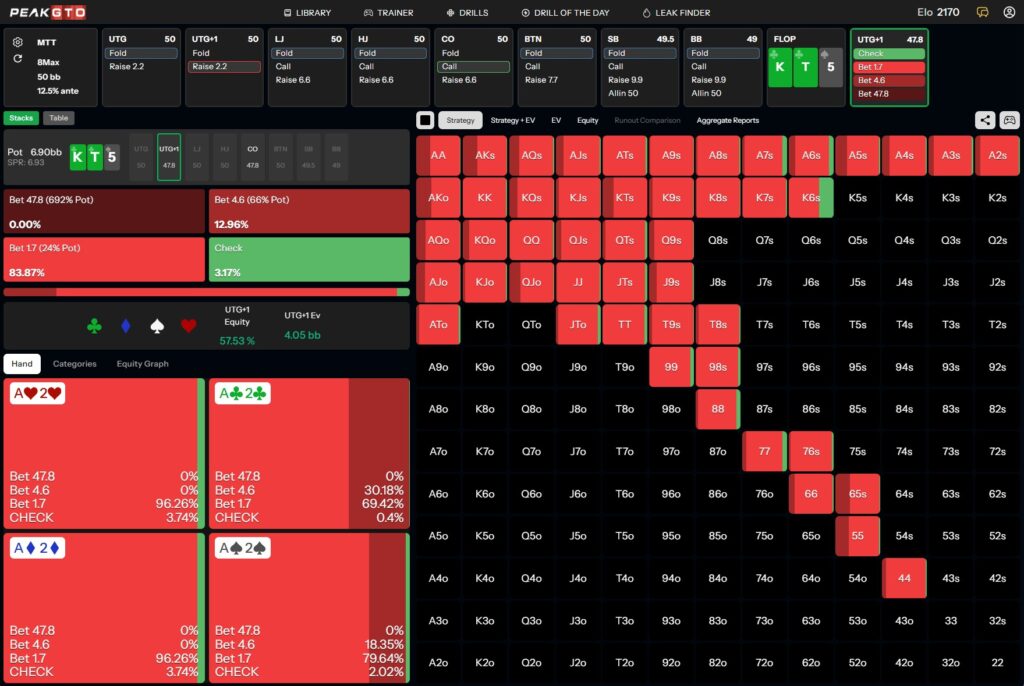
Pot 6.9bb. Hero can bet 1.7bb (83.9%), bet 4.6bb (13.0%), bet 47.8bb (0.0%), or check (3.2%). Hero bet 1.7bb.
The solver almost never checks this board out of position. Hero’s combined continuation bet frequency of 96.8% reflects that. K-T-5 is a high-card, slightly connected flop that belongs to the early-position opener. Hero’s range is loaded with kings, tens, broadway pairs, and overpairs. The cutoff’s flatting range has fewer big pairs, more middling suited connectors, and a lot of pocket pairs from 66 through 99 that are now underpairs to the board.
The 1.7bb size (about 25% pot) is doing a simple job: it targets the large chunk of the cutoff’s range that wants to call but cannot comfortably continue, particularly the underpairs 66 through 99, weak ace-x with no club, and jack-x or queen-x without a draw. Charging that portion of the range a small price is more profitable than charging the top of their range a big price, because the top of their range (sets, two pair, KQ, KJs) is going to continue regardless of sizing.
A♣2♣ fits naturally into the small-bet range. The hand has an ace overcard, a backdoor club flush draw that gives it a direct path to nut equity on any club turn, and backdoor straight potential through running cards. Those equity sources are exactly what a bluff in this spot needs: a pathway to improve, blockers to strong calling hands through the ace, and combined fold equity against the underpairs and weak high-card holdings that fold now.
Villain’s response to 1.7bb: raise 5.8bb (18.1%), raise 47.8bb (0.0%), call (59.4%), fold (22.5%). Villain called. The 22.5% fold rate immediately captures dead money, and the called portion of the range is now weighted toward middling made hands and draws that the small bet is designed to beat up on later streets.
Turn: Q♠
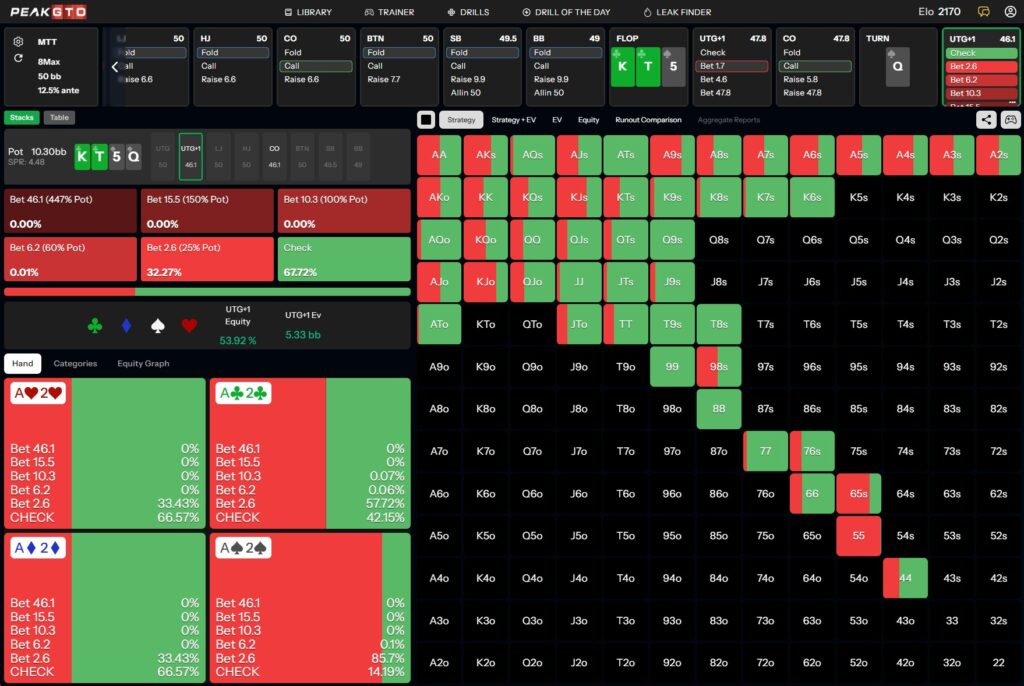
Pot 10.3bb. Hero can bet 2.6bb (32.3%), bet 6.2bb (0.0%), bet 10.3bb (0.0%), bet 15.5bb (0.0%), bet 46.1bb (0.0%), or check (67.7%). Hero bet 2.6bb.
The Q♠ is the first card in this hand that does not purely favor Hero. AJ now has a straight. J9 has a straight. Both players have those hands in their range at meaningful frequency, which is what “shared nut advantage” means in practical terms. The solver cannot polarize and only bet two pair and sets, because the cutoff has just as many straights as Hero does.
Because the nut advantage is shared, a single small size does the entire job. Notice that the solver uses essentially one sizing: 2.6bb, or check. The larger sizings sit at 0%. The 2.6bb sizing is the only way Hero can bet a wide range, including overpairs, top pair, and equity-rich semi-bluffs, without overextending with weaker value.
The bluffing side of this range needs equity. Hero’s bluffs on the turn are not random. They are club draws, ace-x hands that block the strong aces in the cutoff’s range, and jack-x hands that can improve to broadway on a king, nine, or ace river. A♣2♣ is a premium turn bluff. It has the nut flush draw with one card to come, an ace overcard, and blockers to AJ and AK. Those qualities are exactly why this hand appears in the small-bet range rather than the check-back range.
The small size also puts a specific part of the cutoff’s range in a difficult spot: hands like 66, 77, 88, and 99 that called the flop as middling pairs and now face another bet on a Q-high board. These hands have very little equity and must decide whether to continue drawing or give up. The 2.6bb price keeps them in the pot often enough for Hero to continue charging them on the river.
Villain’s response to 2.6bb: raise 8.8bb (0.0%), raise 15.0bb (18.7%), raise 46.1bb (0.0%), call (60.0%), fold (21.3%). Villain called. The called range is now narrowed further, heavy on one-pair hands, draws that want to see a river, and straights that chose to slow-play.
River: 6♣
The 6♣ completes the front door club flush. The board now reads K♣T♣5♠Q♠6♣. Hero has the nut flush with A♣2♣. This is the decision that most players get wrong, because instinct says “I have the nuts, bet big.” The solver says bet small.
Pot 15.5bb. Hero can bet 3.9bb (42.5%), bet 9.3bb (20.6%), bet 15.5bb (4.1%), bet 23.3bb (0.0%), bet 43.5bb (0.2%), or check (32.7%). Hero bet 3.9bb.
This is a block bet in the classic sense: a small bet that sets the price of the showdown at a level Hero is comfortable with, while denying the opponent an opportunity to bet their own range if checked to. The reasoning comes from the runout. Both players arrive at this river with flushes and straights at high frequency. The cutoff can have K9♣, QJ♣, 87♣, and other flush combinations. The cutoff also has AJ and J9 for straights. Those hands are going to continue against any sizing.
A bigger sizing here runs into a specific problem. It folds out the medium-strength bluff catchers in the cutoff’s range, the hands like 54 suited that called flop and turn and missed, or pocket sevens that now hold only a single pair on a flush board. Those hands give up to a big bet. Against a small bet, the same hands often raise as a bluff because the sizing looks like thin value from a top pair or overpair that does not want to fold, and the cutoff’s incentive to represent the flush grows.
The small bet also changes the cutoff’s reaction with their strong hands. A king-nine of clubs that faces a small bet is going to raise for value nearly every time, because the bet looks like it might fold to a raise and the cutoff wants to build a pot. The same hand facing a pot-sized bet is far more likely to just call, because they are worried about running into exactly A♣2♣. The small bet extracts a raise from the second-nut flush where a big bet would only extract a call.
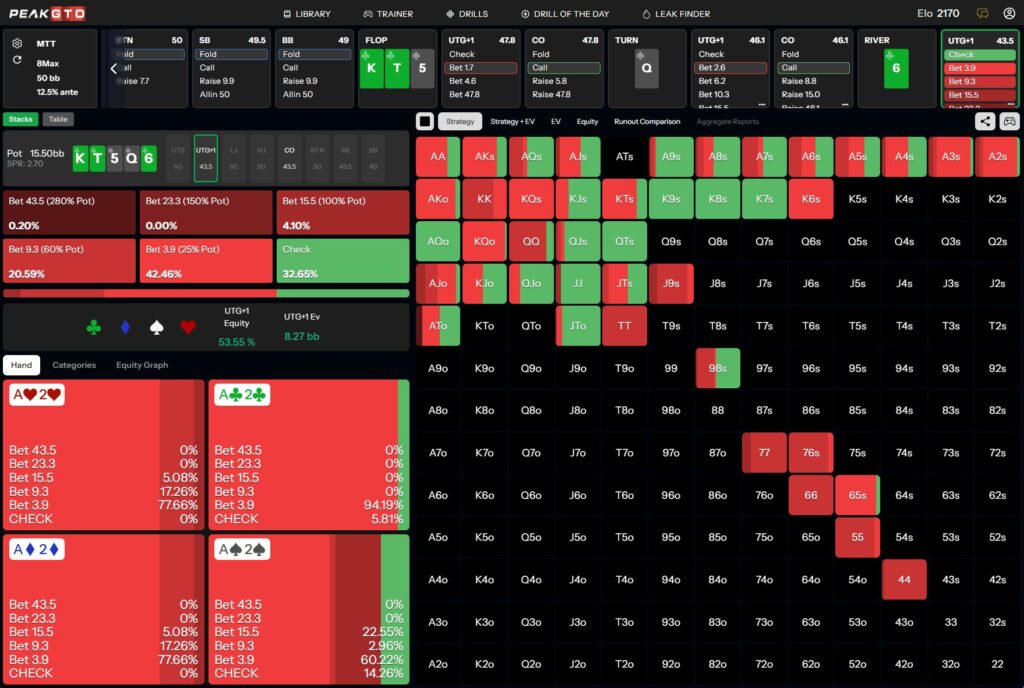
Villain’s response to 3.9bb: raise 15.5bb (4.1%), raise 27.2bb (7.6%), raise 43.5bb (14.3%), call (50.8%), fold (23.1%). Villain raised 43.5bb.
Hero’s options facing the 43.5bb raise: call (31.4%) or fold (68.6%). Hero called.
The 31.4% call is a range-level frequency, and it reflects the composition of Hero’s small-bet range. That range contains thin value hands like KQ, AK, and overpairs that have to fold against a pot-sized raise, alongside the occasional nutted holding. A♣2♣ is the nuts. It makes up the call portion. For this specific holding, the call is automatic: the nut flush does not fold on a paired-but-not-boat board against a pot-sized raise that can contain worse flushes and bluffs at a meaningful combined frequency.
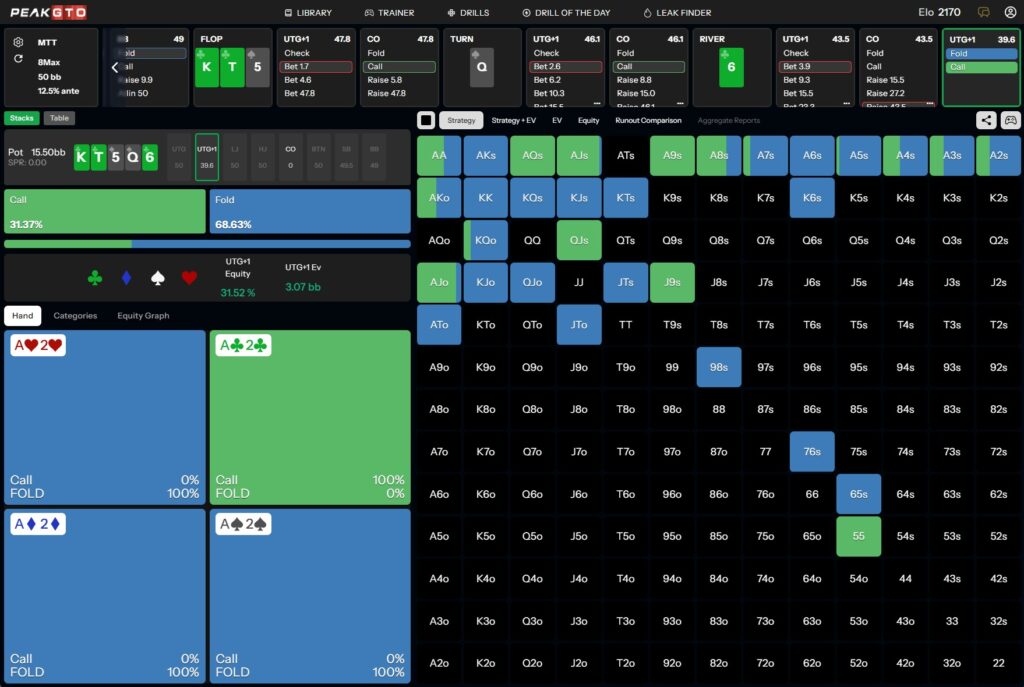
Adjustment note. The block-bet line is a GTO strategy. Against a specific opponent who rarely bluff-raises rivers and simply calls with worse flushes, the expected value of this line drops. In that case, a larger bet or a check-raise attempt extracts more value, because the inducement is no longer producing the bluff raises that justify the small size. The small bet wins in theory because a balanced opponent raises their strong hands and bluffs at the right frequency. A station who only raises for value and only calls with worse kills the block-bet edge.
Key Takeaways
- Flop: On K♣T♣5♠, Hero bets 96.8% of the time and uses the 1.7bb size 83.9% of the time. The early-position range advantage over a cutoff flat lets Hero charge underpairs and weak high-card holdings cheaply while keeping the top of the range in the betting strategy. A♣2♣ fits as a small-bet semi-bluff with backdoor flush and ace overcard equity.
- Turn: On the Q♠, Hero bets 32.3% using a single size (2.6bb). Shared nut advantage from AJ and J9 makes polarized sizings unprofitable. The small bet keeps overpairs, top pair, and club draws in the betting range without running into an opponent range that has just as many straights.
- River: On the 6♣ flush-complete, Hero bets 3.9bb at 42.5%. The block bet induces raises from second-best flushes and straights, and induces bluff raises from busted draws that read the small bet as weakness. A♣2♣ sits at the top of that range, and facing a pot-sized raise at 14.3% frequency, the nut flush is an automatic call.
- Overall: Block betting is not a weakness line. It is a solver-preferred strategy in spots where the nut advantage is shared and where larger sizings would either fold out hands that want to bluff-raise or get called by the exact hands a big bet is trying to beat. Betting small with the nuts keeps the entire betting range balanced and lets the opponent make the mistake of raising with second-best hands. The adjustment against a non-bluffing opponent is to size up, because the inducement no longer pays for itself.