Check-raise bluffing from the big blind is one of the most misunderstood plays in short-stack tournaments. Most players either check-fold too much or only check-raise with strong made hands, making their aggression transparent. The solver builds a balanced check-raise range that includes value hands, draws, and gutshots, then follows through across multiple streets when the math supports it.
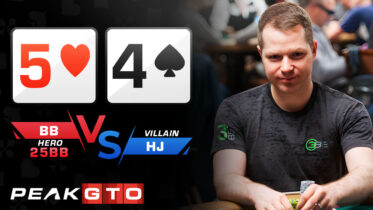
Today we will analyze a 25bb 8-handed tournament hand where the big blind defends 5♥4♠ against a hijack open, check-raises a J♠7♥3♦ flop with a gutshot, barrels the 9♥ turn, and fires the river on the 2♠ with pure air. This hand shows how gutshots become check-raise candidates at shallow stacks, why the turn barrel continues even without new equity, and how river blocker logic determines which missed draws bluff and which give up.
Assumptions
- Stacks: 25bb effective
- Format: 8-handed MTT
- Positions: BB (Hero) vs HJ (Villain)
- Action: HJ raises, BB calls
- Flop: J♠7♥3♦ (Pot: 5.5bb)
- Turn: 9♥ (Pot: 14.9bb)
- River: 2♠ (Pot: 32.7bb)
Preflop
At 25bb, the big blind can shove, 3-bet small, or call against a hijack open. 5♥4♠ is a pure call. It has no blocker value for 3-betting and no high-card strength for shoving, but it has straight-making potential on boards that connect with the 3-4-5 portion of the deck. That potential, combined with the price the big blind is getting, makes it a standard defend.
Flop: J♠7♥3♦
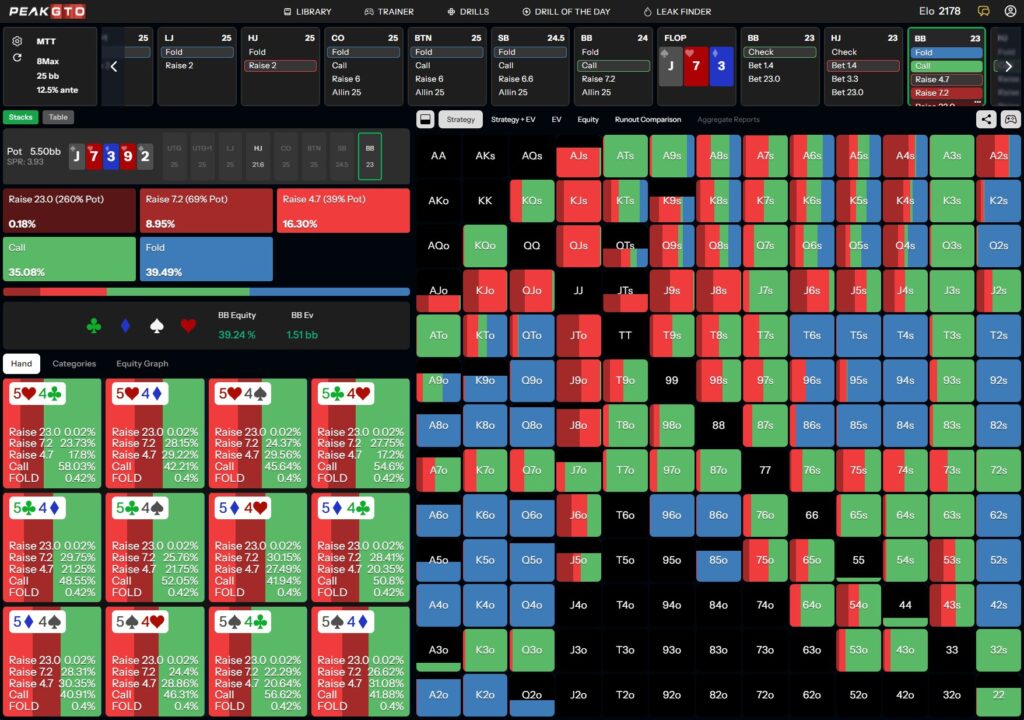
BB checks 99.4% of the time on this board. Jack-high with no flush draw gives the preflop raiser clear nut advantage with all the premium jack-x combos, overpairs, and top sets. HJ continuation bets 88.6% of the time, split almost evenly between a small 1.4bb sizing (42.6%) and a medium 3.3bb sizing (45.6%). Villain bet 1.4bb.
After the small bet, the solver has BB check-raising 25.4% (16.3% to 4.7bb, 9.0% to 7.2bb), calling 35.1%, and folding 39.5%. The value side includes sets, two pair, and strong jacks. At 25bb, top pair good kicker is strong enough to build a check-raise pot. The raise to 4.7bb puts roughly a third of the remaining stack in, setting up a natural turn-river sequence that reaches all-in quickly.
The bluff side includes gutshot straight draws and select backdoor draws. The backdoor draws need an overcard to the jack to qualify. Hands like Q9♥, K4♥, and A5♥ check-raise at high frequency because they combine a backdoor heart draw with an overcard that can improve to top pair. A hand like J4♥ does not, because the jack offers no overcard value.
5♥4♠ has a gutshot to the nut straight, needing any six to make 3-4-5-6-7. It mixes roughly 50/50 between calling and check-raising. Both plays are defensible, but check-raising is the more aggressive option: the hand cannot win at showdown, and aggression at shallow stacks sets up the three-barrel trajectory that can win the pot outright. Hero check-raises to 4.7bb. HJ calls 64.8%, folds 28.3%, and re-raises 6.8%.
Turn: 9♥
The 9♥ is a rough card. It puts two hearts on the board, connects with HJ’s calling range (T9, 98, 99 all improve), and does not help 5♥4♠ at all. The gutshot remains, but no new equity appeared.
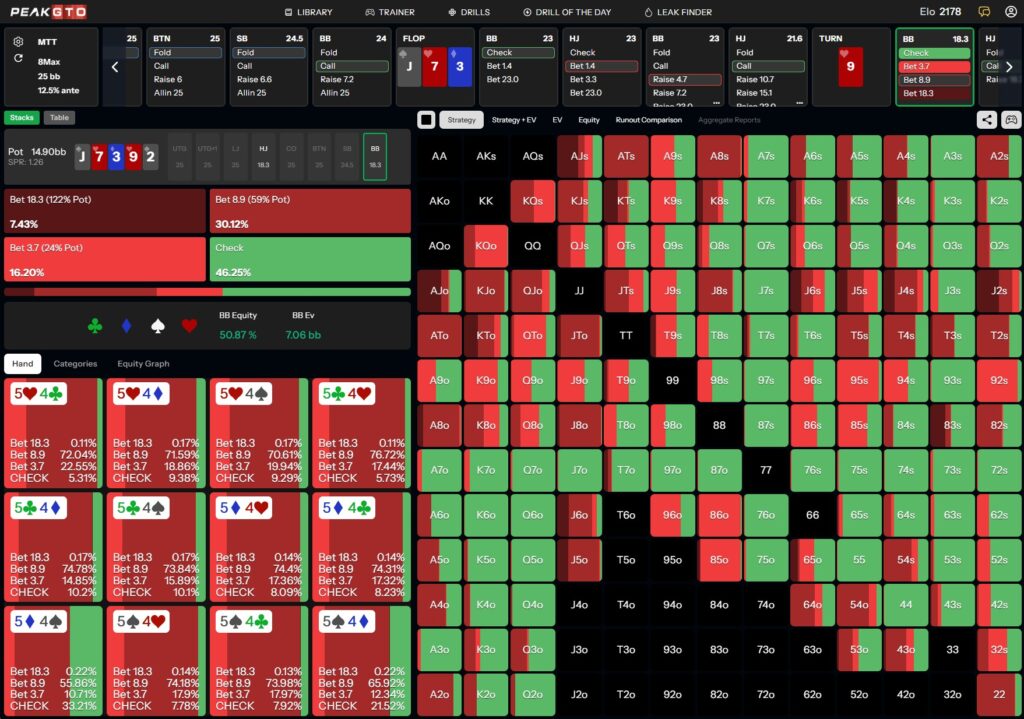
The general principle after a flop check-raise with a draw is to continue betting the turn when you pick up additional equity. Many flop bluffs do exactly that here. K4♥ and A4♥ picked up flush draws. K8♦ turned a gutshot. Those hands all continue betting at high frequency.
5♥4♠ is the exception. It did not improve, but it is essentially the weakest possible hand BB can hold. PeakGTO confirms that 65, 64, and 54 all bet the vast majority of the time. These are the “nut low” bluffs: hands so weak that checking means losing the pot with certainty, so they keep firing. The solver has BB betting 53.8% overall, with 8.9bb as the primary size at 30.1%. That bet leaves exactly 9.4bb behind, setting up a river shove under 30% of the pot. HJ folds 37.8%, calls 37.4%, and raises all-in 24.8%. Hero bets 8.9bb. Villain calls.
River: 2♠
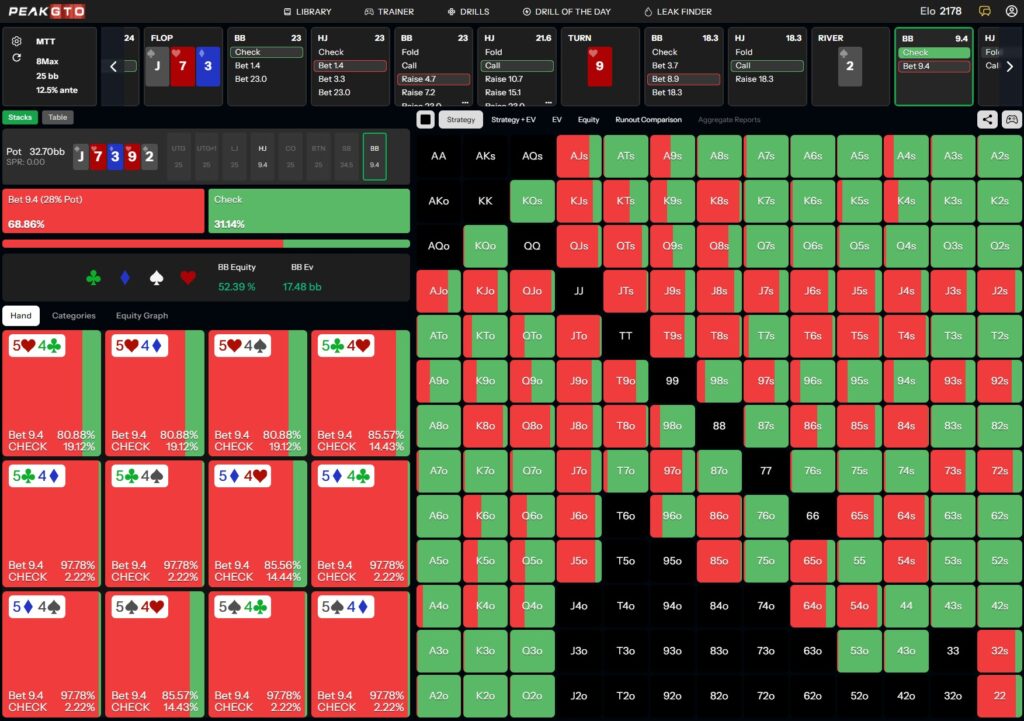
The 2♠ completes nothing. The final board reads J♠7♥3♦9♥2♠. Hero has 5-high and 9.4bb remaining. The solver has BB betting 68.9% and checking 31.1%. The bet is effectively all-in at roughly 28% of the pot. BB’s primary value hand is jack-x, which is very strong after this line and comfortably shoves for 28% pot. Sets and two pair are there as well, but jack-x is the backbone.
Because the all-in is only 28% pot, BB does not get to include many bluffs. The key is which missed draws qualify. Hands that turned a backdoor heart flush draw on the 9♥ and bricked the river, like Q4♥, A5♥, and K6♥, check basically every time. Their heart cards block the opponent’s folding range: HJ’s busted heart draws that called flop, called turn, and would now fold to a river shove. If BB holds hearts, fewer of those folding combos exist, making the bluff worse. The better river bluffs are hands that do not block the heart draws. K-x of clubs and K8♦ bluff at high frequency because they went through the same three-street trajectory but leave the opponent’s folding range intact.
Then there are the pure gutshots. 65, 54, and 64 bluff the vast majority of the time. They have zero showdown value and can force the opponent to fold unpaired hands with busted draws. 5♥4♠ holds one heart, which is a minor blocker concern, but the total absence of showdown value makes it a clear bluff. The pot odds require the bluff to succeed just 22.3% of the time to break even (9.4 divided by 42.1). The solver has HJ folding 23.1%, clearing the threshold by less than 1%.
It is worth noting that HJ should call 76.9% of the time here. The bluff fails far more often than it succeeds, but each failure costs 9.4bb while each success captures the entire 32.7bb pot. This is also a spot where a read can override the default. You might think that because the opponent called a large turn bet, they must have a strong hand. In GTO terms, that is not true: HJ’s calling range still contains plenty of hands that fold to a river shove. But if you can tell your specific opponent is never folding this river, giving up is the practical adjustment.
Hero bets 9.4bb. Villain folds.
Key Takeaways
- Flop: BB checks 99.4% on J♠7♥3♦. After HJ c-bets at 88.6%, BB check-raises 25.4%, calls 35.1%, and folds 39.5%. The bluff range includes gutshots and backdoor draws with overcards to the jack. 5♥4♠ mixes 50/50 between calling and raising, with the gutshot to 3-4-5-6-7 providing the equity.
- Turn: After a flop check-raise with a draw, you generally continue when you pick up equity. 5♥4♠ is the exception: it did not improve, but as the weakest possible holding with zero showdown value, it keeps betting because checking means giving up. HJ folds 37.8%.
- River: The 2♠ bricks all draws. Missed heart flush draws are bad bluffs because they block the opponent’s folding range. Non-heart hands and pure gutshots (65, 54, 64) are the correct bluffs. The all-in clears the 22.3% breakeven threshold by less than 1%.
- Overall: This hand demonstrates a three-barrel bluff trajectory at shallow stacks. The flop check-raise sets it up, the turn barrel continues because the hand is too weak to do anything else, and the river shove is the conclusion the stack math was always building toward. The most transferable concept is the river blocker logic: when choosing which missed draws to bluff with, avoid hands that block the opponent’s folding range.