At shallow stacks, the big blind’s check-raise range looks different than most players expect. The compressed stack-to-pot ratio lowers the threshold for stacking off, which means the value side of the check-raise widens to include hands like top pair with a marginal kicker. That wider value range needs more bluffs to stay balanced, and the solver finds them in a place many players overlook: the backdoor draw paired with an overcard.
Today we will analyze a 25bb 8-handed tournament hand where the big blind defends A♠6♥ against a hijack open, check-raises on Q♠7♠3♥, and navigates turn and river decisions that hinge on whether the bluff picks up additional equity. This hand illustrates how a backdoor draw becomes a check-raise candidate at shallow stacks, how the turn card determines whether the bluff continues or shuts down, and why the river produces a surprising decision between hero-calling and folding.
Assumptions
- Stacks: 25bb effective
- Format: 8-handed MTT
- Positions: BB (Hero) vs HJ (Villain)
- Action: HJ raises, BB calls
- Flop: Q♠7♠3♥ (Pot: 5.5bb)
- Turn: 4♦ (Pot: 14.9bb)
- River: J♥ (Pot: 32.7bb)
Preflop
At 25bb, the big blind has three strategic options against a hijack open: shove, 3-bet small, or call. The shoving range includes pocket jacks and lower, AK/AQ/AJ offsuit, and select low ace-x offsuit combos like A5o and A3o. The small 3-bet to 7.2bb is reserved for premiums: aces through queens, AK suited, and AQ suited. Then there is a set of blocker 3-bets using various offsuit holdings, primarily ace-x, king-x, queen-x, and jack-x.
The key when constructing a blocker 3-bet range is to diversify card values rather than stacking the same kicker across multiple holdings. Choosing A9o, K9o, and Q9o leaves too many nines in the 3-bet range and too few in the calling range. A better construction would be something like A2o, K9o, and J7o, spreading the card coverage so both ranges stay balanced. A♠6♥ mostly calls in this spot. It mixes in a small-frequency 3-bet, but calling is the standard play.
Flop: Q♠7♠3♥
BB checks 99.1% of the time on this board. With a queen on the flop, the big blind never leads. Leading from the big blind in a single-raised pot is reserved for low, connected boards that favor the defender’s range. A queen-high flop gives too much nut advantage to the preflop raiser.
HJ continuation bets 96.4% of the time at this stack depth, primarily using the small 1.4bb sizing at 88.0%. PeakGTO shows the deep-stack habit of checking back flops is far less common at 25bb. The preflop raiser has less reason to check back when the remaining stacks create only two more decisions before the money goes in.
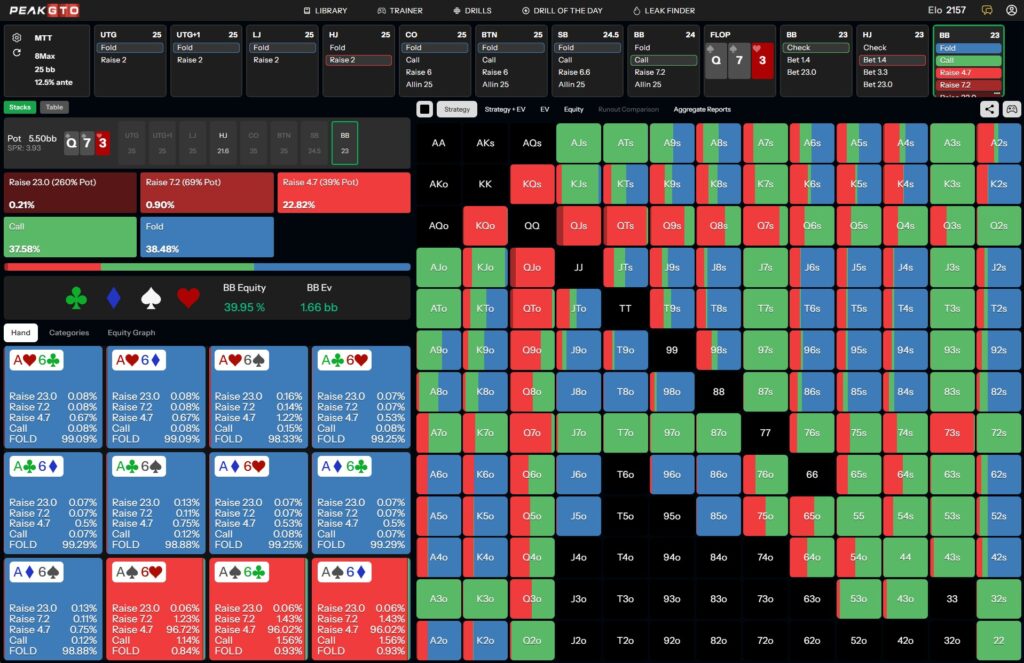
After the 1.4bb bet, the solver has BB check-raising 23.9% (primarily to 4.7bb at 22.8%), calling 37.6%, and folding 38.5%. The check-raise range has three layers.
Value: queen-x. Q8 and better check-raises the majority of the time. Weaker queen-x mixes between raising and calling. At this stack depth, top pair with a marginal kicker is strong enough to stack off. The check-raise builds a pot that sets up a manageable turn shove or near-shove, which is exactly the kind of simple decision tree that favors the out-of-position player.
Primary draws: flush draws and gutshots. Hands like A4♠, K6♠, T6♠, 94♠, and T9♠ check-raise at high frequency. Gutshots like 65, 64, and 54 also check-raise a decent amount, though they can justify calling given the price. These hands have direct equity and can improve on many turn cards.
Backdoor draws with overcards. This is where A♠6♥ lives. It has a backdoor draw in spades and an ace overcard. The critical distinction is the overcard. Hands like K♠4, K♠5, K♠2, and A♠5 check-raise nearly every time. But J♠4 does not, because the jack does not outrank the queen. The overcard is what makes the difference.
There is also a ceiling. A♠8 and A♠9 with the spade backdoor are too strong to check-raise. With two overcards above the seven, those hands have enough equity to simply call and realize their value. A♠6♥ sits in the sweet spot: enough equity to justify aggression (backdoor draw, overcard, potential straight draw pickups on certain turns), but not so much equity that calling is clearly better. This is a spot most players either fold or call. Check-raising ace-x low with a backdoor flush draw is a common edge to leave on the table.
Hero check-raises to 4.7bb. HJ calls 62.1%, folds 30.6%, and re-raises at a combined 7.2% across three sizes. In practice, many opponents fold even more than 30.6% to a check-raise at this stack depth, making the play even more profitable than the solver suggests.
Turn: 4♦
The 4♦ is a significant card for A♠6♥. It gives the hand a gutshot straight draw (any five completes), replacing the backdoor spade flush draw that is now dead. This is the critical principle for turn play after a flop check-raise built on a backdoor draw: if the turn gives you a real draw, keep betting. If it does not, shut down.
Consider the difference. If this turn had been the 2♦ instead of the 4♦, A♠6♥ would check and fold. No gutshot, no flush draw, no reason to continue. But A♠5 and A♠4 would still bet on a deuce turn because they hold gutshots. The turn card is what separates the bluffs that continue from the bluffs that give up, and the determining factor is always the same: does the hand still have a draw?
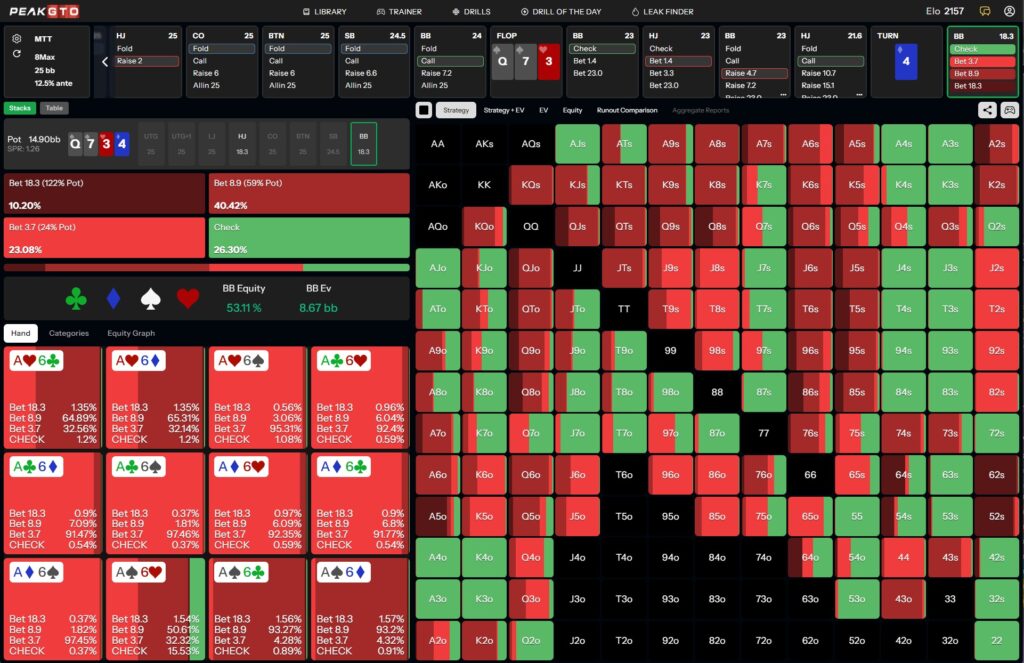
On the actual 4♦ turn, BB needs plenty of bluffs because the queen-x value range from the flop check-raise is still strong. The solver has BB betting 73.7% overall, with 8.9bb as the primary sizing at 40.4%. That size leaves 9.4bb behind, setting up a clean river decision with a single remaining bet. A♠6♥, along with A♠5, K♠6, and K♠5, all bet the majority of the time. The sizing matches what the value hands would use, which is exactly right for a bluff: you want to bet the same size you would bet with your best hands.
HJ responds by folding 38.5%, calling 34.5%, and raising all-in at 26.9%. Hero bets 8.9bb. HJ calls.
River: J♥
The J♥ completes none of BB’s draws. The straight needed a five. The spade flush draw bricked on the turn. The board finishes Q♠7♠3♥4♦J♥. Hero has 9.4bb remaining, roughly 28% of the pot.
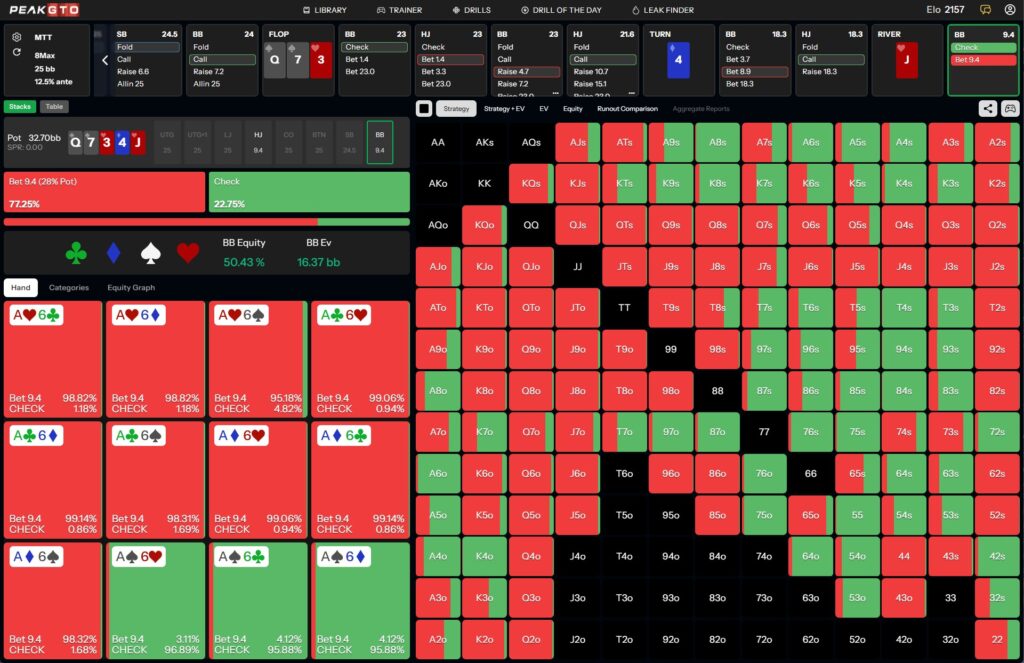
Across BB’s entire range, the solver bets all-in 77.2% and checks 22.8%. The value threshold reaches deep: any jack and even some sevens (K7 and 87 offsuit) shove the river a large portion of the time. When value betting extends that thin, BB needs a proportionally large number of bluffs to balance. But not every missed draw qualifies.
The key heuristic is to avoid bluffing with busted front-door flush draws. They block the opponent’s busted flush draws, which are the hands most likely to fold. K8♥ bluffs every time. K8♠ checks every time. The spade in K8♠ removes HJ’s busted spade draw combos from the folding range, making the bluff less profitable. The better bluff candidates are hands with no spade and no showdown value: K10, K9, T9, hands that have zero chance of winning at showdown and do not block HJ’s folds.
A♠6♥ checks for two reasons. First, the A♠ blocks some of HJ’s busted spade draws. Second, ace high has genuine showdown value. If HJ checks behind, Hero wins. Bluffing with a hand that can win unimproved, while also holding a card that reduces the opponent’s folding frequency, makes it a poor bluff candidate despite the attractive GTO all-in price. That said, A2 offsuit does bluff about half the time in this spot, so jamming A♠6♥ would not be a major mistake. Checking is simply more precise.
Hero checks. HJ bets 9.4bb all-in.
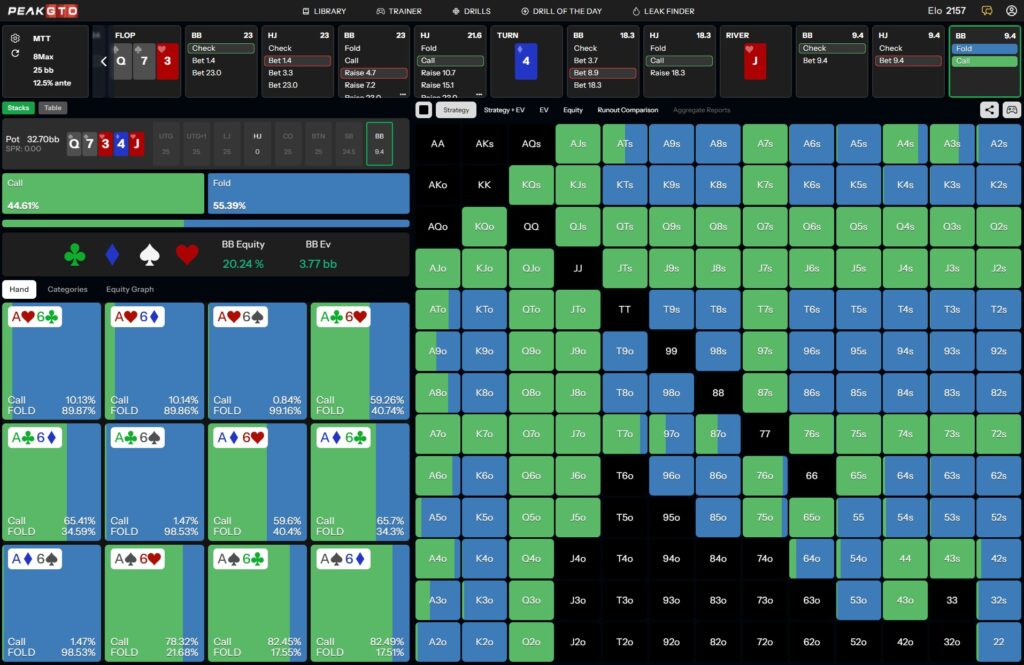
This looks like an easy fold. Ace high, facing a river shove, after checking the river. In practice, most players fold here without a second thought. But the solver calls with A♠6♥ roughly 80% of the time.
The reason comes down to range composition. After checking, BB’s range is thin. Nearly all of the value hands, the queens, jacks, and sevens, were bet as part of the 77.2% all-in range. What remains after checking is primarily busted draws and air. BB needs to find some calls to avoid being exploited, and ace high is near the top of what is left. The pot odds help: Hero must call 9.4bb to win 42.1bb (the 32.7bb pot plus HJ’s 9.4bb bet), requiring roughly 18% equity to break even.
That said, this is a spot where theory and practice diverge. The solver’s call frequency is likely sensitive to the exact ranges in play, and at this stack depth, most opponents are not bluffing the river often enough to justify the call. If you fold A♠6♥ here every time, that is a perfectly reasonable adjustment. But it is a useful spot to recognize that when your range is this weak after checking, you have to find some calls, and ace high with good pot odds is where the solver looks first.
Key Takeaways
- Flop: BB checks 99.1% on this queen-high board. After HJ c-bets small at 88.0%, BB check-raises 23.9%, calls 37.6%, and folds 38.5%. The check-raise range has three layers: queen-x for value, flush draws and gutshots for primary equity, and backdoor draws with overcards as the overlooked third category. A♠6♥ qualifies for the check-raise because of its backdoor draw in spades, ace overcard, and potential turn improvements.
- Turn: The 4♦ gives A♠6♥ a gutshot, keeping the bluff alive. The core principle: after a flop check-raise with a backdoor draw, continue betting when the turn adds a real draw and shut down when it does not. The 8.9bb sizing leaves a clean 9.4bb river stack.
- River: The J♥ bricks all draws. A♠6♥ checks because the A♠ blocks HJ’s folding range and ace high retains showdown value. Facing the all-in, the solver calls ~80% with this specific hand because BB’s checking range is so weak that ace high sits near the top of it, though folding is a defensible practical adjustment.
- Overall: This hand demonstrates the full arc of a backdoor draw bluff at shallow stacks: selecting the right check-raise candidates on the flop, using the turn card to decide whether to continue, and knowing when to stop on a bricked river. The river also shows how range composition after checking can turn an “obvious fold” into a theoretically correct call.