Most players know the basics of short-stack play and defaults to showing or folding, but when someone raises in front of you, the strategy becomes more layered than that.
Your correct response to a preflop raise depends on three things: your stack depth, the raiser’s position, and your own position relative to them. Get those factors wrong, and you will either play too tight and blind out or play too loose and spill chips in bad spots.
This guide breaks down exactly how to respond to a raise as a short stack, covering in-position and out-of-position plays at 60, 25, and 15 big blind depths.

Why the Raiser’s Position Changes Everything
Before looking at specific stack depths, it is worth understanding the core logic driving these adjustments.
When someone raises before you, they are announcing that they like their hand. A player raising from under the gun in a nine-handed game has to like their hand a lot, because they still have eight players left to act.
A player raising from the cutoff with only a few players left can open much wider.
This means your response needs to account for how strong their range actually is.
Against an under-the-gun raise, you should play tight. Their range is strong, so your three-bets need to be stronger, your calls need to be tighter, and your bluffing range needs to shrink.
Against a cutoff raise, you get to open up. Their range is wide enough that you can three-bet more hands for value, run more bluffs, and call with more speculative holdings.
As a general rule, the tighter the raiser’s range, the tighter your response.
Button vs. Raise – Short Stack Strategy When Playing In Position
Try PeakGTO preflop library for free.
Playing on the button against a raise puts you in a relatively good spot. You will have position postflop against everyone, and you get to act last.
At 60 Big Blinds
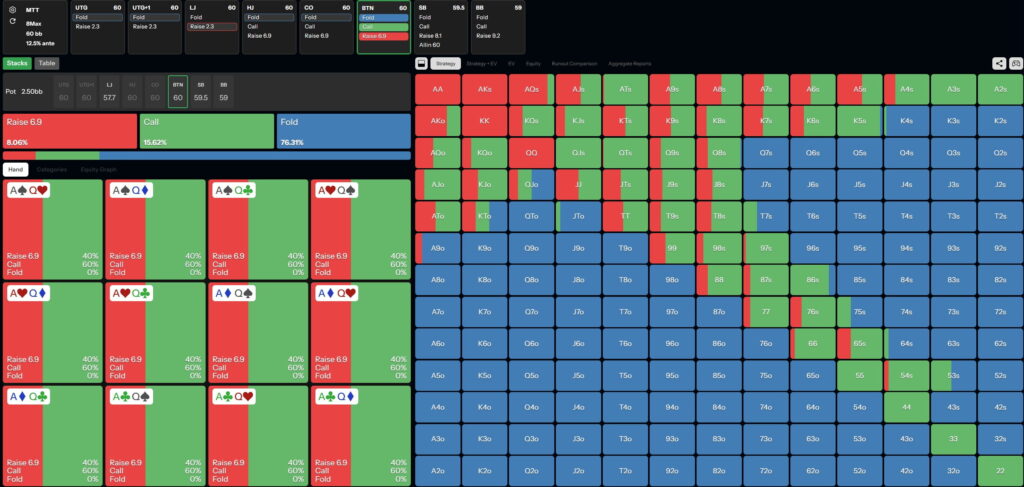
At 60 big blinds, you have enough depth to call with speculative hands, three-bet for value, and put in light three-bets as bluffs.
Against an under-the-gun raise, your three-betting range should be quite tight: pocket aces, kings, and ace-king suited are the clear three-bets. Hands like ace-queen suited, ace-king offsuit, and pocket queens and jacks mix between three-bets and calls. For bluffs, you can use suited aces with a low kicker (ace-five suited, ace-nine suited), a few suited kings, and some offsuit blockers like ace-ten offsuit and king-jack offsuit.
If implementing this as a mixed strategy feels complicated, a simpler approach is to always three-bet the blocker bluffs (ace-five suited, king-eight suited, ace-ten offsuit, king-jack offsuit) and call everything else that qualifies. It is not perfectly GTO, but it is close enough to be useful.
What you do not want to do is call with weak offsuit hands. Ace-nine offsuit, king-ten offsuit, and jack-ten offsuit are all folds against a UTG raise. They perform poorly out of position and have little implied value.
Against a lojack raise, the strategy looks similar but starts to loosen slightly. King-ten offsuit and queen-jack offsuit move from fold to a mix of calls and three-bets. You begin three-betting more medium pairs and adding some suited connector bluffs like seven-six suited and six-five suited.
Against a cutoff raise, the differences become significant. The cutoff opens wide enough that you now have real three-betting equity. Pocket tens and better go in frequently as value. Suited aces, suited kings, and more suited connectors work well as bluffs. Offsuit blockers like ace-nine offsuit and ace-eight offsuit also start working their way into the three-bet range.
One thing many players get wrong: king-five suited and king-six suited are worth playing in most of these spots. A lot of players fold them reflexively, but they are just good enough to call.
Three-four suited and two-three suited are a different story. Those are not good enough to play.
At 25 Big Blinds
At 25 big blinds, the strategy shifts significantly. The first thing you notice is that small three-bets become rare. Against many opponents, the main question becomes: call, shove all-in, or fold?
For small three-bets, you are now limiting yourself to the absolute best hands: aces, kings, queens, jacks, ace-king suited, and ace-queen suited some of the time. You can still add a few blocker bluffs (ace-ten offsuit, king-jack offsuit, some suited aces and kings), but there is not much bluffing happening overall.
The more important development at 25 big blinds is the emergence of an all-in shove range. Against a UTG raise, you can shove ace-king offsuit, king-jack suited, queen-jack suited, tens, and nines. Against a lojack raise, the all-in range expands to include ace-queen offsuit, low suited aces (ace-four suited, ace-three suited), jack-ten suited, and eights. Against a cutoff raise, it widens further to include king-queen offsuit, more Broadway suited hands, and more pairs.
Another important adjustment at 25 big blinds: you should start slow-playing pocket aces a significant portion of the time. This might feel wrong, but it serves a real purpose. If you always three-bet or shove with aces, kings, and queens, your calling range becomes weaker and more transparent. Mixing in calls with your best hands protects your range and allows you to defend wider with other holdings.
One more thing to drop from your 25 big blind calling range: implied odds hands. Suited connectors like nine-seven suited and eight-six suited, as well as weak suited kings like king-three suited, lose much of their value at this depth. You are not deep enough to stack opponents with sets and straights the way you could at 100 big blinds. These hands should mostly be folded.
Also avoid three-betting hands like ace-ten suited, king-nine suited, and jack-nine suited. These hands play well postflop when called. You are better off calling, keeping your opponent in with their full preflop raising range, and realizing their equity on the flop.
At 15 Big Blinds
At 15 big blinds, you are close to pure push/fold territory. Small three-bets disappear almost entirely. There is no logical way to three-bet to five or six big blinds and then fold to a shove when the pot odds force a call.
Your strategy simplifies to: shove, call, or fold.
The calling range is thin. You will still slow-play aces. A handful of suited aces, some suited Broadway hands, suited connectors, and small pairs round out the hands worth calling with. Everything else either shoves or folds.
The shove range widens as the opponent’s position moves from UTG to the button, because a wider raising range means your shoves will get through more often.
Big Blind vs. Raise – Defending Out Of Position
Playing from the big blind against a raise is the trickiest spot in short stack play. You are out of position for the entire hand, which limits your ability to realize equity. But you already have chips invested, which improves the pot odds you are getting.
At 60 Big Blinds
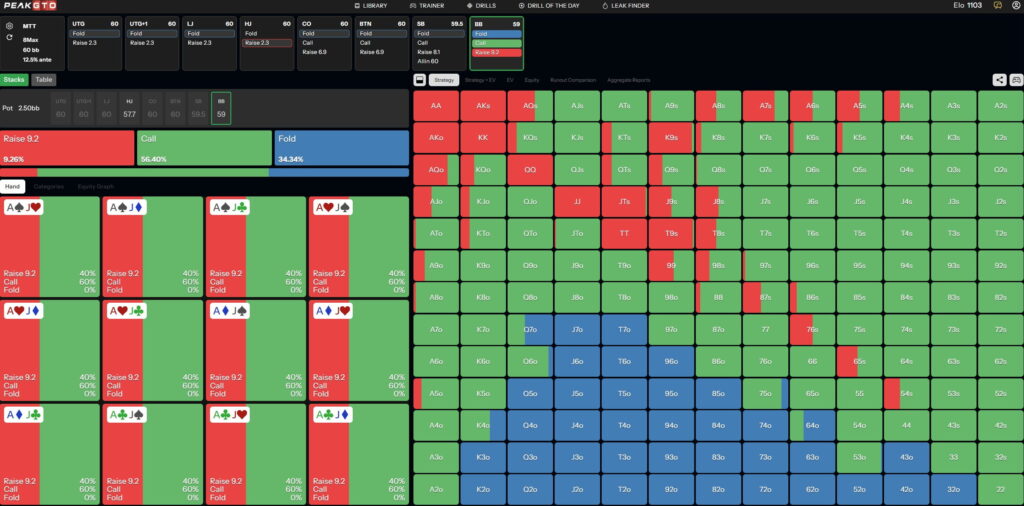
At 60 big blinds, your three-betting range from the big blind against a UTG raise should be tight. Three-bet for value with aces, kings, queens, jacks, and ace-king. Add some suited aces, suited kings, and suited connectors as bluffs, but keep the overall frequency low.
Your calling range is wide. Against a standard two-and-a-half big blind raise, every suited hand is worth calling except the very weakest ones. The pot odds are good enough. That said, offsuit junk like jack-seven offsuit, king-five offsuit, and ace-three offsuit are still folds.
One mistake a lot of players make in the big blind at 60 big blinds: they never three-bet suited connectors. When facing a button raise, the correct strategy includes three-betting a large chunk of suited connected and gapped hands, things like ten-six suited, nine-six suited, ten-seven suited, nine-seven suited, and nine-eight suited. Many players call these every time or fold them entirely, but three-betting them at the right frequency is clearly correct.
The logic is that against a wide button range, these hands have enough equity and playability to turn into three-bet bluffs. You are not relying on them to flop great. You are using their shape and blockers to apply pressure.
As the raiser’s position moves closer to the button, your three-bet range grows. Against a button raise, you can three-bet a near-linear range of the top of your holdings, plus a large group of suited connected hands alongside a few offsuit blockers.
At 25 Big Blinds
At 25 big blinds from the big blind, two things shift.
First, your calling range with offsuit hands actually widens. The reason is straightforward: when you are 25 big blinds deep and you flop top pair, that hand is strong enough to go with. If you call with queen-seven offsuit, flop top pair, and face a shove, you call. You do not fold top pair at 25 big blinds. This changes the math on calling with weaker offsuit hands preflop.
Second, your three-bet bluffs shift away from suited connectors and suited aces. At this depth, those hands want to call and see a flop. Their value comes from flopping well and getting to a cheap all-in. Your three-bet bluffs now come from offsuit blocker hands instead: ace-x offsuit, king-x offsuit, queen-x offsuit, jack-x offsuit.
Your small three-bet value range narrows to the nuts: aces, kings, queens, jacks, ace-king, ace-queen.
You also develop a shove range at 25 big blinds. These are strong-but-not-premium hands: ace-king, ace-queen, jacks, tens, nines, king-ten suited, jack-ten suited, and some small suited aces. Against a button raise, the shove range expands to include more ace-x offsuit hands, lower king-x suited, and more pairs.
At 15 Big Blinds
At 15 big blinds from the big blind, the small three-bet mostly disappears again. You cannot bet six big blinds out of position and then fold to a shove.
The strategy becomes shove or call, with very few folds.
Aces still slow-play frequently. Most hands shove or call because of ICM implications. The only hands worth folding are the absolute worst offsuit combinations: jack-three, jack-four, ten-six, eight-five, six-four.
Against an under the gun raise, shove ace-queen and better, most pairs, a few suited aces, and king-ten suited. Against a lojack raise, that shifts slightly down to ace-jack offsuit and adds a few more suited Broadway hands. Against a button raise, you are shoving a lot of ace-x offsuit, the best ace-x suited, some low king-x suited, and most pairs.
Everything else calls and tries to connect with the flop.
Adjusting to Your Opponent’s Actual Range
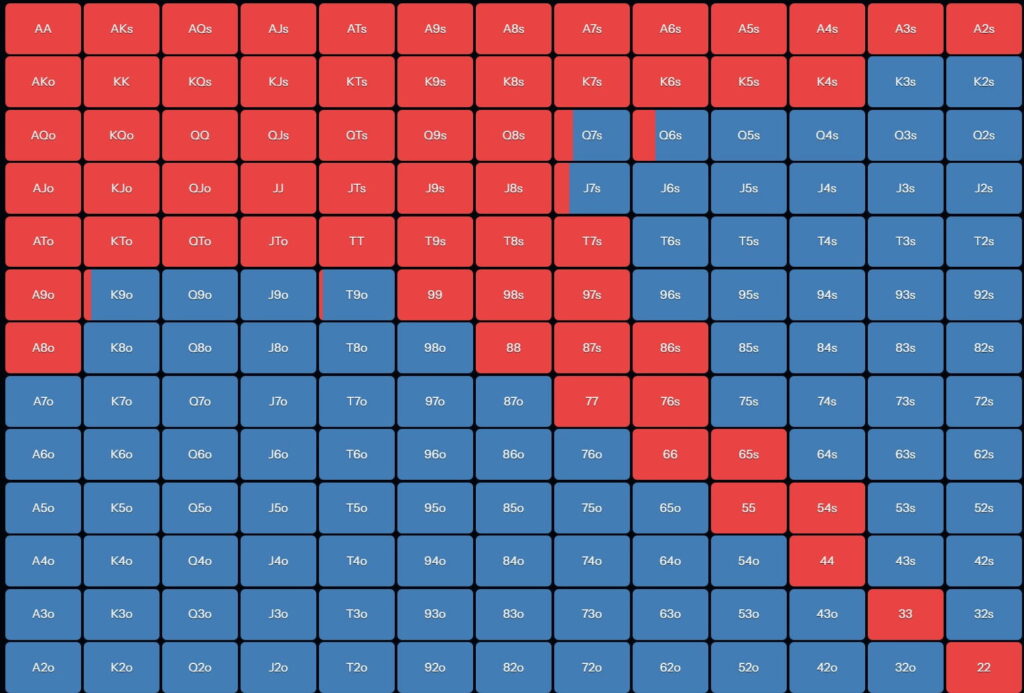
One of the most important concepts in short stack play is that you are not playing against the seat, you are playing against the range.
Preflop charts are built around assumptions about what each position typically raises. But players deviate. If the player under the gun is loose and aggressive and raising hands a cutoff would normally open, the standard UTG chart is the wrong tool. You should be playing something closer to the cutoff chart because that reflects their actual range.
The same principle applies in reverse. If a button player is unusually tight, tighten up accordingly.
This requires some observation, but you do not need to be precise. If someone is clearly raising wide, adjust your calls and three-bets toward the wider chart. If someone is clearly tight, move toward the tighter chart. The logic takes care of the rest.
Conclusion
Short stack play against a raise is more nuanced than most players realize. Your strategy should shift based on the raiser’s position, your own position, and how deep you are.
On the button, you have flexibility at 60 big blinds, begin shifting toward shove mode at 25, and simplify to push/fold at 15. In the big blind, position costs you equity, but the pot odds compensate. At shallower depths, the ability to play top pair strongly lets you defend wider.
The key adjustment is to pay attention to your opponent’s actual range and adjust your chart accordingly. Stack depth and position are the framework. Your read on the raiser is what sharpens the edge.