In plain English, the bubble factor shows how much worse it is to lose your stack than it is to win someone else’s near the bubble.
It explains why you should avoid certain marginal spots, why aggression changes near pay jumps, and why survival often becomes more valuable than chip accumulation.
Players who misunderstand bubble factor routinely torch EV near the bubble, while those who understand it gain a massive edge over the field.
This article breaks down bubble factor in practical terms and shows how to adjust your strategy when tournament pressure is at its highest.

What Bubble Factor Really Means
Bubble factor measures how much more costly it is to lose chips than to gain them in a tournament. Near the bubble or a major pay jump, losing chips hurts your tournament equity more than winning the same number of chips helps it.
In a cash game, winning and losing chips are symmetric. If you risk 10 big blinds to win 10 big blinds, the tradeoff is neutral. In a tournament near the bubble, that same risk can be disastrous, even if it’s profitable in a vacuum.
As the tournament approaches the money, the penalty for busting grows rapidly. When you bust just before a payout, you lose your entire tournament equity. When you survive, even with a small stack, you retain the chance to earn real money.
This causes the bubble factor to increase dramatically for:
- Medium stacks
- Big stacks facing medium stacks
- Players at tables with shorter stacks present
Short stacks, interestingly, experience a lower bubble factor. When you’re close to all-in anyway, the cost of losing is already baked in. This creates very different incentives for each stack size.
How Bubble Factor Changes Optimal Strategy
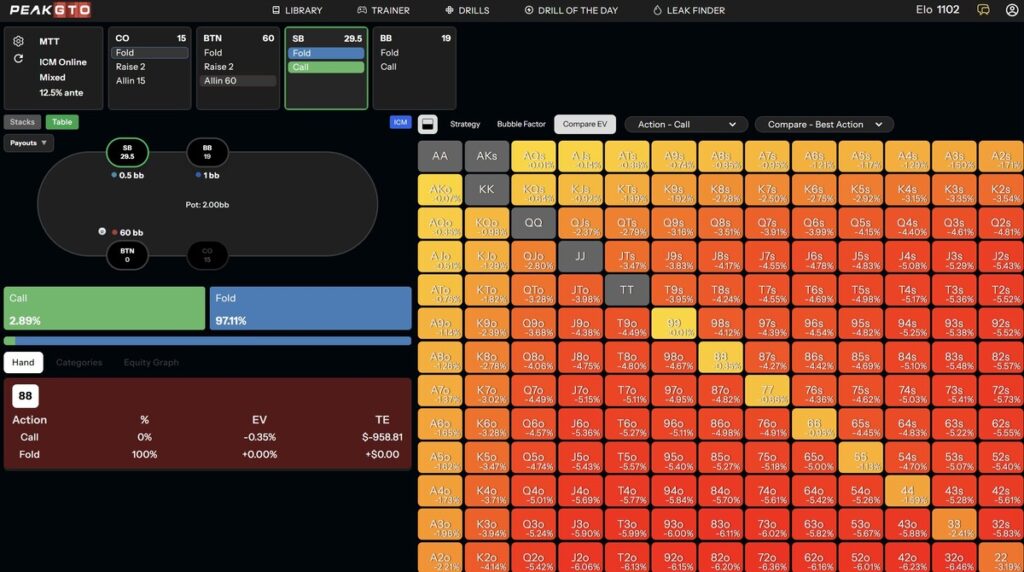
The bubble factor reshapes almost every strategic decision near it.
Tip #1. Calling Becomes Much More Expensive
One of the most important adjustments is that calling all-ins becomes far riskier than shoving. When you call, you risk elimination from the tournament. When you shove, you apply pressure without risking elimination unless called.
This is why correct ICM play often looks tight and aggressive at the same time:
- You shove wider
- You call tighter
- You avoid marginal bluff-catchers
- You pass on thin chip-EV spots
Hands that are easy calls in chip EV become clear folds under a high bubble factor.
Tip #2. Medium Stacks Are Under the Most Pressure
Medium stacks suffer the most from the bubble factor. They have too much to lose to gamble and too little leverage to bully others.
As a medium stack:
- You must be cautious when calling off your stack
- You should avoid clashes with larger stacks
- You should pressure shorter stacks selectively
- You should pass on marginal flips
Many tournament bust-outs happen because medium stacks ignore the bubble factor and take “standard” spots that are actually losing in real money terms.
Tip #3. Big Stacks Gain Enormous Leverage
Big stacks benefit the most from the bubble factor because they can threaten elimination without risking their own tournament life.
As a big stack:
- You can shove wider
- You can apply pressure to medium stacks
- You force opponents into ICM mistakes
- You benefit from others’ overfolding
This is one of the few times in poker where aggression becomes more profitable, specifically because opponents are scared.
Why Chip EV and ICM EV Diverge – A Practical Example
A common mental trap is thinking, “This is +EV, so I should take it.” Near the bubble, that logic often fails.
A spot can be:
- +chip EV
- –tournament EV
This happens when the downside of busting outweighs the upside of accumulating chips. Bubble factor explains why folding a profitable hand can be correct when tournament equity is at stake.
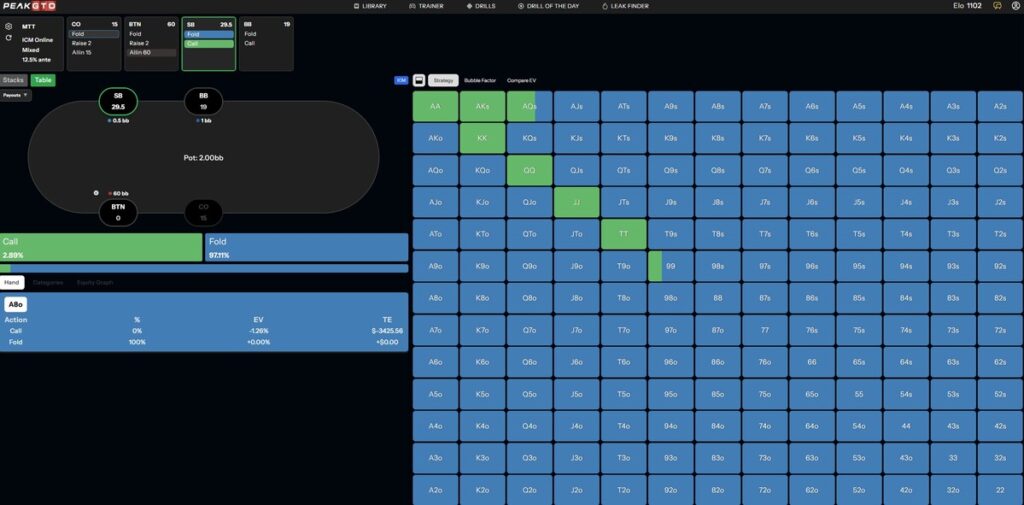
Consider a tournament with one spot left until the money. You are a medium stack in the Small Blind, and a big stack shoves on you from the button. You hold a hand like ATo.
In chip EV, this might be a clear call. Under the bubble factor, it’s often a fold. If you lose, you bust before the money. If you win, your equity increases, but not by enough to justify the risk.
Meanwhile, the big stack loses little by shoving, and this asymmetry is a bubble factor in action.
As you see in the image above, in this exact example, you should be folding hands as strong as AKo, which illustrates the importance of this concept.
Common Bubble Factor Mistakes
You should concentrate on accumulating chips while early in the tournament, and be happy to take even thin edges since you are playing to grow the stack
However, that changes when you are near the bubble. In that spot, you should concentrate on:
- Protect your stack
- Avoid elimination risk
- Apply pressure selectively
- Let opponents make mistakes
On top of that, here are some of the most frequent errors players make:
- Calling too wide near the bubble
- Treating chip EV as the only metric
- Fighting big stacks unnecessarily
- Ignoring shorter stacks at the table
- Failing to apply pressure when they are the big stack
Correcting these mistakes often results in an immediate increase in ROI.
Conclusion
Bubble factor is one of the most important MTT strategy concepts to understand, and one of the least obvious. It explains why survival matters, why calling becomes dangerous, and why aggression shifts near pay jumps.
Players who ignore the bubble factor treat tournaments like cash games and pay the price.
When you understand the bubble factor, you stop taking unnecessary risks, start applying pressure at the right times, and allow opponents to eliminate themselves. In tournament poker, that discipline is often worth far more than any single aggressive play.