Bluff catching is one of the least understood skills in poker. Most players decide whether to call a big bet based on how strong their hand feels, but the solver decides based on blockers: which of your opponent’s bluffs and value hands your specific cards remove from their range. The counterintuitive result is that a weak-looking hand can be a better call than a stronger-looking one, because it leaves all of the opponent’s bluffs in play. This hand is a masterclass in those defense mechanics, calling down three streets with middle pair and a deuce kicker.
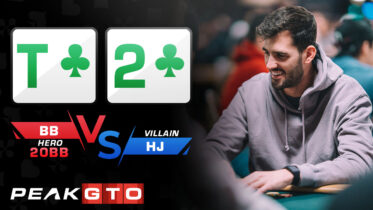
Today we will analyze a 20bb 8-handed tournament hand where the hijack opens, the big blind defends T♣2♣, and the board runs out Q♠T♥7♦5♠4♠. Hero flops middle pair and calls a flop bet, a turn bet, and a river two-thirds-pot bet, beating a triple-barrel bluff. The blocker logic is what makes this scruffy-looking pair the perfect bluff catcher.
Assumptions
- Stacks: 20bb effective
- Format: 8-handed MTT, 12.5% ante
- Positions: BB (Hero) vs HJ (Villain)
- Action: HJ opens, BB calls
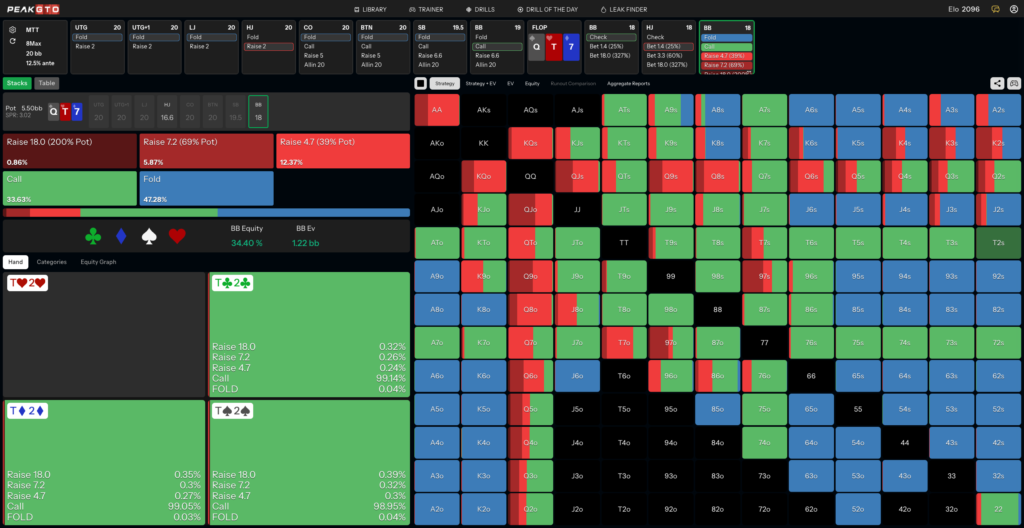
- Flop: Q♠T♥7♦ (Pot: 5.5bb), Hero calls 1.4bb
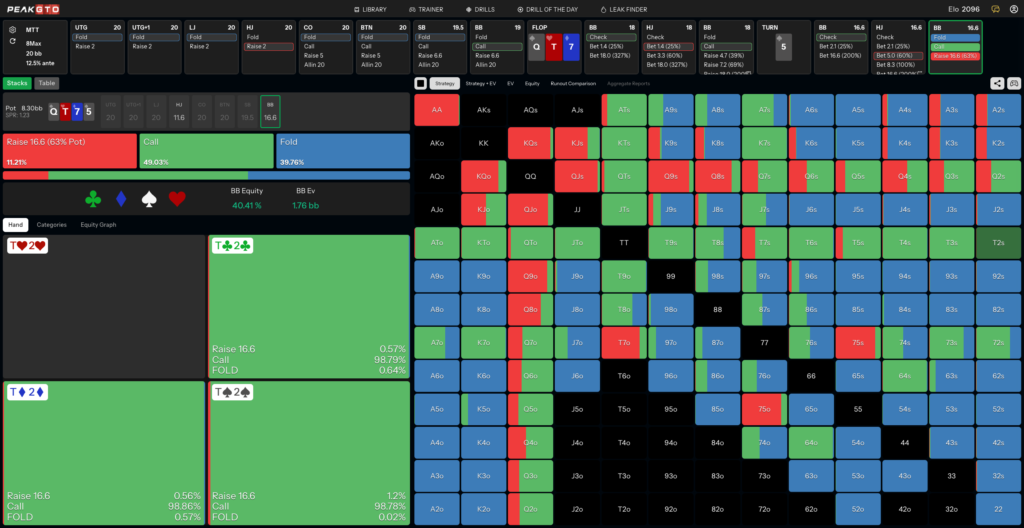
- Turn: 5♠ (Pot: 8.3bb), Hero calls 5.0bb
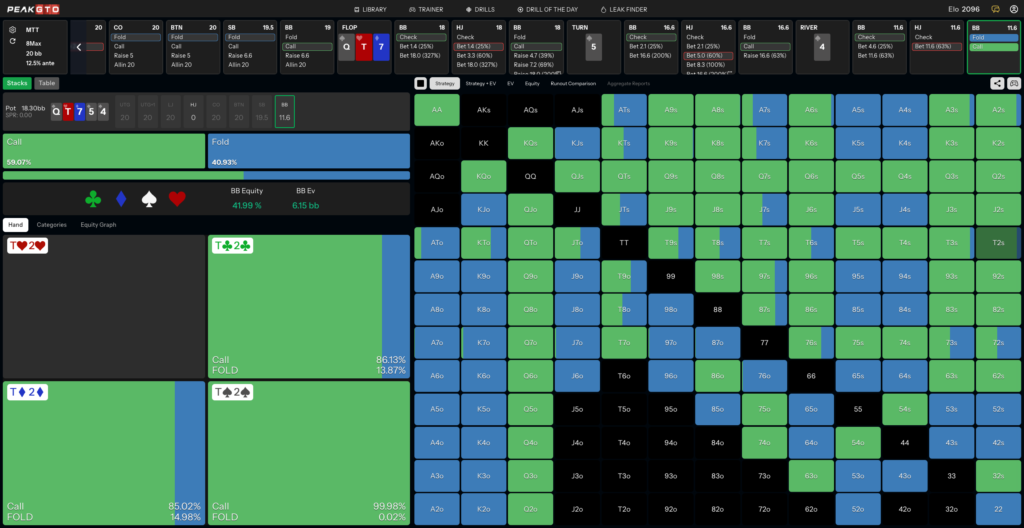
- River: 4♠ (Pot: ~18.3bb), Hero calls an ~11.6bb (two-thirds pot) bet
Preflop
T2s is a routine big blind defend against the hijack open, getting a great price to see a flop with a hand that can flop a pair or a draw. Hero calls, and we go to the flop out of position with 5.5bb in the pot. The whole hand is about how to defend the big blind’s wide, capped range against sustained aggression.
Flop: Q♠T♥7♦
Hero flops middle pair, a pair of tens with a deuce kicker. The hijack fires a small continuation bet of 1.4bb, and this is a straightforward call. There is no merit to raising: it would fold out worse hands, get called by better, and leave Hero with poor visibility on later streets, all while the hand is too good to turn into a bluff. Against a small bet, Hero can never fold middle pair. In fact, with the excellent pot odds, Hero should continue with every pair. The hands that are genuinely uncomfortable here are the no-pair, no-draw holdings like 86o, not a made pair like this one.
It is worth internalizing why a small bet makes folding any pair a mistake. When the opponent risks only a quarter of the pot, you need to defend a large fraction of your range to stop them from auto-profiting with every two cards. A pair of tens is comfortably in the top half of the hands you reach the flop with, so it is never close to a fold. The discipline here is to resist the urge to fold a “weak” pair just because the kicker is ugly. Against a small sizing, the kicker barely matters on the flop; what matters is that you have a pair and a price that makes continuing automatic.
Turn: 5♠
The 5♠ changes little, and the hijack fires again, this time for 5.0bb, about 60% of the pot. Hero is not thrilled, but the hand continues, and the reason is the core defense mechanic worth internalizing. When deciding which hands to call with, you want to keep the holdings that do not interact with the opponent’s bluffs. Hero’s ten blocks a big chunk of the hijack’s ten-based value: second-pair tens, two-pair hands like QT and T7, and sets of tens, while the deuce blocks essentially nothing. PeakGTO shows that prioritizing middle pairs that unblock the bluffs is a powerful general rule.
Compare T2 to a hand like T9o or T8o. Those hands also have a pair or a draw, but they remove the suited nine-x and eight-x combinations that the hijack would be bluffing with, which means they are worse calls even though they look stronger. Hero wants the opponent to keep firing with all of those suited connectors and gappers, so the right hand to keep honest with is the one that leaves those bluffs in their range. By the same logic, hands with a seven block much less value than hands with a ten, so the seven-x bluff catchers are mixed while the ten-x are pure calls. Hero calls and goes to the river. The key habit to build is to picture the opponent’s likely bluffs before you decide, and then ask whether your hand removes them. If it does, your call is worse than it looks; if it does not, your call is better than it looks, even with an ugly kicker.
River: 4♠
The 4♠ completes the third spade, and the hijack fires roughly 11.6bb, about two-thirds of the pot. Facing a bet this large for a pair of tens feels terrifying, but the analysis is the same as the turn, only sharper. The deuce of clubs does a fantastic job unblocking the opponent’s bluffs, so Hero would much rather call with T2 than with AT, KT, JT, T9, or T8, all of which remove bluff combinations from the hijack’s range. The combos to fold, if Hero is folding any, are the ones that interact with the bluffs, not this one.
The texture makes the call even better. When the spades complete, a thinking opponent will not value bet thinly; they will check back a weak queen or a decent ten rather than bet into a range that now has flushes. That means the value portion of their betting range shrinks, while their natural bluffs, hands like KJo, K9s, J9s, and various ace-x like A8, A9, and A6, remain plentiful. Many of those bluffs even carry a single spade that gives them a story to tell. With a pile of bluff candidates and few thin value bets, the opponent is a prime candidate to be over-bluffing, and Hero is getting a good price. This is a comfortable pot odds call. Hero calls, the hijack shows KJ for a busted broadway, and the pair of tens wins.
One subtlety on the river is that the exact T2 combo rewards combo-level thinking. Across Hero’s whole bluff-catching range the solver is close to indifferent, calling about 59% of the time and folding about 41%, right on the threshold where the price and the opponent’s bluffs just barely make calling break even. Hero’s specific T♣2♣ is not a coin flip, though: the solver calls it essentially every time. The deuce of clubs blocks none of the opponent’s busted flush draws and unblocks the offsuit bluffs Hero wants to catch, and the price is good, so this exact combination is a clear call even when the range as a whole sits on the fence. That is the payoff of thinking at the level of specific cards and the ranges they block rather than treating “T2” as a single undifferentiated hand. The solver rewards players who do.
Key Takeaways
- Flop: Never fold a pair to a small continuation bet from the big blind. Middle pair calls with excellent pot odds, and raising has no merit because it folds out worse and gets called by better.
- Turn: Choose your bluff catchers by blockers. Prioritize the hands that unblock the opponent’s bluffs, like a ten that blocks value, and de-prioritize hands like T9 and T8 that remove the suited bluffs you want them to hold.
- River: The same principle holds against a large two-thirds-pot bet. The deuce of clubs unblocks every bluff, so T2 is a better call than any ten with a strong kicker. When the scare card hits and the opponent has few thin value bets, expect over-bluffing.
- Overall: Good defense is a blocker exercise, not a strength exercise. Look for spots where the opponent has many offsuit bluff candidates and little offsuit value, and call with the hands that leave those bluffs alive. That is the heart of GTO defense mechanics.