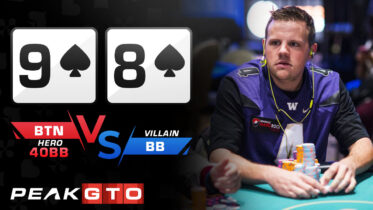
A double barrel bluff with nothing is one of the scariest plays in poker, and also one of the most profitable when the spot is right. When you are the preflop raiser who called a 3-bet in position, a disconnected board and a passive opponent can hand you the chance to float the flop and then barrel twice with what becomes a no-pair, no-draw hand by the river. The trick is knowing why it works: the right board, the right runout, and the right exact combination. This tournament hand walks through a clean example from float to final bluff.
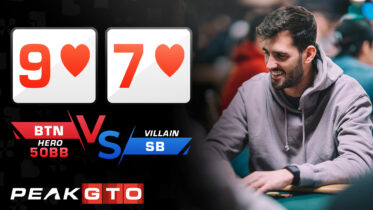
Today we will analyze a 40bb 8-handed tournament hand where Hero opens 9♠8♠ on the button, calls a 3-bet from the big blind, and turns a flop float into a double barrel bluff through a board of K♥5♠2♦, A♦, 2♣. Hero floats the rainbow flop with two backdoor draws, stabs the ace turn when checked to, and fires a second small bet on the paired river, taking the pot with a hand that is no-pair, no-draw from the turn onward. This hand shows why a backdoor-draw float is mandatory on this texture, why small bets unlock the bluff, and why 98s is exactly the combo that gets to keep firing.
Assumptions
- Stacks: 40bb effective
- Format: 8-handed tournament (MTT)
- Positions: BTN (Hero) vs BB (Villain)
- Action: BTN raises, BB 3-bets to 9.2bb, BTN calls
- Flop: K♥5♠2♦ (Pot: 19.9bb): BB bets 5bb, BTN calls
- Turn: A♦ (Pot: 29.9bb): BB checks, BTN bets 7.5bb, BB calls
- River: 2♣ (Pot: 44.9bb): BB checks, BTN bets 18.2bb, BB folds
Preflop
Hero opens 9♠8♠ on the button, raising around half its hands, and the big blind makes it 9.2bb. Facing the 3-bet, 98s is a clear call. The key is knowing the exact bottom of your defending range: every offsuit ten and offsuit eight, the fringe offsuit aces, K4s and Q6s and up, all pairs, and all suited aces. Suited connectors like this one sit comfortably above that floor.
The most important adjustments happen now, not later. If the opponent does not three-bet enough, overfold preflop rather than postflop, because preflop is the cheapest street to fold and the pot only gets more expensive from here. Against a player who three-bets too little, trim hands like KTo, the weak offsuit aces, and even 98s. The other key adjustment is sizing: against a smaller three-bet, you defend dramatically wider. Against this standard 9.2bb, 98s is a routine call, and Hero takes a flop in position.
Flop: K♥5♠2♦
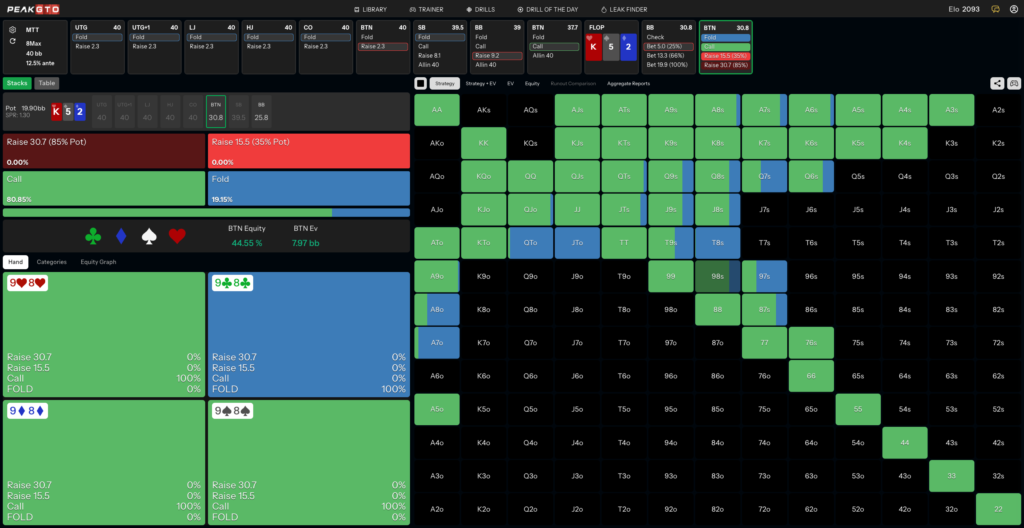
The flop is a rainbow, disconnected king-high board, the kind that gives three-bet pot callers fits. The big blind fires a 5bb continuation bet, about a quarter of the 19.9bb pot. The first move is always to compute the minimum defense: the opponent risks 5 to win the ~20bb pot, so the maximum fold is around 20%, and the solver folds about 19% here, right in line. That means roughly 80% of the time the correct answer is to continue, not fold.
The question is which hands make up that small folding portion. Hero cannot have a five or a deuce given the preflop range, so the folds come from the bottom offsuit hands: JT and QTo, which have no overcard to the king and no backdoor flush, and the weakest offsuit aces. On the suited side, something crucial happens, which is that essentially every hand with a backdoor flush draw continues. 9♠8♠ is exactly that, a backdoor flush draw plus a backdoor straight draw, and at a price of 5 to win ~25 it only needs about 16% equity to call. There is no need to plan the whole hand here; Hero simply calls and reassesses on the turn. The pot grows to 29.9bb.
The leverage these floats carry is what most players undervalue. Even when the backdoor never completes, the hand keeps its positional right to apply pressure the moment the opponent slows down. A capped player who checks the turn is exactly the kind of target a flop float is built to attack, and that threat of a follow-up bet is worth as much as the raw equity, sometimes more. The float is not just a call hoping to hit; it is the opening move of a line designed to take the pot away later.
Turn: A♦
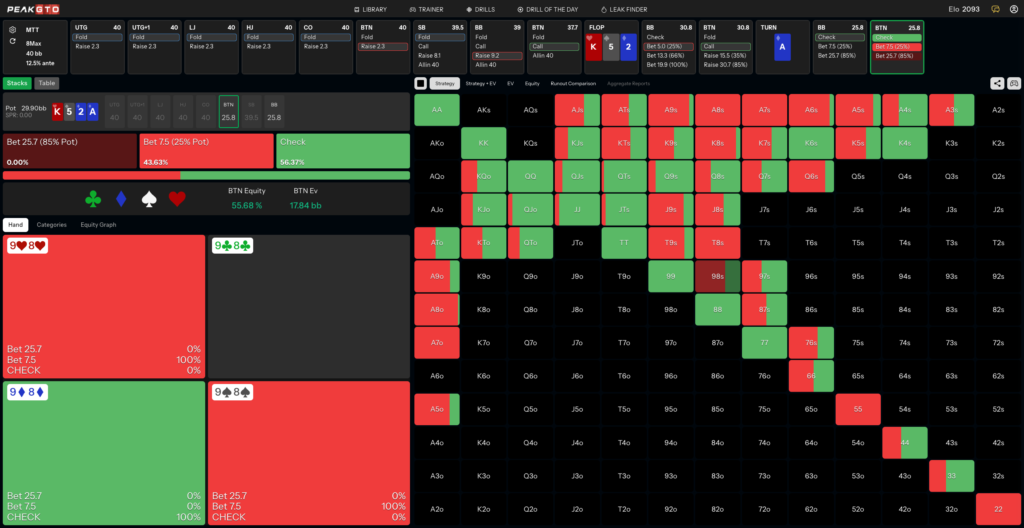
The A♦ arrives and the big blind checks. This is where the float starts to pay off, because the opponent will not bet the turn every time, and when they check they let Hero’s weakest floats keep playing. The ace also improves Hero’s range in a meaningful way: all those suited and offsuit aces that continued on the flop now have a pair, so the value betting range is loaded with ace-x, sets, two pair, and the occasional strong king. Hero has a clear top to the range, which is what makes bluffing safe.
With a stack-to-pot ratio around one, the in-position play is not to shove but to bet small, using escalating bets to set up a river all-in, around a quarter of the pot on the turn and a bit larger on the river. The ace needs no protection, so there is no reason to bloat the pot, and betting small is precisely what unlocks the bluff: Hero cannot profitably jam 98, but a 7.5bb quarter-pot bet lets the worthless hands apply pressure cheaply. PeakGTO bluffs from the bottom up here with the zero-equity hands like 76, 87, 98, and T9s, along with some of the queen-rag and jack-rag combos, while deliberately checking the gutshots like QJ and QT, both because they have value in checking and because those are the very hands Hero is trying to attack. It is also worth noting how the big blind’s range narrows once they check this ace: a check leaves their range skewed toward marginal made hands, weaker aces, and kings rather than the very top of their range, which is exactly the range Hero wants to keep barreling into. Hero bets 7.5bb and the big blind calls.
River: 2♣
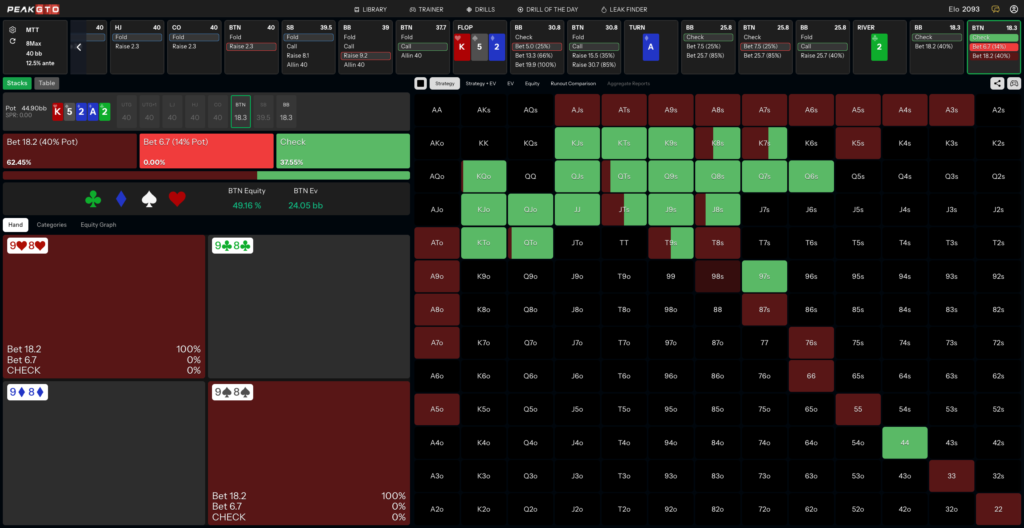
The 2♣ pairs the bottom card and changes nothing for Hero, who still has nine-high. The big blind checks again. The river did not hurt any of Hero’s value bets, so every ace still bets, and the bluffs come from the very bottom of the range: 76, 87, and 98s. Hands like J9, J8, Q6, and Q7 have to give up, because Hero is betting small, only 18.2bb into the 44.9bb pot, around 40% of the pot, which at this SPR is essentially the rest of the stack.
That small size is the key to the whole line. A smaller bet gives the opponent a good price, which means Hero does not need many bluffs to stay balanced, so only the best and worst candidates get to fire while the middling hands check. 98s, with no showdown value whatsoever, is a perfect bluff, and Hero sends it in. The opponent’s range is capped and uncomfortable: by the river it is mostly weak aces that called the turn plus a handful of stubborn king-x, since the deuce paired the board without helping any of their bluff-catchers. They cannot fold an ace and must defend some king-x, so against anyone who overfolds, this bluff simply prints. This is the disciplined heart of GTO aggression: pick the right board, keep your sizes small, and barrel the exact hands that have nothing to lose. The big blind folds, and nine-high takes it down.
Key Takeaways
- Flop: On a rainbow king-high flop in a 3-bet pot, continue almost every backdoor flush draw. 98s with a backdoor flush and straight is a mandatory float against a quarter-pot c-bet.
- Turn: When the ace gives Hero a strong value range and the opponent checks, use small, escalating bets to set up a river all-in rather than jamming. Small sizing is exactly what lets a no-equity hand like 98 keep bluffing.
- River: A small 40% pot bet needs few bluffs, so only the very bottom of the range fires while middling hands give up. 98s has no showdown value, which makes it a clean second barrel.
- Overall: A double barrel bluff after a float is not recklessness, it is structure. Float the right boards, keep your bets small to protect your bluffs, and fire your zero-equity hands against a capped, position-disadvantaged opponent.