Most players never lead into the preflop raiser. They were taught that the out-of-position player should check to the aggressor, full stop. But at shallow stack depths on the right board textures, leading the flop, sometimes called a donk bet, is not just acceptable, it is often the highest-expected-value play. A well-constructed leading range pressures opponents who fold too much, keeps the betting lead while building the pot, and lets you get thin value with the kind of marginal made hands that fill out a big blind defending range. This hand shows the full three-street version of that strategy.
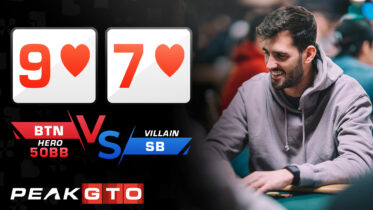
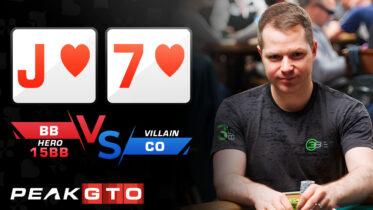
Today we will analyze a 15bb 8-handed tournament hand where the cutoff opens, the big blind defends J♥7♥, and the flop comes 7♠5♥3♦. Hero flops top pair and leads the flop for a small size, fires another small bet on the turn, and then has to choose between a thin value bet and a jam on the river. Leading and barreling small is the way to print money in this short-stacked spot.
Assumptions
- Stacks: 15bb effective
- Format: 8-handed MTT, 12.5% ante
- Positions: BB (Hero) vs CO (Villain)
- Action: CO opens, BB calls
- Flop: 7♠5♥3♦ (Pot: 5.5bb), Hero leads 1.4bb
- Turn: T♠ (Pot: 8.3bb), Hero bets 2.1bb
- River: 2♥ (Pot: 12.5bb), Hero bets 3.1bb
Preflop
J7s is a standard big blind defend against a cutoff open at 15bb, comfortably inside Hero’s wide defending range. Hero calls, and we go to the flop heads-up and out of position. The short stack is the backdrop for everything that follows: with only 15bb, small bets carry real leverage and thin value bets become very profitable.
Flop: 7♠5♥3♦
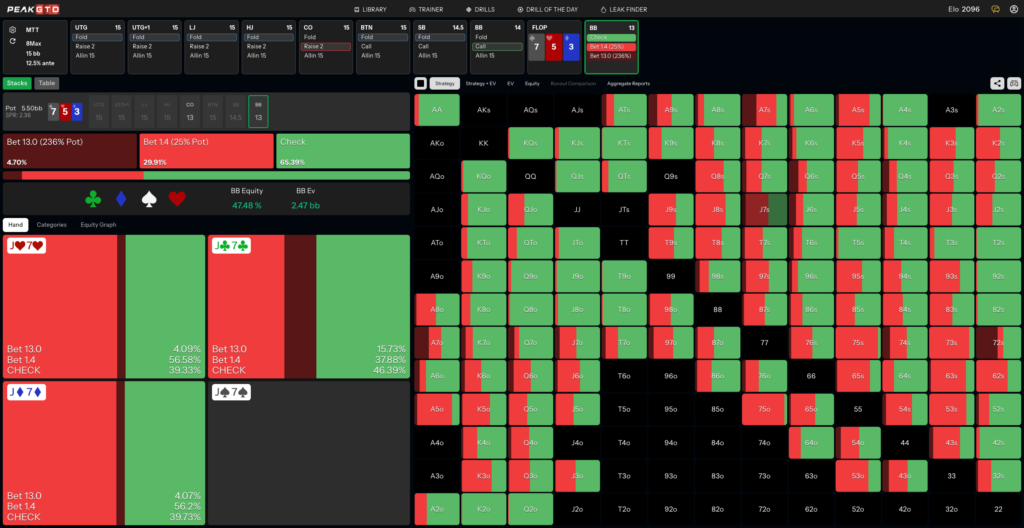
Hero flops top pair with the 7, plus a backdoor flush draw. On low, connected three-card flops like 753, the solver develops a leading range from the big blind, and this is one of those boards. The texture favors leading because the big blind defending range connects with these small cards far better than the cutoff’s opening range, which is loaded with broadways and high cards that whiff completely. Rather than check and let the in-position player make a routine continuation bet, the big blind can seize the betting lead with the hands that benefit most from it. The reason is that Hero holds a lot of hands that are almost always best but vulnerable to being outdrawn, like top pairs, as well as hands with decent equity that would rather bet than face a bet. Hero leads for a tiny 1.4bb, which is the size to use. In theory the cutoff should continue about 92% of the time, because they are in position and realize their equity well, but in practice many opponents instantly fold hands like KT, QT, K9, JT, J9, and Q9, and the weak-tight players even fold KQ or AJ. Folding all of those out makes the lead print money.
Hero’s J♥7♥ mixes between leading and checking, which is true of basically every top pair here, and Hero leads it over half the time. The leading range is not only value: Hero leads roughly half the time with its value hands, plus a smattering of logical draws, which on 753 means hands with a 6 or a 4 that pick up a straight draw, plus marginal hands with a backdoor flush draw and overcards, like J9, Q8, or K♥9♥. What does not lead are the hands with no future, the unpaired high cards like KT and JT that can comfortably check and fold. If Hero leads and gets jammed on, the plan is to call off with most pairs of sevens or better. Hero leads 1.4bb and gets called.
Turn: T♠
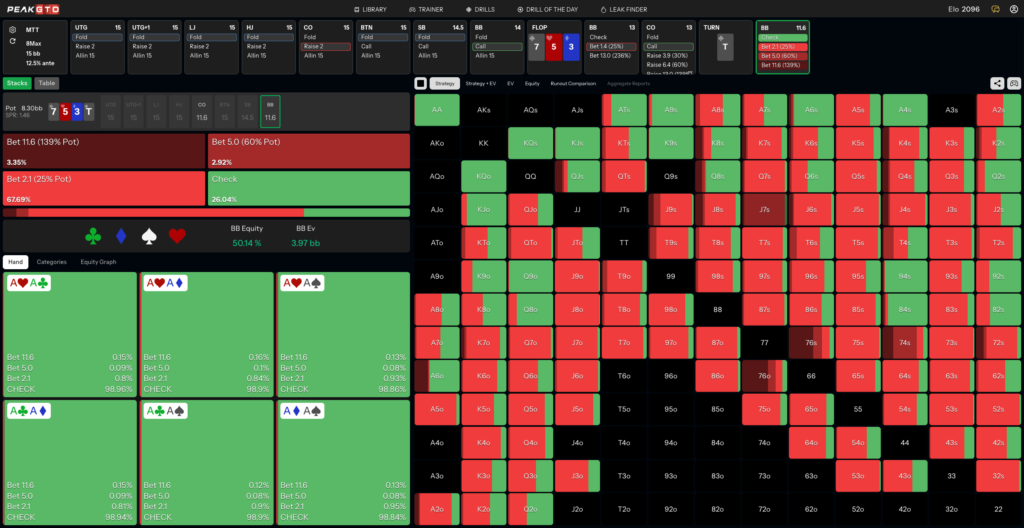
The T♠ looks like a nasty card because an overcard arrived, but Hero is doing fine. Since the cutoff had to continue about 92% of the time against the small flop bet, their range is still wide and weak, and Hero retains roughly 50% equity. PeakGTO bets about 74% of the range here, including nearly all the pairs, using a small 2.1bb size. Why not bet bigger to charge draws? Because the tiny size again forces the cutoff to continue with almost everything, folding only about 16% of the time, which lets Hero make a stream of cheap bluffs and thin value bets. Worth noting on terminology: this is no longer a lead, since Hero was the previous aggressor, so it is simply a bet.
The exploitative case for the small bet is strong. The solver wants the cutoff to continue with hands like KJ, QJ, AQ, AJ, and even K♥8♥, and most opponents will fold far too many of them. Against a population that overfolds, the small turn bet is close to free money. Hero bets 2.1bb and gets called again.
There is a defensive layer to the small sizing as well. If Hero bets 2.1bb and the cutoff jams all-in, Hero’s top pairs can call thanks to the pot odds the already-built pot offers, plus the fact that a balanced opponent should include some bluffs in their jamming range. The small size therefore is not a sign of weakness that can be exploited by a raise; it is a sizing that keeps Hero’s strong hands comfortable continuing. Weaker pairs are closer and can be folded against players who never bluff-jam, but the default plan is to commit with top pair and better.
River: 2♥
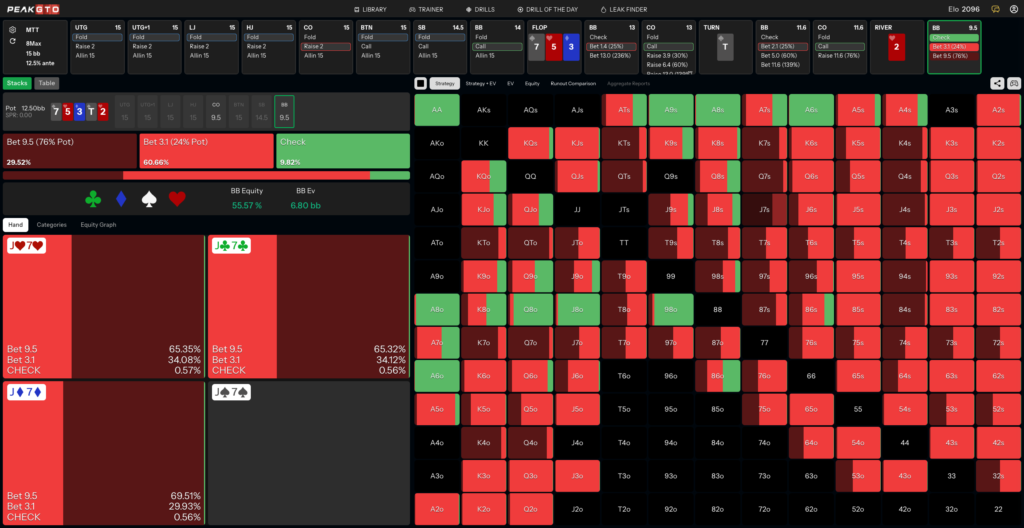
The 2♥ is about as safe a river as Hero could ask for, and the big blind arrives with about 56% equity and a lot of strong hands. The question is sizing: bet small with the whole range for about 3.1bb out of the 9.5bb stack, or build a shoving range? Hero certainly has enough strong hands to jam, and in pure theory the J7 combination shoves all-in about 65% of the time, because the solver assumes the opponent will call off the necessary bluff-catchers like A9, A6, AJ, AK, and AQ.
The real world is different. Most opponents will not make a hero-call with AK for their tournament life facing a river jam. That makes the jam less effective than the GTO baseline suggests, so Hero opts for the small 3.1bb bet instead. The small size accomplishes two things: it coaxes the ace-high hands into calling, where they would fold to a shove, and it keeps Hero’s bluffs cheap. The bluffs that pair best with this thin value bet are the busted draws and overcards that bricked and have essentially no showdown value. If Hero bets small and gets jammed on while holding a marginal hand or one of those bluffs, Hero can simply fold and save the remaining six big blinds, which is enormously valuable in a tournament.
The biggest mistake players make in this line is to bet small on the flop and turn and then check every pair on the river, surrendering all the thin value they worked to set up. That is nowhere near the optimal strategy. Hero bets 3.1bb, the cutoff folds king-high, and the small-ball line collects another pot. Manage your pot odds by sizing your river bet to the calls your specific opponent will actually make.
Key Takeaways
- Flop: On low, connected boards, develop a leading range from the big blind. Lead top pairs and logical draws for a tiny size; the play prints because in-position opponents overfold hands that should continue.
- Turn: Keep betting small with the whole range, including all your pairs. The tiny size keeps the opponent’s range wide and lets you collect a stream of cheap, profitable thin bets across streets.
- River: J7 shoves about 65% in theory, but against opponents who will not hero-call a jam, the small value bet is better. It gets the ace-highs to call and keeps your bluffs cheap enough to fold if jammed.
- Overall: Leading the flop and barreling small across three streets is a powerful short-stack tool. The common error is to bet small early and then check the river, leaving easy value on the table. Get comfortable leading and betting thin, and these become some of your most profitable big blind spots.