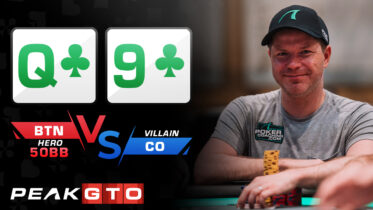
The middle stages of a poker tournament are where fields get separated. Early survival play stops working. Short-stack shove-fold is not quite the right framework either. You are caught between needing to accumulate chips and avoiding the big mistakes that send you to the rail before the money.
This phase typically runs from around 20 to 60 big blinds in effective stacks. Antes are in play, inflating preflop pots and raising the value of every steal. The player pool has thinned, and the skill gap between the chip leaders and the median stack is usually widening by the hour.
This guide covers the specific decisions that define middle-stage Texas Hold’em tournaments: how to construct a correct opening range, how to adjust continuation bet sizing to board texture, which hands to continue bluffing on the turn, when the river warrants a value bet, and how to use your stack as a weapon near the bubble.

Opening Ranges at Middle Stage Stack Depths
As stacks shrink through the middle stages, opening ranges tighten in early position and stay wide in late position. The gap between those two extremes widens considerably compared to deep-stack play.
From early position, the range tightens significantly as effective stacks drop. Speculative hands — small suited connectors, weak suited aces, low offsuit broadways — lose implied odds value because you can no longer build the multiway pots needed to justify them. At shorter depths, you are building pots where the river often arrives with a modest remaining stack, and hands that only win by flopping two pair or better against a wide field become losing opens from early position.
From late position, the story is different. The cutoff and button should maintain a wide opening range throughout the middle stages because antes inflate the preflop pot, making uncontested steals significantly more valuable than at deep stacks. The extra dead money shifts the equity needed to profit from a late-position open, and shorter stacks behind are less likely to respond aggressively to a steal.
The result is a wider gap between early and late position ranges in the middle stages than at 100 big blinds. A hand that is a comfortable button open is not necessarily an early position open. Playing positionally disciplined is more important at this stage, not less.
Below 20 big blinds, the open-raise-and-play framework mostly breaks down. Push/fold charts define the correct shoving and calling ranges at these depths. Open-raising to 2x and folding to a three-bet leaks chips when your stack is this shallow. The decision is almost always shove or fold, not open and navigate.
C-Bet Sizing by Board Texture
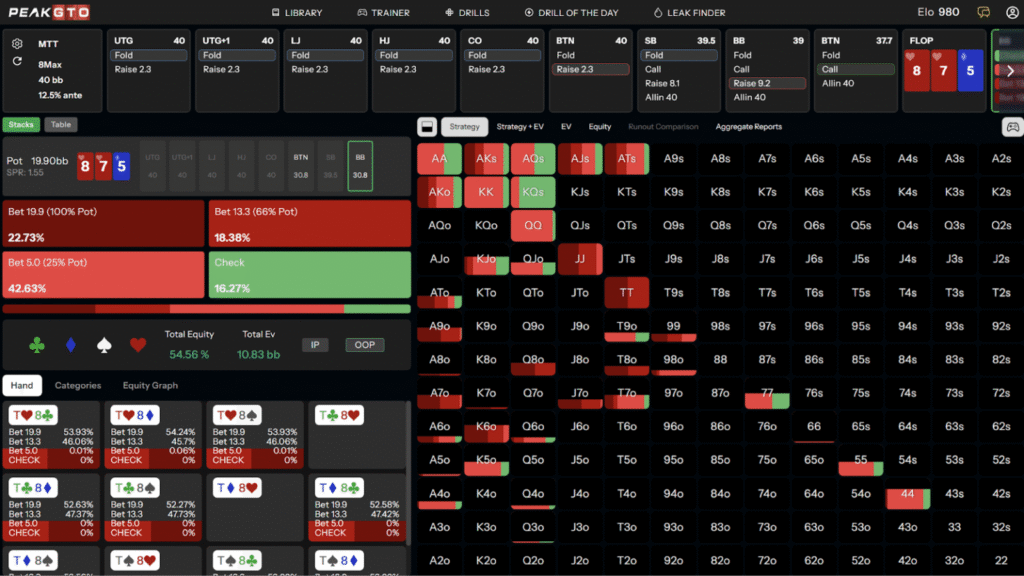
At 40 big blinds from early or middle position facing a big blind caller, continuation betting frequency is high on most boards. What changes by texture is the size.
Studying these spots using a tool like PeakGTO reveals a consistent principle: the size of the correct c-bet tracks how dynamic the board is. High-card boards with straight and flush draw potential demand bigger bets. Low and dry boards reward smaller bets or checking. Understanding why produces better instincts at the table, even without a solver in front of you.
High-Card Dynamic Boards
On boards like king-ten-seven with two suited cards, or jack-six-five rainbow, bet frequently and use a medium to large size. Your range contains all the overpairs, top pairs, and sets, while the big blind defends with a wide range of draws and marginal pairs. Betting big serves two purposes: it extracts value from hands that call with worse, and it charges the outs that the opponent is chasing with straight and flush draws.
Checking back on these boards gives up value and lets draws see free cards. When your range has a structural advantage on a high-card board, take it.
Low and Dry Boards
On boards like ace-three-two or low rainbow boards with few draws, bet smaller or check at a higher frequency. The big blind’s range contains more disguised made hands: sets of small pairs, two-pair combinations from connected low cards, and straights from small suited connectors. You cannot fire large repeatedly on these boards without running into strong hands far more than the bet size justifies.
A small bet, around a quarter to a third of the pot, accomplishes the same fold equity against weak holdings while minimizing the amount lost when you run into something strong. On the lowest and most connected boards, checking back at a significant frequency is the correct default.
Strong Hands on Dynamic Boards
When you make a strong hand on a dynamic board, the correct response is to bet large and get money in quickly. If you flop a set on a board with straight and flush draws, pot-sized betting or close to it is standard. The board is likely to change on the turn in ways that kill your action or complete draws against you. Charging draws the full price immediately captures more value than slow-playing across three streets.
The concept generalizes: on high-card boards with multiple draws in play, your strong hands prefer to play large pots right now, not small pots that grow gradually.
Which Hands to Bluff on the Turn
After the flop goes check-call, the turn bluffing decision requires more precision than many players apply. Not all hands that missed are equally good to continue bluffing with.
The best turn bluffing candidates are king-x hands, hands containing a nine on boards where nines are relevant, and suited connectors that picked up draws. These hands combine decent fold equity with some equity if called. King-high hands also put pressure on opponents who have no pair and weak holdings that can fold, while not blocking the hands you actually want to fold out.
Small pairs are sometimes in the bluffing range, but they are lower priority. The logic is that small pairs have showdown value against the weakest parts of the opponent’s range. Bluffing with king-six when the opponent might check behind with queen-high and lose at showdown is more efficient than bluffing with pocket threes, which wins at showdown more often than it appears.
In my experience, the most common middle-stage bluffing error is continuing with hands that have some equity but no path to making the right hands fold, while overlooking cleaner bluffs with king-x and suited connectors that can make opponents fold marginal pairs they would otherwise show down.
The exploitative adjustment: if you are playing against an opponent who does not check-raise the flop with enough bluffs, your hands that called a check-raise in theory should simply fold to protect your calling range. Folding slightly more than GTO suggests in these spots is correct against opponents who are too passive and transparent.
The River Value Betting Threshold
A simple rule that produces more accurate decisions: the smallest bet you should ever make on the river when you are in position is roughly half the pot. If your hand cannot generate calls from worse hands when you bet half the pot, it is not worth betting at all. Check back and take the showdown equity.
This cuts both ways. It prevents over-betting thin, where you make a small bet hoping to get called by something, but also prevents under-betting strong hands that could have extracted more. The half-pot threshold is approximately where the math starts to work: your hand needs to be called by enough worse hands that the bet generates a positive expected return over time.
In practice: on a board of nine-six-queen where you held nine-eight suited, a hand like ten-nine or jack-nine has enough value to bet half the pot. Weaker pairs, like pocket fours that turn into a top pair on a turn nine, are checking back. Any jack-x that made a second pair might be a borderline bet depending on the board. When uncertain, ask whether the bet gets called by enough worse hands to profit. If the answer is clearly no, check.
When to Triple-Barrel and When to Give Up
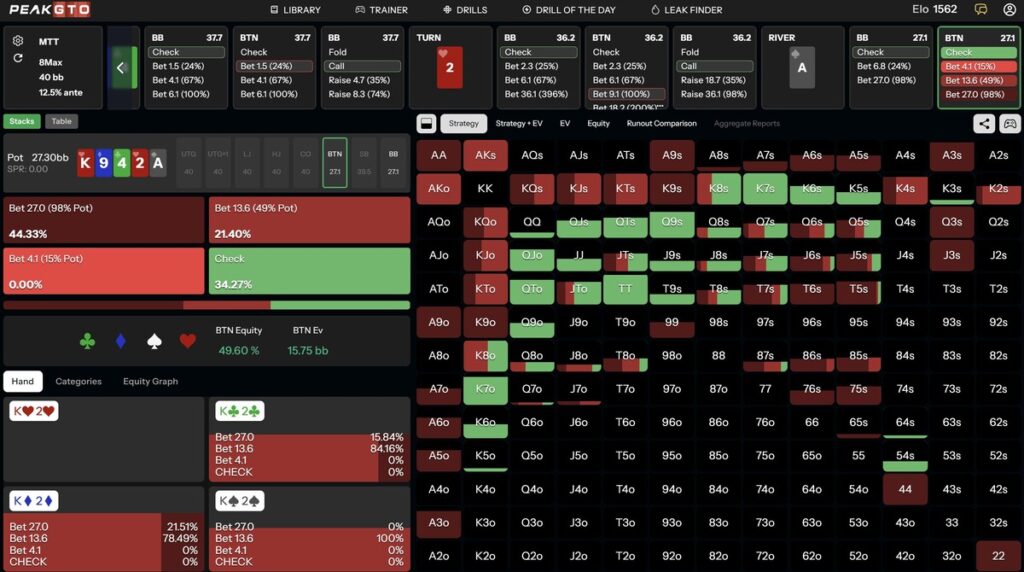
Committing to three streets of betting is one of the most expensive decisions in tournament poker when it goes wrong. The question to ask before continuing is: Can this bluff actually make the opponent’s best realistic holdings fold by the river?
Consider a board of jack-ten-four after a preflop raise, where the caller simply calls the flop. That board is extremely good for the caller’s range: ace-king has a gutshot and overcards, king-queen has an open-ender, top pair holdings are always calling, and flush draws are everywhere. Firing two more streets does not make those hands fold. Giving up early and saving chips is the correct response.
Contrast that with a board of nine-seven-five against an opponent who calls the flop and calls the turn without raising. A strong player holding a nine in that spot almost always raises or bets, both to protect equity and to build the pot. When the opponent simply calls passively, nines are nearly gone from their range. They are capped at a seven, an underpair, or a missed draw. The river shove is mandatory.
Understanding MDF helps frame this correctly: opponents must defend a minimum percentage of their range to prevent bluffs from being infinitely profitable. When a passive opponent has already folded most of their strong holdings through check-calling patterns, they are likely defending below MDF. That deviation creates real fold equity for the triple-barrel. The discipline is recognizing which boards create that situation and which ones do not.
Bubble Strategy: Use Your Stack as a Weapon
As the money bubble approaches, stack size becomes a source of strategic leverage that goes beyond card strength.
When you cover an opponent, you are the only player who can eliminate them. Every decision they make for a significant portion of their chips carries the risk of bubbling, and that weight limits their aggression. You do not carry that constraint.
This asymmetry is the foundation of ICM pressure: chips have unequal tournament value depending on who holds them and who is at risk. A medium stack losing half its chips faces a potentially tournament-ending situation. You gain those same chips with relatively little impact on your tournament life.
Apply this practically. Raise wide from late position into shorter stacks. Three-bet opens when your stack is meaningfully larger. When you make a strong hand against a covered opponent, use multi-street sizing to build a pot that they feel genuine pressure to navigate. Decide what the hand should look like on the river before betting the flop, and choose sizes on each street that make that outcome achievable.
The counterbalance: if a bigger stack is in the pot with you, they have the same leverage over you. Be more selective when the poker hands you are building a pot with cannot withstand a check-raise or a shove from a player who covers you.
Conclusion
The middle stages of a poker tournament are where the game is most demanding. Deep-stack implied odds plays are no longer available. Pure shove-fold math has not taken over yet. Every decision requires understanding your exact stack depth, the board texture in front of you, and the specific tendencies of the opponent you are playing against.
The players who build chip leads through the middle stages do it through consistent execution: a correct preflop range, a disciplined approach to c-betting and bluffing by texture, and aggressive use of stack leverage near the bubble. None of these is advanced in isolation. Together, applied hand after hand correctly, they compound into a meaningful edge over the field.