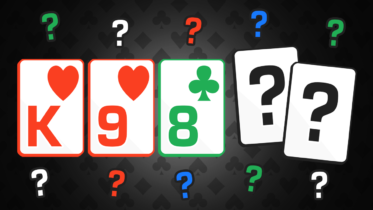

Poker outs are the cards remaining in the deck that will improve your hand to a likely winner. When you hold a flush draw on the flop, for example, nine hearts are still out there. Each one of those cards is an out.
Knowing how many outs you have lets you use simple mathematics to calculate your equity and decide whether calling a bet, raising a draw, or folding is the correct play.
I have reviewed thousands of student hands where the player made the wrong decision because they never stopped to count their outs first. The mistake is almost always the same: players assume they have enough equity to continue without actually checking the number.
This guide will show you how to count outs accurately, convert them into equity using the Rule of 2 and 4, and recognize when an apparent out is actually a trap.
What Are Poker Outs?
In the simplest of terms, any card that can strengthen your hand ranking is an out, whether it gives you a straight, flush, two pairs, or even just one pair. Not all outs are equal: some improve you to the nuts while others improve you to a hand that is still losing.
I will cover the important distinction between clean and dirty outs later in this guide. For now, we will count all cards that can improve your holding and treat them as outs.
For example, imagine you have K♥Q♥, and the board runs J♥10♥4♦. In this situation, there are several cards that can improve your hand.
Any non-heart Ace or a Nine will give you a Straight, which will be the nuts. Any heart will give you a Flush, with A♥ and 9♥ improving you to a Royal Flush and Straight Flush, respectively.
What’s even more, any of the remaining Queens or Kings in the deck will give you a pair, which alone could make the best hand, depending on your opponent’s holding.
So, now that we know what poker outs are, let’s learn how to count them.
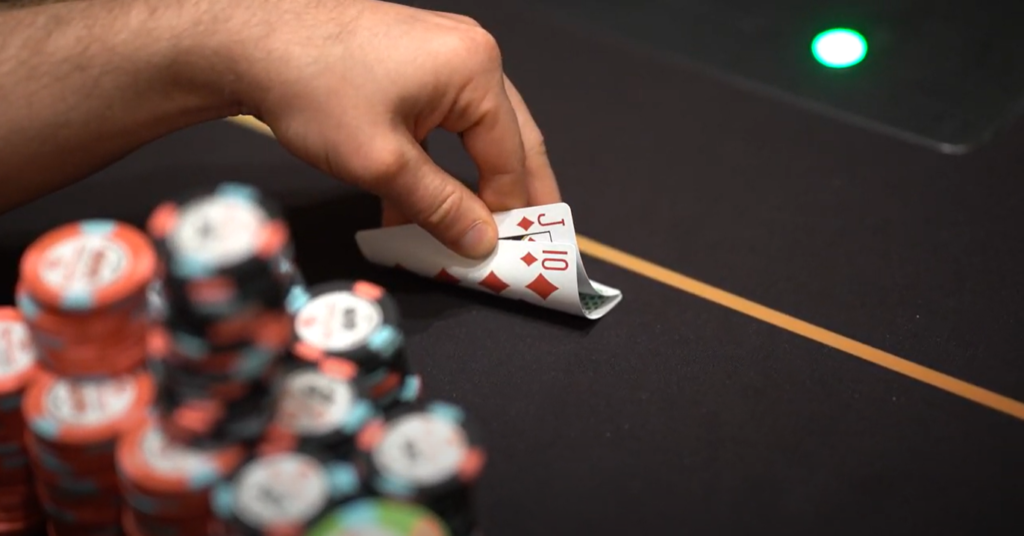
Knowing how to count your outs is critical to making the right decisions, especially when holding suited connectors.
How to Count Outs in Poker
Now that you understand what poker outs are, counting them is straightforward. The process has two steps: identify which cards improve your hand, then count how many of those cards remain in the deck.
What I find when reviewing students’ hands is that most players can do this correctly when they slow down and think. The problem is that in-game, under pressure, they skip the count and guess. That guessing is where money is lost.
In the example above, we already identified the potential poker outs with K♥Q♥ on the board J♥10♥4♦, so let’s count them out:
· Three Aces to make a Straight – 3
· Three Nines to make a Straight – 3
· A♥ and 9♥ to make a Royal/Straight Flush – 2
· Seven Hearts to make a Flush – 7
· Three Queens to make a Pair – 3
· Three Kings to make a Pair – 3
In total, this gives us 21 outs, which is about the most out you can have in the game of Texas Hold’em.
Granted, the Kings and Queens only give us one pair, which may not be the best hand, but most other outs will give us either the nuts or very close to it.
As you can see, the counting process is quite simple. It really only requires you to be good at counting and visualizing which cards will improve your hand.
Keep in mind that there are exactly four cards of each rank in the deck and that there are exactly 13 cards of each suit in the deck.
What’s more, remember to account for the cards you are already seeing and not to double-count some outs. For instance, in our example above, if you count the A♥ and 9♥ as your Flush outs, don’t count them again as the Straight outs.
Common Out Counts in Poker
When it comes to counting outs, there are some very common scenarios in which this skill comes into play, and pro players know their outs count in these spots without even thinking about it.
You can know it too by simply memorizing this chart and remembering what each common draw means in terms of poker outs:
| DRAW | OUTS |
| Open-Ended Straight Flush Draw + 2 Overcards | 21 |
| Open Ended Straight Flush Draw + 1 Overcard | 18 |
| Open-Ended Straight Flush Draw | 15 |
| Gutshot Straight Flush Draw | 12 |
| Flush Draw + 2 Overcards | 15 |
| Flush Draw + 1 Overcard | 12 |
| Flush Draw | 9 |
| Open-Ended Straight Draw + 2 Overcards | 14 |
| Open-Ended Straight Draw + 1 Overcard | 11 |
| Open-Ended Straight Draw | 8 |
| Set to Full House/Quads | 7 |
| Two Pair to Full House | 4 |
| Two Overcards | 6 |
| One Overcard | 3 |
| Pocket Pair to Set | 2 |
In this table, we only counted the outs that gave us at least a top pair or better, but there are some scenarios in which outs to a lower pair could also be considered.
Furthermore, backdoor draws, such as three cards of the same suit or three cards to a Straight, can also be counted as partial outs, as they do add some EV to your hand.
Draw Odds Quick Reference
Once you know how many outs you have, the next step is knowing your equity. Rather than doing the Rule of 2 and 4 calculation every time, use this reference table to instantly see your approximate equity for any number of outs on the flop or turn.
| Outs | Flop to River (%) | Turn to River (%) | Example Draw |
|---|---|---|---|
| 2 | 8% | 4% | Pocket pair to set |
| 3 | 13% | 7% | One overcard |
| 4 | 17% | 9% | Gutshot straight draw |
| 6 | 24% | 13% | Two overcards |
| 7 | 28% | 15% | Set to full house or quads |
| 8 | 32% | 17% | Open-ended straight draw |
| 9 | 35% | 20% | Flush draw |
| 11 | 42% | 24% | Open-ended straight draw + one overcard |
| 12 | 45% | 26% | Gutshot straight flush draw |
| 14 | 51% | 30% | Open-ended straight draw + two overcards |
| 15 | 54% | 33% | Open-ended straight flush draw |
| 18 | 62% | 38% | Open-ended straight flush draw + one overcard |
| 21 | 70% | 43% | Open-ended straight flush draw + two overcards |
The flop-to-river column assumes you will see both the turn and river cards. The turn-to-river column applies when you are facing a bet on the turn, and only one card remains to be dealt. These percentages are based on the Rule of 2 and 4, with the correction formula applied for draws above nine outs.
Putting Poker Outs to Use In-Game – Calculate Your Equity
Counting outs is only the first step. The number you actually need at the table is your equity, which is the percentage of the time you will hit one of your outs and improve your hand.
In my experience coaching players at all levels, the ones who calculate equity on the fly make significantly better decisions than those who go on feel alone. The math does not need to be exact. You need to be close enough to know whether continuing is profitable.
Equity is calculated by counting outs and finding the ratio of those outs to the remaining cards in the deck.
When the flop is dealt, for example, you can see five cards in total, which leaves 47 cards in the deck, any one of which could be your out.
If we assume you have 12 outs in a particular hand, your odds of hitting on the turn would be 12:47, which is just over 25%.
If you are calculating your equity on the flop, you should take into account that two more cards will be dealt. This means you have about 50% equity in this hand.
However, it is worth noting that these numbers do not represent your exact equity against a particular hand or range, as your opponent may also have cards that improve their hand.
In either case, this kind of calculation can give you a very close approximation of your true equity, which will be a couple of percentages up or down from this number.
Now, we are going to investigate an even simpler way to calculate approximate hand equity without having to figure out the ratios we just mentioned.
Rule of Two and Four in Poker – Quick Way to Calculate Poker Equity
While doing the full equity calculation mid-hand can be a bit tricky and daunting, and not very precise, there is another way to come up with a similarly accurate equity number using the rule of two and four.
The rule of two and four is as simple as it sounds. Doing simple multiplication will give you your approximate equity in just seconds.
All you need to do is multiply your number of outs by four if you are on the flop and by two if you are on the turn, and the number you get will be very close to your true equity.
For example, let us assume you have 10♠9♠ against A♣A♦ on a board of 7♠4♠2♥. You have a naked flush draw, which gives you 9 outs in total.
If you were to multiply that number by four give you 36. According to the Hold’em Odds Calculator, your actual equity is 38.8%.
Now, if we assume the turn card is an irrelevant K♣, your real equity will turn to about 20%. Using the rule of two, the equity you would arrive at is 18%, just slightly lower.
By using the rule of two and four and quickly multiplying your outs, you will be able to make quick estimations in play and avoid having to make any complex calculations that could lead to inaccurate numbers. Compare this is your pot odds, and you will know the right decision in any given hand.
While the equity you will come up with is not perfect, it will usually be close enough to tell you whether or not you have enough equity to proceed with your hand.
It is worth noting that as your number of outs increases, the rule of two and four will give more inaccurate numbers, which is why there is another simple formula you can learn to calculate your equity with a high number of outs.
Calculating Equity with Over 9 Outs
As your number of outs increases, the numbers you get from applying the rule of two and four, and your actual equity, start to diverge further.
For this reason, using the rule of two and four in situations where you have more than 9 outs can be a bit tricky, as the numbers produced are quite incorrect.
So, use this formula instead:
Equity = (Outs x 4) – (Outs – 8)
For example, let us recall the earlier example in which we had 21 poker outs.
Equity = (21 x 4) – (21 – 8)
Equity = 84 – 13
Equity = 71%
This number actually comes extremely close to the actual equity in such a situation, as our K♥Q♥ has exactly 71.11% equity against 5♠5♣ on the J♥10♥4♦ board, where our 21 outs are all clean.
As you can see, this is a much more accurate number than we would get using the rule of two and four, which would yield 84% equity, which is significantly more than we actually have.
Dirty Outs: When an “Out” Costs You Money
Not every card that improves your hand is worth counting as a full out. In my hand review sessions, I see dirty outs cause significant losses more often than almost any other concept in drawing situations.
A dirty out is a card that improves your hand but not enough to beat your opponent’s range. Consider this example: you hold A♦7♦ on a board of K♣8♦4♦. You have a flush draw and nine apparent outs. But your opponent’s range is heavy on Kings and sets. If the A♦ hits, it completes your flush. That looks like an out.
The problem is that the A♦ also improves your opponent from two pair to a full house when they hold K♣4♣. An out that completes your draw but also improves your opponent to a better hand is a dirty out and should be discounted or eliminated from your count.
The most common dirty-out situations to watch for:
- Flush cards that pair the board and give your opponent a full house
- Straight cards that also complete a higher straight for a player with a bigger draw
- Overcards to a pair when your opponent holds a set or two pair
Before you count an out, ask yourself: when this card hits, how often does my opponent still have a better hand? If the answer is frequently, discount that out or remove it from your count entirely.
Final Considerations for Counting Outs
You now have the tools to count outs and convert them into equity quickly. Before you apply this at the table, there are a few additional factors I want you to consider. Getting the outs count right is necessary but not sufficient. What matters is whether the equity you have justifies the price you are being asked to pay.
When counting outs and calculating your equity, apart from the obvious things we already covered, you should also make sure to consider:
- Backdoor Draws: Backdoor draws add an extra bit of equity to your hand, but can’t be calculated directly through counting outs. If you have a backdoor straight or flush draw to go with your current draw, add a couple of percentage points to your calculated equity.
- Opponent’s Range: Calculating equity in poker is easy when the cards are flipped over. In the actual game, you will need to try and figure out what hands your opponent can have and calculate your equity against their entire range.
- Multi-Way Pots: When pots go multi-way, you will get into spots where other players may hold some of your outs, or another player holds a better draw than your own. Always downgrade the value of your outs in such spots, apart from the outs that make you the nuts.
- Implied Odds: Hitting one of your outs usually means you will end up winning the pot. However, you should also consider the money you still stand to win on later betting rounds if you make your hand, which we will discuss more in our guide to implied odds.
Now you have it, learning how to count outs is one of the easiest ways to apply the math-based approach in your games to have better results. Take some time to study this concept, and apply this knowledge next time to sit down to play.