
Minimum defense frequency (MDF) is the minimum percentage of your range you must continue with, by calling or raising: when facing a bet, ensuring your opponent cannot profit by bluffing indiscriminately.
Against a half-pot bet, that threshold is 67% of your range. Against a pot-sized bet, it’s 50%. Below these frequencies, any opponent who bets relentlessly makes money automatically, regardless of what poker hand they hold.
I’ve watched students fold their way into losing sessions against recreational players who stumbled onto aggressive betting strategies without even knowing what MDF is.
When you understand this concept, you stop being the player opponents target with relentless pressure, and you start making the wide, mathematically correct calls that look strange from the outside but are right every time.
What Is Minimum Defense Frequency?
Back in the day, poker players used to face a bet and think along the lines of “does my opponent have it” or “is my hand strong enough to call here.”
These days, poker is played differently at the highest levels, with players thinking in poker ranges and asking things like, “how strong is my opponent’s range” and “how does my range look like in this situation?”
If you are thinking about your and your opponent’s range, concepts like minimum defense frequency start to come into play.
Explained in the simplest terms, minimum defense frequency is the minimum percentage of the hands you need to continue with when facing a bet.
In my experience coaching students at all levels, the most valuable shift I see is when players stop asking “is my hand strong enough to call?” and start asking “does my range defend often enough to prevent exploitation?” Those two questions feel similar but produce completely different results.
The first is about your specific holding. The second is about whether your strategy as a whole holds up against a patient opponent who is watching how often you fold. MDF is what formalizes that second question into a number you can actually use.
MDF is calculated based on the size of the bet and the size of the pot, and it tells you how much of your overall range you should be continuing with.

To come up with your MDF, you will use the following formula:
MDF = Pot Size / (Pot Size + Bet Size)
So, for example, if you are facing a $100 bet into a $200 pot, the calculation will look as follows:
MDF = 200 / (200 + 100)
MDF = 200 / 300
MFD = 0.67
From this number, you can easily get your MDF percentage, which shows that you will need to defend 67% of your range.
So, if you are facing a half-pot bet on the flop, you should technically call or raise with at least 67% of all the hands you have reached the flop with (your range).
The reason you want to continue with so many hands is simple. By doing so, you prevent your opponents from exploiting you by bluffing too much.
If you are continuing in accordance with MDF against all bet sizes, your opponents will know you are not easy to push around, and will not exploit you by bluffing their entire range.
If they do, your MDF strategy will make them pay, as you will have enough value hands in there that you will make a profit against them.
If they don’t, you will still break even against them in theory, and you will never allow your opponents to take advantage of your tendencies.

Of course, like most GTO concepts, MDF is not perfect, as you will never be able to play in perfect accordance with it in-game.
Yet, if you practice your minimum defense frequency enough away from the tables and apply it in your poker strategy, you will be a force to be reckoned with when you do sit down to play poker.
Common Minimum Defense Frequencies
While you can use the MDF formula I showed you above to calculate MDF in every single hand, professional poker players usually know their MDF numbers by heart before they even face a bet.
Most poker players make standardized bet sizes, so you will rarely face a bet size that you don’t expect in real poker games.
So, here is a premade table with MDF numbers for the most frequent bet sizes you will face, from biggest to smallest:
| Bet Size | MDF |
| 1.5 Pot | 40% |
| Full Pot | 50% |
| ¾ Pot | 57% |
| 2/3 Pot | 60% |
| ½ Pot | 67% |
| 1/3 Pot | 75% |
From the table above, you can see that MDF makes a lot of sense. The bigger the bet, the more of your hands you should fold. The smaller the bet, the more often you should continue.
Remember, though, that the percentage includes all hands you want to continue with, including those that you will call with and those you will raise in any given spot.
How to Use MDF In-Game
Now you know how to calculate MDF, but it doesn’t really help you play your hand when you face that bet and have to decide what to do with your actual hand.
When I review hands with students in big-blind defense spots, the most consistent error I see is folding roughly 45-50% of the range against small c-bets when MDF requires defending closer to 65-68%. On a board like As9c6c facing a $15 bet into $32, most players I work with continue with their pairs, obvious draws, and maybe a few gutshots: then fold everything else.
That’s leaving an enormous amount of money on the table against opponents who c-bet frequently. The example below shows exactly what the math says you need to call.
So, let’s try to figure out how to use MDF in-game by looking at an example hand.
Playing in a $2/5 live cash game with an effective stack of $500, you face a $15 raise from the button and call in the big blind, going heads up to the flop.
With $32 in the pot, you check the As9c6c flop and your opponent c-bets for $15, just under half-pot.
Doing the quick MDF calculation tells us:
MDF = 32 / 47
MDF = 0.68
Against this bet that’s just under half-pot, we are supposed to call or raise with about 68% of our entire range.
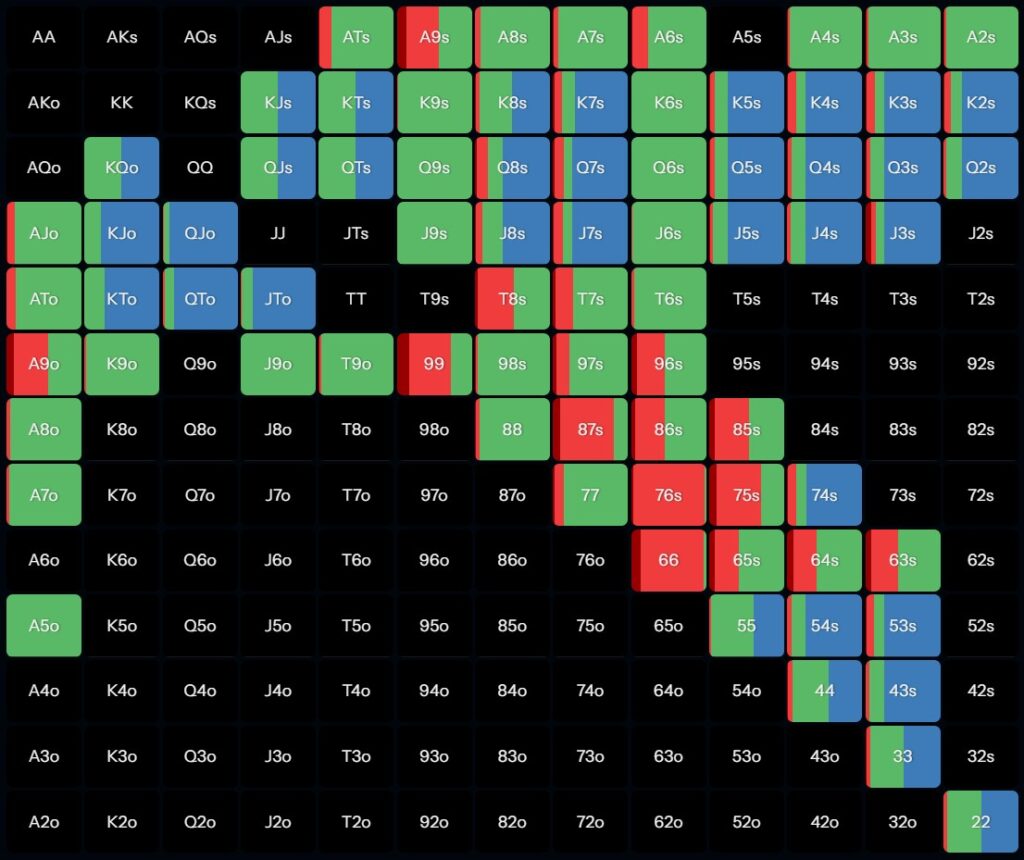
The problem, of course, is that our big blind defending range is very wide, and we have a ton of hands that have not connected with the flop at all.
In most Texas Hold’em games, players do actually end up folding the vast majority of their range, making this a spot in which the button can print money by simply c-betting and taking the pot down way more than 32% of the time.
Of course, even an average player knows that they are supposed to continue here holding any Ace, any Nine, and any flush or open-ended straight draw, but things get a bit more tricky with hands like 6x, gutshot straight draws, and Broadway hands that contain one club.
To get to 68% of our overall big blind defending range, we can’t simply continue when we have a pair or a strong draw, as these hands don’t makeup nearly 68% of our overall range.
If we want to play like the solver and actually continue 68% of the pot, we will need to call the flop bet with a number of dubious hands that only have backdoor equity, as well as raise with plenty of gutshot straight draws with backdoor clubs and other low-equity hands.
Playing this way is neither simple nor convenient, but when facing the best players in the world, it is just about the only way to win in the long run.
If you watch players like Fedor Holz or Isaac Haxton play, you will notice them continuing against flop bets with wide ranges all the time, and the reasoning for this is exactly in minimum defense frequency.
When to Deviate from Minimum Defense Frequency
Minimum defense frequency is a GTO poker concept that top-level players use when playing against other great players, but not one you should automatically use in every game you are in.
The most profitable deviation I recommend to students is in low-stakes live games, where the average player bluffs significantly less than GTO requires. When I’m playing a $2/$5 live game against recreational players, I fold considerably more than MDF suggests in many spots, and it shows a clear profit because the population’s value-to-bluff ratio is heavily skewed toward value hands.
Mechanically applying MDF against players who almost never bluff is not GTO; it’s a leak. The framework is a starting point, not a rule.
One thing you need to realize is that you don’t have to play perfectly when playing against imperfect opponents, as they will make many mistakes you will be able to exploit.
For example, if you are playing against an opponent who will not start bluffing more if you don’t defend enough, there is less of an incentive to apply MDF.

While you would still be winning if you did continue as per MDF, you can probably make even more money by playing tighter against some, and even looser against other opponents.
In low-stakes games, most players will bluff way less than the GTO strategy recommends. For that reason, you can also continue with way fewer hands, as your opponents’ ranges will be value-heavy and lack in bluffs.
Playing exploitative poker works better than GTO against most poker players in the world, but once you reach a certain level, you will have to learn how to apply concepts like MDF, or you will get destroyed by elite players who don’t miss out on any opportunities.
MDF vs Pot Odds: When to Use Each
Both minimum defense frequency and pot odds help you decide whether to call a bet, but they answer different questions and apply in different situations.
- MDF is a range-level concept. It tells you how often your entire range must continue to prevent systematic exploitation. It doesn’t care about the specific hand you’re holding; it cares about whether your overall strategy is exploitable. Use MDF when calibrating how tight or wide to defend in a general sense: especially preflop and on the flop against c-bets, where your range is widest and systematic under-folding is most costly.
- Pot odds are a hand-level calculation. They tell you the equity your specific hand needs to make a profitable call. If you’re getting 3:1 pot odds, you need 25% equity to break even on the call. This is more immediately actionable in spots where you can accurately estimate your hand’s equity: particularly on the river, where draws have resolved and your holding is well-defined.
- How I use each in practice: When I’m thinking about a spot in study, I start with MDF to check whether my overall range defense is calibrated correctly. When I’m at the table facing a specific bet, pot odds give me a faster, more accurate read on whether my particular hand justifies the call. In live low-stakes games, pot odds are almost always more practical because most opponents have imbalanced betting patterns that make pure MDF adherence suboptimal.
The key distinction: if an opponent is bluffing at 30% when GTO requires 45%, MDF says you’re over-calling if you defend 67% of your range: pot odds may still justify calling with a specific hand that has enough equity. Both frameworks are correct; they operate at different levels of analysis.
Play Around with MDF in Your Study Sessions
The most useful exercise I give students is to load a spot in PokerCoaching’s solver, PeakGTO, pick a standard flop texture, and observe the full defending range against a half-pot c-bet.
What you’ll almost always find is that the solver’s continuing range includes hands you’d instinctively fold: gutshots without backdoor draws, weak overcards with no equity, even some completely unconnected hands with blockers to opponent value. That’s MDF working in practice at the range level.
Review 10 or 15 of these spots before your next session, and you’ll notice a consistent pattern: your instinct is to defend too tight. Most players I coach arrive at roughly 45-50% continuing frequency when the math requires 65-67%. That gap doesn’t feel significant in any single hand, but compounded over a session against a player who c-bets frequently, it becomes a measurable leak.
Once you’re comfortable with what MDF looks like in GTO solutions, start loading spots against the loose-aggressive opponent type in PeakGTO and observe how the recommended exploitative adjustments shift the defending frequency. That comparison: GTO versus exploit, is where MDF becomes a tool you understand rather than a rule you follow blindly.