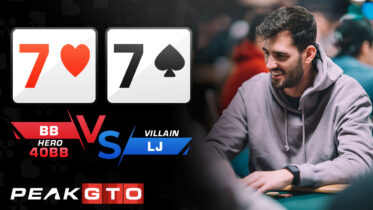
One of the fastest ways to bleed chips is to treat every bet size the same. Facing large bets calls for a different standard than facing small ones, and the hand you continue with against a quarter-pot stab can be a clear fold against a pot-sized blast. As players have improved, they have learned to lean on big sizes precisely on the boards where they hold a nut advantage, and if your only reaction to a big bet is to glance at your hand and call because you have a pair, you will spew. This hand is a deliberate trap, and the way out of it is to think past the flop. We will break it down in a 40bb tournament.
Today we will analyze a hand where Hero defends the big blind with 7♥7♠, checks the 9♠8♥4♦ flop, and faces a pot-sized continuation bet from the lojack. We will look at why 77, a pair that looks perfectly playable, is actually a clear and costly fold against this size, why the real issue is playability rather than raw equity, and which hands belong in the continuing range instead. The action ends on the flop, but the reasoning behind a single fold is some of the most valuable in tournament poker.
Assumptions
- Format: 8-max MTT, 40bb effective stacks
- Positions: Hero is in the big blind (caller, out of position); Villain is in the lojack (preflop raiser, in position)
- Hero’s hand: 7♥7♠
- Preflop: Lojack raises, Hero defends the big blind. Single-raised pot of 6.1bb.
- Flop: 9♠8♥4♦ (pot 6.1bb). Hero checks, lojack bets pot, Hero folds. Action ends on the flop.
Preflop
The lojack raises and Hero defends the big blind with 7♥7♠, a routine call getting a great price with a pocket pair that would love to flop a set. The thing to remember about a small pair from the big blind is that its value is concentrated: it wants to make three of a kind or play a small pot, and it does not want to get involved in big, escalating pots as an underpair. That distinction is the whole story of the flop.
Flop: 9♠8♥4♦
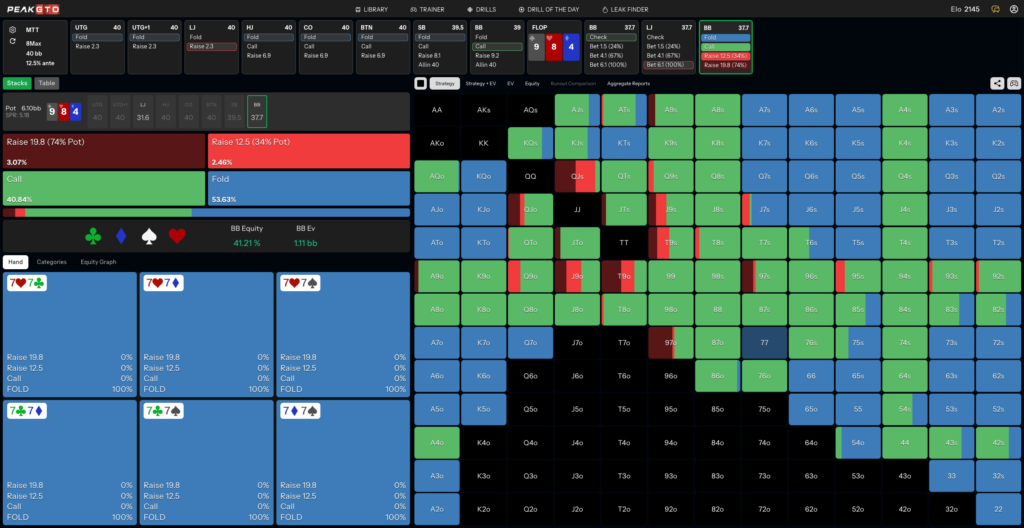
Hero checks on 9♠8♥4♦, and the lojack fires a pot-sized 6.1bb continuation bet. This is a board where the in-position raiser holds a real nut advantage, with all the overpairs, the top pairs, and the occasional set, so a large size is well earned. The big blind’s job is to respond elastically, and that means folding far more than it would against a small bet. PeakGTO folds the big blind’s range about 54 percent of the time here, and 77, despite being a made pair, lands squarely in that folding group.
It feels wrong to fold a pair, so it is worth being precise about why this is not close. Continuing with 77 against the pot-sized bet loses more than 1.3bb in expectation; it is not a marginal call that you can talk yourself into, it is a clear and measurable mistake. The underpair sits below both the nine and the eight, so it only beats the lojack’s bluffs and air, and against a polarized pot-sized bet there simply are not enough of those to justify continuing.
The deeper reason is playability, not the equity you hold at this instant. At this stack depth the pot is already getting large, and a call commits you to navigating turns and rivers out of position with a hand that rarely improves to anything you can feel good about. Even the dream card hurts: when you spike a seven for a set, you run straight into the TJ and other straights that the lojack happily stacks you with, so your two outs come loaded with reverse implied odds. A hand that has no clean way to improve and no clarity on later streets is exactly the kind of holding that should not be paying a pot-sized bet.
Stack depth sharpens the point. At 40bb the pot is already 6.1bb and a pot-sized bet pushes the stack-to-pot ratio low enough that a call more or less commits you to a turn decision, often for a big chunk of your remaining chips. When the money is that close to going in, you cannot afford to defend hands that will be guessing on most run-outs. The whole reason a small bet lets 77 continue is that a small bet keeps the pot small and the stack-to-pot ratio high, giving you room to fold cheaply on bad turns and to see a free or inexpensive river when you want one. A pot-sized bet erases that room, and with it the case for calling.
Compare that to the hands the big blind does continue with, because the contrast is the lesson. A hand as weak as a four is preferable, since it has more equity against the lojack’s continuing range. Better still are the overcard hands with backdoor flush draws, like KQ or KJs, and the QJ with a gutshot. The reason is everything that happens after the flop. When K♠J♠ calls and a king rolls off, Hero turns top pair on a card the lojack is incentivized to keep barreling, so Hero gets to over-realize equity and stack a bluff-heavy range. Those hands turn clean, high-value cards, while 77 turns muddy ones. That is the difference between a profitable call and a costly one, and it has nothing to do with which hand has more equity on the flop.
This also shapes how you read the opponent. A skilled lojack choosing the pot-sized size on a board they smash is telling you their range is strong and polarized, weighted toward the value hands that want to build a big pot plus the few draws and air that round it out for balance. Against that kind of range you do not need many bluff catchers, you need hands that can make the second-best hand pay or that can credibly continue the aggression yourself on later streets. 77 does neither. Recognizing the message in the bet size, rather than reflexively defending a pair, is what separates a disciplined fold from a slow leak that adds up over a session.
The most important takeaway is elasticity. 77 is not always a fold; against a small bet it is a clear continue, worth roughly 1.5bb to call. The exact same hand, the exact same board, and only the bet size has changed, yet the correct play flips from call to fold. When you face a big bet, you are not just being asked to put in more chips now, you are being asked to play a bigger pot across every future street, and you have to weigh the pot odds against how well your specific hand can realize its equity. On boards like this, against large bets, fold the pocket pairs that cannot improve cleanly and keep the hands with clean outs and the overcards that turn top pair. Hero folds the sevens and moves on.
Key Takeaways
- The fold: Against a pot-sized continuation bet on 984 rainbow, a GTO-balanced approach folds 77 here; continuing loses more than 1.3bb. An underpair below two overcards only beats air, and a pot-sized bet does not hold enough of it.
- Playability over equity: The reason is not flop equity, it is what happens next. 77 has no clean outs, plays poorly out of position, and even hitting a set runs into straights with reverse implied odds.
- What to continue: Keep the hands that realize equity well, the overcards with backdoor flush draws and the gutshots, because they turn top pair on cards the in-position player keeps betting and stack a bluff-heavy range.
- Elasticity: The same sevens that fold to a pot-sized bet are a clear call against a small one. Always let the bet size, and your hand’s ability to play future streets, decide whether to continue.