Try This Hand Yourself
Play this exact spot against the solver in PeakGTO before reading the analysis.
A set is one of the most profitable hands in poker, but turning bottom set on a coordinated board is trickier than it looks. The hand is strong enough to play for stacks, yet vulnerable to the straights and flushes the texture threatens, and you are out of position with the betting initiative already surrendered. Played well, it stacks worse hands and even gets to bluff-raise; played carelessly, it bloats the pot into the exact run-outs that beat it. This hand walks the line in a 60bb tournament, all the way to a real-world river decision from a high-stakes event.
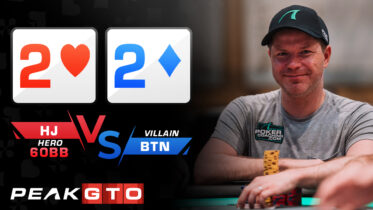
Today we will analyze a hand where Hero raises the hijack with 2♥2♦, checks the 8♠7♠3♥ flop through, turns a set on the 2♣, and navigates a turn raise and a river all-in decision on the T♥. Bottom set leads small this time, the correct response to a raise is a small polarized re-raise or a call rather than a shove, and the river is a default all-in, though a read-based deviation away from it shaped how the real hand played out. The range dynamics drive every street.
Assumptions
- Format: 8-max MTT, 60bb effective stacks
- Positions: Hero is in the hijack (preflop raiser, out of position); Villain is on the button (caller, in position)
- Hero’s hand: 2♥2♦
- Preflop: Hijack raises, button calls. Single-raised pot of 7.1bb.
- Flop: 8♠7♠3♥ (pot 7.1bb). Hero checks, button checks back.
- Turn: 2♣ (pot 7.1bb). Hero bets 1.8bb, button raises to 9.8bb, Hero calls.
- River: T♥ (pot 26.7bb). Hero checks, button bets half pot, Hero calls (the GTO default is a check-raise jam; Hero deviated to a call as a read-based choice).
Preflop
Hero raises 2♥2♦ from the hijack, a standard open since every pocket pair can raise from this position, and only the button calls. Hero takes the flop as the preflop raiser but out of position against a strong, capped flatting range. 22 is mostly looking to flop a set or give up, and that is exactly the binary that defines the next two streets.
Flop: 8♠7♠3♥
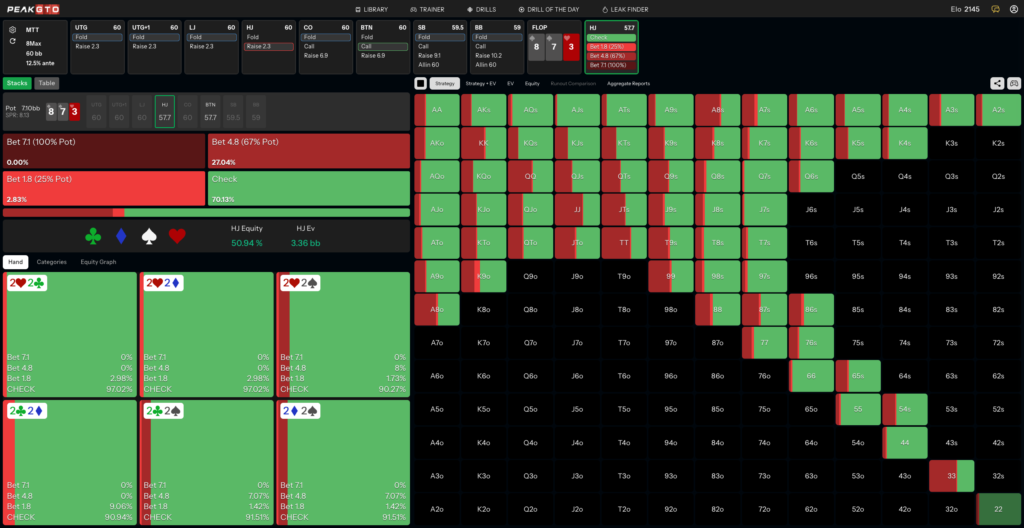
On 8♠7♠3♥, Hero checks, and out of position against the button that is the right play with most of the range. The hijack does not have many strong hands here, so it checks around 70 percent of the time rather than firing a thin continuation bet. The lower pocket pairs that missed the board, the sixes, fives, fours, and deuces, check almost always, while the overpairs and a few top pairs mix in bets. 22 is an easy check, and the button checks back, declining to bet its own range.
That check-back is meaningful information. The button has position and could pressure this board, so when it passes up the bet, it is telling Hero that its range is weighted toward the medium and weak hands that did not want to build a pot, the second pairs, the gutshots, and the overcards. That keeps plenty of hands in the pot that a set can extract from, and it is exactly why a card that pairs Hero turns a near-worthless underpair into a hand worth playing for stacks.
It is worth noting the plan is not simply to check and call. When the hijack checks and the button bets small, the correct response includes a healthy dose of check-raises, around 19 percent of the time, built from top pairs, overpairs, flush draws, and backdoor-flush-plus-overcard hands. Many players fall into the habit of only ever check-calling and never check-raising, which leaves a lot of value and pressure on the table. Here the action checks through, and the turn changes everything.
Turn: 2♣
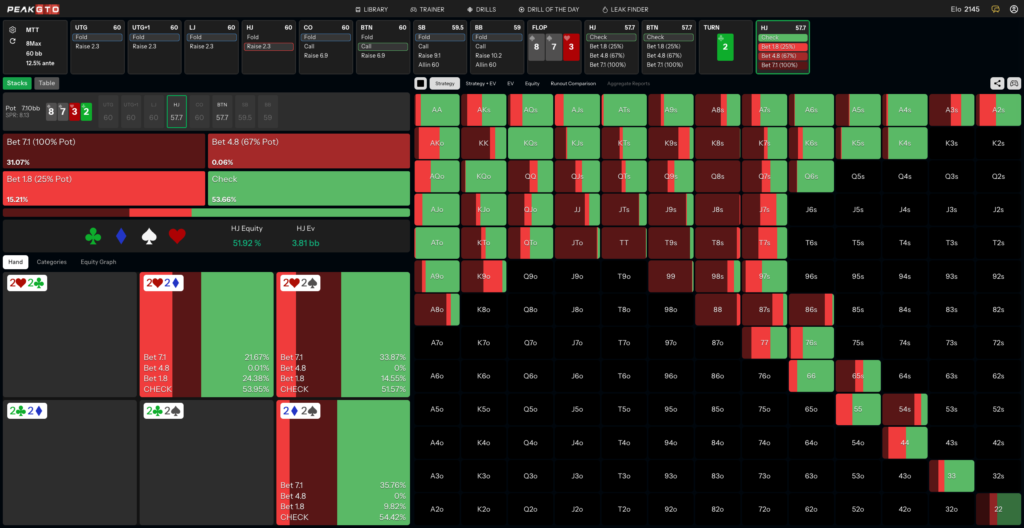
The 2♣ is an excellent card, turning bottom set. PeakGTO actually mixes between betting and checking with the set, and when it does bet it uses either a tiny size or a big one. Hero leads small, 1.8bb, a size that keeps the worse hands in and disguises the strength of the holding on a board where a big bet might scare off the very hands that pay. The button raises to 9.8bb, and now the interesting decision arrives.
The small lead is doing real work on this texture. A board of 873 with two spades is loaded with straight draws and a flush draw, which means a big bet often folds out the worse hands while only getting called by the draws and made hands that have Hero in trouble on bad rivers. A tiny bet, by contrast, charges the floats and gutshots a small fee, keeps the button’s bluffs and weak pairs in, and avoids building a giant pot with a set that is far from invulnerable. It is the same logic that makes the river decision tense: bottom set is strong, but the run-out can always bring the card that beats it.
The instinct with a set is to jam, but shoving 60bb here risks a ton to win relatively little, so the solver prefers a small re-raise to around 30bb or a flat call. That non-all-in re-raise is built as a polarized range: the value side is sets and strong overpairs, and the bluffs are junky hands with just enough equity to make it 30bb and fold to a shove, such as 54, 65, and 85. Notably, the flush draws prefer to call rather than re-raise, because they can comfortably continue against a jam and do not want to get blown off their equity. Bottom set itself mixes between the small re-raise and a call, and Hero takes the simpler line, calling to keep the button’s bluffs and worse hands in the pot. Hero calls and goes to the river.
River: T♥
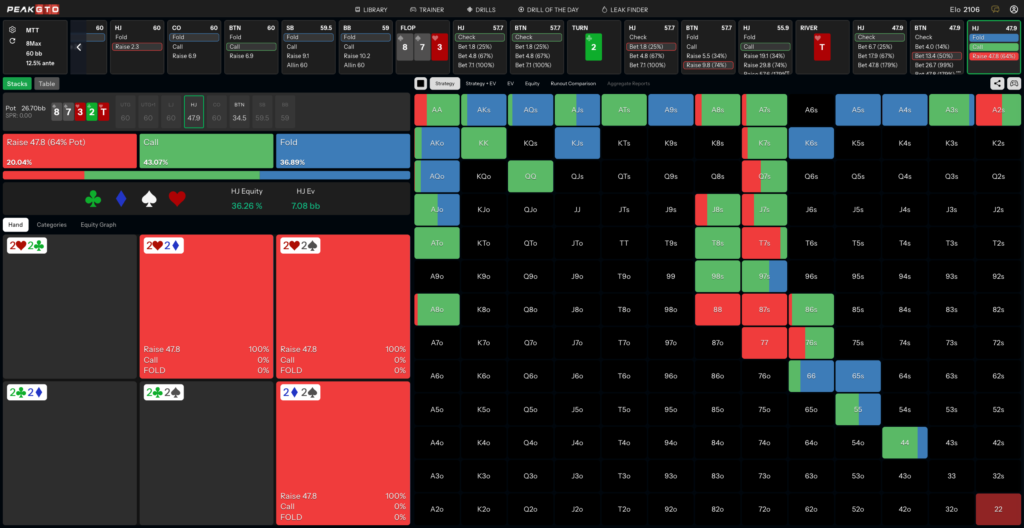
The T♥ completes the board at 8♠7♠3♥2♣T♥, and Hero checks the entire range. The button bets a medium half pot, about 13bb, and the question is whether bottom set is good enough to put it all in for roughly 47bb total. In GTO terms the set mixes between the all-in check-raise and a call, leaning on the raise often enough that the jam is the clear default. The set is effectively the nuts against the bulk of the button’s range, the value check-raises do not go much thinner than 87, and the bluff-raises are hands that block the button’s calls, the seven-x holdings like K7 and Q7 plus the occasional 82. With a hand this strong the default is simply to jam.
There is a real-world coda worth sharing, because this was an actual hand from a 25,000-dollar buy-in event. The opponent acted strangely before betting that half pot, and the only hands that genuinely improved on the ten were the J9, the 96, and TT. Sensing something was off, Hero deviated from the solver and just called rather than check-raising all in, and the button turned over J9 for the rivered straight. The exploitative read saved a stack. The lesson is layered: in tournaments the chips you can lose are often worth more than the chips you can gain, so thin value raises for your whole stack carry extra risk, and the pot odds of stacking off are not the only consideration. But against an unknown playing a balanced game, this is an easy all-in, and the warning is not to talk yourself into a passive fold every time you hold a strong but beatable hand.
Key Takeaways
- Flop: Out of position with a small pocket pair on a coordinated board, check at high frequency. Keep a check-raising range for when the button stabs, rather than defaulting to check-call every time.
- Turn: Turning bottom set, lead small to keep worse hands in. Against a raise, prefer a small polarized re-raise or a call over a shove, since jamming risks a lot to win a little.
- River: A set is effectively the nuts against most ranges, so the default is an all-in check-raise. The exploitative exception is an opponent whose sudden strength tells you the rare straight or higher set has arrived.
- Overall: Turning bottom set rewards careful sizing over reflexive aggression. Lead and call to control the pot, then jam the river by default while staying alert to the tournament reads that justify the occasional non-GTO call.