Under the gun is the seat directly to the left of the big blind. It’s the first player to act before the flop, and it’s the toughest seat at the table to play well.
This guide explains what under the gun means in Texas Hold’em, why the seat is so hard, which hands to open from it, and how to play your hand after the flop.
Key Takeaways 45-second read
- Under the gun is the seat to the left of the big blind, and it acts first before the flop, because the blinds have already posted their forced bets.
- Play your tightest range from UTG, about 11% of hands in a 100 big blind cash game, because you have the most players behind you and poor position after the flop.
- Fold the offsuit trouble hands like ace-jack and king-jack, because from UTG they’re often dominated when someone continues.
Show all 6 takeaways
- Raise or fold rather than limp, because limping invites a multiway pot that you’ll play out of position.
- Bet more on high, dry flops, because your tight range has far more big pairs than the players who call you.
- Slow down on low, connected flops, because the big blind’s range hits those boards much harder than yours.

What Does Under the Gun Mean in Poker?
Under the gun (UTG) is the position immediately to the left of the big blind. Before the flop, the small blind and big blind have already posted their forced bets, so the UTG player is the first to decide whether to fold, call, or raise.
The name comes from the pressure. You’re acting with no information about anyone else’s hand, and everyone behind you gets to see what you did before they choose.
At a full table, the seats after UTG are often called UTG+1 and UTG+2, then the lojack, hijack, cutoff, and button.
Online 6-max tables have only one early seat, so UTG sits where the lojack would be in a full-ring game. For the full map of every seat, see our guide to poker positions.
After the flop, the order changes. The small blind and big blind act first, and UTG acts after them. You’ll still be out of position against anyone who called from a later seat, which is a big part of why this seat is tough.
Why Under the Gun Is the Hardest Seat
Two problems stack up when you’re under the gun.
The first is the number of players behind you. With seven or eight opponents still to act, the chance that someone wakes up with a better hand is much higher than when you open from the cutoff or button. Every extra player is another chance to run into pocket kings or ace-king.
The second is position for the rest of the hand. If the button or cutoff calls your raise, you’ll act first on the flop, turn, and river. You make every decision with less information than your opponent.
Put those together, and the answer is simple. You need a stronger range to open from UTG than from any other seat.
Which Hands to Play Under the Gun
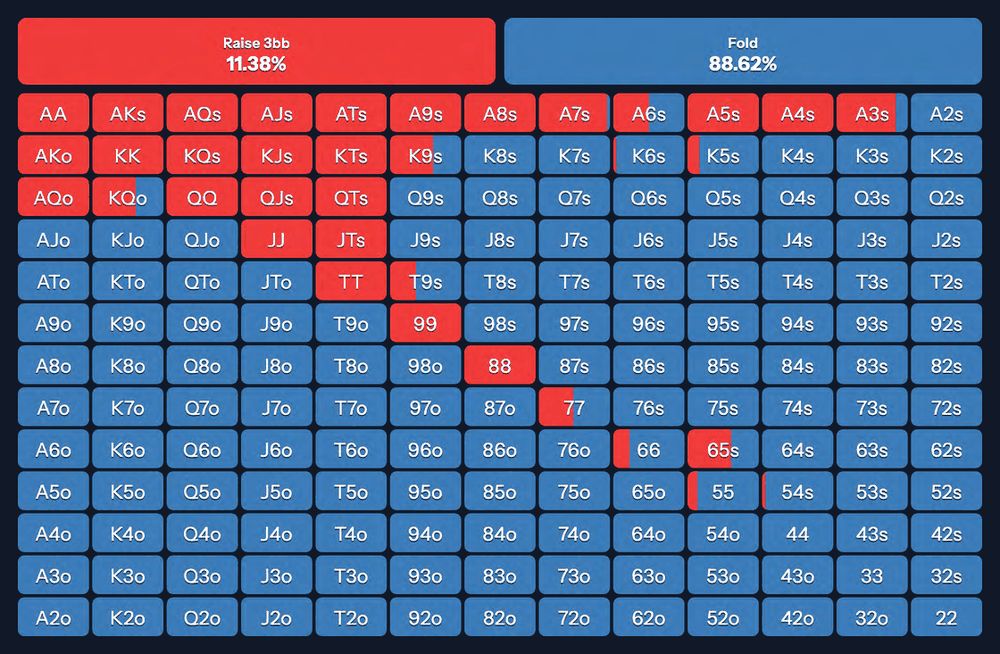
The tight range is where most of your profit from this seat comes from. Solver charts for a 100 big blind, 8-handed cash game open only about 11% of hands from UTG. That rises to about 16% one seat later in the lojack and to about 40% on the button.
In a tournament, the number is a little wider, because the antes put more chips in the middle. Our 80 big blind tournament chart opens about 16% of hands from UTG, compared with around 54% from the button.
Your UTG opening range is built from a few groups:
- Pocket pairs. Big and medium pairs are clear raises. The smallest pairs are much closer, and in the 100 big blind cash chart, pocket deuces through fours are folds.
- Big aces. Ace-king and ace-queen are raises. Weaker offsuit aces like ace-jack and ace-ten offsuit are folds in that same cash chart.
- Suited broadways and suited aces. Hands like king-queen suited and ace-five suited play well because they can make strong pairs, flushes, and straights.
- A few suited connectors at most. Hands like eight-seven suited fold in the cash chart. They look pretty, but they don’t make enough strong hands to open into seven players.
The hands that cost players money are the ones in the middle. King-Jack offsuit, Ace-Ten offsuit, and the small pairs feel playable, but from UTG they’re often dominated when someone continues. I fold more hands under the gun than most players expect, and that discipline pays for itself.
If you want the exact chart for every seat, grab our free preflop charts and start with the UTG range.
How to Adjust Your UTG Range at Real Tables
Charts give you the baseline. A few table conditions should move you a little tighter or a little looser.
Play tighter when the players behind you are aggressive. If the table 3-bets a lot, the marginal hands at the bottom of your range lose value fast, because you can’t continue with them when you face a raise.
Play a little looser when the players behind you are passive. If the table limps and calls but rarely raises, you’ll see more flops in position against weaker ranges. Hands like the stronger suited connectors become more playable.
Play tighter with a big rake. In small-stakes live games, the rake eats into small pots. The hands at the bottom of your range rarely win big pots, so they’re the first to go.
Don’t open limp. Raising or folding is the right default from UTG. Limping invites the whole table in, and you’ll play a big multiway pot out of position with a hand you didn’t want to raise.
Thinking in ranges rather than single hands helps here. Our guide to ranges in poker shows how to picture what each seat is likely to hold.
How to Play After the Flop From UTG
The tight range has an upside after the flop. Because UTG opens so few hands, your range is full of big pairs and big cards. That gives you an edge on many boards.
Take a simple example. You raise from UTG with K♥Q♥ and only the big blind calls. The flop comes 7♠3♦3♣.
You missed, but this board is great for your range. You have every overpair, and the big blind’s range has far fewer of them. A small continuation bet works well here, because the big blind will fold many hands that missed and have no strong reason to fight back.
Compare that with a flop like 8♥7♥6♣. Now the big blind has many more two pairs, straights, and draws, because it defends with lots of suited connectors and small cards. Your range has the overpairs, but very few of the best hands. Checking more often makes sense.
The general rule from UTG is to bet more on high, dry boards and slow down on low, connected boards. If you want to see why solver charts land on these strategies, start with our guide on what GTO poker is.
Common Under the Gun Mistakes
These are the leaks we see most often from this seat.
- Opening too many offsuit hands. Ace-jack, king-jack, and queen-jack offsuit are the classic UTG trouble hands.
- Calling 3-bets with weak hands. If you open a tight range, you’ll still need to fold the bottom of it when a strong player re-raises. Our 3-bet strategy guide covers how to respond.
- Overvaluing one pair. One pair sits near the bottom of the poker hands ranking. When an opponent raises your UTG bet on a scary board, they usually have better.
- Forgetting about position. You’ll be out of position against most callers, so plan the whole hand before you put chips in.
Conclusion
Under the gun is the first seat to act before the flop, and the hardest seat at the table. Too many players behind you and too little position mean you need your tightest range here.
Open strong pairs, big aces, and the best suited hands. Fold the offsuit trouble hands and most small pairs. After the flop, use the strength of your range on high, dry boards and slow down on low, connected ones.
Get this seat right, and you’ll stop bleeding chips from the one position where everyone else does.
FAQ About Under the Gun in Poker
What does under the gun mean in poker?
Under the gun is the seat directly to the left of the big blind. That player acts first before the flop, with every other player still to act behind them.
Why is it called under the gun?
The name comes from the pressure of acting first. You have to make a decision with no information about anyone else’s hand, while the rest of the table gets to see what you did.
What hands should you play under the gun?
Play a tight range of strong hands. In a 100 big blind cash game, solver charts open only about 11% of hands from UTG, mostly pocket pairs, big aces and strong suited broadways and suited aces.
Is under the gun a good position in poker?
No, it’s the weakest position before the flop. You act first with the most players behind you, and after the flop you’re out of position against anyone who calls from a later seat.
What is UTG+1?
UTG+1 is the seat directly to the left of under the gun. It’s the second player to act before the flop and should still play a tight range, only slightly wider than UTG.