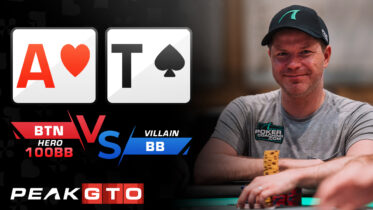
Most players see bottom pair on a scary river, decide they are beat, and fold without much thought. That reflex quietly costs them a lot of money. Bottom pair facing aggression is often a perfectly good bluff-catcher, because the same boards that look terrifying are the ones where your opponent has the most busted draws and the most incentive to bluff. Knowing when bottom pair is a call and when it is a fold is a skill that separates thinking players from autopilot folders. Here is a hand where calling with 54 looked crazy and was exactly right.
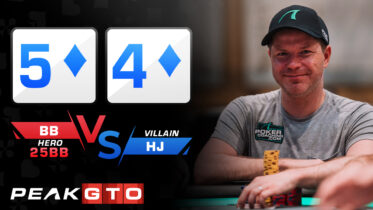
Today we will analyze a 25 big blind tournament hand where we defend the big blind with 5♦4♦ against a hijack open. The flop comes A♠T♠4♥, we check and call a small bet with bottom pair. The turn is the T♥ and checks through. The river is the 3♥, completing a backdoor flush, and after the hijack fires a big bet we make the call. We will walk every street and explain why bottom pair holds up here.
Assumptions
- Format: 8-max MTT, 25bb effective stacks
- Positions: Hero is in the big blind (caller, out of position); Villain is in the hijack (preflop raiser, in position)
- Hero’s hand: 5♦4♦
- Preflop: Hijack raises to 2bb, Hero defends the big blind. Single-raised pot.
- Flop: A♠T♠4♥. Hero checks, Villain bets 1.4bb, Hero calls.
- Turn: T♥. Hero checks, Villain checks back.
- River: 3♥. Hero checks, Villain bets about 6.2bb (three-quarters pot), Hero calls.
Preflop
We defend the big blind with 5♦4♦, a routine call getting a great price against the hijack. Suited connectors like this defend a very wide big blind range profitably, since position and a cheap entry let us see flops and occasionally make a disguised big hand. We take the flop heads up and out of position.
Flop: A♠T♠4♥
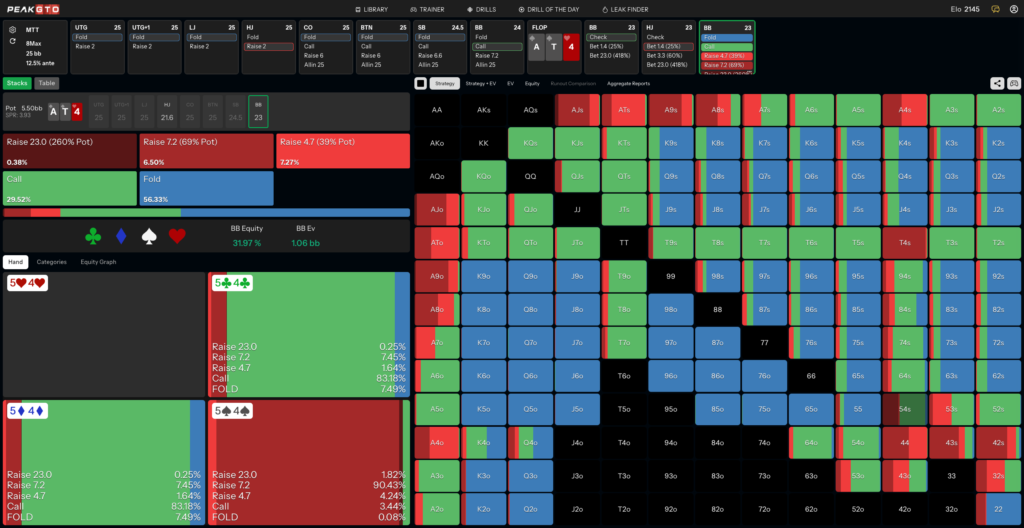
We flop bottom pair and check, and the hijack continuation bets small for 1.4bb, which they should do about half the time, using a larger size the rest. A common reflex is to label bottom pair an easy check-call and move on, but the correct strategy is more nuanced. We should raise our best top pairs against a small bet, plus a mix of draws, and importantly, our bottom pairs that carry additional equity.
Here is the subtle part. The bottom pairs that want to raise are the ones with backdoor straight potential or a backdoor flush draw, like 43 and 42, which raise close to every time. Our 54 is actually only the third-best bottom pair, and crucially it is the diamond version, so it has no backdoor flush draw on this spade-heavy board. 54 only wants to raise when it holds spades for the flush draw, which we do not. That makes this a clear check-call rather than a raise, and we keep our bottom pair in a controlled pot.
It is worth noting just how often the big blind folds here. The AT flop hits the hijack’s raising range hard, so against even a small bet we are folding a little over half of our range, including most of our backdoor flush draws, which are simply not strong enough to continue. That is exactly why the bottom pairs that do continue matter so much: they anchor our calling range with real, if modest, showdown value. 54 clears that bar comfortably as a call, even though it is not strong enough to put in a raise.
Turn: T♥
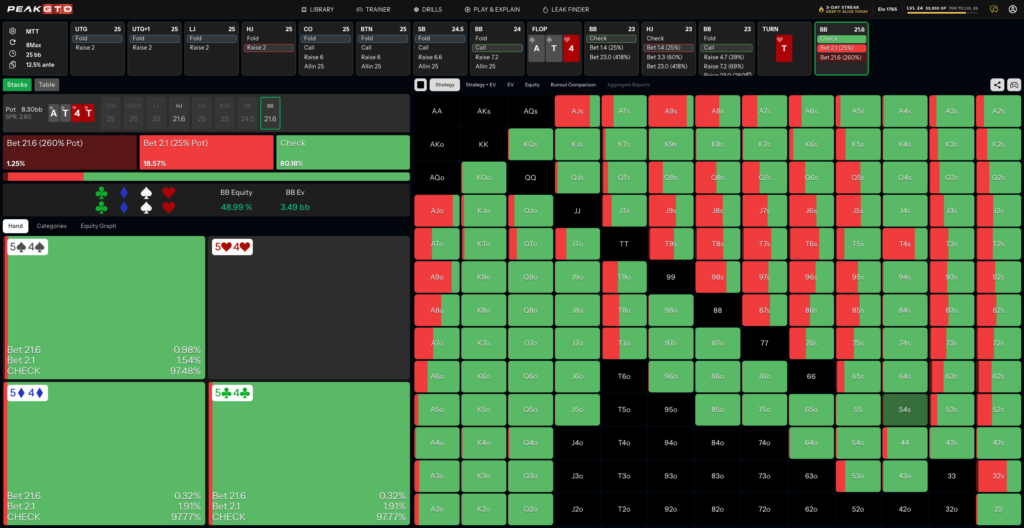
The T♥ pairs the board, and we check. We do have a small leading range on this card, since pairing the ten gives the big blind a few more trips and strong hands, but that lead is reserved for genuinely good made hands like trips and top pairs, plus the occasional spade draw. Bottom pair is nowhere near that range. All of our fours simply check, so we do too, and the hijack checks back.
The check-back is informative. When the hijack declines to bet a paired board in position, they are often giving up with a hand that has some showdown value or a busted draw that gave up for one street. That keeps their range capped and full of hands we can still beat, which becomes the whole story on the river. Studying which turns develop a big blind leading range, and with what hands, is easy to do inside PeakGTO.
It also helps to think about what our check accomplishes. By checking bottom pair we keep the pot small, deny the hijack a chance to barrel us off our hand, and let their bluffs stay in. If we held a hand worth protecting we might lead, but 54 gains almost nothing by betting into a range that folds everything worse and continues with everything better. Pot control with a marginal made hand is the patient, profitable line, and it sets up a cheap, well-informed decision on the river.
River: 3♥
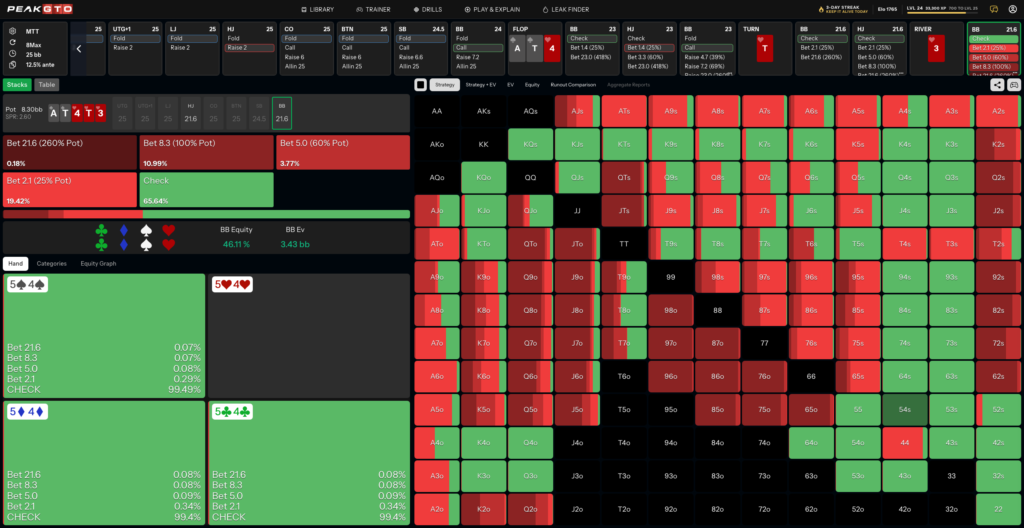
The 3♥ completes the backdoor heart flush, which sounds scary but barely matters for us, because we hold no hearts and our hand cannot improve. We check, and the hijack fires about 6.2bb, roughly three-quarters of the pot. Now the question is whether bottom pair can call. The answer, surprisingly to many, is yes, and it comes down to the opponent’s range. After checking back the turn, the hijack arrives at the river with plenty of busted spade draws and other air, and those hands love to bluff when checked to.
The solver mixes 54 between calling and folding, calling roughly 30 percent of the time, and the call is even better with the five of hearts since it blocks some of the backdoor flushes. Exploitatively the call is stronger still. We look weak after calling the flop and checking twice, so opponents are inclined to bluff, and the pot odds on a three-quarter-pot bet only require us to be good about 30 percent of the time. In this hand the call was correct and was shown J♠7♠, a busted draw, for the win. One crucial caveat from GTO and from practice: against an all-in shove rather than a three-quarter-pot bet, this becomes a clear fold, since a polarized jam is far more weighted toward value.
The deeper principle is that bluff-catching is about the bettor’s range, not your absolute hand strength. It does not matter much that we hold only a pair of fours. What matters is that the hijack’s value hands are limited, since most strong made hands would have bet the turn, while their busted draws are numerous and desperate to win the pot somehow. When the bluffs outnumber the value by enough relative to the price, even the weakest pair becomes a profitable call. Flip the bet to an overbet jam and that ratio inverts, which is precisely why the size of the bet changes the answer.
Key Takeaways
- Flop: Bottom pair is not always a passive check-call. Raise the versions with backdoor equity, but a hand like 54s with no flush draw simply calls the small bet.
- Turn: A paired board gives the big blind a small leading range, reserved for trips, top pairs, and draws. Bottom pair checks and lets the capped opponent show weakness.
- River: A completing flush card looks scary but is irrelevant when you hold none of it. Against a normal-sized bet, bottom pair is a fine bluff-catcher versus a bluff-heavy range.
- Overall: Bottom pair facing aggression is about reading the opponent’s range, not the strength of your own hand. Call the medium bets, but respect the all-in.