


EV in poker, or expected value, is the average profit or loss of any decision over the long run. A call with positive EV makes money over thousands of repetitions even when it loses in a single hand.
A fold with negative EV costs you money even when it feels safe. Every bet, call, raise, and fold has an EV, and the entire goal of good poker is to consistently make decisions where that number is positive.
I have coached thousands of students on this concept, and the shift I see when it finally clicks is dramatic. Players stop asking “Did I win that hand?” and start asking “Was that the correct decision?”
Those are completely different questions, and only the second one makes you a better player. This guide covers what EV is, how to use the formula, and the three mistakes that make most players’ EV calculations wrong when they try to apply them at the table.
EV in poker is the average amount a player expects to win or lose from a specific decision over the long run. A decision with positive EV (+EV) makes money when repeated many times, even if it loses on any single occasion. A decision with negative EV (-EV) loses money over time regardless of short-term results. The formula is: EV = (%W x $W) minus (%L x $L).
What Is Expected Value?
Simply put, the expected value is the measurement of the expected result of a certain action.
However, the expected value does not necessarily translate into a real value each time; it only does so over many attempts.
It is the average result you stand to gain from repeating the same action many times over with the same basic parameters.
Let’s take an example outside of Texas Hold’em to illustrate this. Things like coin tosses or rolls of the dice can be considered neutral EV situations, as there is the same chance to flip each side or roll each number, and each outcome is typically worth the same.
However, in the example of board games, you are often asked to roll a certain number or higher on a die, and this is where EV comes into play.
By calculating the number of sides that work in your favor and taking into account the reward you get for rolling right, you can calculate the exact value of each roll.
We will go into detailed EV calculations, which are quite simple, later in the text, but let’s first put the expected value into the context of poker and explain how EV works in the game.

Like poker, board games offer other unique examples of expected value.
How EV Works in Poker
While novice poker players often think about hands in terms of whether or not their draw is going to hit, all pros care about the expected value of their decisions.
In the long run, making decisions with positive EV (+EV) rather than negative EV (-EV) results in real profit.
A +EV decision yields a positive theoretical chip balance when all factors are considered.
A very simple example of a +EV decision in poker would be holding 9-9 on a board of 9♠7♠3♣ in a cash game, and your opponent going all-in. No matter what they have, and no matter how many chips are already in the pot, you will be the favorite to win this hand, and your call will be +EV.
It becomes a lot more complicated when, on the same board, you have a hand like 10-9, and your opponent plays it equally as aggressively, as now there are hands that beat you, as well as the many possible draws.
The current size of the pot and the value of the chips you still need to put into the pot all come into play as well, as the net chip result is all that matters, at least in cash games.
In tournament poker, on the other hand, many players will try to avoid slightly +EV situations in order to try and wait for a better situation instead of risking their tournament life on a virtual coin flip.
When I review student hands, the single most common pattern I see is evaluating decisions by outcome rather than by process. A player makes a river bluff catch, the opponent shows a bluff, and the player thinks they played well. A different player makes the same call in the same spot, the opponent shows the nuts, and the player thinks they made a mistake.
Both conclusions can be wrong. The decision was +EV or it was not before the cards were turned over. The result of one hand changed nothing about whether the call was correct.

Winning poker tournaments sometimes requires avoiding +EV situations.
Calculating EV in Poker
This brings us to the fun part: actually calculating our EV using a mathematical formula that always works the same way.
To calculate the expected value, we first need a good idea of our equity in hand, and this is where things can get a little tricky.
In certain situations, it can be difficult to tell whether our opponent is holding the nuts, bluffing, or semi-bluffing, and our equity against such hands can vary widely.
For this reason, we must compare our current hand with the opponent’s entire perceived range of hands.
This can be a bit difficult to do in real-time, but with some experience and practice, you will learn to estimate your equity against an opponent’s range quite precisely.
Once you have an idea of your equity in hand, you will be able to use the following formula to determine your expected value:
EV = (%W * $W) – (%L *$L)
The formula itself is not what most players struggle with. Once you understand the inputs, the math is straightforward. What takes real practice is estimating those inputs accurately: your equity against an opponent’s range, and how much money will go in on future streets.
Those estimates require genuine range-reading skill, and that skill comes from repetition, not from memorizing equations. I recommend running EV calculations on 20 to 30 recent hands you have played before expecting to do this quickly and accurately in real time at the table.
In this formula, %W and %L stand for the percentage of times you will win or lose, while $W and $L stand for the number of chips you can win or lose.
Note that the number of chips you can win is usually not the same as the number of chips you can lose, as there is usually some amount of chips in the pot before the current action.
Let’s take a look at an example of an actual hand and do some quick EV calculations.

Especially when playing at the biggest stages,
you must be able to mentally calculate EV in poker hands. (Photo courtesy of PokerGO)
EV Calculation Example
Playing in a poker tournament, with blinds at 100/200 and a 200 ante, you are sitting on the dealer button with 28,000 chips in your stack.
You open the hand to 450 with Q♥J♥, the big blind re-raises to 1,800, you make the call, and you take it to the flop heads-up.
With 3,700 in the pot, the big blind c-bets for 2,500 on the flop of A♥K♦7♥, and it is time to do some calculations.
The first thing we need to figure out is how much equity we have against our opponent’s range.
Since this board significantly favors his range over ours, we can assume that we will bet almost all of his hands that he chose to 3-bet with.
This certainly contains all the big hands, like A-A, K-K, and A-K, and some bluffs, like suited connectors.
A quick look at the odds calculator shows that against a hand like A-A or K-K, we have about 33% equity; against A-K, about 40%; and against A-Q, about 45%. So even when he has the best hands, we can still hit a flush or a gutshot and win.
It is also worth noting that there will be hands in our opponent’s range that have completely missed this board, and we are an even bigger favorite against them.
Let’s assume the 3-bet range of around 10%, including these holdings…
9-9+,A-Ts+,K-Qs,9-7s+,8-6s+,75-s+,6-5s,5-4s,A-Jo+,K-Qo
If he c-bets most of the hands, we have around 55% equity, so we will clearly have a positive EV.
For the sake of the argument, let’s assume he is a very tight player and will c-bet very few bluffs and mostly make hands like top-pair or better. Against that range, we would have around 42% equity.
Now, let’s do some calculations with the numbers we have:
EV = (42% * 6,200) – (58% * 2,500)
EV = 2,604 – 1,450
EV = 1,154
The formula clearly tells us that we will win 1,154 chips by simply making this call, even without ever bluffing with our strong draw.
In fact, this call would be profitable even with significantly less equity, as we would still be making some chips if we had 35% equity or less.
Common Mistakes When Calculating EV in Poker
Even players who understand the formula regularly misapply it. In my experience coaching students’ hands, these three errors come up most often.
Ignoring implied odds on earlier streets
The formula works precisely when the current bet is the last money going in. On earlier streets, it only gives you part of the picture. If you are calling a flop bet with a flush draw, your actual EV includes the chips you stand to win on the turn and river when you complete the draw.
Leaving this out makes draw calls look worse than they really are. The reverse is also true: if your draw completes into the second-best flush, you may end up winning a small pot and losing a large one. Before calling on an early street, always ask yourself how the hand is likely to play out when you hit or miss. That full picture is what your EV actually reflects.
Getting the reference point wrong for $W and $L
Money already in the pot no longer belongs to you. When calculating $W (what you win if you call and win), you count the full pot, including all money that has been bet, because all of it is available to win. But $L (what you lose if you call and lose) is only the amount of the current call, not your total investment in the hand.
A common error is using your total chips contributed to the pot as $L instead of just the call amount. This consistently inflates your apparent loss and makes marginal calls look worse than they are, particularly in situations where there is a large pot relative to the bet size.
Applying chip EV to tournament decisions
The standard formula calculates chip expected value. In cash games, chips equal money directly, so this works. In tournaments, a chip gained is worth less than a chip lost because of how payouts are structured. This is what ICM quantifies. A shove that is slightly profitable in chip terms can be significantly -EV in real dollars when you are near a bubble or a pay jump.
If you play tournaments and apply the standard formula without adjusting for ICM, you are consistently overvaluing aggressive plays in precisely the spots where patient decisions would be most profitable. Learn the basic ICM framework before applying chip EV to tournament spots near the money.
Bluffing for +EV and Other Considerations
One thing I want to clarify before we get into bluffing EV: the correct play is not simply the one with the highest EV on its own. It is the one with the highest EV relative to all your other options. A call may be +EV.
A raise in the same spot may be even more +EV. The call is correct if no other option beats it, but you have to check the alternatives first. This is why I always recommend calculating the EV of at least two lines before making your decision in any borderline spot.
It is worth noting that expected value is not only used to calculate the value of your calls but also your bets and raises. In many situations in poker, you will be faced with a decision between calling with your hand or making a raise, whether for value or as a bluff.
In such situations, it is important to first figure out the EV of making a call. If it is negative or not positive enough, you may be able to increase it by raising it instead.
A raise with a drawing hand in some spots may result in your opponent folding a lot of their hands, significantly increasing the amount of chips you make every time you continue with the hand.
Since your goal in poker is always to maximize your chips won, make sure to consider all your options and assess how each will affect your equity and EV.
Furthermore, other factors, such as implied odds, must be considered when deciding on early street calls or raises.
For example, how much more value will you be able to extract if your draw gets there? Conversely, is there a high probability of your opponent having a stronger draw that will end up costing you greatly when you hit it?
You should consider all of these considerations when calculating the EV of your decisions, and you should remember to calculate for all of them before making up your mind.

When attempting bluffs, you must mind your
body language and not give away any tells.
Realizing Your EV: How the Long Run Works
The hardest thing for most students to accept about EV is not the math. It is the timeline. You can make correct +EV decisions for weeks and still be losing. The math is working, but the sample size is not large enough yet to show it.
I have seen players with genuinely strong technical fundamentals abandon their strategy during a bad run because the variance felt like evidence that something was wrong with their game. It was not. Variance is not feedback. Results over a small sample are not representative. The only meaningful feedback is whether each individual decision was correct at the time it was made.
As you saw in the earlier example, our decision to call the flop was profitable from a mathematical perspective, but in some cases it will cost us chips, namely when our draws don’t hit.
Of course, this will be negated by the times we do get there, and once we have played the same or similar situation many times, the variance will break in our favor.
However, it is important to understand that the long run in poker can take quite a while to realize, and there may be times when it seems like our +EV decisions are not working out.
This is NOT the time to go the other route and take the –EV route, as this is a sure way to make your results even worse both in the short and long term. Keep making +EV decisions and wait for the variance to even out.
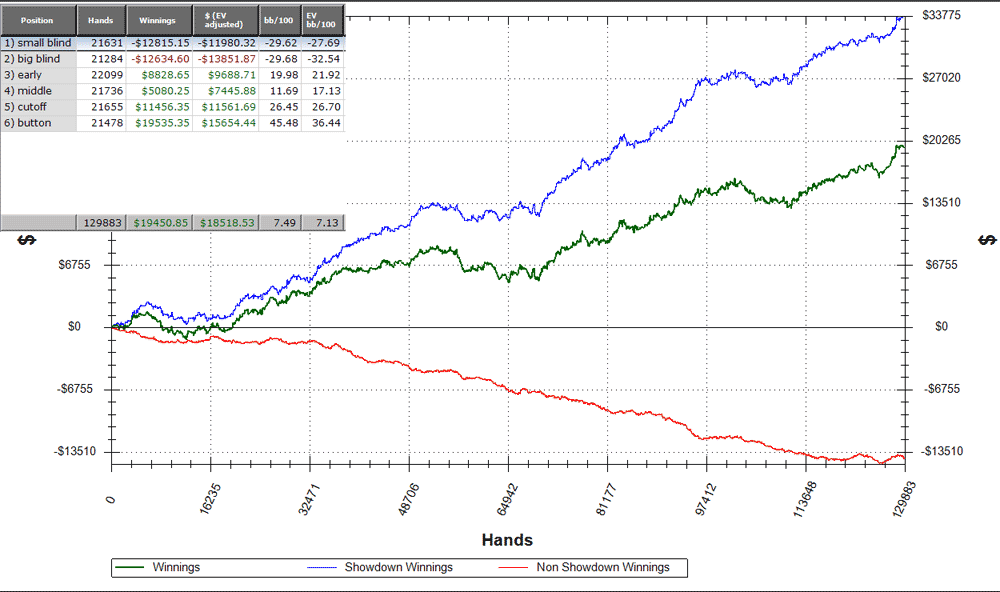
Understanding EV in poker is critical to long-term profit.
Final Words on Expected Value
Poker is a game of numbers, and it’s all about the long run and what you expect to win after making a certain play.
While you can’t control what card will roll off next, you can certainly control the situations in which you choose to put your chips on the line or fold your cards.
If you can train your mind to think in terms of expected value and always make the correct +EV plays you are able to, you will see this reflected in your final numbers without a doubt.
Next time you are facing a bet, stop for a second to calculate the EV of your potential plays and only act once you have completed such calculations. Your poker bankroll will thank you!





I like your all post. You have done really good work. .Thank you for the information.Thankful to you for your post.
Thankful to you for your post I’ve been looking for something like this for a long time and am delighted to have found it.