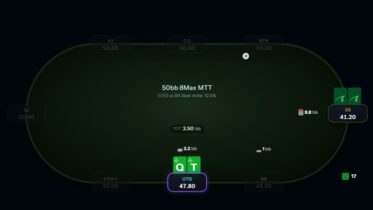
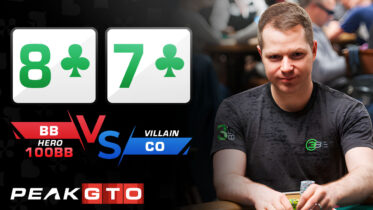
Dynamic, middling textures often create complex decisions for the preflop raiser. This tournament poker hand between the lowjack and big blind shows how the solver transitions from equity denial on the flop to polarized pressure on the turn and river. With A♦9♠, Hero finds a balanced GTO line that turns a low-equity hand into an effective three-street bluff.
Assumptions
- Stacks: 50bb effective
- Positions: LJ vs BB
- Action: LJ raises to 2.2bb, BB calls
- Flop: 8♠7♥3♠ (Pot 5.9bb)
- Turn: 2♦ (Pot 13.7bb)
- River: Q♣ (Pot 41.1bb)
Flop: 8♠7♥3♠
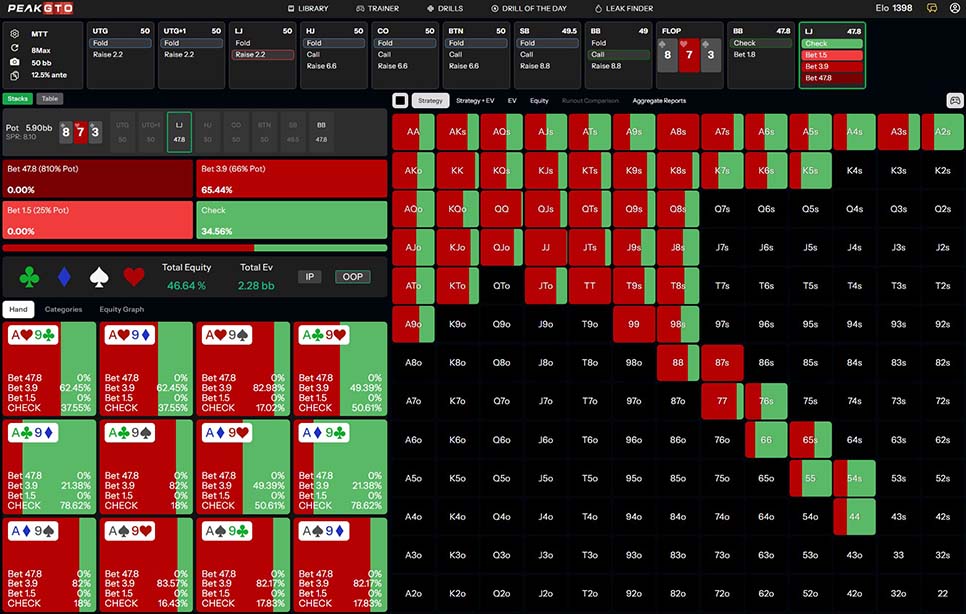
The solver identifies this as a highly dynamic texture. Both players hold a wide spread of equity, BB with connected suited combos and LJ with higher card strength and overpairs.
In game theory optimal strategy, the big blind checks range (100%), and the LJ responds with a mid-size continuation bet of 3.9bb about 65% of the time.
A♦9♠ is part of that betting range due to its useful characteristics. It unblocks folds such as low pairs and weak suited connectors while holding the 9♠ blocker, which reduces the likelihood of check-raises from flush draws.
Betting denies equity from overcards and builds the pot for future aggression when favorable cards appear. BB folds about 40% of the time, with most continuations as calls.
Turn: 2♦
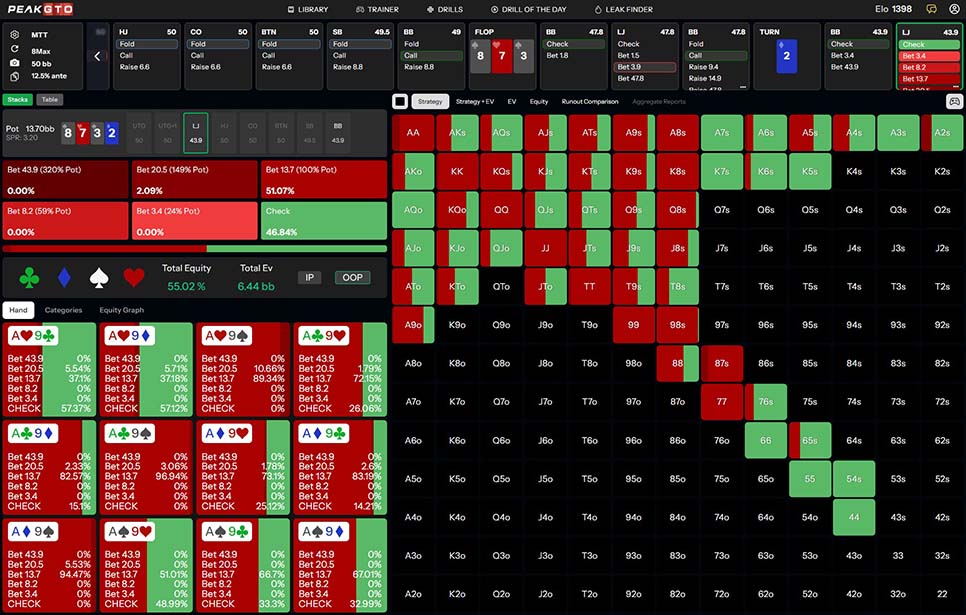
The 2♦ is one of the cleanest possible turns. It changes almost nothing about range advantage, and equities remain stable. Solver output shows LJ betting 13.7bb around 51% of the time, and checking the rest.
Smaller bet sizes are rarely used because the 2♦ doesn’t shift equity and poker hands that were strong remain strong, while weak hands stay weak.
With A♦9♠, this large turn size is solver-preferred. This combination performs well as a bluff because it blocks ace-high continues and can cleanly realize equity when an ace appears on the river.
The hand effectively functions as a polarized barrel as it’s too weak to check and too strong to give up. BB continues about half the time, splitting between calls and folds with almost no raising.
River: Q♣
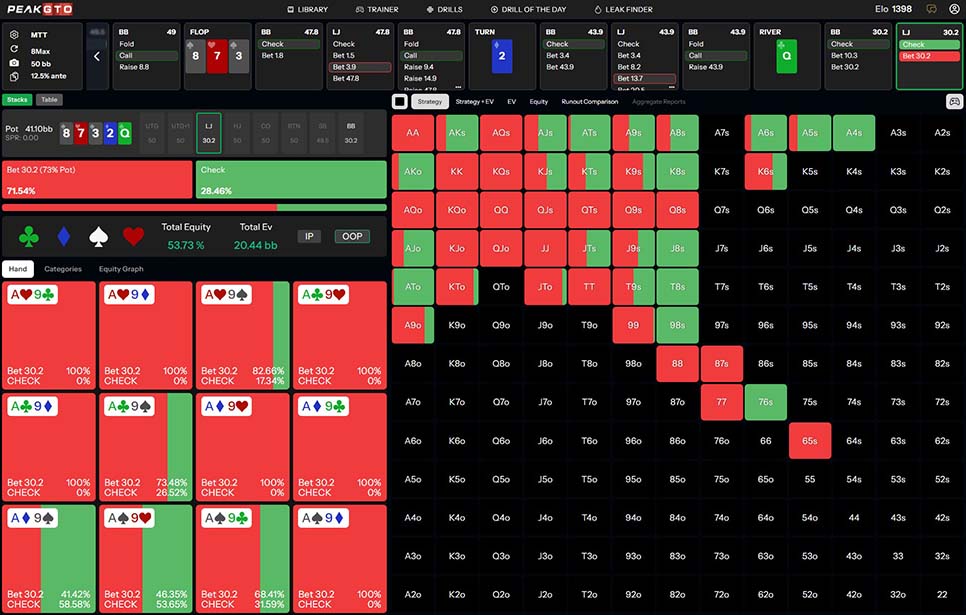
The Q♣ heavily favors the aggressor’s range. Many of LJ’s flop bluffs include Qx and now connect to top pair. PeakGTO shows LJ betting 30.2bb about 72% of the time after a BB check, representing a strongly polarized range.
A9o becomes a near pure bluff here. It has little showdown value and benefits from ace-high blocker effects, removing several of BB’s natural call candidates.
Solver output shows that this exact combo continues barreling at a high frequency, targeting folds from marginal pairs and missed draws. BB folds 45.6% at equilibrium, giving Hero a profitable result with this three-street line.
Key Takeaways
- Flop: On dynamic textures like 8♠7♥3♠, GTO prefers large, high-frequency bets. A♦9♠ fits naturally as an equity-denial c-bet with strong blocker properties.
- Turn: The 2♦ is a brick; solver continues big with polarized hands. A♦9♠ bluffs profitably thanks to spade and ace blockers.
- River: The Q♣ shifts advantage decisively to the raiser. A♦9♠ converts cleanly into a bluff, leveraging range advantage and positional pressure.
- Overall: GTO strategy transitions from denial to polarization. Hands like A♦9♠ show how well-chosen bluff candidates balance strong value and maintain equilibrium across all streets.