
Poker chips come in standard colors that are recognized in casinos around the world. Whether you walk into a poker room in Las Vegas, a cardroom in Europe, or sit down at a friend’s home game, white chips are worth $1, red chips are worth $5, and black chips are worth $100. These conventions have been established over decades and make it easier for players to track the action at a glance.
In this guide, I will walk you through the standard chip color values used in casino cash games, the chip denominations used at major tournaments like the WSOP and EPT, and how to assign chip values for your own home game in a way that keeps things running smoothRunning a poker home game can seem like a very fun thing to do, and it definitely is, but it is also a task that comes with some challenges.
Traditional Cash Game Chip Values
When I play poker at any casino, I can assess another player’s stack instantly because the chip colors follow the same conventions everywhere. Poker chip colors and values can be slightly different at different venues, but the core standards are consistent enough that most poker players share a universal visual language at the table.
For instance, black chips are worth 100 in local currency almost everywhere around the world, with very few exceptions.
Across America and Europe, the black chip is worth $100 or €100, and you will find very few poker rooms where this is not the case.
For that reason, you will want to adopt at least some of the traditional cash game chip values when you set up your home game, as this will make things easier for players who have played at other places in the past.
Here is a look at some traditional cash game chip values that you can assign in your home game:

- White Chips: $1
- Red Chips: $5
- Blue Chips: $10
- Green Chips: $25
- Black Chips: $100
- Purple Chips: $500
While many casinos in the world have chips with values of $1,000 and higher, most home games will not need such high-value chips, as the stakes would need to get very high for that to be the case.
If your chips are not marked with numbers, you can always assign any value you want to any of the chips, but remember that using these standardized cash game chip values will make it much easier for players to understand the values.
Running a Cash Game at Home
Setting up a home game correctly is one of those things that looks easy until you try it for the first time. I have played in home games where the chip setup was so poorly thought out that players were arguing about change for the first 30 minutes.
With the standard chip values in mind, here is how to set up the stacks for a typical $1/$2 home cash game. If most players will buy in between $100 and $500, you can set up starting stacks that keep things running smoothly with a simple distribution plan.
For starters, players will not need too many $1 chips, as these are mostly used just to cover the blinds in a $1/2 game. However, assigning every player with 20 white chips is a good start to allow for poker straddles, and these chips can always be added to the game if needed.
The red $5 chips are going to make the bulk of all the chips in play, and you can even start by completing every player’s buyin strictly in red chips if you have enough of them.
For instance, a $200 buyin can be made up of 20 white chips worth $20 and 36 red chips worth $180. Players who buyin for more can be given green or black chips over this amount.
The number of red chips you have at your disposal is going to be crucial in a $1/2 game, and if you want the game to keep running smoothly, you want everyone to have plenty of those on hand.
As the night progresses, you can start introducing the bigger chips for rebuys, and players will be able to get change from others at the table without interrupting the game.
Running a Poker Tournament at Home
Running a home tournament requires more planning than a cash game because you need to think about chip denominations in relation to the blind structure from the very start. In my experience, the most common home tournament mistake is starting with stacks that are either too shallow or too awkward to play with. Here is how to think about it correctly.
You will want to assess the number of players who might show up to play in your tournament and figure out an appropriate starting stack, blind levels, and level duration to make the tournament enjoyable and fun for everyone.
While you don’t want your tournament to be a super-turbo, you also have to take into account the fact that some people have to wake up early the next morning and can’t play until the late hours of the night.
If you have chips with denominations on them, you will want to set up your tournament in a way where these chips make sense in relation to the starting stack.
For example, if you have chips with denominations of 5, 10, 25, 50, 100, and 500, you will not want to start with 40,000 chip stacks, as that would require way too many of your chips.
Instead, in a case like this, you can start everyone off with 5,000 chips and start the blinds at 10/25, which still means everyone is starting with 200 big blinds.
On the other hand, if you have bigger chips to work with, you can start with a chip stack of 30,000 or 40,000 and make the first level 100/200 or 200/400, depending on how deep you want the tournament to be.
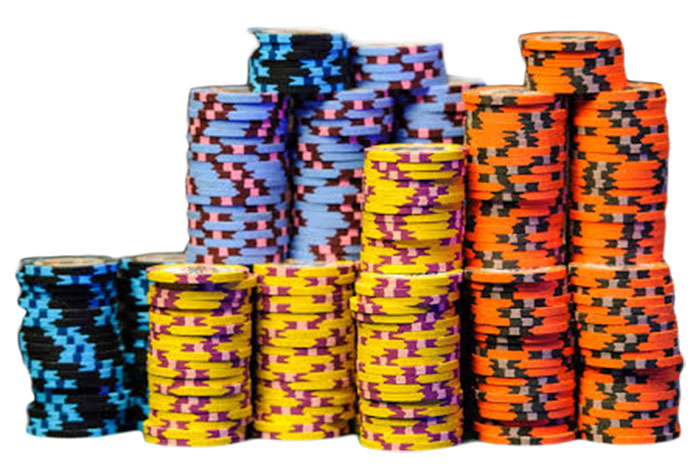
A good way to run your home poker tournament is by giving everyone in play 40,000 in chips in the following denominations (colors are a suggestion):
- 4x 5,000 chips (Orange)
- 15x 1,000 chips (Yellow)
- 6x 500 chips (Blue)
- 20x 100 chips (Black)
If you start the blinds at 100/200, everyone will have plenty of change to post the blinds and plenty of other chips to make raises and play with, while the bulk of their chips will be in the four big 5k chips that will come into play in the big pots and at later levels.
Poker Chip Colors at Major Poker Tournaments
Tournament chips are different from cash game chips in one fundamental way: they have no real money value. A $1,000 chip in a tournament cannot be exchanged for anything at the casino cage. Tournament chips are simply tokens used to determine who wins the event, and they are returned to the casino once the tournament ends.
Because of this, different major tours have developed their own chip color conventions, and these change from venue to venue. Here are the chips you are most likely to encounter at the biggest live poker events in the world.
WSOP Chip Colors and Values
The World Series of Poker (WSOP) is the most prestigious live tournament series in the world. Common chip denominations at WSOP events include:
| Chip Color | Denomination |
| Green | $25 |
| Black | $100 |
| Blue | $500 |
| Yellow | $1,000 |
| Orange | $5,000 |
| Green (Large) | $25,000 |
| Lavander | $100,000 |
| Big Red | $500,000 |
| Big Yellow | $1,000,000 |
WPT Chip Colors and Values
The World Poker Tour (WPT) runs events globally and uses a consistent chip set across its stops:
| Chip Color | Denomination |
| Black | $100 |
| Red | $500 |
| Yellow | $1,000 |
| Blue | $5,000 |
| Green | $25,000 |
EPT Chip Colors and Values
The European Poker Tour (EPT), sponsored by PokerStars, uses the following denominations at its events:
| Chip Color | Denomination |
| Green | $25 |
| Black | $100 |
| Purple | $500 |
| Red | $1,000 |
| Yellow | $5,000 |
| Blue | $10,000 |
| Grey | $25,000 |
| Pink | $50,000 |
Blind Levels and Chip Ups
Blind structure is what separates a well-run home tournament from a frustrating one. I find that most amateur organizers either make the levels too fast (which turns the game into a lottery) or too slow (which means people are still playing at 3am). Here is how to get the timing right.
For example, if you started a freezeout tournament at 100/200 with 40,000 chips, you will want the blinds to go up every 20 minutes for a faster structure, every 30 minutes for a slower structure, or every 40 minutes for a very slow structure.
Furthermore, you will need to think about whether you want to keep doubling the blinds with every level or if you want to introduce various levels in between the doubles.
One example of a solid tournament structure with 40,000 chips can look like this:
- 100/200
- 100/300
- 200/400
- 300/600
- 400/800
- 500/1,000
- 600/1,200
- 800/1,600
- 1,000/2,000
- 1,500/3,000
- 2,000/4,000
- 2,500/5,000
- 3,000/6,000
- 4,000/8,000
- 5,000/10,000
If we take the example above and assume that a total of 50 entries were made and the blind levels are set at 20 minutes, this means we will have a total of 2,000,000 chips in play, and after 300 minutes of play (5 hours), this will represent 200 big blinds.
That means the tournament will be down to the final table after that time, or very close to it, and this allows you to predict the time at which the tournament will end.
Note that if you set the blinds to 30 minutes, the tournament will only get to level 15 after 7.5 hours, adding significant total running time.
Additionally, you will notice that after level nine, chips with a value of 100 are no longer needed, and they can be completely removed from play.
By doing a chip up and removing these small denomination chips from play, you will speed up the game and allow even more hands to be played at every level.
Assigning Value to Chip Colors in Poker
Most consumer chip sets do not include chips in the exact colors standard casinos use, and that is completely fine. I have seen perfectly enjoyable home games run with orange chips worth $5 and purple chips worth $1 because the host simply told everyone at the start.
Different poker chip sets come with chips in different colors, shapes, and sizes. Some chips come with denominations on them, while others are completely blank. If you have a poker set made up of the latter, you can reasonably assign any value to any chip color you want. As long as you notify the players, the game should run smoothly.
However, the best thing you can do is assign chips with colors that are typically used in casinos and poker rooms, as well as in TV poker games, as this will ensure that players understand the colors from the get-go.
If you happen to be working with a chipset that has chips of different colors, don’t worry about it! Home games are designed to have fun, so as long as you make sure everyone knows some poker basics and what each chip is worth, there should be minimal confusion.