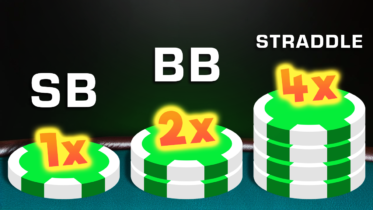

A poker straddle is a voluntary blind bet placed before the cards are dealt, typically by the player to the left of the big blind, for twice the big blind.
It acts as a third blind, increases the effective stakes of the game, and gives the straddler the option to act last before the flop. In my experience playing and coaching live cash games, the straddle comes up constantly, and I find that most players do not have a clear framework for when it is worth posting and when it is simply giving away chips.
This article covers the three types of straddles in Texas Hold’em and other poker formats, the mechanics of each, and my specific take on when a straddle is a reasonable play versus when it is just variance for its own sake.
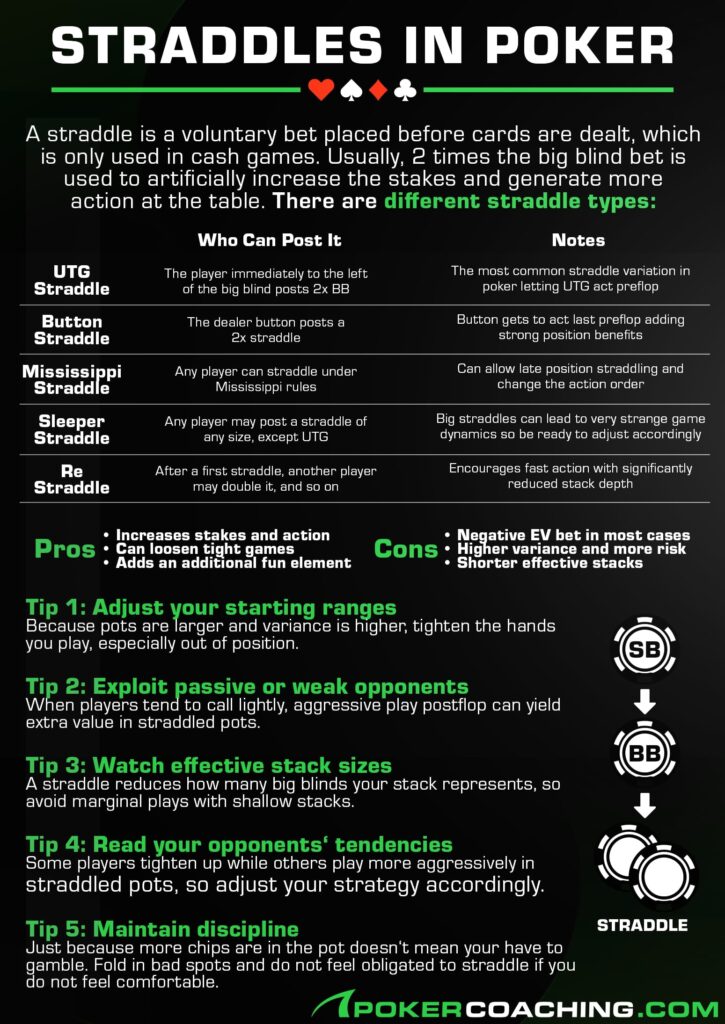
Download Poker Straddles PDF Guide
What Is a Straddle in Poker?
Typically, the word straddle is used in poker to describe a voluntary bet placed by the player to the left of the big blind before the cards are dealt.

The size of the straddle should always be exactly two times the big blind. So, in a $5/10 game, the UTG player would have to place $20 into the pot in order to straddle.
Once the UTG player has straddled, the player to their left now has the option to re-straddle unless the game does not allow it.
In some cash games, only one straddle is allowed, while in others, no straddling is allowed. Straddles are not used in poker tournaments.
In many private cash games, multiple players are allowed to straddle, which is why you will often see a $1/2 game go up to as high as $32 before the flop, as players look to get unstuck on the night and seek to play big pots and get lucky.
The only advantage of placing a straddle is that you get to act last before the flop.
Instead of going first and usually having to fold, the player in the straddle can now go last and see everyone else act on their hand before the action comes to them.
Sleeper Straddle and Mississippi Straddle
Apart from the regular UTG straddle, some poker games allow for two other types of straddles, called sleeper straddle and Mississippi straddle.
Any player can place a sleeper straddle at the table and can be worth any amount they choose in most cases.
For instance, in a $2/5 game, the player in the cutoff can place a $100 sleeper straddle. In this case, the action starts with the UTG player.
If any of the players before the sleeper straddle decides to enter the pot, the sleeper straddle is not “live,” and the player gets to act on their hand any way they choose to.
On the other hand, if other players fold over to the sleeper, their straddle is now live, with action skipping them and going to the next player.
The player who posted the sleeper straddle gets to play the last preflop but will not have that same privilege on other streets, depending on their position.

A Mississippi straddle, on the other hand, can only be placed by the player on the dealer’s button, and it can also be made to any size, with a minimum of 2 times the big blind (higher in some games).
When a Mississippi straddle is posted, the player in the small blind must play first, and the action goes around the table, with the dealer having the last action both preflop and on subsequent betting streets.
A Mississippi straddle is considered advantageous in some games, namely Pot Limit Omaha, and some players refuse to play with Mississippi straddles as they believe they give an unfair advantage to the button.
The Button Straddle
The button straddle deserves its own mention because it is strategically distinct from the UTG and sleeper straddles. When the player on the dealer button posts a button straddle (minimum 2x the big blind, unlimited in many games), the action starts with the small blind and proceeds clockwise around the table, with the button acting last both before and after the flop.
This is the one straddle type I give the most credit to. Acting last before the flop is the button position’s primary advantage in standard play, and the button straddle preserves that advantage while also increasing the pot. In soft games where the effective stacks are deep, a button straddle lets you enter a larger pot with full positional control, which is the closest thing to a strategic use of the straddle that I can endorse.
Even so, most players post button straddles far too frequently and in the wrong game conditions. Use it selectively when the table is passive and the stack-to-bet ratios favor deep-stack play.
Should I Straddle in My Games
My answer to this question has not changed over thousands of hands of live cash game coaching: the UTG straddle is a –EV play almost every time, and the main thing it accomplishes is making a bad position even worse.
You are posting two big blinds from early position before looking at your cards, then playing out of position for the rest of the hand against anyone who calls or raises you. The blind positions are already the most consistently losing positions in poker for every player’s graph I have reviewed. The straddle is voluntarily opting into a worse version of the big blind.
By posting the UTG straddle, you are simply putting chips into the pot before looking at your cards when you could instead just do that.
While you will get to go last preflop and sometimes have a chance to re-raise with your strong hands or good bluffs, you will also usually be out of position against any players who decide to call you in these situations.
You will also be forced to play more hands from out of position against small preflop raises, in a similar way you are in the big blind, but this is not a favorable position to be in.
While there is no way to avoid the blinds, avoiding the straddle is easy: you simply do not post it.
Sleeper straddles are even more insane, as they contribute very little extra value while often putting you in difficult spots. These straddles are typically posted only by major gamblers who are looking to gamble rather than play poker.
Finally, the Mississippi straddle is the only one that can make sense on occasion, as it allows the player on the button to gain some advantage by acting last preflop.
Since this player also gets to act last on all other streets and retain the position, a Mississippi straddle is a good way to take control in some games, especially if your table is soft and easy to dominate.
Still, playing good out of the Mississippi straddle also requires a high level of poker strategy, and most players will be torching money when they post this type of preflop bet without being forced to as well.
So Is There Ever a Time to Straddle?
I tell students that there are essentially two legitimate reasons to straddle: either everyone at your table is doing it, and you are not giving up EV by going along, or you are at a table of extremely tight, passive players, and the straddle lets you apply enough aggression to print money in a game that otherwise does not generate enough action to be worth your time.
In almost any other situation, you are just putting money into the pot without cause. The social reason (not wanting to antagonize your table) is real, but it applies only when straddling is the table norm, not as a general habit.

First of all, you may be playing in a cash game with extremely deep effective stacks. Straddling in such a game can make sense as the effective stack could still be 500 big blinds or more after the straddle, leaving plenty of room to play on each street.
In such games, you will often see all players at the table post at least one straddle, and being the only one not doing it could be considered rude.
While you are completely within your rights not to post any straddles, posting the UTG straddle when it’s on you will be appreciated by the other players.
If everyone at the table is straddling, you are not giving up any EV by straddling along. While you could add some extra EV by not doing it, you don’t want to do so at the expense of being hated by everyone at the table.
Strategically, straddling in games where the table is very tight and not very aggressive can be advantageous.
With most players just limping into pots and only raising their premium holdings, you will get to make the game bigger, make your opponents play out of their comfort zone, and dominate the table.
Even still, straddling too much can backfire and cause you to become the sucker at the table, so make sure you know what you are doing and why before you put any chips into the pot that you don’t have to.
Bankroll Considerations of Poker Straddles
I always ask students the same question before they sit in a straddle-heavy game: how many buy-ins do you have at the actual effective stake? If you sit down to a $1/2 game with $200 but the table regularly runs straddles to $8 or $16, you are not playing $1/2 poker.
You are playing $1/2/4/8/16 poker, and your $200 stack represents roughly 12 big blinds at the highest straddle level. Players who do not do this math before sitting down consistently go broke at stakes they thought were comfortable for their bankroll. Run the numbers before you commit chips.
Of course, there is no exact way to know this before you start playing, but you can usually get a pretty good feel for it an hour or so into the game.
While players posting straddles in your game is definitely a net positive for you, you should also be aware of the effect straddles have on the size of the game and pot odds.
Imagine you sit down at a $1/2 table with a $200 buyin. At this point, you are playing with 100 big blinds and can approach the game with an appropriate strategy.
Very soon, players at the table start straddling to $4, with some choosing to straddle to $8 and even $16 on occasion.
The key to remember is that when you are straddling $8, you are playing with just 25 big blinds, whereas when you are straddling $16, you are playing with a mini stack of 12.5 big blinds.
While this can be great if you pick up some hands and either pick up the blinds or get a light stack-off for an opportunity to double up, it will also add tons of variance to the game.
A stack of $200 that would normally only go into the pot in situations that warrant it can now go into the middle with a pair of sixes or AT before the flop.
When playing in games with a lot of straddles, be sure that you have a bankroll that can sustain quite a few beats or allow you to buyin deeper and play the game as if the blinds were higher throughout the game.
Straddles in Online Poker
Online cash game straddles are available on several major platforms, including GGPoker, and the option is spreading to more sites. My advice for online straddles is more definitive than for live games: almost never post one.
Live games justify the occasional straddle because of the social dynamics, the deeper effective stacks that develop over long sessions, and the prevalence of genuinely passive opponents who can be exploited. Online games are tighter, faster, and populated by players who are already studying their game.
The recreational player looking to gamble their session away is a smaller percentage of the player pool online than at a live $1/2 table. Posting a straddle online gives away chips in a game that does not reward the social or dynamic reasons that make straddling occasionally acceptable in live settings.
If you want to study the mathematical edge you give up by straddling, PokerCoaching’s own solver, PeakGTO, lets you model the EV difference between straddled and non-straddled positions in specific spot configurations. The numbers confirm what experience shows: the straddle is a chip-bleeding play in the absence of specific table conditions that justify it.