

Limping in poker means calling the big blind preflop without raising, and it is almost always the wrong play in a cash game when you are first into the pot. You give up initiative, invite multiple callers, and make your range transparent to anyone paying attention.
I have reviewed thousands of student hands over the years, and when I see consistent open limping, it usually traces back to one of two habits: wanting to “see cheap flops” or trying to trap opponents with big hands.
Both habits lose money long-term. The good news is that limping is not always wrong. There are specific poker strategy spots where it is not only acceptable but correct, and knowing the difference is what this guide is about.
- What Is Limping in Poker?
- Why You Should Not Limp In Poker
- What Is Over-Limping in Poker?
- Completing the Small Blind
- Limp Re-Raise with the Strongest Hands
- Limping the Button in Poker Tournaments
- How to Play Against Limpers
- Final Verdict: Should I Ever Limp In Poker?
- Frequently Asked Questions About Limping in Poker
What Is Limping in Poker?
In my experience coaching players at every level, open limping is one of the most common and costly preflop leaks I see. The player who limps is usually thinking about their hand in isolation.
The player in position is thinking about ranges, initiative, and the opportunity to put the limper in a tough spot. That gap in thinking is exactly why limping bleeds money.
Every hand of poker starts with players getting dealt two hole cards and taking turns making the initial decision of whether or not to play their hand.
Whenever all players in front of us decide to fold their cards, we are given three options. We can either fold, call, or raise.
The decision to call the value of the big blind without putting in a raise when no players in front of us have done the same is called limping.
So, anytime you are the first player into the pot, and you decide to call, you are effectively, in poker terminology, limping into the pot.
For many years now, an open limp has been considered a very weak play, as it does not give us a chance to win the pot outright, does not give us the initiative in the hand, and does not make our opponents pay anything extra to see the flop.
In most cases, open limping is actually very weak. Entering the pot with a raise instead has many advantages, but there are also some cases where this advice does not hold true, which we are going to explore in this article.
There is also an important third form of limping that gets less attention but costs recreational players a significant amount of money: the limp-call. This is when you limp into a pot, someone behind you raises, and you call the raise anyway.
You start passive, then commit more chips, and you arrive at the flop with a range that is face up and rarely ahead. In my coaching work, the limp call is one of the patterns I flag immediately. It combines two separate mistakes into one hand.
Why You Should Not Limp In Poker
As already mentioned, being the first player to limp into a pot is generally not a part of a successful poker strategy, and there are quite a few reasons for that.
Many poker players limp into pots in the hopes of seeing “cheap flops,” but this logic makes little sense, as seeing the flop should not be your goal in poker.

Even when facing aggressive opponents, playing passively until you make a big hand and trying to extract all the value at that point is generally not a strategy that’s going to work.
At best, this kind of approach to poker is going to make you a small winner, while playing more aggressively could potentially make you a big winner in your games.
Instead of limping to see a cheap flop, you should be looking to win the pot outright and playback at very aggressive players who get out of line and 3-bet your raises too much.
If you limp into a pot and then call a raise, you will very often be left in a situation where your only way to win the pot is to actually make a big hand, which is extremely hard to do in No Limit Hold’em.
Raising, on the other hand, allows you to take control of the hand, represent a very strong range of hands, and often win the pot on the flop or the turn without actually having the goods.
What’s even more, raising it will allow you to get information that you won’t get if you limp into a pot.
For instance, whenever you limp into the pot and the big blind checks, you will have very little information on their hand. While you will know they probably don’t have a hand like AA or KK, you won’t be able to tell if they have 86s, T2, or pocket Threes.
Getting information on your opponents’ hands is another important reason to raise before the flop instead of just limping, and it is only one of many compelling reasons to do so.
What Is Over-Limping in Poker?
Over-limping is the one form of limping I am not opposed to in the right situation. When two or three players have already limped in front of you, and you are on the button with a hand like 5s4s, folding is often too tight, and raising does not make a lot of sense with a speculative hand that wants to flop big and get paid. Overlimping here is simply taking a favorable price.
For example, imagine sitting on the button in a cash game with 5s4s and seeing three players in front of you limp.
You could raise it up, but you expect that at least one or two of these early position limpers will come along, and one of them might even be setting the trap and getting ready to re-raise you big.
On the other hand, just folding does not seem too appealing either, as your hand has a lot of implied odds, and you are getting an amazing price to make the call in position.
So, over-limping in a situation like this is definitely a very solid play, as it allows you to make a minimal investment for a potentially massive return while not exposing yourself to getting re-raised by a strong early position opener.
Over-limping in spots like these can be extremely profitable, as early position limpers often do have hands like AA and are looking to make a big preflop re-raise. Limping along and flopping big can often result in such opponents stacking off and drawing nearly dead for a massive pot after the flop.
Completing the Small Blind
Completing the small blind is one of the spots I genuinely think limping can be correct, and it is worth understanding why this situation is different from an open limp from early or middle position. You already have money in the pot, there is only one player left to act behind you, and the odds you are getting make it profitable to continue with a wide range.
The logic of always raising or folding does not hold true when you are in the SB, as you are getting an extreme discount on limping in.
You will still want to raise some of your hands, but coming along with a limp makes sense with quite a bit of your range, especially in games with antes.
For example, imagine sitting in the SB in a poker tournament at 400/800 level with an 800 big blind ante.
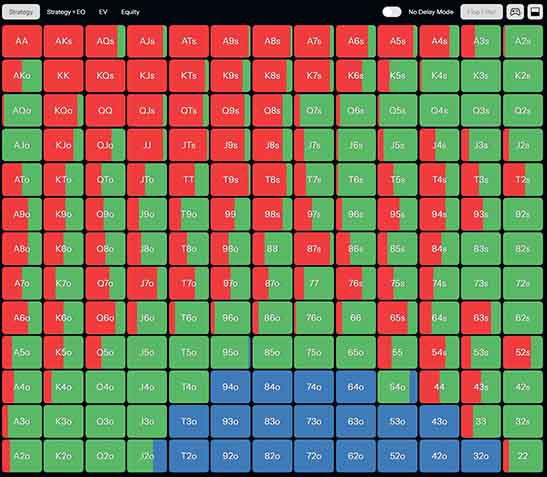
When the action folds to you, there are already 2,000 chips in the pot, and you only need to put 400 in there for a chance to win 2,400.
Getting 5:1 on your money, you only need to win the pot once out of six times to make your limp profitable, which means you can do it with almost any two cards.
Typically speaking, most good players will still fold the bottom of their range but will at least call most suited hands and many off-suit hands that have one high card or some connectivity.
Many professional players at the highest stakes have been experimenting with never raising from the small blind and limping in their entire range, splitting between limp-folding, limp-calling, and limp-raising whenever they face a raise from the big blind.
For the time being, you can keep raising the SB first-in with all your strong hands, as well as suited connectors and one-gappers, while limping in other suited hands such as Q3s, 94s, 73s, and off-suit hands like J8, K2, Q4, and folding your weakest hands like T5, J3, 72, etc.
Limp Re-Raise with the Strongest Hands
Another play you will notice some players make once in a while, especially in live poker games, is a limp re-raise with strong hands like AA, KK, or AK.
This play is absolutely something you should avoid when playing against any competent opposition, but it can be very profitable when playing against weak live players.
In many live games, especially at lower stakes, players will not be paying any attention to what’s happening at the table and will throw in their chips regardless of how you play your cards.
Limping in an early position with a hand as strong as AA and then coming over the top of any iso-raise with a huge re-raise will often get you paid big, making the pot a lot bigger before the flop than it normally would be.
However, keep in mind that this play only works against players who are completely oblivious to positions in poker and what’s happening in the game, while it can cost you dearly against observant players who will fold very strong hands when faced with a limp re-raise from a player who does not tend to limp with a lot of different hands.
Limping the Button in Poker Tournaments
The button limping strategy in tournaments with 12 to 25 big blinds is one of the more nuanced preflop plays in the game, and it is a spot I think many tournament players miss out on.
The core idea is that when your stack is in the right range, limping a mixed range from the button creates a difficult problem for the blinds: they cannot simply jam over you without risking running into your strong hands, but they also cannot passively check behind with hands that dominate your speculative hands.
This balance is worth studying in depth. If you have access to a solver, PokerCoaching’s own tool PeakGTO lets you model the EV of different button limping ranges versus specific blind configurations, which is the most direct way to see why this strategy works at these stack depths.

The button limping strategy involves limping into an unopened pot with a range made up of strong hands like AA-88, AK-AJ, KQs, and KJs, along with hands like suited Aces and suited connectors.
By limping in such a mixed range, you will make it hard for your opponents in the blinds to raise you, as they will be risking getting shoved on by your strong hands.
On the other hand, you will also get to play your strong speculative hands like A8s or T9s very cheaply against the big blind’s entire range when they check behind.
This strategy only works well when you have a stack you are comfortable with re-shoving anytime one of the blinds does make a raise, so make sure not to do it when your stack is too big to re-shove or too small to have any fold equity when you do re-shove.
How to Play Against Limpers
Most articles about limping focus on whether you should limp. The question that affects your bottom line just as much is what to do when other players limp in front of you.
The short answer is: punish them with a raise. Open limpers in cash games almost always have a capped range. They have removed the premium hands they would open-raise with, which means you can apply pressure with a wider range than you would normally use for an open-raise over a fold.
Isolation sizing that works
In live cash games, use this simple rule: raise to 4 big blinds plus 1 big blind per limper. If you are out of position, add one more big blind to your sizing. The goal is to price out the hands that want a cheap flop (small pairs, suited connectors, suited aces) while keeping the pot manageable enough that you retain a positional edge postflop.
For example, in a $1/$2 live game where two players limp, you are on the button with AJs. A raise to $12 (6 BB) makes calling a clear mistake for hands like 76s or 44. If both limpers call, you go to the flop as the preflop aggressor in position with a strong hand and around $37 in the pot.
Online, where isolation frequencies are higher and players are more aggressive, sizing can come down slightly. Raise to 3.5 BB plus 1 BB per limper in position, or 4 BB plus 1 BB per limper out of position.
What to do after isolating
Once you have isolated a limper and are heads up in position, play straightforward poker. Bet boards that favor your range. Do not force action on coordinated, low boards that connect well with the kinds of hands limpers hold. Against multiple limpers in a multiway pot, tighten your continuation bet frequency and lean toward value betting more and bluffing less.
One pattern I have found particularly profitable is targeting limp-callers specifically. Players who limp and then call a raise frequently overplay top pair weak kicker and fold too easily to pressure on the turn and river. In my experience reviewing hands against this player type, a well-timed turn barrel on a blank card ends the hand far more often than most players expect.
Final Verdict: Should I Ever Limp In Poker?
While the consensus among the poker pros is that you should “never” limp into an unopened pot, there are quite a few scenarios in which such a play can be profitable.
For the most part, you should remember that a raise is the better play, as it allows you to collect information about your opponents’ hands, deny other players their equity, and win pots without even seeing the flop.
However, situations such as SB v BB scenarios, shallow stack ICM tournament play, and pots with multiple limpers can all be good spots to enter the pot as a limper and employ the limping strategy successfully.
The next time you play poker, think about our tips for limping in poker and try to employ a successful limping strategy in the few spots in which it is possible, while entering most other pots as the raiser and applying as much pressure as possible on other limpers in your games.