

Spin and Go poker tournaments are three-player hyper-turbo sit-and-gos with a randomly determined prize pool that can multiply your buy-in anywhere from 2x to thousands of times its value.
I have studied this format extensively and coached players who have used Spins as their primary game, and my honest assessment is this: you can build a real, consistent profit at Spins without ever needing to hit a big multiplier, but only if you approach them with the right fundamentals from day one.
This guide covers the ten most important strategy principles I would teach any player starting in Spin and Gos today.
- What Is Spin and Go Poker?
- Spin and Go Strategy Tip #1 – Practice Good Bankroll Management
- Spin and Go Strategy Tip #2 – Don’t Speculate
- Spin and Go Strategy Tip #3 – Get Very Aggressive
- Spin and Go Strategy Tip #4 – Know Your Push/Fold Charts
- Spin and Go Strategy Tip #5 – Keep Your Raises Small
- Spin and Go Strategy Tip #6 – Ignore ICM
- Spin and Go Strategy Tip #7 – Don’t Play for the Jackpot
- Spin and Go Strategy Tip #8 – Keep Your Emotions in Check
- Spin and Go Strategy Tip #9 – Volume Is Key
- Spin and Go Strategy Tip #10 – Always Keep Studying
- Frequently Asked Questions About Spin and Go Poker
What Is Spin and Go Poker?
Spin and Go is a three-player hyper-turbo sit-and-go format that was introduced by PokerStars in 2014. Games begin the instant three players register, with no scheduled start time. The defining feature is the randomized prize pool: before any cards are dealt, the multiplier is randomly drawn, determining what the total prize pool will be for that game.
The starting stack at PokerStars is 500 chips, with blinds starting at 10/20. That gives each player exactly 25 big blinds to begin, meaning the game moves into push-or-fold territory very quickly as the blinds escalate at hyper-turbo speed.
Prize pool structure
The vast majority of Spin and Gos, roughly 80 to 90 percent, land on the 2x or 3x multiplier. At those levels, the winner takes everything, and the other two players receive nothing. Larger multipliers occur rarely, and the grand jackpot (sometimes as high as 240,000x the buy-in) happens only a handful of times per year across all players globally.
The payout structure shifts slightly at higher multipliers. At 10x, both first and second place receive a portion. At 25x and above, all three players are paid, though first place still takes the majority. This matters strategically because at higher multipliers, there is a small ICM element, while at the 2x and 3x levels, it is a pure chip accumulation game.
I find that players new to the format consistently underestimate how fast the stacks get short. You start with 25 big blinds, miss a few spots in the first level, and suddenly you are at 15 big blinds and in push-or-fold mode. Understanding the format structure is not optional background knowledge: it shapes every decision you make from hand one.
Spin and Go Strategy Tip #1 – Practice Good Bankroll Management
The most important thing I want you to understand before you play your first Spin and Go is that your bankroll requirements are higher than in almost any other poker format.
Here is why: the variance is extreme because 80 to 90 percent of games pay only 2x the buy-in to the winner, meaning you are playing hyper-turbo winner-takes-all games at a tiny edge for your entire career.
While Spin and Goes can be played profitably, the variance in these games tends to be very high, as the majority of games have a prize pool of just 2x the buyin.
As you work your way through all the low multipliers and deal with the hyper-turbo structure of the games, you will need a lot of money to make sure you never go bust.
The bankroll you might need to survive the swings is at least 200 buyins while having as many as 500 buyins is definitely advisable.
If you are able to replenish your bankroll on a regular basis, you can take some shots with Spins with a lesser bankroll, but be prepared to have to reload even if you play very well.
When looking to move up to higher stakes, be extremely careful and make sure you have the bankroll to sustain the variance of the next level before giving it a shot.
Spin and Go Strategy Tip #2 – Don’t Speculate
One of the most common leaks I see in players transitioning from MTTs or regular SNGs to Spin and Gos is an instinct to play speculative hands in the early levels, as if there is time to build a big stack through set mining or flush draws. There is not.
While this strategy works pretty well in MTTs and even in most SNGs, it is to be avoided altogether in Spin and Goes.

Spins start with shallow stacks, and the blinds go up very fast, which means you will not be able to call raises and look to make big hands on flops.
Calling a few raises and missing a few flops would leave you crippled, which is why you want to mostly play big hands and play them aggressively.
Of course, you will want to throw some bluffs into your ranges across the board, but playing polarized ranges is the way to go in almost every situation in Spins.
Spin and Go Strategy Tip #3 – Get Very Aggressive
If I had to identify the single trait that separates winning Spin and Go players from losing ones, it is aggression. I have watched hundreds of student hands in this format, and passive play is almost always the root cause of the losses. In Spin and Gos, passive play wastes equity at every level.
Even at the earliest levels, winning blinds or re-stealing against raises will result in significant increases to your starting stack.
As the game moves into the later stages, you will want to steal like a maniac and never play passively, as passive play simply doesn’t make sense with such shallow stacks.
Raise and re-raise with polarized ranges made up of your strongest hands and bluffs that have a good chance of sucking out against hands like AK or AQ, which might call you off.
Make sure to fold all those hands in the middle that is usually good enough to call with in regular tournaments, but don’t make the cut in Spins.
Spin and Go Strategy Tip #4 – Know Your Push/Fold Charts
Push/fold decisions are the dominant skill requirement in Spin and Gos, and I want to give you a concrete starting point. At 10 big blinds from the button in a three-player game, your shove range should be roughly 40 to 50 percent of hands.
At 8 big blinds, it is wider. At 15 big blinds, there is still room for small raises, but even those are preparatory for the shove-fold stage that is coming. Most recreational players in this format shove too tight when short-stacked because they are playing by instinct rather than by a studied chart.
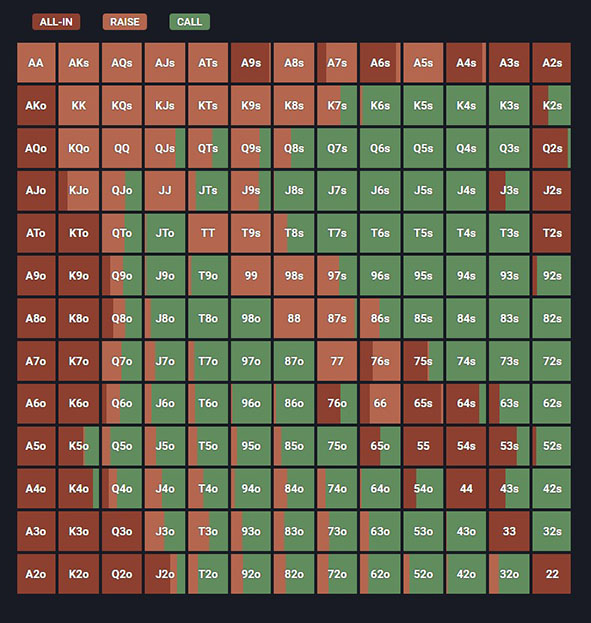
The real question, of course, is what poker ranges to do it with. To find answers to this question, you will need to know the push/fold charts for various stack sizes and positions by heart.
Studying push/fold charts is an essential part of training for Spin and Goes, as the vast majority of your plays after the first couple of levels will be all-ins.
If you get good at making profitable shoves and calling off with appropriate ranges, you will gain an edge over an average Spin and Go player, which will turn into monetary gain.
On the other hand, if you go into the games unprepared, you will constantly be questioning your plays and be unsure of whether to shove or not with a whole bunch of hands you are dealt.
Spin and Go Strategy Tip #5 – Keep Your Raises Small
I want to be specific about raise sizing because I see recreational players consistently opening too large in the early levels of Spins. While you will want to be moving all-in frequently as stacks shrink, there is real structure to the early game that most players skip past entirely.
As long as you have more than 10 big blinds, you will want to open your hands for a raise and make a decision if your opponents decide to shove on you.
In almost every case, you should raise just 2x from the button and 2.5x from the small blind, as these raise sizes are definitely big enough.
If you see players raising 3x or 4x in the first level, you can be 100% sure that these are inexperienced recreational players just punting away.
Instead of following their lead, open every hand you want to play for a min-raise, never limp your button, and keep it aggressive every step of the way.
Spin and Go Strategy Tip #6 – Ignore ICM
I want to address one of the biggest mental resets players need to make when moving from regular SNGs to Spin and Gos: ICM, which shapes nearly every decision in a standard SNG, is irrelevant in almost every Spin and Go you will ever play.
In regular SNGs, the payout structure creates genuine ICM pressure because multiple spots are paid, and chip preservation has a monetary value. In Spin and Gos at 2x and 3x multipliers, the winner takes all, and the second place pays nothing, so chip accumulation is always optimal.
The one exception worth knowing: at multipliers of 10x and above, there is a meaningful payout for second place, and a small amount of ICM thinking becomes appropriate. But since you will play 80 to 90 percent of your games at 2x or 3x, the default should always be to play for the win and accumulate chips aggressively.

In a Spin and Go tournament, all the money is reserved for the first place (except in the highest multipliers), which means you should always be playing for the win.
Essentially speaking, every Spin is a cash game, and all the chips in play are worth two, three, five, or more initial buyins.
Regardless of how much the first place is, you will need to win the tournament to get it. If you come second, you get nothing.
This is another great reason to be very aggressive and keep playing in ways that allow you to accumulate chips and give yourself the best chance to win all the chips in play.
Spin and Go Strategy Tip #7 – Don’t Play for the Jackpot
I want to address the mindset that brings most recreational players to this format in the first place: the jackpot. Spin and Gos are marketed as lottery-style games, and the idea of winning a million dollars from a $5 or $10 buy-in is genuinely appealing.
But I want to reframe how you think about this, because the players who are actually profitable in this format almost never factor the jackpot into their plans.
Instead of chasing after the jackpot and hoping it will change your life forever, learn how to play Spins for profit and beat the games even without winning the jackpot.
Spin and Goes are currently the games with the most recreational players out there, which means they are the softest games you will find on the internet.
Despite a lot of the money being siphoned off for the jackpot, the best players out there are still able to beat spins for an ROI of 2% or 3%.
If you can have ROI like this, collect your rakeback, and put in a lot of volume every day you play, you will be printing money.
Despite what anyone might tell you, it is entirely possible to win at Spin and Goes if you learn the right Spin and Go strategy and always stick to it.
Spin and Go Strategy Tip #8 – Keep Your Emotions in Check
Variance in Spin and Gos is not abstract. I have spoken with players who were running well above expectation and with players who had lost 400 buy-ins while playing perfectly, and both of those outcomes are statistically realistic in this format.
That asymmetry puts genuine pressure on your emotional state and decision-making in ways that differ from standard tournament play.

Losing over and over again when you are playing good poker can be extremely frustrating, but that’s just the nature of hyper-turbo poker games.
When experiencing a bad downswing in Spins, you may end up questioning your every decision or going on tilt and playing against your better judgment.
While we all want to be immune to tilt, the truth is no one truly is, and it’s just a matter of what needs to happen to trigger an emotional response from a player.
If you are going to play Spins for a living, you will want to practice patience, work on your poker mindset, and do your best not to allow the swings of the game to influence the way you play the cards you are dealt.
Spin and Go Strategy Tip #9 – Volume Is Key
Volume is not a side consideration in Spin and Gos: it is the mechanism by which skill converts into profit. I think about this differently than most coaches. In formats like MTTs or cash games, a skilled player can often show a profit over a relatively small sample.
In Spin and Gos, the variance is high enough that you need a statistically significant volume of games before your edge becomes visible in your results.
Since you are going to be relying on a fairly low ROI, the only way to make a big profit is to play a lot of games in every single session you play.
Fortunately, Spins are extremely fast, and you can play one in just a few minutes. This means that if you multi-table them, you can easily play dozens of Spins in a single hour.
Professional players who grind Spin and Goes play hundreds upon hundreds of games every week and are able to make consistent profits by doing this.
Of course, if you keep playing at such a high volume, you may just end up getting lucky once in your life and being part of the jackpot Spin, and that’s just the extra bonus that may or may not come at some point.
Spin and Go Strategy Tip #10 – Always Keep Studying
Reaching a winning baseline in Spin and Gos is the beginning, not the end. I have seen players hit their ROI targets and immediately shift into pure grinding mode, assuming the work is done. It is not. The format evolves, player pools shift, and your own leaks calcify if you stop reviewing them.
My recommended study workflow for Spin and Go grinders: review push/fold spots where you felt uncertain, study your actual calling frequencies from the big blind against short-stacked shoves, and analyze hands where you exited a game as the short stack to understand whether you were too passive too early.
PokerCoaching’s native solver, PeakGTO, is built for this kind of spot-specific review and is the tool I recommend for players studying short-stack push/fold accuracy in this format.

Regardless of how good you become, you should always make sure to take some time away from the tables, study the game, and constantly improve your poker strategy.
Not only does poker always evolve and change, but you can also start forgetting certain concepts and how to apply them if you don’t study the game regularly.
The better you are, the less time you will need to spend in the lab, but you should still make sure to include at least a few study sessions every week.
Study your own hands, talk to other players, find areas in which you can improve to raise your ROI even further, and make sure you never allow the general population to catch up with you.