
Rebuy poker tournaments allow players to purchase additional chips during a designated early period whenever their stack drops to or below the starting chip count. Unlike re-entry events, rebuys cost no additional rake, are played from the same seat, and often let you buy double the starting stack immediately if you bust.
At the end of the rebuy period, all players get one final add-on before the event converts to a standard freezeout. I’ve coached hundreds of players through rebuy MTTs, and the most consistent mistake I see is players treating the rebuy period and PKO tournaments as an invitation to gamble, when the real edge comes from playing solid poker while everyone else is throwing chips away chasing coin flips.
What Is a Rebuy Tournament?
As you could probably guess from its name, a rebuy tournament allows you to buy more chips if you lose your initial stack, but then again, so is re-entry.
There are several major differences between these two formats that make rebuy tournaments and re-entries quite a bit different.
For all intents and purposes, a re-entry tournament plays like a freezeout. If you lose your chips, you must go to the cashier, pay your buyin in full again, and receive a fresh stack of chips. You even pay the rake again and are seated at the new table.
Rebuy tournaments are quite a bit different, as some of the following rules apply in most rebuy structures:
- You can buy a rebuy when you lose all your chips
- You can buy a rebuy when you fall under your starting stack
- You can buy up to two starting stacks at once when you are out of chips
- You don’t pay rake when buyin rebuys
- You stay at the same table and the same seat
- You can buy an add-on at the end of the rebuy period
As you can see, rebuy tournaments offer several different ways you can add chips to your stack, and they don’t require you to lose every last chip before you do so.
Instead, you can replenish your chip stack in a rebuy poker tournament every time you fall below the starting stack. If you lose all your chips, you can buy two full stacks immediately.
While re-entry tournaments often limit the number of re-entries a single player can make, rebuy tournaments allow players to buy unlimited amounts of chips and bust as many stacks as they want to.
Finally, when the rebuy period ends, the tournament goes on a short break, and all remaining players are allowed to purchase an add-on, usually at the same price as the original buyin, but often for substantially more chips.
The Different Stages of a Rebuy Tournament
Like any other poker tournament, a rebuy tournament starts with all players assigned their starting stack, and the blinds set fairly low in comparison to that stack.
What’s even more, players in rebuy tournaments get to buy double stacks if they want to and can add on more chips as soon as they fall back under the starting stack.For this reason, the early stage of a rebuy tournament differs from that of a freezeout quite a bit, so it is worth discussing tournament strategy for the three main phases separately.
Early Play in Rebuy Tournaments
I’ve played and coached countless rebuy events, and the table dynamic in the first few levels looks the same every time: two or three players are firing chips recklessly, one player is already on their third bullet, and everyone else is nervously watching. The players who consistently build the biggest stacks in rebuy early stages are almost never the ones gambling it up. They’re the ones waiting patiently while their opponents hand them chips.
The early levels of play in a rebuy poker tournament tend to be quite hectic, with players throwing their stacks into the middle and hoping to gamble up a big stack. While it is true that the rebuy format allows for some more gambling and chance-taking, playing too wild and too loose during this stage will only get you in trouble.
It is very common to see some players go into rebuy tournaments with the intention of firing a dozen bullets, but this is certainly not the correct way to play in the early stages.
In fact, the more wild players there are at your table, the less inclined you should be to get in on that wild action. Instead, waiting for good hands and spots and chipping up when you are a huge favorite is the best way to approach the early levels of a rebuy event.
Also, don’t mind the chip stacks during the early levels, as you will always see some lucky players climb up to a massive stack, but this won’t really matter in the long run.
The escalating blinds will diminish the advantage of the big stacks, and the ability to purchase an add-on will put you on a comfortable playable stack after the break, even if you don’t chip up too much in the early levels.
Middle Stages of Rebuy Tournaments
The mental transition from rebuy period to freezeout is where I see the most costly errors. In my experience reviewing student hands from rebuy MTTs, players routinely continue making high-variance plays in the first few post-break levels, still in “rebuy mode” mentally even though no more chips can be purchased. The players who adapt immediately to a freezeout mindset right after the add-on break gain a significant edge.
Once the add-on break ends and everyone adds more chips to their stacks, the middle stages of the tournament begin.
In rebuy tournaments, you will typically have at least around 30 big blinds after the break, even if you just barely made it, and you may have quite a bit more if you did well in the early levels.
In either case, the middle stages of a rebuy tournament will typically play reasonably deep, so there is no reason to rush things and look for quick double-ups.
Of course, as the blinds go up, you will want to start playing more hands and look for spots to chip up, but play will generally be a bit slow for a few levels before escalating quite a bit as the late stages approach.
Final Stages of Rebuy Tournaments
By the time you reach the late stages and final table of a rebuy MTT, I think of it as a deep-stacked freezeout with bigger pay jumps than you’re used to. Because of all the extra chips pumped in during the rebuy phase, average stacks are typically larger relative to the blinds than in a standard freezeout.
That extra depth is a skill advantage for players who can navigate complex spots on the flop and turn. Use it. ICM pressure near the bubble and final table is real, and you need to balance chip accumulation against the monetary value of ladder jumps. For a deep dive into ICM, check out our guide to poker ICM strategy.
As the money bubble bursts and the final table approaches, a rebuy tournament will play just the same as a freezeout. With no more ability to buy chips and no add-ons waiting, the late stages of a rebuy tournament are similar to freezeouts in all things except the number of chips in play.
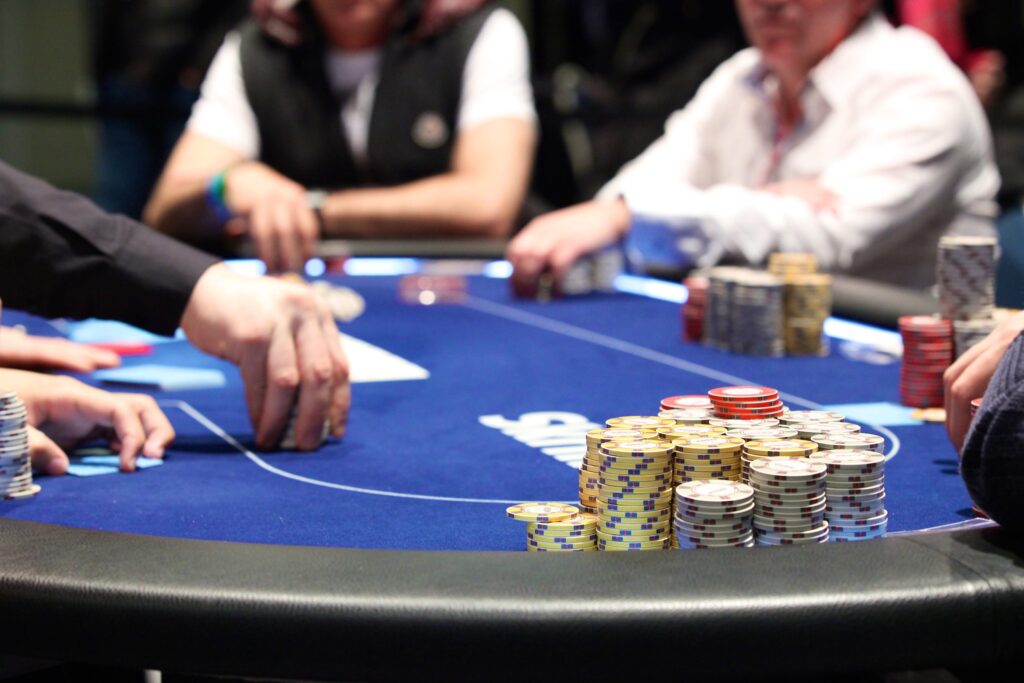
Typically, there will be tons of chips in play for every player who entered the event, as many of them bought more than one stack to begin with, and everyone bought an add-on.
This means that final tables of rebuy tournaments often play deeper than those in freezeout tournaments and that you will have more room to play in the late levels.
Nevertheless, the final table play will be quite the same, with ICM poker strategy playing a huge role in your decisions and pay jumps getting quite real quite fast.
Strategic Adjustments for Rebuy Tournaments
Since rebuy tournaments are different than freezeouts in quite a few ways, it is only natural that certain strategic adjustments must be made in order to thrive in them.
If you want to win big in rebuy tournaments, it is important to go into them with the right poker strategy. So, let us go into a few major strategic adjustments you should keep in mind when playing rebuy poker tournaments.
Always Buy Maximum Chips
My standard rule in every rebuy event: buy the maximum chips at the start, buy double stacks if I rebuy during the period, and always take the add-on at the break no matter the size of my stack. Players who single-stack at the start or skip the add-on to “save money” are already playing at a structural disadvantage before a single hand is dealt.
While it can be tempting to just buy a single stack each time, buying two stacks and covering your opponents will allow you to capitalize the most from loose play in the early stages.
When it comes to choosing how many times you will rebuy, the limits should be based on your bankroll, not your strategy.
You should always aim to play good poker, not play stacks with the intention of buying new ones when you lose, as that is not a winning strategy.
What’s even more, always buy the add-on in a rebuy tournament, no matter how many chips you have. Small stack or big, always get those extra chips that could come in handy later.
Expect Action Early
The biggest adjustment I make in the rebuy period is playing my strong hands fast. In a freezeout, I might slowplay top set against a single opponent to build the pot gradually. In a rebuy tournament early on, if I flop a set, I’m betting big immediately.
Say I have pocket Kings on a K-9-3 rainbow board during the rebuy period. In a regular MTT, I might check-call the flop. In a rebuy, I’m leading out for a large bet because at least one of my opponents is likely looking for an excuse to stack off with a draw or top pair. Charging them to chase is far more profitable than letting them see free cards with impunity.
What this means for you is that you will have to push your made hands even more than you would normally, and that you will want to be prepared to lose some hands to bad beats.
In a rebuy tournament, it is often worth trying to see flops with speculative hands multi-way, as there is a very good chance someone will be looking to stack off on the flop when you hit big.
Don’t Gamble
The rebuy option does not change your equity in any individual hand. If I have 60% equity in a pot, getting my chips in is correct whether or not I can rebuy. If I have 40% equity, committing my stack is wrong for exactly the same reason it would be wrong in a freezeout. The format changes the table atmosphere and opponent behavior, not the math. I tell students this constantly: play as if you cannot rebuy, even when you can.
The early levels of a rebuy poker tournament may seem like everyone is playing craps, but that’s not really true.

The equities remain the same as they would in any other format, and you should always remember that you are still playing poker and that you can’t win the tournament twenty minutes into play.
For that reason, you should treat your chip stack no differently than you would a freezeout when approaching a rebuy.
Just because you can buy new chips if you lose the ones you have does not mean you should gamble it all on a 20% chance to double up.
What’s even more, remember that the chips you win in the early levels won’t really be worth all that much later on, as the blinds will escalate, so don’t risk the money you paid to buyin just for a double up that might not be worth as much as you think it is.
Be Careful with Your Bankroll
In my experience, players consistently underestimate the true cost of rebuy tournaments, which is why bankroll management for rebuys requires a different approach than for freezeouts. A simple example: in a $55 rebuy tournament, buying the double starting stack costs $50, and the add-on costs another $50.
At minimum, you’re committing $155 before a single hand is dealt. If you bust twice in the rebuy period and buy two additional double stacks, you’re now in for $255 total. For the same bankroll stakes, I recommend playing a rebuy at roughly a third of the buy-in level you’d play for a freezeout.
When deciding to play rebuy tournaments, make sure to go quite a bit lower than your typical buyin for a freezeout tournament, or you could see your bankroll strained beyond expectations.
It Stops Being a Rebuy at Some Point
Remember that rebuy tournaments turn into pure freezeouts once the add-on break is over, and this is when you need to adjust your strategy as well.
Since there are no more rebuys available, you will want to start playing more conservatively with your chips but also giving other players a bit more credit.
While everyone may be going crazy in the early stages of rebuy tournaments, once the add-on break is over, players will play much tighter and more honestly.
So, once the rebuy phase is over, you should consider the tournament a freezeout and make all the necessary adjustments.
The Pros and Cons of Rebuy Poker Tournaments
Before you add rebuy tournaments to your regular schedule, it helps to understand the format’s real advantages and drawbacks. In my experience, players who go in with a clear picture of what they’re signing up for make far better decisions when things get chaotic.
Pros of Rebuy Poker Tournaments
- Bigger prize pools. Because every player is effectively buying in multiple times, prize pools in rebuy events are typically much larger than in a freezeout at the same buy-in level. That creates real upside for players who can navigate the format correctly.
- Weaker competition in the early stages. Even solid players tend to loosen up in the rebuy period. That chaos creates value for players disciplined enough to wait for premium spots. When everyone around the table is willing to stack off with marginal holdings, you will get paid off handsomely when you wake up with a strong hand.
- Bad beats are less painful. Losing your stack on a two-outer in the first level of a freezeout means leaving the room. In a rebuy, it means buying chips and continuing. That psychological buffer is real, even if the monetary cost of rebuying is equally real.
Cons of Rebuy Poker Tournaments
- Much higher variance. The gambling atmosphere of rebuy events introduces more wild swings than you’ll encounter in freezeouts at the same stakes. Prepare for some deeply ugly beats, especially in the first few levels when opponents are stacking off with draws and weak pairs.
- More expensive than advertised. The posted buy-in is the floor, not the ceiling. Factor in the starting double stack, the add-on, and any rebuys before committing. If you’re not bankrolled for the real cost, you will feel the strain.
- Requires tighter emotional control. The option to rebuy can become a trap. After a few painful beats, it’s easy to shift into tilt mode and start firing bullets with no plan. Set a firm limit on how much you’re willing to spend before sitting down, and do not cross it regardless of how the session feels.
Crush Rebuy Poker Tournaments
Rebuy poker tournaments remain some of the juiciest and most profitable ones today, as tons of loose action goes down in their early stages.
With so much gambling going on, you will find more opportunities to exploit and more chances to build up your stack early.
Remember the strategic tips we gave you for rebuy tournaments in this article, and you may see yourself fall in love with the format.
You can find some low-stakes rebuy tournaments at any major poker site online, so get out there and get some practice playing rebuys and applying our general strategy to see just how well you can do.