A semi-bluff is one of the most powerful tools in poker because it lets you win the pot two ways: your opponent folds now, or you improve later. But the same draw that makes a great semi-bluff on the flop and turn can become the worst possible bluff on the river once it misses. The reason comes down to blockers, and understanding it is the difference between a disciplined give-up and a spew that hands your stack to a sticky caller. This hand walks through the full arc of a draw out of position when short-stacked.
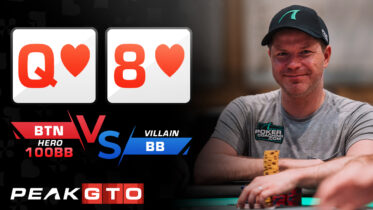
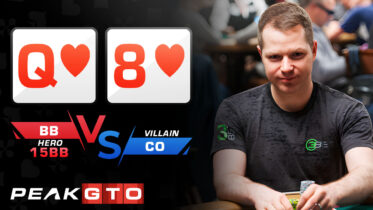
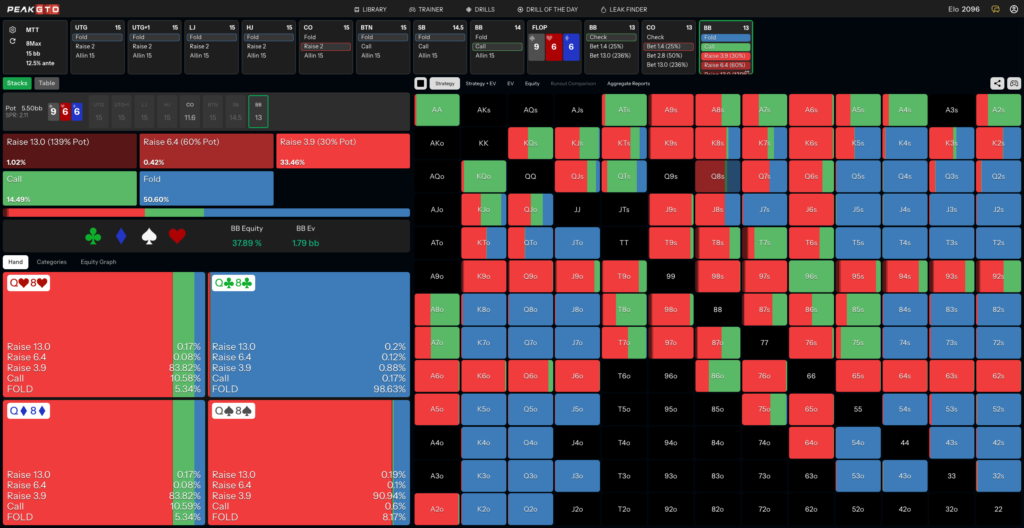
Today we will analyze a 15bb 8-handed tournament hand where the cutoff opens, the big blind defends Q♥8♥, and the flop comes 9♠6♥6♦. Hero check-raises a backdoor draw as a semi-bluff, barrels the turn when the J♥ brings a flush draw and a gutshot, and then has to decide what to do when the river bricks. The busted flush draw is exactly the hand that should give up.
Assumptions
- Stacks: 15bb effective
- Format: 8-handed MTT, 12.5% ante
- Positions: BB (Hero) vs CO (Villain)
- Action: CO opens, BB calls
- Flop: 9♠6♥6♦ (Pot: 5.5bb), Hero check-raises to 3.9bb
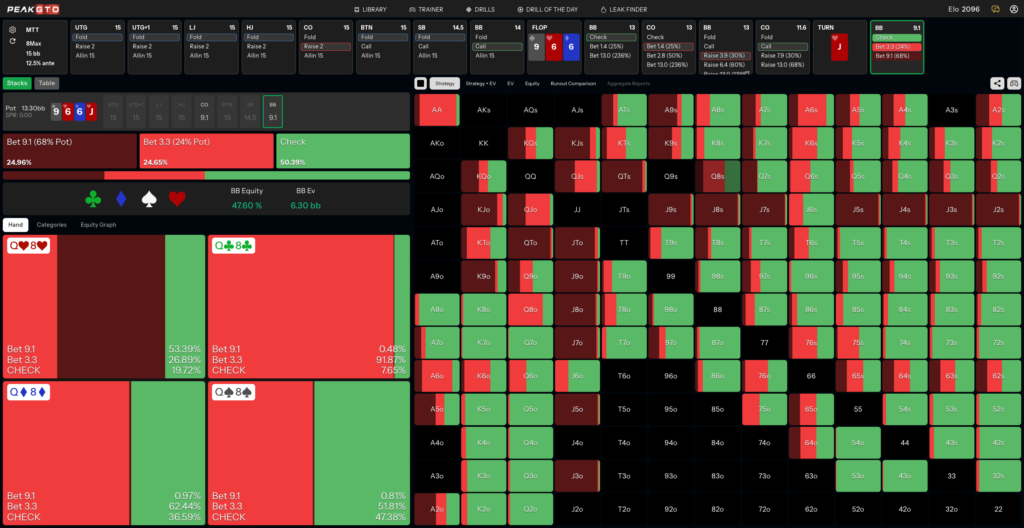
- Turn: J♥ (Pot: 13.3bb), Hero bets 3.3bb
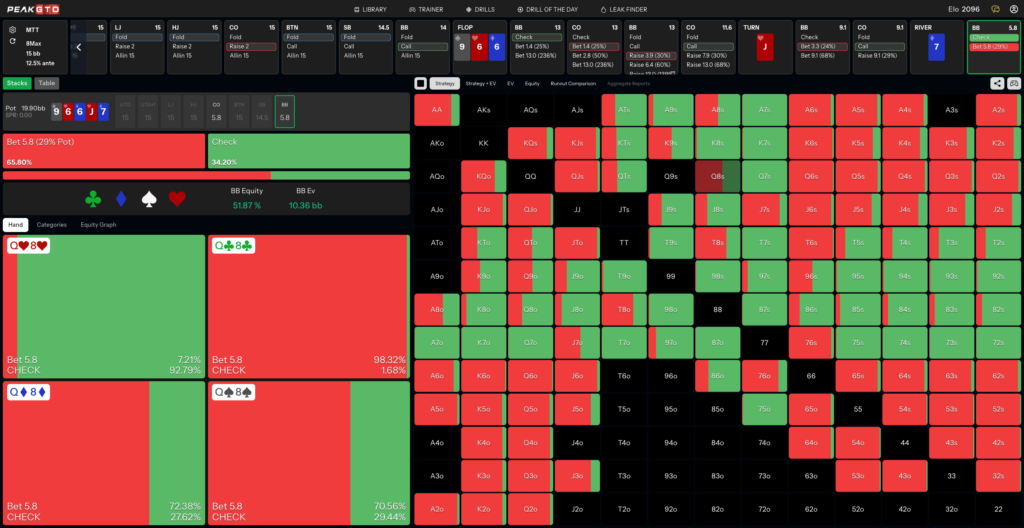
- River: 7♦ (Pot: 19.9bb), Hero checks
Preflop
Q8s is a fine big blind defend against a cutoff open at 15bb, a suited hand with two reasonable cards that flops draws and the occasional pair. Hero calls, and we go to the flop heads-up and out of position with about 5.5bb in the pot, with a plan built around short-stack leverage. This sits comfortably in Hero’s defending range.
Flop: 9♠6♥6♦
Hero checks the whole range, and the cutoff fires a small continuation bet of 1.4bb. On this paired board, the right hands to check-raise are the ones with both a backdoor straight draw and a backdoor flush draw, ideally with an overcard. Q♥8♥ qualifies on all counts: an overcard to the nine plus a card above the paired sixes, a backdoor straight draw, and a backdoor flush draw. By contrast, Q♥5♥ lacks a real backdoor straight draw and K8 lacks the backdoor flush draw, so those hands simply fold. Hero check-raises to 3.9bb as a semi-bluff, joining a check-raising range that also includes plenty of trips, top pairs, and higher-equity draws. The cutoff calls.
The short stack is what makes this check-raise so strong. At 15bb, a 3.9bb raise commits a meaningful chunk of both stacks, so the threat of getting it all in looms over every street. The cutoff cannot comfortably continue with their weakest hands, and the ones that do call are signing up to face more pressure on the turn. A paired board amplifies this further, because the cutoff holds relatively few of the trips and pairs that want to play a big pot, so a large share of their range is made up of overcards and weak pairs that hate the action. That is precisely the texture where a balanced check-raise of value hands plus the right semi-bluffs prints.
Turn: J♥
The J♥ is a big card for Hero’s hand, bringing a flush draw and a gutshot to go with the overcard. It is also a reasonable card for the cutoff, who turns some top pairs with hands like KJ or QJ that continued past the flop check-raise, while KQ picks up a gutshot and QT a straight draw. Still, when you check-raise a backdoor draw and improve to a real draw, you usually keep betting. PeakGTO has Q♥8♥ mixing between jamming and a small bet of 3.3bb, while the pure gutshots use the small bet only. The difference is equity when called: when Hero jams the Q♥8♥, the flush draw gives it decent equity even against a calling range, whereas jamming a hand with only a gutshot does not.
Hero chooses the small bet of 3.3bb, which Hero’s range uses about 25% of the time on this turn, specifically to keep the hand going to the river. Jamming would end the hand immediately, and with a high-equity draw Hero would rather see the river card. There is a nice safety net to this plan: if Hero had instead checked and the cutoff bet small, the Q♥8♥ would happily check-shove, and even if the cutoff jams, the draw has enough equity to make a reluctant call. That flexibility is part of why a high-equity draw is comfortable in this spot. The cutoff calls the 3.3bb bet, and we go to the river.
River: 7♦
The 7♦ bricks, and now the decision is whether to jam the last 5.8bb into the roughly 20bb pot, a very small bet of about a third of the pot. Hero cannot bluff too often, because the opponent is getting an excellent price to call. But Hero’s range still contains a lot of trips for value, which means Hero gets to bluff with the hands that completely lack showdown value, working up from the bottom of the range. Trips dominate that value range because the flop check-raise was built around the sixes and the hands that flopped them, so by the river Hero arrives with a thick cluster of trip sixes plus the occasional full house that the cutoff struggles to beat. A heavy value share is exactly what earns the right to bluff at this small sizing. The trouble is identifying which busted hands those are.
Here is the key insight, and it is all about blockers. When you hold a busted flush draw, you should be far less inclined to bluff than when you do not. Q♥8♥ holds two hearts, so it blocks the very busted flush draws in the opponent’s range that would fold to a jam. By removing the opponent’s most likely folding hands, the flush blocker makes the bluff far less effective. The solver checks Q♥8♥ about 93% of the time, while the same hand without the flush blocker, Q♦8♦, jams 72% of the time. That is an enormous swing driven entirely by which two cards Hero happens to hold. Hero checks and gives up, which is the correct, if frustrating, play with most busted backdoor flush draws.
There is an exploitative footnote worth knowing. In the real world, a river jam forces the opponent to make uncomfortable hero-calls with ace-high for their tournament life on a 966J7 board, and most players will not do it. They tend to overfold, which makes the jam more profitable than the GTO baseline suggests, since the solver assumes a perfectly calibrated calling range. Against a population that overfolds the river, firing even the Q♥8♥ despite its flush blocker can be the right adjustment. But against a theoretically sound opponent, and as the default, the check is correct. The cutoff turns up a pair of nines and takes the pot.
Key Takeaways
- Flop: Check-raise the backdoor draws that have both a backdoor straight draw and a backdoor flush draw, ideally with an overcard. Q♥8♥ is a perfect semi-bluff candidate; hands missing one of those components fold.
- Turn: When the draw improves to a flush draw and gutshot, keep betting. Choose the small bet over the jam when you want to keep a high-equity draw in the pot and see the river rather than ending the hand immediately.
- River: A busted flush draw is the worst bluff, not the best one. Holding the flush blocker removes the opponent’s folding hands, so Q♥8♥ checks about 93% of the time while the non-flush version jams.
- Overall: A semi-bluff draw plays aggressively while it has equity and gives up cleanly when it misses with the wrong blockers. The exploitative adjustment is to bluff more against opponents who overfold the river, but the disciplined default with a busted backdoor flush draw is to check and let it go. Manage your pot odds by bluffing with the hands that block value, not the ones that block folds.