Try This Hand Yourself
Play this exact spot against the solver in PeakGTO before reading the analysis.
When the in-position player declines to bet a flop you checked to them, they are quietly handing you information. A player with a strong hand almost always bets when checked to, so a check-back caps their range below the top of it. That single fact can transform a hand you were not even sure was worth a bet on the flop into a clear value lead on the turn and river. Learning to recognize a checked-through flop as an opportunity, rather than a sign to keep checking, is one of the most profitable adjustments a cash game player can make.
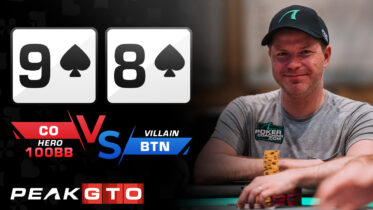
Today we will analyze a 100bb 8-handed cash game hand where the cutoff opens 9♠8♠, flops marginal top pair on 8♣4♦2♥, checks it through, and then leads the 4♠ turn and 6♦ river for value. This hand shows why the out-of-position raiser checks a weak top pair on this flop, why a checked-through flop raises the value of decent made hands, and how to build a turn and river leading range against a capped opponent.
Assumptions
- Stacks: 100bb effective
- Format: 8-handed cash game
- Positions: CO (Hero) vs BTN (Villain)
- Action: CO raises, BTN calls
- Flop: 8♣4♦2♥ (Pot: 7.5bb), checks through
- Turn: 4♠ (Pot: 7.5bb)
- River: 6♦ (Pot: 16.5bb)
Preflop
From the cutoff, 9♠8♠ is an automatic open at 100bb. The button calls, and it is worth noting that the solver’s button calling range is far tighter than what most live players actually use. In the real world, the button shows up with hands like JTo, A8o, J7s, and 86s. The looser that calling range is, the bigger a range advantage Hero enjoys on most flops, because the opponent simply has more junk. We see a flop heads-up and out of position.
Flop: 8♣4♦2♥ (checks through)
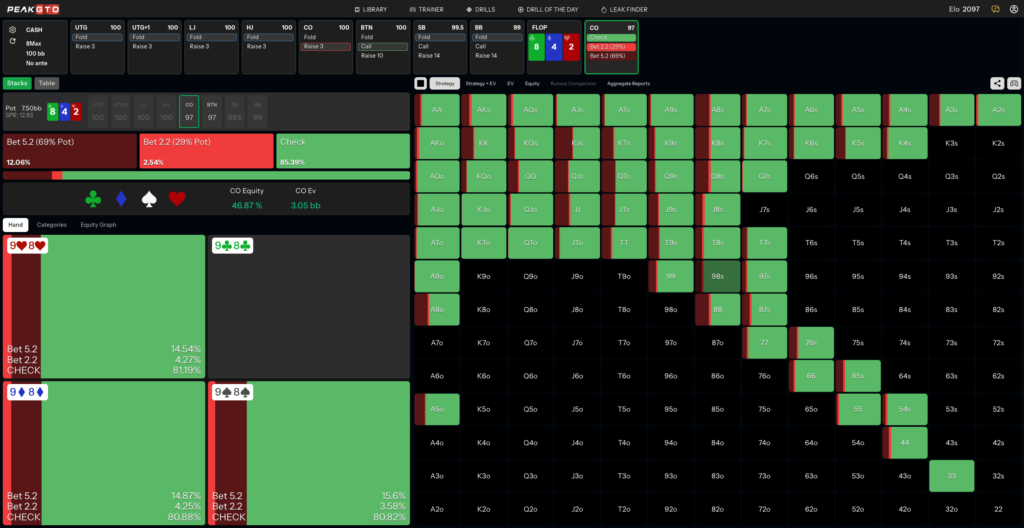
Hero flops top pair with a nine kicker, which sounds good but is genuinely marginal here. After a cutoff raise and a button call, the ranges run close, and on this low board the cutoff is actually at a slight equity disadvantage, around 46.9%. The reason is that Hero’s range is full of hands like king-x suited and offsuit broadways that completely miss 84-deuce, while the button’s calling range is more compact. Without a range or nut advantage, the correct approach is to check a great deal, and 98 checks about 80% of the time. The solver does bet a small slice, and when it does it uses a large, polarized size of two-thirds pot, but against a strong calling range erring toward checking is right. A marginal made hand does not need to bet the flop to stay relevant in the pot, especially when betting would mostly fold out the weaker holdings it already beats and get called by the stronger ones. Hero checks, the button declines to continuation bet, and the flop goes check-check.
There is a useful exploit hiding in this flop decision. PeakGTO says the button should bet a fair amount when the cutoff checks, but in live play most opponents only bet when they have a real hand, like an overpair, top pair, or A8, and they check back everything else. That makes their actual check-back range even weaker than the solver assumes, which means two things: when you are the button facing a check, you should bet more than GTO recommends, and when you are the cutoff who checked and got checked back to, you can be confident the opponent is capped. Hero is in the second situation, and that read is what justifies the aggression to come. The logic is simple once you slow it down. A button with a set, two pair, an overpair, or even a strong top pair almost never passes up the chance to bet a flop the cutoff has surrendered, so when the button checks behind, those hands are largely removed from its range. What remains is a collection of weak pairs, ace-highs, and complete air, and that is exactly the kind of capped range a marginal made hand can attack on later streets.
Turn: 4♠
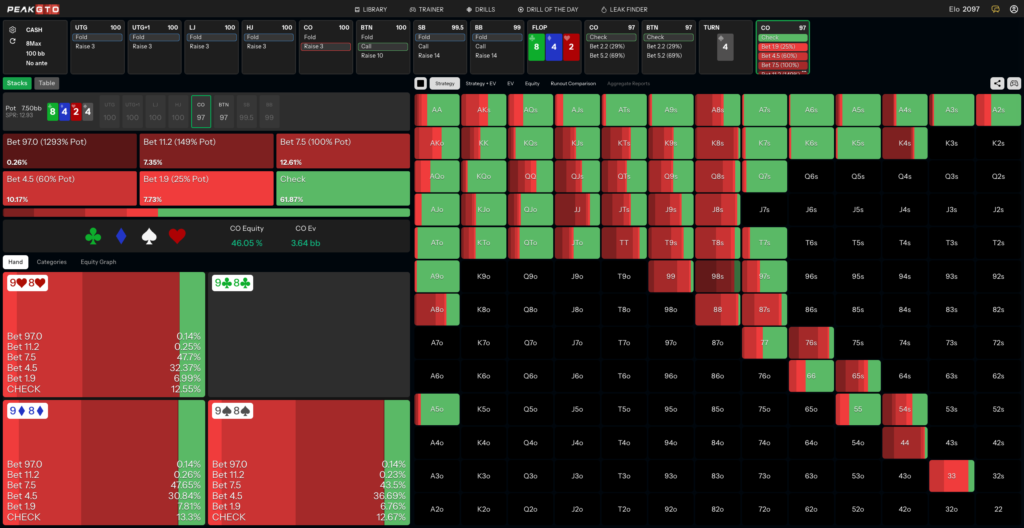
The 4♠ pairs the board without changing much, but the key shift is that the checked-through flop caps the button. Hero’s range does pick up a few extra trips combinations, such as A4s, K4s, and 54s, which support the value bets. More importantly, when the flop checks through, the value of good but non-premium hands rises sharply, because the button would have bet most of the hands that beat top pair on the flop. By checking back, it capped itself. GTO now leads basically every eight, mixing sizes but favoring something around pot or two-thirds pot.
Hero leads 4.5bb, about 60% of the pot, and a larger size would be defensible too. Against this bet, the button is supposed to continue with a fair number of ace-highs and even KQ, KJ, and KT, although most live players will fold those broadway hands too readily. That is fine. When you hold top pair, you do not mind the opponent calling too wide, so a bet that gets paid by every ace-high is doing its job. The button calls.
It is worth contrasting this lead with a turn bet you would make after betting the flop yourself. There, the opponent has already shown some strength by calling, so your value range needs to be stronger. Here, the opponent has shown weakness twice, by calling preflop and then declining to bet a flop you checked, so the bar for value drops considerably. A hand like 98 that was not even a clear flop bet becomes a confident turn lead, precisely because the population of hands that beat it has been thinned out by the check-back. The board pairing the four may help Hero’s range slightly, but the real value driver is still the eight itself, which is now near the top of a range the capped opponent cannot keep pace with.
River: 6♦
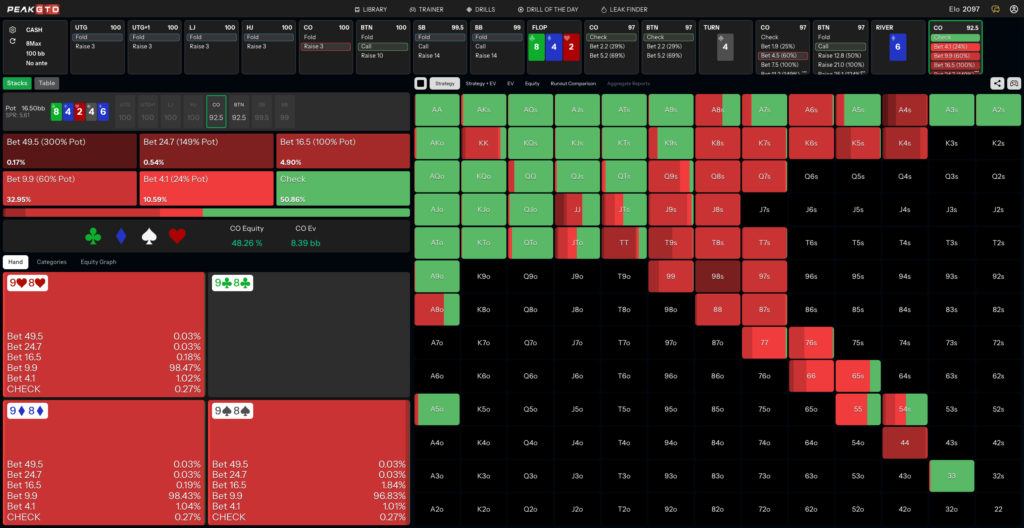
The 6♦ is a blank, and Hero gets to bet for value one more time. The solver has every eight happily leading around two-thirds pot, and the leading range here is almost entirely eights and the overpairs to the eight, hands like 99, tens, and jacks. 98 is right at the top of the thin value bets, so it leads 9.9bb, about 60% of the pot, and the button folds. It is worth seeing why the range is built this way. The opponent reached the river having declined to bet the flop and called only a single turn lead, so the strongest hands it can credibly hold are the ace-highs and weaker top pairs that made it to the river. A bet that targets exactly those hands, rather than one that only gets called by something better, is how thin value works. Every eight is comfortably ahead of that calling range, which is why the solver bets the entire category and Hero never needs to slow down with top pair here.
The sizing carries a nice exploitative wrinkle. Two-thirds pot is the GTO default because the value range is made up of good but not overly premium hands, and that size keeps the opponent’s ace-highs paying off. If you bet pot instead, the opponent can correctly fold more of those ace-highs, so a larger size can actually cost you value, unless you are exploiting an opponent who calls too much. There is also an image factor worth knowing: when you check the flop through and then bet the turn and river, many opponents read that line as you “messing around” and call wider, convinced you are trying to buy the pot. The pot odds you offer with a two-thirds pot bet invite exactly the kind of light calls a marginal value hand wants to face. Against that read, you can size up; against a thinking, folding opponent, two-thirds pot is the disciplined choice.
Key Takeaways
- Flop: On 8♣4♦2♥, the out-of-position raiser is at a slight equity disadvantage and checks marginal top pair about 80% of the time. Against a strong calling range, checking is safer than betting.
- Turn: The 4♠ and the checked-through flop raise the value of 98, because the button capped itself by not betting the flop. Hero leads 60% pot for thin value and welcomes wide calls.
- River: The 6♦ bricks, and every eight value bets around two-thirds pot. Sizing up to pot can fold out the ace-highs you want to pay you, so the smaller size is usually better.
- Overall: A checked-through flop is a green light to value bet your decent made hands. When the in-position player declines to continuation bet, develop a leading range and extract value with hands like marginal top pair that you could not bet on the flop. The information your opponent gives you by checking back is worth more than the strength of your own hand.