Understanding how a solver thinks can feel overwhelming, but Aggregate Reports in PeakGTO make the process far more approachable. Instead of forcing you to dissect individual nodes one at a time, they highlight the patterns that appear across your entire range on every type of flop.
This article breaks down what those aggregated outputs really mean, why they matter, and how you can start studying them effectively to build a more balanced and intuitive GTO strategy.
What Aggregate Reports Are and Why They Matter
What They ARE
✔ A condensed representation of GTO logic
✔ A tool to identify strategic patterns
✔ A way to compare human tendencies vs. solver baselines
✔ A learning accelerator for range construction
What They ARE NOT
✘ A substitute for exploring individual nodes
✘ A prescription for rigid, robotic play
✘ A single chart you memorize and “follow”
Aggregate Reports teach why certain poker hands prefer certain actions, not just that they do. This is crucial because GTO poker is ultimately about balanced ranges and unexploitable decision-making.
How Range Logic Appears in Aggregate Reports
One of the first insights Aggregate Reports offer is how your entire range behaves across different flop textures.
Instead of looking at a single board in isolation, you can see how your strategy shifts on dry high-card boards, coordinated middling boards, paired boards, or low disconnected textures.
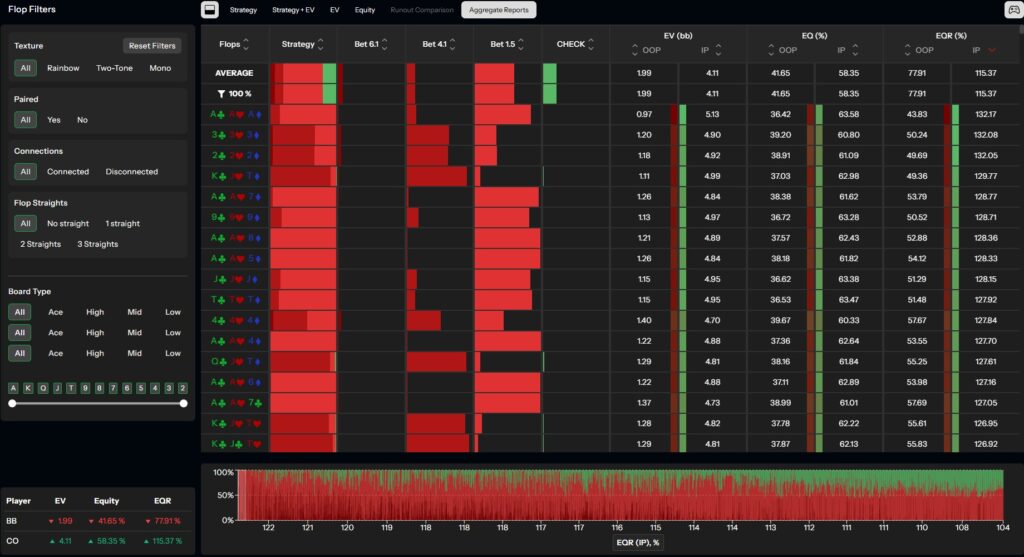
Studying these patterns across all flops makes it much easier to understand how your range advantage, nut advantage, and equity distribution interact with the board.
Solvers also apply mixed strategies differently depending on the flop type, and Aggregate Reports make these adjustments more intuitive. Many hands that seem marginal on one texture become natural bets on others, while hands that appear strong may be mixed to protect checking ranges.
This happens because the solver often finds several actions with nearly identical expected value, creating “EV indifference” where a mix is required to maintain balance.
Aggregate Reports reveal these class-level mixing patterns far more clearly than studying individual nodes ever could.
Understanding Patterned Solver Behavior
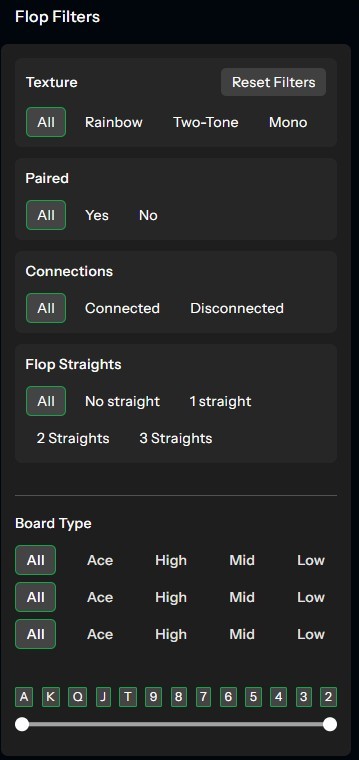
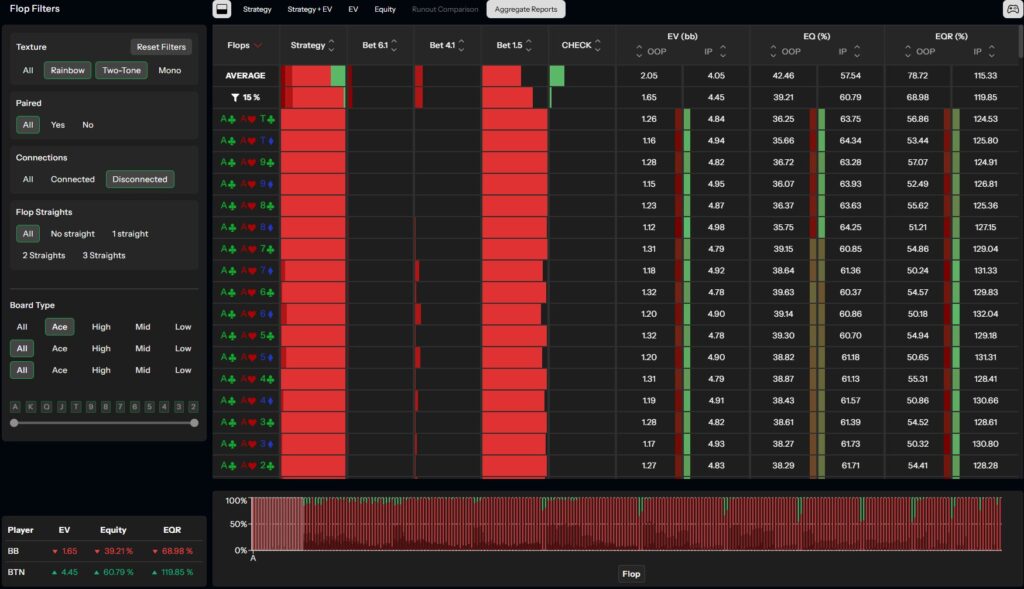
Flop Filters are one of the most intuitive parts of PeakGTO’s aggregated outputs. By filtering for different flop types allow for quick review of strategy on different boards.
For example, static boards such as K-7-2 rainbow tend to favor higher continuation-bet frequencies, while dynamic boards like J-T-9 require more checking and protection. These shifts illustrate how solvers weigh range advantage, interaction, and future-street playability.
Putting Aggregate Reports to Work
Using Aggregates helps players build c-betting ranges, more thoughtful leading structures, and more coherent defense strategies. Instead of memorizing individual charts, you learn how entire hand classes behave in relation to one another. This creates in-game intuition that is far easier to apply under pressure.
Aggregate Reports are also powerful for analyzing your own database results. When you compare your frequencies to solver aggregates, leaks stand out immediately. Whether you fold too often in certain positions, c-bet too frequently on dynamic textures, or miss natural bluff candidates, this gives you a clear and structured process for improvement.
How to Begin Studying With Aggregate Reports
Studying with Aggregate Reports doesn’t need to be complicated. When you follow a simple structure, the patterns become easy to understand, and the reports quickly become one of your most valuable learning tools. The goal at this stage isn’t to master every detail, but to start recognizing how your range behaves across many flop textures.
Start With One Range Matchup
Begin by choosing a single range interaction by choosing the preflop positions, such as BTN vs. BB or CO vs. SB. Keeping this fixed helps you see how your strategy shifts across different boards without juggling too many variables. Once you build familiarity with one matchup, expanding to others becomes straightforward.

Focus on One Flop Family at a Time
Next, select a category of flops, ace-high dry boards, paired flops, or coordinated middling textures. Studying these in clusters helps you see how your strategy changes based on the board’s structure rather than treating each flop as a separate problem. This approach quickly clarifies when your range should bet frequently versus when it should slow down.
Review the High-Level Action Frequencies
After choosing your flop set, look at the overall frequencies for betting and checking. You don’t need to memorize exact percentages; simply notice whether the solver prefers aggression or caution on that texture. Understanding these broad tendencies is more valuable than trying to recall specific numbers.
Compare Your Play to the Aggregates
Finally, pull a few recent hands from your database and compare your poker stats to the solver’s tendencies. If you notice that you’re betting too often on dry textures or not raising enough on dynamic ones, you’ve found clear areas for improvement. Even modest adjustments in these spots often produce significant long-term gains.
This streamlined study process helps you build solver intuition without feeling overwhelmed. Over time, the patterns you see in Aggregate Reports will naturally guide your in-game decisions, improving both balance and profitability.
A Few Things Aggregate Reports Clarify Especially Well
- How solvers balance value and bluffs across streets
- Which hands belong in mixed strategies and why
- How position influences equity realization
- How board textures shift c-bet and check frequencies
The Value of Thinking in Patterns
In the end, Aggregate Reports teach you how to think like a solver without getting lost in technical detail. They simplify GTO poker into patterns you can remember and apply naturally. When you understand strategy at this level, you stop reacting hand-to-hand and start making decisions that fit a complete, balanced framework.